 2025, Vol. 36


b Department of Chemistry and Key Laboratory for Preparation and Application of Ordered Structural Material of Guangdong Province, Shantou University, Shantou 515063, China;
c Center of Super-Diamond and Advanced Films (COSDAF) and Department of Chemistry, City University of Hong Kong, Hong Kong SAR, China
Organic light-emitting diodes (OLEDs) have aroused extensive attention in both industry and academia because of its fascinating features (lower power consumption, high image quality, large viewing angle, flexible, wearable, etc.) [1]. However, in practical OLED applications, the progress of blue light-emitting devices has been significantly limited due to the bottleneck of wide bandgap (∼3 eV), large carrier injection barriers and poor stability [2]. Despite great efforts have been made to develop blue emitters and elaborate device architectures, many challenges and issues still remain for blue OLEDs, especially achieving desirable external quantum efficiency (EQE) and reducing efficiency roll-off at high brightness, simultaneously [3]. In order to improve the efficiencies of OLEDs, triplet-triplet annihilation (TTA), phosphorescence, thermally activated delayed fluorescence (TADF) and "hot exciton" mechanisms have been established successively by effectively utilizing triplet excitons [4-7]. Nevertheless, serious efficiency roll-off constantly exists in electroluminescent (EL) process due to singlet-triplet or triplet-triplet quenching caused by the generation and accumulation of long-lived triplet excitons [8]. Hence, accelerating the reverse intersystem crossing (RISC) from triplet to singlet is essential to alleviate the device efficiency roll-off [9]. In the TADF system, the charge transfer (CT) dominant transition process from the lowest triplet (T1) to singlet (S1) excited states intrinsically results in a relatively small spin-orbit coupling (SOC) matrix and low RISC rate, and thus the significant efficiency roll-offs exhibit even in doped devices [10]. Besides, an efficient TADF material needs to precisely control the donor and acceptor unit to balance the relationship between singlet-triplet energy splitting (ΔEST) and photoluminescence quantum yield (PLQY) [11].
Recently, multi-resonance (MR) TADF materials based on fused polycyclic aromatics are proposed to narrow full widths at half maximum (FWHM) and improve color purity [12]. Despite the structural relaxation and vibronic coupling between the ground state (S0) and S1 can be minimized, deep blue emission is hardly achieved and the efficiency roll-off seldom meets the requirements of commercial application [13]. And the synthetic method of the most promising boron-based MR emitters reported at present is through the introduction of an organolithium reagent, which reduces the yield of the reaction and increases the difficulty of product purification [14]. Meanwhile, the strengthened molecular rigidity necessitates the preparation of low-concentration doping devices to improve color purity and efficiency [15]. Thus, the MR-TADF OLEDs are still a long way from commercialization. For the purpose of negligible efficiency roll-off in the non-doped blue devices, the critical point is to manipulate the excited states since the large CT components will undoubtedly redshift the spectrum and elongate the lifetime of dark triplet excitons [16]. Fortunately, Fortunately, the "hot exciton" materials, proposed by Ma and the co-workers, can fully harvest the triplet excitons through the high-lying RISC (hRISC) process [6]. The lifetime of triplet excitons can be confined to a nanoseconds level via the effective hRISC transition process, which makes the efficient non-doped OLED device possible [17]. Hence, the "hot exciton" materials have the potential to achieve superior EQE and negligible efficiency roll-off in a non-doped blue OLED [18]. In fact, despite considerable research efforts dedicated to exploring hot excitons in non-doped OLED devices to achieve high efficiency, the efficiency roll-off remains significant [3,19-21].
[1,2,4]Triazolo[1,5-a]pyridine (TP), a building block fused 1,2,4-triazole with benzene (Fig. 1a), containing a large flat rigid structure, is a valuable electron-deficient functional unit. In 2019, we designed and synthesized two TP-based derivatives for fabricating blue and white OLEDs [22,23]. After that, the structure-property relationships between different substituted sites of TP unit and the electron-donating group were also systematically studied by our group [24]. The above prevalent results demonstrate that the TP unit is an effective skeleton for constructing highly efficient blue "hot exciton" emitting materials and hosts (Figs. 1b-d). However, non-doped blue OLEDs using TP group as a regulating unit to achieve a negligible efficiency roll-off are still under-reported. As is known, anthracene (An) is a polycyclic aromatic hydrocarbon compound consisting of three fused benzene rings that center on a straight line [19]. As a classical excellent chromophore, anthracene has its unique features of large rigid planar molecular structure, good carrier mobility, high PLQY and wide energy gap. Hence, in this study, three high-efficiency blue emitters (TAT, TAMT and TAMT-CN) with anthracene as the primary fluorophore and TP unit as a modification unit were designed and synthesized to investigate the influence of TP unit on the efficiencies of non-doped blue OLEDs (Fig. 1). The functional properties of all three emitters are investigated systematically, and the effect of the structural modification on the EL performances are clarified. Benefiting from the flat rigid structure of TP unit, high horizontal dipole orientations (Θ//) of 90% and 92% are obtained. As a result, the non-doped blue OLED devices achieve the best EQE of 6.44% and the efficiency roll-off as low as 2.97% at 10,000 cd/m2.

|
Download:
|
| Fig. 1. Molecular design concept. (a) Structure of TP unit. (b-d) Previously reported compounds based on TP unit. | |

Based on the previously reported work in our group, the m-site position of TP unit has the best color purity and minimal CT components [24]. Hence, compared to the direct conjunction on benzene ring, the other two compounds are connected on the m-site position to guarantee the blue emission. The target emitters were successfully obtained through the Suzuki palladium (Pd) catalyzed cross-coupling reaction between the intermediate compounds. The synthetic routes of the three compounds are summarized in Scheme S1 (Supporting information). The products were purified by silica column chromatography and temperature-gradient sublimation with the confirmed 1H/13C NMR, mass spectrometry (Figs. S1-S9 in Supporting information) and single crystal X-ray diffraction (XRD).
Firstly, density functional theory (DFT) and time-dependent DFT calculations have been conducted to clarify the relationship between the decoration of TP unit and the electronic properties with the simulation of Gaussian 09 software at the level of b3lyp/6–31g*. As shown in Fig. S11 (Supporting information), the different connection modes of the TP group affect the spatial configuration. Compared to TAT, TAMT and TAMT-CN possess more twisted geometry due to the larger twist angles between TP unit and anthracene ring. The distributions of frontier molecular orbital (FMO) of all three molecules are roughly similar with slight differences. Specifically, the highest occupied molecular orbitals (HOMOs) are mainly distributed on TPA unit with some electron clouds dispersed over anthracene unit, and the lowest unoccupied molecular orbitals (LUMOs) are primarily located on the anthracene ring. With the introduction of cyano group, TAMT-CN exhibits a slightly more delocalized LUMO distribution, while TAMT shows maximal HOMO/LUMO overlap integral of 42.2% (37.8% for TAT and 31.3% for TAMT-CN), resulting in a higher PLQY. The corresponding root mean square deviation (RMSD) is also calculated to further describe the conformation changes of S1 relative to S0 for all three emitters. As shown in Fig. S12 (Supporting information), the RMSD values are in the order of TAT (0.5065 Å) > TMAT-CN (0.2523 Å) > TAMT (0.2244 Å), indicating the structural relaxation is restricted by the connection with the m-site position of TP unit, and the introduction of cyano group has little effect on geometry change. Furthermore, TAMT-CN exhibits a more non-uniform charge distribution (Fig. S13 in Supporting information), which facilitates intermolecular charge communications, thereby enhancing charge transport and mitigating efficiency roll-off [25]. This suggests that the mode of directly connecting the fused TP unit to anthracene is conducive to achieving better device performance.
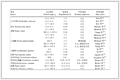
Ultraviolet-visible (UV–vis) absorption and photoluminescence (PL) spectra were scanned in diluted dichloromethane (DCM) solution and thin film on quartz substrates to explore the influence of TP regulating unit on photophysical properties of the three as-synthesized blue emitters. The corresponding spectra are shown in Fig. 2 and the basic photophysical parameters are summarized in Table 1. Analogous absorption properties are observed for all three materials owing to their similar structural skeletons [26]. Concretely, the longer wavelength absorption bands in the range of 350–400 nm are ascribed to the π-π* transitions of the anthracene moiety, and the sharp and strong absorption peaks at around 260 nm could be ascribed to the π-π* transitions of the benzene rings [27]. Besides, the absorption bands in the range of 280–330 nm are assigned to the π-π* transition of TPA and TP moieties [28]. Differently, the molar absorption coefficient decreased in the order of TAMT (4.4 × 10⁴ L mol-1 cm-1) > TAMT-CN (4.0 × 10⁴ L mol-1 cm-1) > TAT (3.3 × 10⁴ L mol-1 cm-1), indicating that TAMT has a higher oscillator strength (f), which is mainly attributed to the more rigid skeleton of TAMT (Figs. S12 and S23 in Supporting information) [29]. Whereas, no obvious charge transfer absorption band was observed, probably owing to the hybridized local and charge transfer (HLCT) characteristics inherent in its ground states (Fig. S11). And their optical band gaps (Egs) are calculated to be 2.91, 2.88 and 2.88 eV from the onset of absorptions for TAT, TAMT and TAMT-CN, respectively. For PL spectra, the PL peaks for TAT, TAMT and TAMT-CN in film and DCM solution are 479/489, 483/512 and 493/514 nm, respectively. Obviously, the PL peaks in the neat film are blue-shifted compared with that of in DCM solution for all three materials, which could be assigned to the suppressed rotation of the TPA unit in solid states [30]. Compared with TAMT and TAMT-CN, TAT exhibits an obvious blue shift in both DCM solution and thin films, which could be attributed to the additional benzene ring, leading to a weaker CT interaction between the TP unit and the An-TPA moiety. These preliminary results mentioned above indicate that different linkage mode and modifications of the TP unit have a significant impact on photophysical properties of the as-synthesized emitters.

|
Download:
|
| Fig. 2. (a) UV–vis absorption and PL spectra in DCM solution. (b) PL spectra in spin-coated film. (c) Linear fitting of orientation polarization (f) of solvent media with the Stokes shift (va-vf) for three emitters. (d) Transient PL decay spectra in the neat film. | |

|
Table 1 Key photophysical and thermal parameters of three emitters. |
To further analyze the properties of excited states of TAT, TAMT and TAMT-CN, the absorption and PL spectra were also scanned in various solvent systems. The corresponding spectra are presented in Fig. S14 (Supporting information). Obviously, only slight changes are observed in the absorption spectra for all three emitters in various solvents with increasing polarities, demonstrating an insignificant influence on the S0 in different polarity solvents. However, the PL spectra exhibit significant changes of redshift upon the increasing solvent polarity, indicating a typical CT state property for their excited states. Apparently, compounds (TAMT and TAMT-CN) linked at the m-site position of TP unit exhibit larger redshift values than that of TAT, which is attributed to the more twisted molecular structure. Besides, the linear fitting analysis of the Stokes shift and solvent orientational polarizability are also plotted to further investigate the CT characteristics according to the Lippert-Mataga model. As depicted in Fig. 2c, all three emitters displayed two separate linear relationships in different solvents, suggesting their shared HLCT characteristics. The PLQYs of three emitters were tested to be 56.6%, 70.2% and 62.8% for TAT, TAMT and TAMT-CN, respectively. The highest PLQY in TAMT is probably ascribed to its more localized LUMO distribution and larger electron cloud overlap on the anthracene ring. Time-resolved fluorescent spectra reveal that TAT, TAMT, and TAMT-CN exhibit single-exponential decay both in neat films (Fig. 2d) and in solution (Fig. S15a in Supporting information), with lifetimes of 2.62, 2.72, and 2.40 ns respectively in neat films. This indicates that no TADF process occurs in these three emitters. And the corresponding radiative rates (kr) are calculated to be 2.2 × 10⁸, 2.8 × 10⁸ and 2.6 × 10⁸ s-1, indicating that TAMT is a better candidate emitter than TAT and TAMT-CN for achieving high EQE blue OLED. Fluorescent emissions of all three materials at 77 K are successfully obtained (Fig. S15b in Supporting information) in THF solution and the corresponding S1 energy levels are calculated to be 2.66, 2.63 and 2.62 eV for TAT, TAMT and TAMT-CN, respectively. While the delayed phosphorescent emissions at 77 K are not detected, which is consistent with the previously reported anthracene-based materials [6,19,31].
As shown in Fig. S16 (Supporting information), thermogravimetric analysis (TGA) and differential scanning calorimetry (DSC) were used to investigate the thermal stability. All three compounds exhibit high thermal stability with decomposition temperatures (Tds, 5% weight loss) of 449 ℃ for TAT, 452 ℃ for TAMT and 478 ℃ for TAMT-CN. Such high Tds demonstrate that these TP derivatives are thermodynamically stable during the process of vacuum evaporation. For the DSC curves, the crystallization temperatures (Tcs) were determined to be 140 and 185 ℃ for TAT and TAMT, respectively. Whereas, no discernible glass transition temperature (Tg) was observed for any of the compounds. Moreover, as depicted in Fig. S17 (Supporting information), atomic force microscopy (AFM) was also performed to investigate the film-forming ability. The root-mean-square (RMS) roughness of TAT, TAMT and TAMT-CN were measured to be 2.39, 2.08 and 2.33 nm, respectively. The absence of observed Tgs and small RMS roughness indicate that the vacuum-deposited neat film is morphologically stable for the as-synthesized TP derivatives, which will be beneficial to achieve high OLED performance.
The HOMO energy levels of TAT, TAMT and TAMT-CN were estimated to be −5.59, −5.68 and −5.69 eV as determined by photoelectron emission spectrometer (Fig. S18 in Supporting information). Then, the corresponding LUMO energy levels were calculated to be −2.68, −2.80 and −2.81 eV according to the values of the Eg. Apparently, the linkage mode has more influence on the energy level than that of the cyano-modified TP unit.
In order to estimate the difference in the bipolar charge transporting properties, two single-carrier devices of the emitters were fabricated with the structures of [ITO/1,3,5-tris(1-phenyl-1H-benzimidazol-2-yl)benzene (TPBi) (10 nm)/TAT, TAMT and TAMT-CN (70 nm)/TPBi (10 nm)/lithium fluoride (LiF) (1 nm)/Al (100 nm)] and [indium tin oxide (ITO)/N,N'-di(1-naphthyl)-N,N'-diphenyl-(1,1′-biphenyl)-4,4′-diamine (NPB) (10 nm)/TAT, TAMT and TAMT-CN (70 nm)/NPB (10 nm)/Aluminum (Al) (100 nm)] for the electron- and hole-only devices, respectively. The corresponding current density-voltage (J-V) curves are displayed in Fig. S19a (Supporting information). Obviously, all three emitters possess excellent bipolar transporting abilities as both the hole and electron current density increased with the increasing operating voltage. With the method of space-charge-limited current (SCLC) [32], the electric field dependent hole and electron mobility are calculated and the corresponding results are presented in Fig. S19b and Table S1 (Supporting information). Accordingly, the hole and electron mobilities become more balanced with the order of TAT < TAMT < TAMT-CN, and TAMT-CN shows a remarkable carrier migration equilibrium in the range of electric field from 2.5 × 10⁵ Ⅴ/cm to 1.4 × 10⁶ Ⅴ/cm. The improved electron mobility of TAMT-CN can be attributed to the electron-withdrawing ability of the cyano group. These data suggest that the m-site position of TP unit is beneficial to balancing carrier transporting and improving exciton recombination efficiency, while the further incorporation of a cyano group is beneficial to the improvement of this performance.
Furthermore, to evaluate the EL performance of all three materials as emitter, we prepared the non-doped blue devices with the structure of ITO/NPB (70 nm)/TCTA (tris(4-carbazoyl-9-ylphenyl)amine, 10 nm)/TAT, TAMT or TAMT-CN (20 nm)/TPBi (40 nm)/LiF (1 nm)/Al (100 nm) (Fig. 3a). Here, the functional layers of NPB, TCTA, TPBi and LiF are served as hole transport, electron-blocking, electron transporting and electron injecting layers, respectively. All fabricated non-doped devices exhibit blue EL emission with peaks of 476 and 480 nm, and the EL spectra are scarcely altered at different working voltages (Fig. S20 in Supporting information), indicating outstanding spectral stability under electric excitation. The key EL parameters are presented in Fig. 3 and listed in Table 2. Clearly, compared to m-site substituted TAMT and TAMT-CN, the TAT-based device exhibits the highest turn-on voltage (Von) of 3.6 Ⅴ, which is attributed to its relatively shallow HOMO energy level. The TAMT-based device achieves the highest EQEmax of 6.44%, which can be ascribed to its highest PLQY. Besides, all the devices achieve high EQE of over 6% (6.11% and 6.06% for TAT- and TAMT-CN-based devices, respectively) and luminance of over 22,000 cd/m2 (24,180, 22,630 and 30,420 cd/m2 for TAT, TAMT, and TAMT-CN based devices, respectively). Furthermore, extremely low-efficiency roll-offs are observed for all devices, especially for TAMT-CN-based OLED. Even under the high luminance of 10,000 cd/m2, the EQE of the TAMT-CN-based device remains at 5.88%, representing a negligible efficiency roll-off of 2.97%, and the roll-off of the other two devices is also <10% (6.06% and 9.16% for TAT- and TAMT-based devices). To the best of our knowledge, the efficiency roll-off is the best result of the non-doped blue devices based on "hot exciton" with EQE over 6% (Fig. S21 in Supporting information). To accurately assess the exciton utilization efficiencies (EUE), we investigate the (Θ//) of the neat films of three emitters and light out-coupling efficiencies of the OLED devices by measuring their p-polarized angle-dependent PL spectra (Fig. 4). The (Θ//) values are estimated to be 78%, 90% and 92% for TAT, TAMT and TAMT-CN, respectively. Accordingly, the light out-coupling efficiencies are simulated to be 20%, 26% and 28% in the non-doped devices. Therefore, the EUEmax are calculated to be 53.9%, 35.3% and 34.4%, which surpasses the limitation of exciton utilization of 25% for traditional fluorescent materials. Given that the T2-S1 energy gaps for all three molecules are nearly negligible, the heightened EUE observed in TAT can be attributed predominantly to its significantly large energy gap between T2 and T1, which effectively impedes the internal conversion process from T2 to T1.

|
Download:
|
| Fig. 3. (a) Device configuration, energy level diagram, and functional layers for the non-doped blue OLEDs. (b) The EQE-luminance curves (insert: the photograph of TAMT-based device under electro-excitation). (c) Current density-voltage-luminance (J-V-L) curves. (d) Transient EL decay curves of OLED devices based on targeted emitters and MADN as emitting layers. | |

|
|
Table 2 The key data of fabricated non-doped blue devices based on three emitters. |

|
Download:
|
| Fig. 4. Measured p-polarized angle-dependent PL radiance of (a) TAT, (b) TAMT and (c) TAMT-CN neat films and optical simulations on the OLED devices based on (a) TAT, (b) TAMT and (c) TAMT-CN as emitting layers. | |

As mentioned above, the TADF procedure can be unambiguously eliminated due to the single exponential lifetime of all three emitters. Besides, the calculated energy gaps between T1 and S1 are all over 1.0 eV, which cannot support the RISC process from T1 to S1. Moreover, unlike the TTA-controlled triplet excitons utilization process of bimolecular emission between luminance and current density (Fig. S22 in Supporting information), relationships between luminance and current density exhibit excellent linear correlation in these devices at low current density, which excludes the TTA emission mechanism [33,34]. Furthermore, transient EL analysis was also performed to confirm the "hot exciton" pathway in these devices. The proportion of the delayed component in the 2-methyl-9,10-di(2-naphthyl)anthracene (MADN) based device gradually declined as the driving voltage rose from 6 Ⅴ to 8 Ⅴ. This reduction may be attributed to an intensification of quenching interactions, including those between triplet excitons and charge carriers, as well as singlet excitons or other quenching mechanisms. In contrast, the TP-based devices displayed minimal variation across different applied voltages (Fig. 3d). These findings suggest that the TTA process plays a minor role in the TP-based device. To further investigate the intrinsic principle by which TAT, TAMT and TAMT-CN emitters captured triplet excitons, the energy level arrangements and natural transition orbital (NTO) calculations of singlet and triplet excited states are analyzed with detailed information shown in Fig. S23. The "holes" and "particles" of S1 states of all three emitters are distributed to TPA and An units respectively, representing a typical CT character. While their T2 states exhibit HLCT character with overlapped "holes" and "particles" on the benzene ring. The LE proportion is helpful to increase the PLQY and the CT states support the RISC process from triplet states to singlet states. Obviously, all three emitters exhibit a larger energy gap between T1 and T2 (over 1.00 eV) and a small gap between high-lying triplet excited states (Tm, m ≥ 2) and singlet states (Sn, n ≥ 1), which provides the possibility for the hRISC process from Tm to Sn. In addition, the larger spin-orbit coupling (SOC) value between Tm to Sn than S1 and T1 also facilitates the hRISC process. Furthermore, the nearly degenerate high-lying triplet excited states can also provide multiple potential "hot exciton" channels, which is conducive to improving the utilization of triplet excitons. Consequently, we deduced that the high EUE is primarily driven by the "hot exciton" pathway rather than the TTA process and the rapid hRISC process reduces the efficiency roll-off in EL devices.
In summary, with structural modification on the classical fluorophore (An-TPA), three blue-emitting materials are acquired with "hot exciton" properties as well as negligible efficiency roll-off. Their excited state properties, charge transfer abilities, horizontal orientation and efficiency roll-off are finely tuned by the linkage between the TP unit and An-TPA as well as the modification of TP unit. Non-doped blue OLEDs achieve an EQEmax over 6% with minimal efficiency roll-off (2.97%) at high brightness. Besides, the studied results demonstrate that the m-site position of TP unit enhances OLED performance, especially for efficiency roll-off, compared to the direct conjunction on the benzene ring. This work further expands the application of TP units in the field of low roll-off blue OLEDs.
Declaration of competing interestThe authors declare that they have no known competing financial interests or personal relationships that could have appeared to influence the work reported in this paper.
CRediT authorship contribution statementGuoxi Yang: Writing – original draft, Visualization, Validation, Software, Methodology, Investigation, Formal analysis, Data curation, Conceptualization. Hongji Tan: Software, Methodology, Investigation. Jieji Zhu: Methodology. Qingxiao Tong: Writing – review & editing, Supervision, Project administration, Funding acquisition. Jingxin Jian: Data curation. Zhihai Yang: Software. Deli Li: Conceptualization. Denghui Liu: Visualization. Shijian Su: Writing – review & editing, Supervision.
AcknowledgmentsWe thank the financial support from the National Natural Science Foundation of China (Nos. 52273187 and 51973107), the Guangdong Province Universities and Colleges Pearl River Scholar Funded Scheme 2019 (No. GDUPS2019).
Supplementary materialsSupplementary material associated with this article can be found, in the online version, at doi:10.1016/j.cclet.2025.111138.
| [1] |
C.W. Tang, S.A. VanSlyke, Appl. Phys. Lett. 51 (1987) 913-915. |
| [2] |
W.C. Chen, Q.X. Tong, C.S. Lee, Sci. Adv. Mater. 7 (2015) 2193-2205. DOI:10.1166/sam.2015.2264 |
| [3] |
C. Du, H. Liu, Z. Cheng, et al., Adv. Funct. Mater. 33 (2023) 2304854. |
| [4] |
H. Uoyama, K. Goushi, K. Shizu, H. Nomura, C. Adachi, Nature 492 (2012) 234-238. DOI:10.1038/nature11687 |
| [5] |
G.X. Yang, D.H. Liu, Q. Gu, et al., Adv. Opt. Mater. 11 (2023) 2300455. |
| [6] |
Y. Xu, X. Liang, X. Zhou, et al., Adv. Mater. 31 (2019) 1807388-1807395. |
| [7] |
J. Liu, Z. Feng, C. Peng, et al., Chin. Chem. Lett. 34 (2023) 107634. |
| [8] |
Q.Y. Meng, R. Wang, Y.L. Wang, et al., Nat. Commun. 14 (2023) 3927. |
| [9] |
M. Zhang, G. Dai, C. Zheng, et al., Chin. Chem. Lett. 33 (2022) 1110-1115. |
| [10] |
Y.Z. Shi, H. Wu, K. Wang, et al., Chem. Sci. 13 (2022) 3625-3651. DOI:10.1039/d1sc07180g |
| [11] |
X. Cai, S.J. Su, Adv. Funct. Mater. 28 (2018) 1802558-1802590. |
| [12] |
H.Z. Li, F.M. Xie, Y. Li, J. Tang, J. Mater. Chem. C 11 (2023) 6471-6511. DOI:10.1039/d3tc00676j |
| [13] |
H.J. Kim, T. Yasuda, Adv. Opt. Mater. 10 (2022) 2201714. |
| [14] |
S. Jiang, Y. Yu, D. Li, et al., Angew. Chem. Int. Ed. 62 (2023) e202218892. |
| [15] |
H. Lee, R. Braveenth, S. Muruganantham, et al., Nat. Commun. 14 (2023) 419. DOI:10.1124/jpet.122.547770 |
| [16] |
R. Ieuji, K. Goushi, C. Adachi, Nat. Commun. 10 (2019) 5283. |
| [17] |
H. Liu, X. Tang, Z. Cheng, et al., Chin. Chem. Lett. 35 (2024) 109809. |
| [18] |
Y. Xu, P. Xu, D. Hu, Y. Ma, Chem. Soc. Rev. 50 (2020) 1030-1069. DOI:10.3390/rs12061030 |
| [19] |
B. Li, J. Lou, H. Zhang, et al., Adv. Funct. Mater. 33 (2023) 2212876. |
| [20] |
P. Han, C. Lin, E. Xia, et al., Angew. Chem. Int. Ed. 62 (2023) e202310388. |
| [21] |
Z. Cheng, C. Du, S. Ge, et al., Chem. Eng. J. 474 (2023) 145867. |
| [22] |
C. Cao, W.C. Chen, J.X. Chen, et al., ACS Appl. Mater. Interfaces 11 (2019) 11691-11698. DOI:10.1021/acsami.9b01105 |
| [23] |
C. Cao, W.C. Chen, S. Tian, et al., Mater. Chem. Front. 3 (2019) 1071-1079. DOI:10.1039/c8qm00678d |
| [24] |
G.X. Yang, H.J. Tan, J.W. Zhao, et al., Chem. Eng. J. 445 (2022) 136813. |
| [25] |
R.K. Konidena, W.J. Chung, J.Y. Lee, Org. Lett. 22 (2020) 2786-2790. DOI:10.1021/acs.orglett.0c00767 |
| [26] |
Z. Zhang, C.L. Chen, Y.A. Chen, et al., Angew. Chem. Int. Ed. 57 (2018) 9880-9884. DOI:10.1002/anie.201806385 |
| [27] |
F. Liu, X. Man, H. Liu, et al., J. Mater. Chem. C 7 (2019) 14881-14888. DOI:10.1039/c9tc05040j |
| [28] |
W. Song, Y. Chen, Q. Xu, et al., ACS Appl. Mater. Interfaces 10 (2018) 24689-24698. DOI:10.1021/acsami.8b07462 |
| [29] |
Z. Yang, G.X. Yang, S. Jiang, et al., Adv. Opt. Mater. 12 (2024) 2301711. |
| [30] |
D. Zhang, T. Yang, H. Xu, et al., J. Mater. Chem. C 9 (2021) 4921-4926. DOI:10.1039/d1tc00249j |
| [31] |
Y. Xu, X. Liang, Y. Liang, et al., ACS Appl. Mater. Interfaces 11 (2019) 31139-31146. DOI:10.1021/acsami.9b10823 |
| [32] |
Y. Fu, H. Liu, D. Yang, et al., Sci. Adv. 7 (2021) eabj2504. |
| [33] |
S. Xiao, Y. Gao, R. Wang, et al., Chem. Eng. J. 440 (2022) 135911. |
| [34] |
J.H. Lee, J.X. Huang, C.H. Chen, et al., Adv. Opt. Mater. 11 (2023) 2202666. |