 2025, Vol. 36


b Hubei Longzhong Laboratory, Xiangyang 441053, China;
c Key Laboratory of Material Physics, Ministry of Education, School of Physics and Microelectronics, Zhengzhou University, Zhengzhou 450001, China;
d Department of Chemical Physics & Hefei National Laboratory for Physical Sciences at Microscale, University of Science and Technology of China, Hefei 230026, China;
e School of Physics and Material Engineering, Hefei Normal University, Hefei 230601, China
The celebrated Mermin-Wagner theorem [1] points out that long-range magnetic order does not exist in low-dimensional (d ≤ 2) Heisenberg magnets at T > 0. Surprisingly, two-dimensional (2D) magnetic materials exhibit stable long range magnetic orders which have been discovered in experiments in the past few years. One of the most important reason is that some of the 2D magnets exhibit strong anisotropy [2], which open the Goldstone mode and thus stabilizes the long-range magnetic order. The 2D magnetic materials display various fascinating properties and important applications, such as topological superconductivity in monolayer transition metal dichalcogenides (TMDs) [3], quantum anomalous Hall (QAH) effect in layered materials of MnBi2Te4 [4], quantum spin liquid (QSL) state in metal–organic frameworks (MOFs) [5] and strained CrSiTe3 [6], room temperature multiferroicity [7], and skyrmions in Fe3GeTe2 [8]. The emergence of 2D magnetic materials provides an ideal platform and extend playground for the study of low dimensional exotic magnetic phenomena.
In recent years, binary transition metal trihalides TMX3 such as CrI3 are extensively studied [9-12]. Similar to the CrI3, the new vdW layered structure Ⅵ3 has been paid some attentions recently. Kong [13], Tian [14] and Son et al. [15] synthesized bulk Ⅵ3 experimentally, and observed that the Ⅵ3 is a strongly anisotropic hard ferromagnetic semiconductor (band gap is about 0.7 eV). As the temperature increases, the Ⅵ3 will undergo a magnetic phase transition and a structural phase transition. The Curie temperature TC of the Ⅵ3 is about 50 K, and when the temperature is higher than TS = 80 K, a structural phase transition from R
The crystal structure and three sets of coordinate systems, namely the global coordinate system {xyz}, the right hand local coordinate system {x′y′z′} and the lattice vectors {abc} are shown in Fig. 1. The local coordinate chosen for the octahedron in the Ⅵ3 monolayer, where the O-x′, O-y′ and O-z′ are along the three Ⅴ-Ⅰ bonds respectively. For the lattice vectors {abc}, the c axis is perpendicular to the ab plane, and the angle between a and b is 120°. In the global coordinate system {xyz}, the xy plane is parallel to the ab plane, the x and z-axes are parallel to the a and c axes respectively, and the c or z axis is exactly the [111] direction of the local coordinate system {x′y′z′}. The space group of the monolayer Ⅵ3 is

|
Download:
|
| Fig. 1. View of the Ⅵ3 monolayer. (a) The c axis (V in red; upper layer Ⅰ in violet; lower layer Ⅰ in light purple). (b) The a axis. (c) Two coordinate systems of the Ⅵ3, local {x′y′z′} basis and global {xyz} basis. | |

A key factor affecting the order of the singlet ag and the doublet

|
Download:
|
|
Fig. 2. Left: trigonal contraction; right: trigonal elongation. The t2g splits into the ag and the |
|

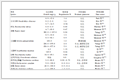
First, we do not consider spin-orbit coupling (SOC) effect. We tested a series of Hubbard U values. When U = 3.68 eV, the calculated band gap value is consistent with the experimental measurement value [14]. By controlling the orbital occupation, the initial density matrix was fully relaxed by the VASP software package and the electronic structures and total energies of different occupied states were calculated [29-33]. The spin-polarized band structures of the four different occupied states are shown in Fig. 3. It can be seen from the band structures that the three constrained occupation states are all direct band gap semiconductors, and the band gaps are about 0.8 eV. Since the d2 electrons fully occupy the two orbitals in the t2g manifold, the remaining one empty orbital is pushed up to the conduction band, and thus opening up a band gap. But for the unconstrained state, the DFT + U calculation results show a Dirac-like half-metallic band structure [16, 17]. As shown in Table 1, comparing the energy of the four states, we find that the lowest energy occupied state is the

|
Download:
|
|
Fig. 3. Calculated non-SOC electronic spin resolved band structures the monolayer Ⅵ3 in the ferromagnetic state along the high-symmetry paths of corresponding Brillouin zones. Occupied states from left to right are: |
|

|
Table 1 Energy difference and magnetic moment of Ⅴ atom under different orbital occupations. |
The spin-resolved projected density of states (PDOS) of the 4 different occupied states are plotted in Fig. 4. We note that the fully occupied spin-up lower Hubbard band is mainly located around -2 eV below the Fermi level, and the spin-down empty upper Hubbard band is located around 2 eV above the Fermi level in Fig. 4. It is estimated that the Hubbard U is about 4 eV, very close to the 3.68 eV we set in the DFT + U approach. The contribution of the VBM of the

|
Download:
|
|
Fig. 4. Calculated spin resolved projected density of states (PDOS) of the Ⅴ atom in the monolayer Ⅵ3. Occupied states from left to right are |
|

When the SOC effect is included, reorientation of the spin and the orbital MM will cause a little change in the total energy. In the Ⅵ3 monolayer, the orbital MM is constrained along the z or -z direction, and the orientation of the spin is not restricted. The interaction of the SOC and CF leads to single ion anisotropy [36]. We adopt the DFT + U + SOC combined with the constrained density matrix method to calculate the anisotropy properties. Consider that there are three possible occupations for the orbital part, namely electrons occupying
|
|
Table 2 Energy difference, spin-up magnetic moment and orbital magnetic moment under different occupied states. |
|
|
Table 3 Energy difference, spin-down magnetic moment and orbital magnetic moment under different occupied states. |
|
|
Table 4 Energy difference, spin magnetic moment and orbital magnetic moment without occupation constraints. |
Additionally, we can use atomic picture to understand the origin of the out-of-plane MAE. The SOC effect of the Ⅴ3+ can be explained through the Hund's third rule that the level with the lowest value of the total angular momentum quantum number J lies lowest in energy. Each of the Ⅴ3+ ion has only two d electrons, that is, less than half-filled of the t2g manifold. The orbital angular momentum L is antiparallel to that of the spin angular momentum S resulting the ground state. Taking the two occupied states of the
In summary, by controlling orbital occupancy, we systematically studied the electronic structure and magnetic anisotropy of the Ⅵ3. Our results suggest that the possible ground state of monolayer Ⅵ3 is a ferromagnetic semiconductor with strong uniaxial magnetic anisotropy. In the Ⅴ3+ ion, the d2 electrons occupy the ag and the
Ke Xu: Writing – original draft, Software, Methodology, Investigation, Formal analysis, Conceptualization. Shulai Lei: Writing – review & editing, Supervision, Software, Resources, Project administration, Conceptualization. Panshuo Wang: Formal analysis. Weiyi Wang: Visualization. Yuan Feng: Writing – review & editing, Visualization. Junsheng Feng: Writing – review & editing.
CRediT authorship contribution statementThe authors declare that they have no known competing financial interests or personal relationships that could have appeared to influence the work reported in this paper.
AcknowledgmentsThis work is partially supported by the Natural Science Foundation of Hubei Province (No. 2022CFC030), the Science and Technology Research Project of Hubei Provincial Department of Education (No. D20212603) and Hubei University of Arts and Science (No. 2020kypytd002). W. Y. Wang acknowledges the support from National Natural Science Foundation of China (No. 22303098). J. S. Feng acknowledges the support from Anhui Provincial Natural Science Foundation (No. 1908085MA10). We thank Prof. H. J. Xiang and Dr. J. Y. Ni for useful discussions.
Supplementary materialsSupplementary material associated with this article can be found, in the online version, at doi:10.1016/j.cclet.2024.110257.
| [1] |
N.D. Mermin, H. Wagner, Phys. Rev. Lett. 17 (1966) 1133-1136. |
| [2] |
X. Jiang, Q.X. Liu, J.P. Xing, et al., Appl. Phys. Rev. 8 (2001) 031305. |
| [3] |
Y.T. Hsu, A. Vaezi, M.H. Fischer, et al., Nat. Commun. 8 (2017) 14985. |
| [4] |
Y.J. Deng, Y.J. Yu, M.Z. Shi, et al., Science 367 (2020) 895. DOI:10.1126/science.aax8156 |
| [5] |
Y. Misumi, A. Yamaguchi, Z.Y. Zhang, et al., J. Am. Chem. Soc. 142 (2020) 16513-16517. DOI:10.1021/jacs.0c05472 |
| [6] |
C.S. Xu, J.S. Feng, M. Kawamura, et al., Phys. Rev. Lett. 124 (2020) 087205. |
| [7] |
T.T. Zhong, X.Y. Li, M. Wu, et al., Natl. Sci. Rev. 7 (2019) 373-380. DOI:10.1109/tmech.2019.2892331 |
| [8] |
C.S. Xu, X.Y. Li, P. Chen, et al., Adv. Mater. 34 (2020) 2107779. |
| [9] |
C.S. Xu, J.S. Feng, H.J. Xiang, et al., NPJ Comput. Mater. 4 (2018) 57. |
| [10] |
B. Huang, J. Cenker, X.O. Zhang, et al., Nat. Nanotechnol. 15 (2020) 212-216. DOI:10.1038/s41565-019-0598-4 |
| [11] |
Y. Xu, A. Ray, Y.T. Shao, et al., Nat. Nanotechnol. 17 (2022) 143-147. DOI:10.1038/s41565-021-01014-y |
| [12] |
A. Edström, D. Amoroso, S. Picozzi, et al., Phys. Rev. Lett. 128 (2022) 177202. |
| [13] |
T. Kong, K. Stolze, E.I. Timmons, et al., Adv. Mater. 31 (2019) 1808074. |
| [14] |
S.J. Tian, J.F. Zhang, C.H. Li, et al., J. Am. Chem. Soc. 141 (2019) 5326-5333. DOI:10.1021/jacs.8b13584 |
| [15] |
S.H. Son, M.J. Coak, N.Y. Lee, et al., Phys. Rev. B 99 (2019) 041402. |
| [16] |
J.J. He, S.Y. Ma, P.B. Lyu, et al., J. Mater. Chem. C 4 (2016) 2518-2526. |
| [17] |
T.Y. Jia, W.Z. Meng, H.P. Zhang, et al., Front. Chem. 8 (2020) 722. |
| [18] |
K. Yang, F.R. Fan, H.B. Wang, et al., Phys. Rev. B 101 (2020) 100402. |
| [19] |
Y.P. Wang, M.Q. Long, Phys. Rev. B 101 (2020) 024411. |
| [20] |
G.D. Zhao, X.G. Liu, T. Hu, et al., Phys. Rev. B 103 (2021) 014438. |
| [21] |
C. Long, T. Wang, H. Jin, et al., J. Phys. Chem. Lett. 11 (2020) 2158-2164. DOI:10.1021/acs.jpclett.0c00065 |
| [22] |
T.P.T. Nguyen, K. Yamauchi, T. Oguchi, et al., Phys. Rev. B 104 (2021) 014414. |
| [23] |
M. An, Y. Zhang, J. Chen, et al., J. Phys. Chem. C 123 (2019) 30545-30550. DOI:10.1021/acs.jpcc.9b08706 |
| [24] |
Z.M. Zhou, S.K. Pandey, J. Feng, Phys. Rev. B 103 (2021) 035137. |
| [25] |
A. Payne, G. Avendano-Franco, E. Bousquet, et al., J. Chem. Theory Comput. 14 (2018) 4455-4466. DOI:10.1021/acs.jctc.8b00404 |
| [26] |
A. Payne, G. Avendano-Franco, X. He, et al., Phys. Chem. Chem. Phys. 21 (2019) 21932-21941. DOI:10.1039/c9cp03618k |
| [27] |
J. Yan, X. Luo, F.C. Chen, et al., Phys. Rev. B 100 (2019) 094402. |
| [28] |
D.I. Khomskii, Transition Metal Compounds. Cambridge: Cambridge University Press, 2014.
|
| [29] |
G. Kresse, J. Furthmüller, Phys. Rev. B 54 (1996) 11169-11186. |
| [30] |
G. Kresse, D. Joubert, Phys. Rev. B 59 (1999) 1758-1775. |
| [31] |
J.P. Perdew, K. Burke, M. Ernzerhof, Phys. Rev. Lett. 77 (1999) 3865-3868. |
| [32] |
S.L. Dudarev, G.A. Botton, S.Y. Savrasov, et al., Phys. Rev. B 57 (1998) 1505-1509. |
| [33] |
H.J. Monkhorst, J.D. Pack, Phys. Rev. B 13 (1976) 5188-5192. |
| [34] |
M. Cococcioni, S. de Gironcoli, Phys. Rev. B 71 (2005) 035105. DOI:10.1103/PhysRevB.71.035105 |
| [35] |
S. Landron, M.B. Lepetit, Phys. Rev. B 77 (2008) 125106. DOI:10.1103/PhysRevB.77.125106 |
| [36] |
H.J. Xiang, C.H. Lee, H.J. Koo, et al., Dalton Trans. 42 (2013) 823-853. |