 2025, Vol. 36


b School of Materials Science and Engineering, China University of Petroleum (East China), Qingdao 266580, China;
c Department of Physics and Electronic Information, Weifang University, Weifang 261061, China;
d School of Physics and Electronic Engineering, Hubei Key Laboratory of Low Dimensional Optoelectronic Materials and Devices, Hubei University of Arts and Science, Xiangyang 441053, China;
e Hubei Longzhong Laboratory, Xiangyang 441053, China
The growing concern for the exhaustion of fossil energy has brought a rising demand for high energy density storage devices [1–4]. In recent years, rechargeable alkali ion batteries have achieved great successes due to their high energy densities, high reversible capacities, and long cycle lives. Among many possible anode material candidates, carbon-based materials are one of the most important families, for example, amorphous carbon [5–7], graphite [8–10], graphene [11,12] and polymers [13,14]. Although it is in consensus that pristine graphene is not favorable for alkali ion adsorption as a good anode material [15], it is still not clear whether other 2D materials with honeycomb lattices are suitable for alkali atom adsorption.
Recently, C3N and C3B monolayers, which are similar to graphene having a planar hexagonal structure material, have been synthesized experimentally and it is predicted that those materials may have potential applications as anode materials [16–18]. It has been identified that heterostructures (HTSs) constructed by combining various 2D semiconductors can effectively engineer the electronic structures, and promising candidates for nanoscale electronic, photovoltaic and optoelectronic devices [19–21]. Experimentally, various graphene based HTSs, such as graphene/MoS2 [22,23], MXene/graphene [24], borophene/graphene [25] and V2O5/graphene [26], have been successfully synthesized, showcasing enhanced properties for nanoelectronics and optoelectronics applications. These HTSs exhibit strong interlayer coupling through charge transfer, resulting in distinct optical and electronic properties. Furthermore, the in-plane stability of 2D HTSs is sustained by strong covalent or ionic interactions, while weak van der Waals (vdW) interactions maintain the interlayer stacking pattern. By tuning the interlayer electronic coupling, 2D HTSs can be endowed with attractive electronic properties. Motivated by these advantages, we have constructed a series of HTSs by stacking monolayers of C3N, C3B, and graphene, and investigated the impact of interlayer charge transfer on their electronic structures. Additionally, we have assessed the adsorption of sodium on these HTSs to evaluate their potential as anode materials and provide insights for performance improvement. The binding of sodium atoms on 2D HTSs involves significant charge transfer [27], making it highly influenced by the chemical reactivity of the substrate. The stability of sodium adsorption is primarily determined by the substrate to which the sodium atom directly binds, and can be further adjusted through interlayer charge transfer.
All the calculations were performed by using the Vienna ab initio Simulation Package (VASP) [28,29] based on density functional theory (DFT). The exchange-correlation effects were described by the Perdew-Burke-Ernzerhof (PBE) functional [30]. Projector augmented wave (PAW) potential is utilized to describe the electron-ion interactions [31,32]. The plane-wave kinetic energy cutoff is set to 500 eV. All the structures are fully relaxed with a force tolerance of 0.01 eV/Å. The DFT-D3 method is adopted for dispersion interactions [33,34]. The first Brillouin zone is sampled by a 7 × 7 × 1 Monkhorst-Pack grid in geometric optimizations, and a 13 × 13 × 1 grid in electronic structure analysis. The cutoff energy and the k-point mesh are benchmarked in the convergence tests. We used a 2 × 2 supercell for C3X (X = B, N) monolayers and bilayer HTSs, while using a 4 × 4 supercell for graphene. A vacuum layer of 20 Å normal to the materials’ plane was used to avoid interaction between neighboring images.
The adsorption energy (Eads) is given by
| $E_{\mathrm{ads}}=E_{\mathrm{tot}}-E_{\mathrm{sub}}-E_{\mathrm{Na}}$ | (1) |
where Etot and Esub are the total energies of the adsorbed system and the substrates, respectively, and ENa is the energy of a single sodium atom in the bulk phase. We also evaluated the adsorption energies with respect to a single sodium atom in the vacuum, denoted as EadsV. According to this definition, more negative adsorption energy indicates stronger adsorption. Charge transfer is analyzed by using differential charge density, given by Δρ = ρtot – (ρsub + ρNa), where ρtot, ρsub, and ρNa are charge densities of the substrate-adsorbate system, the substrate, and a single Na atom, respectively. Bader charge analysis was performed to give quantitative evidence for charge transfer between subsystems [35]. The chemical bonding and anti-bonding characteristics were analyzed using crystal orbital Hamiltonian populations (COHP) implemented in the LOBSTER package [36].
Both C3B and C3N monolayers are structurally similar to graphene with hexagonal lattices, with two boron or nitrogen atoms substitute the para-sites in half of the hexatomic rings (Fig. 1a). The fully relaxed lattice constants of C3B and C3N monolayers are 5.17 and 4.86 Å, respectively, agree well with previous results [37,38]. In this work, we are interested in the effects of the interlayer charge transfer and the electron accumulation/depletion on the sodium adsorption stability, therefore only the most stable stacking HTSs were surveyed (Fig. 1b). Three HTSs were constructed by pairwise stacking of C3B, C3N and graphene monolayers. Despite there are considerable differences between the lattice constants in the monolayer C3B (5.17 Å), C3N (4.86 Å) and graphene (4.92 Å), lattice mismatch is cued by relative strain or stress. The calculated lattice constants of the HTSs are listed in Table S1 (Supporting information), we found that the relative strain is small (< 0.8%) for the C3N and graphene layers in the C3N/GR HTS, while the layers in other HTSs possess slightly further deformations (2%−3%). The interlayer distances of the C3B/GR, C3B/C3N, and C3N/GR HTSs are 3.322, 3.226, and 3.344 Å, respectively. The relatively shorter interlayer height in the C3B/C3N HTS can be ascribed to the substantial interlayer charge transfer, which yields intrinsic electrostatic attractions between the layers.

|
Download:
|
| Fig. 1. (a) Top view of the single layer hexagonal lattices, (b) top view of the double layer stacked heterojunctions. (c, d) side views of sodium chemically adsorbed on the single or double layers, respectively. Gray and yellow balls represent carbon and sodium atoms. Cyan and purple balls represent two different kinds of atoms among carbon, boron, or nitrogen. | |

There are six favorable high-symmetry adsorption sites on the hexagonal monolayer or bilayer HTSs, as shown in Fig. 1a, labeled as top (T), bridge (B) and hollow (H) sites. When a Na atom adsorbs on the C3B or C3N layer as shown in Figs. 1c and d, each class of the adsorption sites (T, B, and H) could be further classified by its chemical environment. We use a subscript to denote this discrimination, for instance, HC denotes the hollow site of a carbon hexagonal, HX denotes the hollow site of the hexagonal composed by four carbon atoms and two X atoms, and BX denotes the bridge site of a chemical bond between a carbon and an X atom, where X can be N or B. The case would be much more complex when considering Na adsorption on HTSs. As shown in Fig. S1 (Supporting information), for Na adsorbed on the graphene side of the C3X/GR, denoted as Na@GR/C3X (X = B, N), there are three top sites, three bridge sites and two hollow sites. When Na is adsorbed on the C3X side of a HTS, either with a C3X or GR sublayer, there are four top sites, three bridge sites, and two hollow sites.
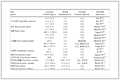
Our results are in agreement with previous reports that the hollow sites exhibit significant energetic favorability for Na adsorption, where the HC for graphene and HB for C3B are the most stable adsorption sites [39,40]. Adsorption energies on the other sites were listed in Table S2 (Supporting information). Due to the facilitation of comparing sodium adsorption on monolayer or bilayer HTSs in a similar chemical environment, and with the aim of achieving a comprehensive understanding of the impact of interlayer interactions on sodium adsorption in this study, our focus will be on sodium adsorption at the hollow site of the carbon hexagonal ring. The binding energies of Na adsorbed on the monolayer and bilayer substrates are listed in Table 1. The Na binding energies on monolayer C3B, GR, and C3N are −0.72, 0.69, and 1.01 eV, respectively, which agree well with previously predicted results [39–41]. We also noted some authors claimed that C3N would be a good anode material due to its large Na adsorption energy of about −1.8 eV [42]. We revisited the same system with the identical computational methods. The fully relaxed Na@C3N possesses nearly the same geometrical configuration as reported, but the adsorption energies are 1.02 and −0.37 eV with bulk and isolated Na atom as references. The negligible differences between the adsorption energies generated by this computational setting and ours also validate the data listed in Table 1.
|
Table 1 Adsorption energies with reference Na atom energies in the bulk phase (Eads) and in vacuum (EadsV), Na adsorption heights (h), C—C bond lengths below the Na atom (dC—C), and the carbon pz band centers (EpzC) of the substrate-adsorbate systems. GR denotes a graphene layer, and A/B denotes a HTS with Na adsorbed on the A side. All energies in electron volts (eV) and lengths in angstroms (Å). |
There was consensus that pristine graphene is not a good anode material due to its weak adsorption to alkali atoms [39,40], while it is still not clear whether nitrogen doped graphene is good for alkali atom adsorption. Nitrogen is more electronegative, potentially has stronger ionic interactions with alkali atoms and provides stronger adsorption. It has been validated that nitrogen-rich mesoporous carbon materials have superior lithium storage properties [43]. However, the adsorption energies listed in Table 1, as well as many previously studies, suggest that alkali atom adsorption on C3N is unfavorable, indicated by the positive adsorption energy (1.01 eV). This discrepancy can be understood by considering the peculiar electronic structures of the honeycomb lattices. The perfect sp2 hybridization of the lattice results in particle-hole symmetry in pristine graphene, where the bonding valence band and the anti-bonding conduction band intersect at the Fermi level. The fully occupied bonding band and the empty anti-bonding band ensures strong covalent bond between adjacent carbon atoms with a bond order of 2 and high stability. Nitrogen substitution induces electron doping. The extra electron occupies the anti-bonding states and lifts the Fermi level while reduces the bond order. In this context, the C3N layer is unfavorable to accept more electrons that would further destabilize the system. Strong Na adsorption could only be attained by accommodating its valence 3s electron in the bonding states of the substrate, which is difficult for an electron abundant system, such as C3N. Consequently, C3N is not favorable to Na adsorption. On the contrary, the electron deficient C3B is a better substrate for Na adsorption, indicated by the energy gain upon adsorption (−0.72 eV). Pristine graphene is neutral in the context of electron abundance or deficiency, which is unfavorable to adopt extra electrons, has a Na adsorption energy of +0.69 eV, which is in line with the tendency discussed above.
We further study the bonding mechanism employed by projected the crystal orbital Hamilton population (COHP) analysis. We follow the usual way of displaying COHPs, namely, the negative (green) and positive (red) shadings represent bonding and anti-bonding populations, respectively. Fig. S2 (Supporting information) shows the COHP curves resolved by interactions between C—Na and C—C bonds of Na atom adsorbed on the monolayers. And the integral COHP data up to the Fermi level (ICOHP) provides an efficient measure of the bond strength. The anti-bonding states near the Fermi level for C—Na bond explain pristine graphene is unfavorable for Na atom adsorption. Compared to the electron abundant N atom, the electron deficient B atom decrease the ICOHP value (−0.104 eV) of C—Na bond in Fig. S2a, explaining the Na stabilization on C3B monolayer.
Can the adsorption properties of Na ions be adjusted by introducing additional electron abundance/deficiency, especially to enhance or reduce the adsorption performance of sodium ions according to the material’s application requirements? It can be inferred that the electron abundance or deficiency of the substrate should strongly influence sodium adsorption, since it has demonstrated significant interlayer charge transfer in vertically stacked C3B/C3N bilayer HTSs, resulting in notable changes in electronic structure and surface properties [37,44–46]. We assessed the effect of the interlayer charge transfer on Na adsorption. Using the adsorption energies and structural parameters as listed in Table 1, the correlation between these properties and the electron abundance of the substrates are summarized in Fig. 2. According to the Na adsorption behavior, the bilayer HTSs, together with the three monolayers, can be classified into three families: the three substrates with C3B layer directly interact with Na atom possess the most negative adsorption energies, suggesting they are favorable for Na adsorption; the three substrates with graphene directly interact with Na atoms possess positive adsorption energies, and the magnitudes are widely tunable from 0.20 eV to 0.84 eV; the three substrates with C3N directly interact with Na atom possess the most positive adsorption energies, indicating Na directly adsorbed on C3N is thermodynamically unfavorable. From the point of view of electron abundancy/deficiency, pristine graphene can be considered as a neutral reference. We found that Na@C3N/C3B has a similar adsorption energy (0.72 eV) with that of Na@GR (0.69 eV). This can be understood by considering that substantial charge of the top C3N layer (electron abundance) transfers to the bottom C3B layer (electron deficiency), makes the top C3N layer behaves like the neutral reference on Na adsorption. In all the three families, the adsorption energies increase (less negative or more positive) as the top layer was stacked on more electron abundant sublayers and vice versa. The fact that Na adsorption is tunable by the electron abundance of the substrates can be achieved by interlayer charge transfer by constructing vdW HTSs. For the C3B family of substrates, the adsorption energies increase from −0.72 eV to −0.51 eV by lining with an underneath electron abundant C3N layer. The same tendency was observed in the graphene and C3N families of substrates.

|
Download:
|
| Fig. 2. Correlations between (a) the Na adsorption energies and the substrate p-band centers, (b) the electron loss of Na atom, (c) the interlayer charge transfer, (d) the heights of the adsorbed Na atom (the C—C bond lengths in the hexagonal ring with the hollow site occupied by the Na atom). | |

Similar to the d-band theory that correlates the d-band center of a surface containing transition metals and its hydrogen adsorption strength [47,48], we examined the correlation between the p-band centers of the top layer and the Na adsorption stabilities. The 3s electrons of the Na atom transfers to the pz-band of the substrate. The transferred electron would stabilize the system if it was accommodated to a bonding state, in cases that the substrate itself is electron more deficient compared to the neutral reference, i.e., graphene; on the other hand, if the bonding states were fully occupied, like in graphene or the more electron abundant C3N, the incoming electron could only be accommodated to the antibonding state, which destabilizes the system. As shown in Fig. 2a, there is a nearly linear correlation between the Na adsorption energies and the p-band centers of the substrates. The similar slopes for each family of the substrates imply charge accumulation in the top layer has similar effects on Na adsorption. This is the consequence of the similar p-orbital constituents of the bonding and antibonding states near the Fermi level in all the substrates. A negative deviation of the p-band center from the Fermi level corresponds to greater occupation of the antibonding states formed by the p orbitals. The linear correlation between the adsorption energies and charge transfer are more obvious for each family of substrates. Fig. 2b depicts the correlation between the adsorption energies with the electron loss of the Na atom. For the C3B family of substrates, the amount of charge transfer from the adsorbed Na atom to the top layers are nearly the same (~0.9 e), the differences between the adsorption energies can be ascribed to the electron accumulation on the top layer induced by interlayer charge transfer. As the C3B monolayer is stacked on graphene, interlayer charge transfer of about 0.05 e induces electron accumulation on the top C3B layer, lowering the pz-band center from +0.5 eV to +0.2 eV, results in weaker Na adsorption. Stacking on more electron abundant C3N layer would further weaken the adsorption. The interlayer charge transfer increases to 0.32 e, and the p-band center is lowered to −0.3 eV, relative to Fermi energy. Consequently, the Na adsorption is weakened from −0.72 eV for the C3B monolayer, to −0.59 and −0.51 eV for the C3B/GR and C3B/C3N HTSs, respectively. The same tendency can also be observed for the other two families of substrates, as shown in Figs. 2b and c.
The geometric configurations of the substrate-adsorbate system can also be correlated with the adsorption strength. Fig. 2d depicts the linear correlations between the adsorption energies and the Na heights. The family behavior of the Na adsorption of the 9 substrates can now be classified into two classes: chemical adsorption for the C3B family (green squares) and the graphene family (blue dots), and nearly physical adsorption for the C3N family (orange diamonds). For chemical adsorption, the equilibrium Na heights monotonically increases from 2.15 Å to 2.25 Å, as the substrate changes from the most electron deficient C3B monolayer to the least electron deficient GR/C3N bilayer. While when the Na atom directly interact with the C3N layer, the Na height increases from 3.15 Å to 3.25 Å as the substrate changes from the least electron abundant C3N/C3B bilayer to the most electron abundant C3N monolayer. This classification can also be rationalized by revisiting the change transfer from Na to the substrates. Na loses much less electrons on the C3N family of substrates compared with those on the other two families of substrates.
The distinct Na adsorption behavior of the three families of substrates originates from their electronic structures. Figs. S3 and S4 (Supporting information) depict the band structures and projected density of states (PDOS) of the monolayer and bilayer substrates. The neutral reference graphene has an electron-hole symmetry, with fully occupied bonding bands and empty antibonding bands intersect at the Fermi level. This electron configuration ensures the strongest bonding pattern in GR among the substrates. On the other hand, C3B (C3N) is electron deficient (abundant), introduces holes (electrons) into the hexagonal lattice, lowers (lifts) the Fermi level and results in lower C—C bond order (Fig. S3). The PDOS of the bilayer HTSs shown in Fig. S4 depict similar contribution from the components near the Fermi level, except slight deviations from the monolayers due to interlayer charge transfer.
The band structures of Na adsorbed on the monolayer and bilayer substrates are shown in Fig. 3, the Na 3s contribution is denoted as orange dots with varying radii. And the adsorption energy for the three HTSs families exhibits linear relationship with the ICOHP of C—Na bond in Fig. S5 (Supporting information). For the C3B family of the substrates, as shown in Fig. 3, the Na 3s states locates 1.5–1.9 eV above the Fermi level, indicates substantial charge transfer from Na to the substrates. This charge transfer can also be validated by the differential charge density plots shown in Fig. 4, where a large portion of the Na 3s electrons transfers to the substrates and delocalized among the whole C3B layer. The substantial electron accumulation between the Na atom and the C3B layer implies the existence of strong chemical interaction and provides the strongest adsorption, confirmed by the ICOHP of C—Na bond in Fig. S6a (Supporting information). The graphene family of substrates exhibits the widest range of variation in the Na 3s energies, in accord with the variation in adsorption energies (Fig. 2). For Na adsorbed on pristine graphene, as shown in Fig. 3e, the Fermi level is lifted from the Dirac cone by accommodating extra electrons transferred from the Na 3s states to the graphene anti-bonding conduction states (Fig. S6a). The Na 3s states locate just above the Fermi level, coincide with the partial electron loss of the Na atom (Table 2). The Fermi level lifting is much weak in Na@GR/C3B compared with that in Na@GR, as the consequence of interlayer charge transfer from GR to C3B. The Na 3s band in Na@C3N is flat and locates at the Fermi level, as shown in Fig. 3i, reflects that the Na 3s electrons are nearly free, and hardly participate in chemical bonding. The charge difference plot in Fig. 4i also approves this point, where slight charge transfer only occurs between the Na atom and the hexagonal ring underneath. The band structures of Na@C3N/C3B and Na@C3N/GR do not deviate from those of the bilayer substrates.

|
Download:
|
| Fig. 3. (a-i) Band structures of Na adsorbed on various substrates. The substrates are labeled as legends in each subfigure. The contribution of Na 3s states is denoted by orange dots with varying radii. | |


|
Download:
|
| Fig. 4. (a-i) Differential charge density isosurfaces of Na atom adsorbed on various substrates. Cyan and yellow colors represent electron depletion and accumulation, respectively. All isosurfaces are plotted with an isovalue of 0.0005 a.u. | |

|
|
Table 2 Charge transfer between the adsorbed Na atom and the substrates. Lines 2–4 list the net charge of the Na atom, the top layer, and the bottom layer (if exists) of various substrates. Units in absolute electron charge (|e|). |
In conclusion, we performed systematical theoretical studies of the interlayer charge transfer effects on Na adsorption on various substrates. We found that it is energetically favorable for sodium adsorption on electron deficient substrates. The adsorption strength, represented by the adsorption energy, can be effectively tuned by electron accumulation/depletion of the layer directly interacts with the Na atom. The charge density of the substrate is tunable by interlayer charge transfer implemented by constructing vdW HTSs. The Na adsorption behavior is dominated by the direct interacting layer and is linearly correlated to the p-band center of that layer. For substrates with the same top layer, the Na adsorption energies are linearly correlated with the electron loss of the Na atom, the interlayer charge transfer, and the heights of the adsorbed Na atom. These linear correlations indicate both the geometric and electronic structures can be effectively tuned by interlayer charge transfer in vdW HTSs.
Declaration of competing interestThe authors declare that they have no known competing financial interests or personal relationships that could have appeared to influence the work reported in this paper.
CRediT authorship contribution statementHuifang Ma: Writing – original draft, Investigation. Tao Xu: Investigation, Formal analysis. Saifei Yuan: Visualization, Investigation. Shujuan Li: Writing – review & editing, Supervision, Methodology. Jiayao Wang: Visualization, Investigation. Yuping Zhang: Writing – review & editing, Supervision, Methodology. Hao Ren: Writing – review & editing, Formal analysis. Shulai Lei: Writing – review & editing, Supervision, Software.
AcknowledgmentsWe acknowledge the financial support by the National Key Research and Development Program of China (No. 2019YFA0708700), the National Natural Science Foundation of China (Nos. 62305196, U23B2087 and 62375158), the China Postdoctoral Science Foundation (No. GZC20231498), the Qingdao Postdoctoral Innovation Project (No. QDBSH20240102078), the Postdoctoral Innovation Program of Shandong Province (No. SDCX-ZG-202400318), Science and Technology Research Project of Hubei Provincial Department of Education (No. D20212603), HubeiUniversity of Arts and Science (No. 2020kypytd002).
Supplementary materialsSupplementary material associated with this article can be found, in the online version, at doi:10.1016/j.cclet.2024.110219.
| [1] |
J. Xiao, J. Han, C. Zhang, et al., Adv. Energy Mater. 12 (2022) 2100775. |
| [2] |
J. Zhou, S. Guo, SmartMat 2 (2021) 176-201. DOI:10.1002/smm2.1042 |
| [3] |
H.S. Hirsh, Y. Li, D.H.S. Tan, et al., Adv. Energy Mater. 10 (2020) 2001274. |
| [4] |
L. Lin, J. Chen, D. Liu, et al., Adv. Energy Mater. 10 (2020) 2002621. |
| [5] |
X. Yang, R. Zhang, S. Xu, et al., Chem. Eur. J. 26 (2020) 5818-5823. DOI:10.1002/chem.201905311 |
| [6] |
S. Sarkar, S. Roy, Y. Hou, et al., ChemSusChem 14 (2021) 3693-3723. DOI:10.1002/cssc.202101270 |
| [7] |
H. Qi, C. Zhao, J. Huang, et al., Nanoscale 14 (2022) 780-789. DOI:10.1039/d1nr06705b |
| [8] |
Q. Liu, R. Xu, D. Mu, et al., Carbon Energy 4 (2022) 458-479. DOI:10.1002/cey2.120 |
| [9] |
X. Li, J. Li, L. Ma, et al., Energy Environ. Mater. 5 (2022) 458-469. |
| [10] |
X. Gong, Y. Zheng, J. Zheng, et al., ChemElectroChem 7 (2020) 1465-1472. DOI:10.1002/celc.201902098 |
| [11] |
J. Yang, R.U.R. Sagar, T. Anwar, et al., Int. J. Energy Res. (2021). DOI:10.1002/er.7514 |
| [12] |
M.J. Lee, K. Lee, J. Lim, et al., Adv. Funct. Mater. 31 (2021) 2009397. |
| [13] |
D. Wang, H. Hu, Y. Liao, et al., Sci. China Mater. 64 (2021) 318-328. |
| [14] |
D. Kong, H. Fan, X. Ding, et al., ACS Appl. Mater. Interfaces 12 (2020) 46065-46072. DOI:10.1021/acsami.0c12389 |
| [15] |
J. Zhang, J. Han, Q. Yun, et al., Small Sci. 1 (2021) 2000063. |
| [16] |
C. Xia, W. Xiong, W. Xiao, et al., Phys. Rev. Appl. 10 (2018) 24028. |
| [17] |
Y. Ren, F. Cheng, X. Zhou, K. Chang, G. Zhou, Carbon 143 (2019) 14-20. |
| [18] |
Y. Qie, J. Liu, S. Wang, S. Gong, Q. Sun, Carbon 129 (2018) 38-44. |
| [19] |
K.S. Novoselov, A. Mishchenko, A. Carvalho, A.H. Castro Neto, Science 353 (2016) aac9439. |
| [20] |
A. Gao, J. Lai, Y. Wang, et al., Nat. Nanotechnol. 14 (2019) 217-222. DOI:10.1038/s41565-018-0348-z |
| [21] |
K. Bushick, S. Chae, Z. Deng, J.T. Heron, E. Kioupakis, npj Comput. Mater. 6 (2020) 3. |
| [22] |
X. Yu, G. Zhao, C. Liu, et al., Adv. Funct. Mater. 31 (2021) 2103214. |
| [23] |
S. Gao, Z. Wang, H. Wang, et al., Adv. Mater. Interf. 8 (2021) 2001730. |
| [24] |
D.X. Song, Y.Z. Du, W.G. Ma, X. Zhang, Int. J. Energy Res. 45 (2021) 3421-3429. DOI:10.1002/er.6027 |
| [25] |
J. Yu, M. Zhou, M. Yang, et al., Adv. Mater. Interf. 9 (2022) 2102088. |
| [26] |
X. Wang, Y. Li, S. Wang, et al., Adv. Energy Mater. 10 (2020) 2000081. |
| [27] |
F. Zou, T. Xu, Z. Wu, et al., J. Phys. Chem. C 124 (2020) 28074-28082. DOI:10.1021/acs.jpcc.0c08143 |
| [28] |
G. Kresse, J. Hafner, Phys. Rev. B 47 (1993) 558-561. |
| [29] |
G. Kresse, J. Furthmüller, Comput. Mater. Sci. 6 (1996) 15-50. |
| [30] |
J.P. Perdew, K. Burke, M. Ernzerhof, Phys. Rev. Lett. 77 (1996) 3865-3868. |
| [31] |
P.E. Blöchl, Phys. Rev. B 50 (1994) 17953-17979. |
| [32] |
G. Kresse, D. Joubert, Phys. Rev. B 59 (1999) 1758-1775. |
| [33] |
S. Ehrlich, J. Moellmann, S. Grimme, Acc. Chem. Res. 46 (2013) 916-926. DOI:10.1021/ar3000844 |
| [34] |
S. Grimme, J. Antony, S. Ehrlich, H. Krieg, J. Chem. Phys. 132 (2010) 154104. |
| [35] |
W. Tang, E. Sanville, G. Henkelman, J. Phys. Condens. Matter 21 (2009) 84204. |
| [36] |
S. Maintz, V.L. Deringer, A.L. Tchougréeff, R. Dronskowski, J. Comput. Chem. 37 (2016) 1030-1035. DOI:10.1002/jcc.24300 |
| [37] |
C. Zhang, Y. Jiao, T. He, et al., J. Phys. Chem. Lett. 9 (2018) 858-862. DOI:10.1021/acs.jpclett.7b03449 |
| [38] |
H. Li, L. Xu, X. Huang, et al., Int. J. Hydrogen Energy 48 (2023) 2186-2199. |
| [39] |
K.T. Chan, J.B. Neaton, M.L. Cohen, Phys. Rev. B 77 (2008) 235430. DOI:10.1103/PhysRevB.77.235430 |
| [40] |
C. Ling, F. Mizuno, Phys. Chem. Chem. Phys. 16 (2014) 10419-10424. |
| [41] |
O.I. Malyi, K. Sopiha, V.V. Kulish, et al., Appl. Surf. Sci. 333 (2015) 235-243. |
| [42] |
P. Bhauriyal, A. Mahata, B. Pathak, J. Phys. Chem. C 122 (2018) 2481-2489. DOI:10.1021/acs.jpcc.7b09433 |
| [43] |
Y. Mao, H. Duan, B. Xu, et al., Energy Environ. Sci. 5 (2012) 7950. DOI:10.1039/c2ee21817h |
| [44] |
S. Li, J. Hao, F. Li, et al., J. Phys. Chem. C 118 (2014) 27843-27849. DOI:10.1021/jp5074768 |
| [45] |
A.H. Woomer, D.L. Druffel, J.D. Sundberg, J.T. Pawlik, S.C. Warren, J. Am. Chem. Soc. 141 (2019) 10300-10308. DOI:10.1021/jacs.9b03155 |
| [46] |
J.H. Lee, A. Avsar, J. Jung, et al., Nano Lett. 15 (2015) 319-325. DOI:10.1021/nl5036012 |
| [47] |
J.K. Nørskov, F. Abild-Pedersen, F. Studt, T. Bligaard, Proc. Nat. Acad. Sci. U. S. A. 108 (2011) 937-943. DOI:10.1073/pnas.1006652108 |
| [48] |
J.K. Nørskov, Progr. Surf. Sci. 38 (1991) 103-144. |