 2025, Vol. 36


b Department of Physics, College of Basic Medical Science, Army Medical University, Chongqing 400038, China;
c Key Lab of Colloid and Interface Chemistry, Ministry of Education, School of Chemistry and Chemical Engineering, Shandong University, Ji'nan 250100, China
Magnetic properties are intensively studied because of their potential applications, including food preservation, magnetocaloric effect and single-molecule magnets [1–9]. Single-molecule magnets (SMMs) due to their bistability (exhibiting a slow reorientation of their magnetization that gives a magnetic hysteresis of molecular origin), present significant prospective applications in data storage and/or processing, next-generation computer technologies (i.e., spintronics and quantum computing) at the atomic and molecular scale [10–18]. In the past decades, many strategies were used to improve SMM properties, basically in two ways, improving large Ising-type magnetic anisotropy (negative zero-field-splitting parameter D) or/and the large spin (S) ground state for the spin Hamiltonian DSz2 − S(S + 1)/3 [19,20], generally, the energy barrier of reorientation of the magnetization for SMMs is U = S2|D| and (S2 − 1/4)|D| for integer and half-integer spin systems, respectively [21].
More recently, research efforts have shifted to build mononuclear SMMs, normally, called single ion magnets (SIMs), which could be easily to tuned by structure symmetry and molecular vibration [5,7,12,19,22–30]. To better tune and control the magnetic anisotropy, to date, many records of SMMs are the mononuclear complexes, for instance, the complex [(CpiPr5)Dy(Cp*)]+ with the largest effective energy barrier Ueff = 2219 K and largest hysteresis was up to 80 K was reported by Layfield and co-workers [5], and the complex Co(C(SiMe2ONaph)3)2 presents the record effective energy barrier Ueff = 648 K for the transition metal based SIMs [7]. Mononuclear complexes present clear advantages over polynuclear clusters, as they can be easily manipulated in solution and on surfaces, which is a requirement if one wants to employ them as single quantum bits for quantum information applications [31]. In addition, it is easier to control coordination geometry and in turn tune and engineer magnetic anisotropy in transition metal-based SIMs rather than lanthanide-based SIMs, which presents large spin-orbit coupling of the f-block orbitals and are deeply buried beneath the valence shell [32]. Even the weaker spin-orbit coupling effect in transition metal-based SIMs will result weaker magnitude of magnetic anisotropy.
To the best of our knowledge, the most common SIMs include a linear Fe(Ⅰ) complex, a linear Co(Ⅱ) complex, a tetrahedral Co(Ⅱ) complex, and a trigonal bipyramidal Co(Ⅱ) complex [7,19,23–27]. Mallah's group has previously reported that imposing a trigonal bipyramidal symmetry around Co(Ⅱ) and Ni(Ⅱ) cations results in high Ising-type magnetic anisotropy (negative D value) for the NiⅡ complex (D value close to –200 cm–1) [23,24]. Also the magnetic anisotropy could be tuned by replacing the ligand tris(2-(dimethylamino)ethyl)amine (Me6tren) with (2-(isopropylthio)ethyl)amine (NS3iPr) for the Co(Ⅱ) one showing pretty good results with our prediction (employing a ligand that forces a trigonal bipyramidal arrangement and has weak equatorial σ-donating atoms, increases (in absolute value) the negative zero-field-splitting parameter D) [19]. Moreover, structural and chemical effects on the magnitude of the magnetic anisotropy and the relaxation times in a series of Co(Ⅱ) compounds based on the ligand 2-(tert–butylthio)-N-(2-(tert–butylthio)ethyl)-N-((neopentylthio)methyl)ethan-1-amine (NS3tBu) were investigated [28].
Herein, addition to organic and axial ligands tuning, we predict that larger counter-ion could change the environment of Co(Ⅱ)-based single ion magnet to some extent, diluting the cobalt-containing complex and slowing magnetic relaxation, which is often ignored. Keeping these observations in mind, we used the ligand NS3tBu to obtain two complexes [Co(NS3tBu)Cl]Y, Y = PF6– (1), ClO4– (2). Furthermore, we investigate how counter-ion effect interacts with the structural and chemical effects on the magnitude of magnetic anisotropy and the magnetic relaxation duration in these serial Co(Ⅱ) compounds. The crystal structures, magnetic properties, theoretical calculations and correlations to the axial magnetic anisotropies were studied.
The syntheses of ligand NS3tBu, as well as compounds 1 and 2 were represented in Scheme 1. The one pot reaction NS3tBu, and related cobalt(Ⅱ) salts with related [Bu4N]PF6 or [Bu4N]ClO4 in nBuOH/EtOH mixture afforded the mononuclear complex that adopts the trigonal bipyramidal topology, with the one negative charge counter-balanced by the PF6– or ClO4– anion (Scheme 1). It should be mentioned that in the third step of synthesis of NS3tBu, the tert–Butylmercaptan used is a very poisonous gas with an obnoxious odor, and all procedures must be carried out in an efficient fume hood. The apparatus must be connected to a series of washing bottles charged with chromic acid mixture or other absorbing solutions [32].

|
Download:
|
| Scheme 1. Synthesis procedure of organic ligand NS3tBu, and compounds 1, 2. | |

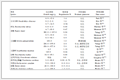
As noted in Table S1 (Supporting information), compound 1 and 2 crystalized in the monoclinic space group P21/n. The cation structure in the two compounds is comprised of a central Co(Ⅱ) ion surrounded by three sulfur atoms in the equatorial sites, a nitrogen and a chloride ion in the axial sites (Fig. 1). As expected, the ligand imposes a trigonal bipyramidal arrangement in the two compounds with pseudo C3 molecular symmetry axis for 1 and 2 (in the following, we noted 1ⅰ and 1ⅱ instead of crystallographically independent molecules in the asymmetric unit of the compound 1). Concurrently, we use the C3v point group notation for clarity, although the symmetry for the three complexes (1ⅰ, 1ⅱ and 2) is lower. The corresponding parameters of the three complexes is shown in Table 1. Herein, we just detail that the CoⅡ ion in the complex 1ⅰ lies 0.384 Å below the equatorial plane of the three sulfur atoms with an average

|
Download:
|
| Fig. 1. Molecular structure of compound 1 obtained from X-ray diffraction. Violet sphere, Co; tan sphere, S; blue, N; green, Cl; black, C. The hydrogen atoms and counter-ion molecules were omitted for clarity | |

|
Table 1 Relevant CoⅡ-ligand bond distances (Å) and angles (°) for compounds 1 and 2. |
Dc magnetic susceptibilities have been measured on polycrystalline samples in the temperature range of 2–300 K (Fig. 2 left). The χMT (χM means the molar susceptibility) is constant between room temperature and 50 K with values of 2.50 and 2.43 cm3 K/mol for compounds 1 and 2 respectively (Fig. 2 left). Below 40 K the χMT decreases indicating magnetic anisotropy, which can be qualitatively assigned to the zero-field splitting (ZFC) of the S = 3/2 manifold (Ms = ±1/2 and = ±3/2 sublevels). The fit of the susceptibility data with the spin Hamiltonian that includes the ZFC part allows extracting the axial ZFC parameter D and Landé-factor g value for the two compounds (1 and 2).

|
Download:
|
| Fig. 2. Temperature-dependent magnetic susceptibility and field dependent magnetization at variable temperatures for compounds 1 and 2. (○) experimental data; (—) theoretical fit with the best D and g parameters; (▾) average of the calculated magnetization considering D values from ab initio calculations. | |

It should be mentioned that it is not possible to discriminate between negative and positive D values from the χMT data, however, which can be further confirmed by the magnetization (M) versus B plots (Fig. 2 middle and right for compounds 1 and 2 respectively). In order to quantify the magnitude of the ZFS parameter, we fitted the magnetic data using the spin Hamiltonian
Furthermore, it is important to indicate here that due to the Kramers nature of the levels (S = 3/2), a range of D and g values can give calculated data with reasonably consistent agreement with experimental results for the fitting of magnetization data [32]. In this study, we fit the field dependent magnetization data by leaving free g (= gy), gz and D, which indicates that the magnetic anisotropy is of the Ising-type, where the Ms = ±3/2 sub-levels have a lower energy than the ±1/2 sub-levels, and there is an easy axis of magnetization. Also, it is worth noting that for compound 1, which contains two crystallographically independent molecules. Also, we calculated the magnetization for each independent molecule using the D parameters obtained from ab initio calculations (Table 1 and Fig. 2), averaged them and compared with the experimental data; the average calculated curves are in good agreement with the experimental data. The main result is that compounds 1 and 2 have D values of –13 and –22 cm–1, respectively [32].
Ac susceptibility measurements would bring complementary information on the dynamics of the magnetization reversal at higher temperatures. Applying a dc magnetic field may also slow down the tunneling of the magnetization and make other processes more visible. We first measured the ac susceptibility on microcrystalline samples of compounds 1 and 2 with an ac oscillating field of 3.0 Oe at T = 2 K for different frequencies and at different values of the applied dc magnetic field, to find the optimum field value where relaxation is slower (Figs. S1 and S2 in Supporting information). This optimum field usually corresponds to the one where QTM is suppressed and the direct mechanism is minimized. In Fig. S1, we can see that under an applied zero dc magnetic field, almost no obvious out-of-phase susceptibility (χM″) was observed for compounds 1 and 2. Upon increasing the dc magnetic fields (200 and 400 Oe for compounds 1 and 2, respectively), a maximum appears around 116 and 167 Hz for compounds 1 and 2, respectively. They shift towards the lower frequency when increasing the dc magnetic field up to 2000 Oe The variation of the frequency value of the maximum of χ” vs. μ0H shows that the optimum applied dc magnetic field range is 1000–3000 Oe and 1600–3400 Oe for compounds 1 and 2 (Fig. S2). This also indicated the presence of quantum tunneling of magnetization (QTM, which natively affects the magnetic bistability) in compounds 1 and 2. The magnetic field can suppress more QTM in compound 1 than compound 2. Furthermore, these behaviors are the essential characteristics of field-induced slow magnetization relaxation.
The ac susceptibility data in Fig. 3 show comparisons of the frequency dependence of the out-of-phase susceptibility at 2 K for compounds 1 and 2, we can see that the magnetic relaxation of 1 (Y = PF6–) is slower than 2 (Y = ClO4–). In addition, all the ac data in the form of Cole-Cole plots (Fig. 4 for compounds 1 and 2) were fitted to the generalized Debye model [19,34,35], which allowed to extract the relaxation times at different temperatures (τ) and their distribution (α) [34]. The Cole-Cole plots of both compounds exhibit an asymmetric semicircle with a tail (Fig. 4), and the fit of the χ’= f(ν), χ”= f(ν) and χ” = f(χ’) were carried out (Table S2 in Supporting information).

|
Download:
|
| Fig. 3. Frequency dependent out-of-phase and in-phase ac magnetic susceptibilities ((○) experimental data; (—) fit) at 2 K under an applied dc magnetic field of 1800 and 3000 Oe for compounds 1 and 2 respectively. | |


|
Download:
|
| Fig. 4. Cole-Cole plots, experimental data (○) and fit (—) under an applied dc magnetic field of 1800 and 3000 Oe for compounds 1 (left) and 2 (right), respectively. | |

The resulting α values vary in the range of 0.0824–0.2606 for 1 and 0.01158–0.1907 for 2 (Table S2), indicating a relatively weak distribution of the relaxation times. The α values increase to 0.26, 0.19 for 1 and 2, respectively at low temperatures and decrease toward zero at high temperatures. These results indicate the presence of a nearly weak uniformly distributed relaxation process in the range of the measured temperatures.
The effective energy barrier (Ueff) and relaxation time (τ, τ0 is the relaxation time at infinite temperature) can be obtained through fitting the plot of ln(τ) vs. 1/T (Fig. 5) of the high temperatures (Orbach regime) using Arrhenius equation ln(τ) = ln(τ0) + Ueff/kBT, which elicited a value of Ueff = 26.4 K and τ0 = 1.4 × 10⁻⁸ s for 1. In order to fit the whole curve for compound 2, which requires consideration of all relaxation process, we attempted to fit the dependence of the relaxation time using the following general expression:
| $ \tau^{-1}=A H^2 T+\frac{B_1}{1+B_2 H^2}+C T^n+\tau_0^{-1} \exp \left(-U / k_{\mathrm{B}} T\right) $ | (1) |
where AH2T,

|
Download:
|
| Fig. 5. ln(τ) vs. inversion of T plots using ac data for compounds 1 and 2, experimental data (○) and fit (—). | |

The In a trigonal bipyramidal, the splitting of the d orbital by the ligand field usually results in the scheme (Fig. 6), where the

|
Download:
|
| Fig. 6. Removal of the degeneracy of the d orbitals in a trigonal bipyramidal (C3v) crystal field. | |

We will not perform a detailed analysis of the relationship between the structure of the complexes and the anisotropy. We will only comment the results of the calculations and try to extract only general ideas on the effect of the axial ligands on the anisotropy. The ab initio calculations result of the energy spectrum for the compounds 1 and 2 can be seen in Fig. 7.

|
Download:
|
| Fig. 7. CAS(7,10)SCF energies of the lowest quadruplet states calculated for complexes 1ⅰ, 1ⅱ and 2. | |

The evolution of the energy spectrum shows that the energy difference between the ground and the first excited states. |D| is inversely proportional to the energy difference between the ground and the excited states [19,40,41]. For CoⅡ (d7, S = 3/2) ions in a trigonal bipyramidal environment (Fig. 6) [23], the first excited quadruplet state (4A1) brings a negative contribution to D, while the others (4E1, 4E2 and 4E3) bring a positive one. 4A1 is the result of excitations involving the
In summary, two sulfur containing trigonal bipyramidal Co(Ⅱ) complexes have been synthesized and characterized. We demonstrated that the counter-ion effect could present a large effect to the environment of trigonal bipyramidal Co(Ⅱ), and thus result different magnetic relaxation and their magnetic anisotropy parameters, and display large different SMM behavior, which is focusing on the often ignored design concept: the counter-ion effects. Therefore, to consider Co(Ⅱ) complexes with slow relaxation times and large barrier to the reorientation of the magnetization, one needs not only to consider the environment of the central Co(Ⅱ), but also the environment of the whole molecule, such as counter-ion, which is easily overlooked by most researchers. Our findings are helpful to guide the design and synthesis of SIMs, even some oligonuclear SMMs.
CRediT authorship contribution statementJiajia Zhuang: Writing – original draft, conceptualization. Chunyu Cui: Formal analysis. Changjiang Li: Formal analysis. Gang Luo: Formal analysis. Jiaping Tong: Writing – review & editing, project administration, supervision, conceptualization. Di Sun: Writing – review & editing, conceptualization.
Declaration of competing interestThe authors declare that they have no known competing financial interests or personal relationships that could have appeared to influence the work reported in this paper.
AcknowledgmentsThis work was financially supported by the National Natural Science Foundation of China (Nos. 92361301 and 52261135637), Natural Science Foundation of Xiamen University (No. 201920), Instrument Improvement Funds of Shandong University Public Technology Platform (No. ts20220102), and the receipt of Army Logistics Academy.
Supplementary materialsSupplementary material associated with this article can be found, in the online version, at doi:10.1016/j.cclet.2024.110091.
| [1] |
A. Caneschi, D. Gatteschi, R. Sessoli, et al., J. Am. Chem. Soc. 113 (1991) 5873-5874. DOI:10.1021/ja00015a057 |
| [2] |
R. Sessoli, D. Gatteschi, A. Caneschi, M.A. Novak, Nature 365 (1993) 141-143. |
| [3] |
F. Liu, N. Yang, L.T. Zhang, et al., Food Biosci. 53 (2023) 102667-102800. |
| [4] |
F. Shao, J.J. Zhuang, M.G. Chen, et al., Dalton Trans. 47 (2018) 16850-16854. DOI:10.1039/c8dt04153a |
| [5] |
F.S. Guo, B.M. Day, Y.C. Chen, et al., Science 362 (2018) 1400-1403. DOI:10.1126/science.aav0652 |
| [6] |
K. Choroba, J. Palion-Gazda, B. Machura, et al., Inorg. Chem. 63 (2024) 1068-1082. DOI:10.1021/acs.inorgchem.3c03405 |
| [7] |
P.C. Bunting, M. Atanasov, E. Damgaard-Møller, et al., Science 362 (2018) 7319. |
| [8] |
R. Luo, C.Z. Xie, M.G. Chen, et al., Chin. J. Chem. 41 (2023) 3662-3668. DOI:10.1002/cjoc.202300432 |
| [9] |
Z. Zhu, M. Guo, X.L. Li, J. Tang, Coord. Chem. Rev. 378 (2019) 350-364. |
| [10] |
M. Urdampilleta, S. Klyatskaya, J.P. Cleuziou, M. Ruben, W. Wernsdorfer, Nat. Mater. 10 (2011) 502-506. DOI:10.1038/nmat3050 |
| [11] |
G. Lococciolo, S.K. Gupta, S. Dechert, et al., Inorg. Chem. 63 (2024) 5652-5663. DOI:10.1021/acs.inorgchem.4c00054 |
| [12] |
C.A.P. Goodwin, F. Ortu, D. Reta, N.F. Chilton, D.P. Mills, Nature 548 (2017) 439. DOI:10.1038/nature23447 |
| [13] |
S.K. Gupta, H.H. Nielsen, A.M. Thiel, et al., JACS Au 3 (2023) 429-440. DOI:10.1021/jacsau.2c00575 |
| [14] |
S. Thiele, F. Balestro, R. Ballou, et al., Science 344 (2014) 1135. DOI:10.1126/science.1249802 |
| [15] |
P.K. Sahu, R. Kharel, S. Shome, S. Goswami, S. Konar, Coord. Chem. Rev. 475 (2023) 214871. |
| [16] |
R. Vincent, S. Klyatskaya, M. Ruben, W. Wernsdorfer, F. Balestro, Nature 488 (2012) 357-360. DOI:10.1038/nature11341 |
| [17] |
L. Bogani, W. Wernsdorfer, Nat. Mater. 7 (2008) 179-186. DOI:10.1038/nmat2133 |
| [18] |
M. Shiddiq, D. Komijani, Y. Duan, et al., Nature 531 (2016) 348-351. DOI:10.1038/nature16984 |
| [19] |
F. Shao, B. Cahier, N. Guihery, et al., Chem. Commun. 51 (2015) 16475-16478. |
| [20] |
A.M. Ako, I.J. Hewitt, V. Mereacre, et al., Angew. Chem. 118 (2006) 5048-5051. DOI:10.1002/ange.200601467 |
| [21] |
V.E. Campbell, H. Bolvin, E. Rivière, et al., Inorg. Chem. 53 (2014) 2598-2605. DOI:10.1021/ic402950j |
| [22] |
Y.S. Ding, K.X. Yu, D. Reta, et al., Nat. Commun. 9 (2018) 3134. |
| [23] |
R. Ruamps, L.J. Batchelor, R. Guillot, et al., Chem. Sci. 5 (2014) 3418-3424. |
| [24] |
R. Ruamps, R. Maurice, L. Batchelor, et al., J. Am. Chem. Soc. 135 (2013) 3017-3026. DOI:10.1021/ja308146e |
| [25] |
J.M. Zadrozny, D.J. Xiao, M. Atanasov, et al., Nat. Chem. 5 (2013) 577-581. DOI:10.1038/nchem.1630 |
| [26] |
J.M. Zadrozny, J. Liu, N.A. Piro, et al., Chem. Commun. 48 (2012) 3927-3929. DOI:10.1039/c2cc16430b |
| [27] |
D. Schweinfurth, M.G. Sommer, M. Atanasov, et al., J. Am. Chem. Soc. 137 (2015) 1993-2005. DOI:10.1021/ja512232f |
| [28] |
F. El-Khatib, B. Cahier, F. Shao, et al., Inorg. Chem. 56 (2017) 4601-4608. DOI:10.1021/acs.inorgchem.7b00205 |
| [29] |
M. He, F.S. Guo, J. Tang, A. Mansikkamäki, R.A. Layfield, Chem. Commun. 57 (2021) 6396-6399. DOI:10.1039/d1cc02139g |
| [30] |
A. Lunghi, F. Totti, R. Sessoli, S. Sanvito, Nat. Commun. 8 (2017) 14620. |
| [31] |
G.A. Timco, S. Carretta, F. Troiani, et al., Nat. Nano 4 (2009) 173-178. DOI:10.1038/nnano.2008.404 |
| [32] |
F. Shao, B. Cahier, E. Rivière, et al., Inorg. Chem. 56 (2017) 1104-1111. DOI:10.1021/acs.inorgchem.6b01966 |
| [33] |
F. Shao, Doctoral Thesis: Engineering Magnetic Anisotropy in Mononulear Cobalt(Ⅱ) Complexes and Lanthanide-based Metallacrowns, Université Paris–Sud, Université Paris-Saclay, Paris, 2017.
|
| [34] |
K.S. Cole, R.H. Cole, J. Chem. Phys. 9 (1941) 341-351. DOI:10.1063/1.1750906 |
| [35] |
M. Perovic, V. Kusigerski, V. Spasojevic, et al., J. Phys. D: Appl. Phys. 46 (2013) 165001. DOI:10.1088/0022-3727/46/16/165001 |
| [36] |
V.V. Novikov, A.A. Pavlov, Y.V. Nelyubina, et al., J. Am. Chem. Soc. 137 (2015) 9792-9795. DOI:10.1021/jacs.5b05739 |
| [37] |
J.M. Zadrozny, M. Atanasov, A.M. Bryan, et al., Chem. Sci. 4 (2013) 125-138. |
| [38] |
Y. Rechkemmer, F.D. Breitgoff, M. van der Meer, et al., Nat. Commun. 7 (2016) 10467. |
| [39] |
B. Cahier, R. Maurice, H. Bolvin, T. Mallah, N. Guihéry, Magnetochemistry 2 (2016) 31. DOI:10.3390/magnetochemistry2030031 |
| [40] |
F.E. Mabbs, D. Collison, Electron Paramagnetic Resonance of d Transition Metal Compounds, Elsevier, The Netherlands, 2013.
|
| [41] |
J.N. Rebilly, G. Charron, E. Rivière, et al., Chem. Eur. J. 14 (2008) 1169-1177. DOI:10.1002/chem.200701243 |