 2025, Vol. 36


Carboxylic esters are a class of compounds of great significance in organic synthesis, pharmaceuticals, fine chemicals, and materials. Hydroesterification of readily available olefins provides an easy access to this class of molecules and attracts attentions from both academia and industry. Great progress has been made in the field with CO [1-14] or its surrogates [15-34] as carbonyl sources. For terminal olefins, the regioselectivity (linear vs. branched) has been one of the focusing issues (Scheme 1). For internal olefins, the double bond could migrate under the reaction conditions via hydropalladation/β-H elimination, which could result in a mixture of ester products upon hydroesterification (Scheme 2). The site selectivity becomes an important issue. Synthetically, it would be useful if the double bond could efficiently migrate all way to the terminal carbon and subsequently regioselectively hydroesterified. The key for such process is that the catalyst system would be favorable for both migration and hydroesterification. Significant success has been achieved for various internal olefins including fatty acids from plant oils using CO as carbonyl sources primarily with Pd and 1,2-DTBPMB or its derivatives frequently in the presence of a sulfonic acid catalyst [35-55]. Such double bond isomerization/hydroesterification reaction process with CO surrogates has also been reported. For example, Beller and coworkers showed that the linear methyl esters can be produced from a number of internal olefins via olefin migration and hydroesterification under various reaction conditions such as Pd/HCO2Me/MeOH/MeSO3H/100 ℃ [56], Pd/(CHO)n/MeOH/PTSA/100-120 ℃ [57,58], Pd/HCO2H/MeOH/PTSA/100 ℃ [59], Carreira and coworkers showed that allylic amides can be remotely hydroesterified with Ru3(CO)12 and pyridin-2-ylmethyl formate [60,61]. Despite these successful examples, developing new olefin migration/hydroesterification reaction process with broad substrate scope and high site selectivity using carbonyl sources easy to handle under mild conditions is still highly desirable and warrants further exploration.

|
Download:
|
| Scheme 1. Regioselective hydroesterification of olefins. | |

|
Download:
|
| Scheme 2. Hydroesterification of internal olefins. | |
HCO2Ar has been shown to be an attractive carbonyl source for hydroesterification of olefins [31,62-64]. The resulting aryl esters are more reactive than the corresponding alkyl esters, and can be readily transformed to other carboxylic acid derivatives [64]. In our earlier studies, high regioselectivities can be achieved for aryl and alkyl terminal olefins with proper ligands [62-64]. In efforts to expand the synthetic potential of such hydroesterification process, we have found that internal olefins can be efficiently isomerized and regioselectively hydroesterified to the corresponding linear aryl esters with Pd(OAc)2 as catalyst, 1,2-DTBPMB as ligand, and HCO2Ar as carbonyl sources under mild conditions (Scheme 3). Herein, we wish to report our preliminary results on this subject.

|
Download:
|
| Scheme 3. Hydroesterification of internal olefins. | |
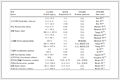
4-Octene (4a) was used as test substrate for initial studies. Various phosphine ligands were first examined with 5 mol% Pd(OAc)2 and 3.0 equiv. of HCO2Ph in toluene at 90 ℃ for 48 h. Among these ligands (for more details, see Table S1 in Supporting information), 1,2-DTBPMB stood out as the best ligand in terms of both reactivity and selectivity, giving the corresponding esters in 90% NMR yield and 18:1 l/b ratio (Table 1, entry 14). Additional Pd catalysts were subsequently examined with 1,2-DTBPMB (Table 1, entries 15-20). Pd(OAc)2 and Pd(Cy3P)2Cl2 were among the better ones with regard to both yield and l/b ratio (Table 1, entries 14 and 17). Solvent studies showed that other solvents such as DCE, DCM were also suitable for the reaction (Table 1, entries 21-27). Further studies showed that the reaction still worked well when the reaction temperature was lowered to 50 ℃ (Table 1, entries 28-31). When the catalyst loading was reduced to 2 or 1 mol%, high yields were still obtained but with somewhat decreased l/b ratios (Table 1, entries 32 and 33). Nevertheless, the yield and l/b ratio dropped dramatically when 0.5 mol% Pd(OAc)2 used (Table 1, entry 34). High yields and l/b ratios can also be achieved when the reactions were carried out with slightly different conditions, including with Pd(Cy3P)2Cl2 in DCE at 70 ℃ (Table 1, entry 35) or Pd(OAc)2 in DCM at 50 ℃ (Table 1, entry 36).
|
Table 1 Studies of hydroesterification reaction conditions.a |

In addition to HCO2Ph, a number of other formates were investigated with trans-4-octene (4a) in the presence of 5 mol% Pd(OAc)2 and 10 mol% 1.2-DTBPMB in DCE at 70 ℃ (Table 2). The reaction also proceeded well with aryl formates 7b-e, giving the corresponding aryl esters in 50%-92% yields with > 20:1 l/b ratios (Table 2, entries 1-4). The corresponding amides (5a-5 and 5a-6) were isolated in 42% and 79% yield, respectively, with N-formylsaccharin (7f) or 1H-benzotriazole-1-carboxaldehyde (7g) (Table 2, entries 5 and 6). In each case, > 20:1 l/b ratio was obtained. When HCO2CH2CHF2 (7h) and HCO2CH2CF3 (7i) were used, the corresponding esters can be isolated in 57%-58% yields (Table 2, entries 7 and 8). However, no desired product was obtained with HCO2Et (7j) (Table 2, entry 9).
|
|
Table 2 Pd-Catalyzed hydroesterification with other formates.a |


The substrate scope for the migratory hydroesterification reaction was subsequently investigated with 5 mol% Pd(OAc)2 and 10 mol% 1.2-DTBPMB in DCE at 70-90 ℃ (Table 3). The reaction can be extended to a wide variety of trans or cis-disubstituted olefins at different positions, providing the corresponding linear phenyl esters (5a-r) in 63%-87% yields (Table 3, entries 1-18). In all these cases, the hydroesterification reaction proceeded regioselectively with > 20:1 l/b ratios. The reaction was compatible with various functional groups including, 8-aminoquinoline (4g), phthalimide (4h), OAc (4i), CN (4j), sulfone (4k), phosphonate (4l), phenyl (4m-n), CO2Et (4o-p), Weinreb amide (4q), and enone (4r). Conjugated olefins can also be efficiently isomerized and hydroesterified (Table 3, entries 13-17). In the case of 4r, ester 5r was obtained in 69% yield while the cyclopentenone moiety remained unaffected during the reaction (Table 3, entry 18). As illustrated with 4a, the reaction process can proceed smoothly on gram scale (Table 3, entry 1). The isomerization/hydroesterification process can also be applied to certain trisubstituted olefins (Table 3, entries 19-24). For example, ester 5s was obtained from dimethyl styrene 4s in 61% yield (Table 3, entry 19). In the case of olefin 4t, the esterification predominately occurred at carbon a, giving esters 5t and 5t’ in 58% total yield (Table 1, entry 20). The isomerization/hydroesterification reaction also proceeded with trisubstituted conjugated esters 4u and 4v. The esterification mainly occurred at carbon a, giving the corresponding ester 5u in 55% and 51% isolated yield, respectively (Table 3, entries 21 and 22). For methyl cyclohexenes 4w and 4x, the double bonds at different positions in the ring were isomerized to the outside of the ring and subsequently hydroesterified to give ester 5w in moderate yields (33%-41% yield). As shown in Scheme 4, the reaction process also proceeded well with a mixture of octene isomers, giving the corresponding ester 5a in 79% isolated yield.
|
|
Table 3 Pd-Catalyzed regioselective migratory hydroesterification of internal olefins.a, b, c |


|
Download:
|
| Scheme 4. Hydroesterification of octene isomers. | |

A precise reaction mechanism is not clear at this moment and await further study. One plausible catalytic cycle is outlined in Scheme 5 [35]. The Pd(0) was oxidatively added into HCO2Ph to form Pd-H complex 8, which rearranged to Pd-H complex 9 [62-64]. The hydropalladation of the olefin by 9 gave alkyl Pd species 10a, which led to Pd intermediate 11a via repetitive β-H elimination/hydropalladation process [65,66]. Upon migratory insertion, 11a was converted to acyl Pd intermediate 12a, which gave ester 5a via reductive elimination, with regeneration of the Pd catalyst.

|
Download:
|
| Scheme 5. Proposed catalytic cycle for the hydroesterification. | |

The yield-time relationship studies for the hydroesterification of 4-octene over 48-h reaction time were carried out (Fig. S1 in Supporting information). It appeared that the linear ester (5a) was formed preferentially and slightly enriched over the reaction time. The corresponding terminal olefin (1-octene) was barely detectable if there was any during the reaction course. When the reactions were performed in the presence of 4-methoxyphenol or 4-trifluoromethylphenol under the standard conditions, the corresponding esters incorporated with these phenols were formed (Scheme 6).

|
Download:
|
| Scheme 6. Hydroesterification in the presence of other phenols. | |

In summary, we have shown that internal olefins can be efficiently isomerized and regioselectively hydroesterified with Pd(OAc)2-1,2-DTBPMB and formates under mild conditions, providing a wide variety of linear carboxylic esters bearing various functional groups in up to 92% yield with > 20:1 l/b ratios. The reaction process is operationally simple and requires no handling of toxic CO and strong acid. Efforts will be devoted to understanding the reaction mechanism and developing more effective hydrocarbonylation processes.
Declaration of competing interestThe authors declare that they have no known competing financial interests or personal relationships that could have appeared to influence the work reported in this paper.
CRediT authorship contribution statementJunhua Li: Writing – review & editing, Writing – original draft, Validation, Supervision, Methodology, Formal analysis, Data curation, Conceptualization. Tianci Shen: Visualization, Validation, Methodology, Investigation, Formal analysis, Data curation. Yahui Zhuang: Validation, Data curation. Yu Fu: Validation. Yian Shi: Writing – review & editing, Resources, Project administration, Methodology, Investigation, Funding acquisition, Formal analysis, Conceptualization.
AcknowledgmentsWe are grateful for generous financial support from the National Natural Science Foundation of China (Nos. 22271024, 21632005) and Changzhou University.
Supplementary materialsSupplementary material associated with this article can be found, in the online version, at doi:10.1016/j.cclet.2024.110599.
| [1] |
B.E. Ali, H. Alper, Hydrocarboxylation and hydroesterification reactions catalyzed by transition metal complexes, in: M. Beller, C. Bolm (Eds.), Transition Metals for Organic Synthesis, WILEY-VCH Verlag GmbH, Weinheim, 1998, pp. 49–67.
|
| [2] |
G. Kiss, Chem. Rev. 101 (2001) 3435-3456. |
| [3] |
C. Godard, B.K. Muñoz, A. Ruiz, C. Claver, Dalton Trans. (2008) 853-860. |
| [4] |
R. Sang, Y. Hu, R. Razzaq, et al., Org. Chem. Front. 8 (2021) 799-811. DOI:10.1039/d0qo01203c |
| [5] |
J. Li, Y. Shi, Chem. Soc. Rev. 51 (2022) 6757-6773. DOI:10.1039/d2cs00150k |
| [6] |
M. Yang, Y. Liu, X. Qi, Y. Zhao, X.F. Wu, Green Synth. Catal. (2024). DOI:10.1016/j.gresc.2024.04.008 |
| [7] |
T. Fuchikami, K. Ohishi, I. Ojima, J. Org. Chem. 48 (1983) 3803-3807. DOI:10.1021/jo00169a040 |
| [8] |
K. Yokota, H. Tatamidani, Y. Fukumoto, N. Chatani, Org. Lett. 5 (2003) 4329-4331. |
| [9] |
T.O. Vieira, M.J. Green, H. Alper, Org. Lett. 8 (2006) 6143-6145. DOI:10.1021/ol062646n |
| [10] |
H. Li, K. Dong, H. Jiao, et al., Nat. Chem. 8 (2016) 1159-1166. DOI:10.1038/nchem.2586 |
| [11] |
Z. Huang, Y. Dong, X. Jiang, et al., J. Catal. 409 (2022) 98-104. |
| [12] |
Z. Deng, S. Han, M. Ke, Y. Ning, F.E. Chen, Chem. Commun. 58 (2022) 3921-3924. DOI:10.1039/d2cc00228k |
| [13] |
T.H. Jing, K.C. Zhao, G.H. Shi, et al., J. Catal. 426 (2023) 214-221. |
| [14] |
W. Huang, R. Jackstell, R. Franke, M. Beller, Chem. Commun. 59 (2023) 9505-9508. DOI:10.1039/d3cc02277c |
| [15] |
T. Morimoto, K. Kakiuchi, Angew. Chem. Int. Ed. 43 (2004) 5580-5588. |
| [16] |
J.C. Leung, M.J. Krische, Chem. Sci. 3 (2012) 2202-2209. DOI:10.1039/c2sc20350b |
| [17] |
L. Wu, Q. Liu, R. Jackstell, M. Beller, Angew. Chem. Int. Ed. 53 (2014) 6310-6320. DOI:10.1002/anie.201400793 |
| [18] |
H. Konishi, K. Manabe, Synlett 25 (2014) 1971-1986. |
| [19] |
B. Lin, F. Hu, B.F. Shi, ACS Catal. 5 (2015) 1863-1881. |
| [20] |
J. Cao, Z.J. Zheng, Z. Xu, L.W. Xu, Coord. Chem. Rev. 336 (2017) 43-53. |
| [21] |
T. Fujihara, Y. Tsuji, J. Jpn, Petrol. Inst. 61 (2018) 1-9. DOI:10.1627/jpi.61.1 |
| [22] |
N. Hussain, A.K. Chhalodia, A. Ahmed, D. Mukherjee, ChemistrySelect 5 (2020) 11272-11290. DOI:10.1002/slct.202003395 |
| [23] |
P. Isnard, B. Denise, R.P.A. Sneeden, J.M. Cognion, P. Durual, J. Organomet. Chem. 256 (1983) 135-139. |
| [24] |
S. Ko, Y. Na, S. Chang, J. Am. Chem. Soc. 124 (2002) 750-751. |
| [25] |
L. Wang, P.E. Floreancig, Org. Lett. 6 (2004) 4207-4210. DOI:10.1021/ol048378f |
| [26] |
E.J. Park, J.M. Lee, H. Han, S. Chang, Org. Lett. 8 (2006) 4355-4358. DOI:10.1021/ol061753e |
| [27] |
H. Konishi, T. Ueda, T. Muto, K. Manabe, Org. Lett. 14 (2012) 4722-4725. DOI:10.1021/ol301850y |
| [28] |
I. Profir, M. Beller, I. Fleischer, Org. Biomol. Chem. 12 (2014) 6972-6976. |
| [29] |
B. Li, S. Lee, K. Shin, S. Chang, Org. Lett. 16 (2014) 2010-2013. DOI:10.1021/ol500579n |
| [30] |
Y.N. Cui, J.M. Yin, D.B. Gao, et al., Chin. Chem. Lett. 18 (2007) 17-20. |
| [31] |
Y. Katafuchi, T. Fujihara, T. Iwai, J. Terao, Y. Tsuji, Adv. Synth. Catal. 353 (2011) 475-482. DOI:10.1002/adsc.201000750 |
| [32] |
H. Wang, B. Dong, Y. Wang, J. Li, Y. Shi, Org. Lett. 16 (2014) 186-189. DOI:10.1021/ol403171p |
| [33] |
J. Chen, M. Huang, W. Ren, J. Chu, Y. Shi, Eur. J. Org. Chem. 2020 (2020) 1078-1083. DOI:10.1002/ejoc.201901601 |
| [34] |
J. Li, Y. Yang, Z. Wang, Y. Shi, New J. Chem. 46 (2022) 9507-9510. DOI:10.1039/d2nj01027e |
| [35] |
J. Vondran, M.R.L. Furst, G.R. Eastham, T. Seidensticker, D.J. Cole-Hamilton, Chem. Rev. 121 (2021) 6610-6653. DOI:10.1021/acs.chemrev.0c01254 |
| [36] |
S. Pandey, B.S. Rajput, S.H. Chikkali, Green Chem. 23 (2021) 4255-4295. DOI:10.1039/d1gc00955a |
| [37] |
K. Nomura, N.W.B. Awang, ACS Sustain. Chem. Eng. 9 (2021) 5486-5505. DOI:10.1021/acssuschemeng.1c00493 |
| [38] |
C.J. Rodriguez, D.F. Foster, G.R. Eastham, D.J. Cole-Hamilton, Chem. Commun. (2004) 1720-1721. |
| [39] |
C. Jiménez-Rodriguez, G.R. Eastham, D.J. Cole-Hamilton, Inorg. Chem. Commun. 8 (2005) 878-881. |
| [40] |
Y. Zhu, J. Patel, S. Mujcinovic, W.R. Jackson, A.J. Robinson, Green Chem. 8 (2006) 746-749. |
| [41] |
D. Quinzler, S. Mecking, Angew. Chem. Int. Ed. 49 (2010) 4306-4308. DOI:10.1002/anie.201001510 |
| [42] |
F. Stempfle, D. Quinzler, I. Heckler, S. Mecking, Macromolecules 44 (2011) 4159-4166. DOI:10.1021/ma200627e |
| [43] |
R. Duque, E. Öchsner, H. Clavier, et al., Green Chem. 13 (2011) 1187-1195. DOI:10.1039/c1gc15048k |
| [44] |
G. Walther, J. Deutsch, A. Martin, et al., ChemSusChem 4 (2011) 1052-1054. DOI:10.1002/cssc.201100187 |
| [45] |
M.R.L. Furst, R.L. Goff, D. Quinzler, et al., Green Chem. 14 (2012) 472-477. |
| [46] |
F. Stempfle, B.S. Ritter, R. Mülhaupt, S. Mecking, Green Chem. 16 (2014) 2008-2014. |
| [47] |
H. Busch, F. Stempfle, S. Heß, E. Grau, S. Mecking, Green Chem. 16 (2014) 4541-4545. |
| [48] |
T. Witt, F. Stempfle, P. Roesle, M. Häuβler, S. Mecking, ACS Catal. 5 (2015) 4519-4529. DOI:10.1021/acscatal.5b00825 |
| [49] |
J.D. Nobbs, C.H. Low, L.P. Stubbs, et al., Organometallics 36 (2017) 391-398. DOI:10.1021/acs.organomet.6b00813 |
| [50] |
K. Dong, X. Fang, S. Gülak, et al., Nat. Commun. 8 (2017) 14117-14123. |
| [51] |
Y. Liu, K. Dong, M. Beller, S. Mecking, ACS Catal. 8 (2018) 9232-9237. DOI:10.1021/acscatal.8b03117 |
| [52] |
J. Liu, K. Dong, R. Franke, et al., Chem. Commun. 54 (2018) 12238-12241. DOI:10.1039/c8cc07470d |
| [53] |
K. Dong, R. Sang, Z. Wei, et al., Chem. Sci. 9 (2018) 2510-2516. DOI:10.1039/c7sc02964k |
| [54] |
J. Yang, J. Liu, Y. Ge, et al., Chem. Commun. 56 (2020) 5235-5238. DOI:10.1039/d0cc00650e |
| [55] |
K. Zhao, H. Wang, T. Li, et al., Nat. Commun. 15 (2024) 2016. |
| [56] |
I. Fleischer, R. Jennerjahn, D. Cozzula, et al., ChemSusChem 6 (2013) 417-420. DOI:10.1002/cssc.201200759 |
| [57] |
Q. Liu, K. Yuan, P.B. Arockiam, et al., Angew. Chem. Int. Ed. 54 (2015) 4493-4497. DOI:10.1002/anie.201410764 |
| [58] |
R. Sang, C. Schneider, R. Razzaq, et al., Org. Chem. Front. 7 (2020) 3681-3685. DOI:10.1039/d0qo01164a |
| [59] |
R. Sang, P. Kucmierczykx, K. Dong, et al., J. Am. Chem. Soc. 140 (2018) 5217-5223. DOI:10.1021/jacs.8b01123 |
| [60] |
N. Armanino, M. Lafrance, E.M. Carreira, Org. Lett. 16 (2014) 572-575. DOI:10.1021/ol4034463 |
| [61] |
X.J. Zou, Z.X. Jin, H.Y. Yang, et al., Angew. Chem. Int. Ed. 63 (2024) e202406226. |
| [62] |
W. Ren, W. Chang, Y. Wang, J. Li, Y. Shi, Org. Lett. 17 (2015) 3544-3547. DOI:10.1021/acs.orglett.5b01630 |
| [63] |
J. Li, W. Chang, W. Ren, J. Dai, Y. Shi, Org. Lett. 18 (2016) 5456-5459. DOI:10.1021/acs.orglett.6b02467 |
| [64] |
J. Li, T. Shen, Y. Yang, Y. Shi, Chin. J. Chem. 42 (2024) 1381-1386. DOI:10.1002/cjoc.202300691 |
| [65] |
P. Roesle, C.J. Dürr, H.M. Möller, et al., J. Am. Chem. Soc. 134 (2012) 17696-17703. DOI:10.1021/ja307411p |
| [66] |
G. Walther, L.R. Knöpke, J. Rabeah, et al., J. Catal. 297 (2013) 44-55. |