 2025, Vol. 36


b Key Laboratory of Biocatalysis & Chiral Drug Synthesis of Guizhou Province, Generic Drug Research Center of Guizhou Province, School of Pharmacy, Zunyi Medical University, Zunyi 563006, China;
c School of Public Health, Zunyi Medical University, Zunyi 563006, China;
d Key Laboratory of Applied Surface and Colloid Chemistry, Xi'an Key Laboratory of Organometallic Material Chemistry, School of Chemistry and Chemical Engineering, Shaanxi Normal University, Xi'an 710119, China
Owning to the distinctive properties of silicon atom with larger covalent radius, less electronegativity, and empty 3d orbitals, replacement of carbon atom of parent molecules with silicon atom or introduction of siliconate groups into organic molecules has been employed as an efficient strategy in the design of biologically and pharmacologically active molecules [1-4]. In this context, considerable efforts have been devoted to the development of methodology to forge organosilicon compounds [5-12]. Notably, synthesis of silacycles is particularly attractive because of the widespread application of them in medicinal chemistry [13-17]. In the past decades, various organosilicon reagents or substrates were explored, and them have been successfully applied in the synthesis of five- to eight-membered silacycles through transition-metal-catalyzed intermolecular (m + n) annulations, including (3 + 2) [18-20], (4 + 1) [21-23], (4 + 2) [24-27], (4 + 3) [28, 29], (4 + 4) [30-32], intramolecular ring expansion [33-35], intramolecular C(sp2/sp3)−H silylation [36-41], intermolecular C(sp2/sp3)−H silylation [42-44], etc. (Fig. 1a) [45-48]. Despite significant progresses have been made in the construction of small- and medium-sized silacycles (5- to 8-membered rings), the forging of larger size silacycles is under developed. Therefore, developing new organosilicon reagents, and further application of them in the forging of silamacrocycles in a unique reaction manner is highly desirable.

|
Download:
|
| Fig. 1. (a) Synthesis of silacycles from explored silicon reagents or substrates by transition metal catalysis. (b) Palladium-catalyzed twofold C−H silacyclization with ODCS. (c) Time-controlled palladium-catalyzed divergent synthesis of silacycles with ODCS. (d) The Catellani reaction. (e) The interrupted Catellani reaction. (f) This study. | |
Octamethyl-1, 4-dioxacyclohexasilane (ODCS), an easily accessible and stable six-membered tetrasilane, was first reported by Kurjata and co-workers in 2007 for using in ring-opening polymerization [49]. In spite of the attractiveness of ODCS containing four silicon atoms, its first application as the silicon reagent for the construction of value-added silacycles was not explored until 2021 by Shi's group [50]. In this process, ODCS was utilized as a glamorous reagent for the direct transfer of a disiloxane-bridged unit to (hetero)arenes via a P(Ⅲ)-directed Pd(Ⅱ)-catalyzed twofold C−H silylation (Fig. 1b). Recently, Yang and Liang reported an elegant palladium-catalyzed cascade C−H silacyclization for divergent synthesis of silacycles, a plausible catalytic mechanism wherein oxidative addition of the five-membered palladacycle generated by intramolecular carbopalladation/C−H activation to ODCS was involved (Fig. 1c) [51]. Also, as known as the Catellani reaction, the palladium/norbornene (Pd/NBE) cooperative catalysis involved an aryl-norbornyl-palladacycle (ANP) intermediate and a NBE expulsion process, achieving the various difunctionalizations at the ortho- and ipso-positions of aryl (pseudo)halides, aryl boronic acids, or their derivatives in an efficient and selective manner (Fig. 1d) [52-61]. Inspired by the specificity toward the Catellani reaction, an interrupted Catellani reaction that also comprises the ANP intermediate, while retained the NBE moiety probably due to the weak ring tension, was developed for the construction of pentacyclic-fused arenes (Fig. 1e) [62-66]. Considering the significance of chromone scaffold in medicinal chemistry [67-69], we recently revealed that the chromonyl-norbornyl-palladacycle (CNP) generated through successive oxidative addition of Pd(0) to 3-iodochromones, migratory insertion of NBE and intramolecular ortho-C(sp2)−H activation was an intriguing Pd(Ⅱ) species, which could further follow intermolecular coupling-cyclization with some electrophiles, such as α-bromoacetophenones [70, 71], benzyl bromides [72], cyclopropenones [73], aziridines [74], dimethyl squarate [75] and o-bromobenzoic acids [76]. As such, we wondered if the engaging CNP could reacted with ODCS by the second oxidative addition to give a Pd(Ⅳ) species, followed by two reductive elimination processes with the retaining of NBE unit, thus affording chromone-incorporated ten-membered silacycles by the interrupted Catellani reaction (Fig. 1f). Strikingly, the proposed protocol involved a (2 + 2 + 6) annulation process will offer a novel route to efficiently construct silaoxycarbocyclics from readily available substrates. Herein we wish to report our most recent endeavours on this subject.
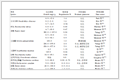
Initially, the model reaction of 3-iodochromone (1a) with NBE (2a) and ODCS (3) was conducted in the presence of Pd(OAc)2 (10 mol%), PPh3 (20 mol%) and Cs2CO3 (2.0 equiv.) in 2.0 mL of PhMe under an Ar atmosphere at 140 ℃ for 8 h, providing the target product 4a in 40% yield (Table 1, entry 1) (For details, see the supplementary material). After a careful screening of phosphine ligands, 48% yield of 4a could be obtained as P(4-CF3C6H4)3 was utilized in this annulation process (Table 1, entry 3). However, an electron-rich monodentate phosphine ligand—P(4-MeC6H4)3—led to relatively low yield (Table 1, entry 2), even bulky phosphine such as Xantphos or RuPhos were ineffective (Table 1, entries 4 and 5). Subsequently, the palladium sources were tested, and the isolated yield of 4a could be improved slightly when Pd(dppf)2Cl2•DCM was used (Table 1, entry 8). No better result could be obtained as PdCl2, Pd(TFA)2, and Pd(dba)2 were employed (Table 1, entries 6, 7 and 9). As the investigation proceeded, we became aware that the stoichiometric ratio of substrates might be essential for the outcome of desired product. The increase in the amount of 2a resulted in negative effect, while uplifted yield (60%) was obtained when 3.0 equiv. of 3 was utilized (Table 1, entries 10 and 11). Encouraged by these results, the solvent effect on the interrupted Catellani reaction was examined next, suggesting that PhF was the optimal solvent for this process, and adduct 4a could be isolated in 84% yield (Table 1, entry 13). Relative low yields of 4a were attained in o-xylene or PhCF3 (Table 1, entries 12 and 14), while DMF as the polar solvent performed ineffectively (Table 1, entry 15). Further investigation of the base revealed that K2CO3 also promoted the generation of 4a, but no better results were obtained with NaOAc or K3PO4 (Table 1, entries 17 and 18). Unfortunately, the yield was decreased under lower temperature (Table 1, entry 19).
|
Table 1 Optimization of reaction conditions.a |


Under the established reaction conditions obtained above, the generality of this protocol with respect to 3-iodochromones and bridged olefins was evaluated. As shown in Scheme 1, the C5 position of aromatic ring with -OMe, -F and -Cl were well tolerated, giving 4b−4d in 43%−60% yields. Different substituents at the C6 position, no matter what bearing electron-donating (-Me, -OMe, -iPr) or electron-withdrawing (-F, -Cl, -CN, -NO2, -CO2Me, -NHCOnPr) groups, were successfully applied to this reaction and produced the corresponding chromone-incorporated silaoxycarbocyclics 4e−4m in moderate to good yields. Similarly, substituents at the C7 and C8 positions of aromatic ring in 3-iodochromones, the (2 + 2 + 6) annulation with ODCS also proceed well, delivering the corresponding polysilacycles 4n−4s in 50%−74% yields. This three-component reactions can be extended to di-substituted 3-iodochromones, giving the corresponding products 4t−4w in up to 91% yield. At the same time, electron-neutral but sterically hindered moieties, such as 3-iodo-4H-benzo[h]chromen-4-one and 2-iodo-1H-benzo[f]chromen-1-one, were also suitable substrates for this annulation process, affording 4x in 77% yield and 4y in 62% yield, respectively. Compare with electron-donating substrates, relatively low isolated yields were obtained for strongly electron-withdrawing groups, which might be attributed to the unexpected deiodination of 3-iodochromones at high temperature. In addition, under the optimal reaction conditions, different kinds of bridged olefins were surveyed by this domino annulation. As depicted, the corresponding polysilacycles 4z−4af originated from bridged olefins 2b−2h were smoothly constructed in moderate yields.

|
Download:
|
| Scheme 1. Substrate scope of 3-iodochromones and bridged olefins. Reaction conditions: 1 (0.2 mmol), 2 (0.4 mmol), 3 (0.6 mmol), Pd(dppf)2Cl2∙DCM (10 mol%), P(4-CF3C6H4)3 (20 mol%), Cs2CO3 (0.4 mmol) in 2.0 mL of PhF under an Ar atmosphere at 140 ℃ for 8 h. Isolated yields based on 1 are given. | |

At the same time, commercially available iodoarenes was subjected to Pd-catalyzed (2 + 2 + 6) annulation reaction. As outlined in Scheme 2, this reaction exhibits good functional group compatibility, including electron-donating moiety (-OPh), electron-withdrawing moieties (-CN, -Ac, -CO2Me and pyridine), and electrically neutral benzene and naphthalene, giving the corresponding polysilacycles 6 in modest yields (32%−71%). In comparison, the yields of the reaction with iodoarenes were generally low, which is possibly attributable to the unexpected coupling reaction of aryl iodides with NBE as the major side products.

|
Download:
|
| Scheme 2. Substrate scope of aryl iodide. Reaction conditions: 5 (0.2 mmol), 2a (0.4 mmol), 3 (0.4 mmol), Pd(OAc)2 (10 mol%), PPh3 (20 mol%), Cs2CO3 (0.4 mmol) in 2.0 mL of PhMe under an Ar atmosphere at 100 ℃ for 8 h. Isolated yields based on 5 are given. | |

To show the synthetic value of current methodology, two gram-scale reactions were conducted (Scheme 3, see Supporting information for details). Under the standard conditions, 1.54 g of 4a with 76% isolated yield and 2.24 g of 4af with 82% isolated yield were obtained, respectively.

|
Download:
|
| Scheme 3. Gram-scale reactions. | |

Encouraged by the good functional group compatibility of this interrupted Catellani reaction, late-stage transformation of pharmaceuticals and natural products was carried out (Scheme 4). Aryl iodides derived from celecoxib and isoxepac were good substrates for this reaction, the desired products 7 and 8 were obtained in 44% yield and 37% yield, respectively. When 3-iodochromones 9 derived from estrone by successive O-acylation, Fries rearrangement, aldol reaction and electrophilic iodization/elimination process was subjected to the (2 + 2 + 6) annulation, regrettably, the adduct 10 was attained in only 52% yield, which might be attributed to the unexpected decomposed as monitored by thin layer chromatography analysis.

|
Download:
|
| Scheme 4. Late-stage modifications. a Performed the reactions on 0.2 mmol scale. b For the synthesis of compound 9, see the supplementary material. c The standard conditions. Isolated yields are given. | |

Finally, the practicality of this Pd-catalyzed three-components cascade protocol was investigated by the conversion of functional groups. As depicted in Scheme 5, the carbonyl directed C−H bond alkenylation of 4a under Rh-catalyzed conditions was conducted, and the reaction proceeded smoothly to deliver 11 in 46% yield. Delightfully, treatment of 4a with H2O2 under weak base conditions led to the formation of eleven-membered silacycles 12 in 65% yield. Moreover, 4z could be successfully transformed by olefin metathesis and epoxidation, affording 13 in 75% yield and 14 in 55% yield, respectively. When the reaction was carried out using 4z instead of NBE under the standard conditions, however, expected polymer was not obtained, and we detected that compound 4z was decomposed under current conditions.

|
Download:
|
| Scheme 5. Transformation of products. Reagents and conditions: (a) styrene, Rh2Cp2Cl2, AgSbF6, Cu(OAc)2, 1, 4-dioxane, 120 ℃, 5 h. (b) KHCO3, H2O2, MeOH/THF, 50 ℃, 2 d. (c) Grubbs Ⅱ catalyst, C2H4, CH2Cl2, r.t., 24 h. (d) Na2CO3, m-CPBA, CH2Cl2, r.t., 12 h. | |

Based on our previous works on the palladium-catalyzed reaction involved palladacycle intermediate [70−76] and related literatures [77, 78], a plausible mechanism for the model reaction was proposed in Scheme 6. Firstly, the oxidative addition of Pd(0) generated in situ from Pd(dppf)2Cl2•DCM to 3-iodochromone (1a) led to palladium(Ⅱ) complex A, which transformed into CNP intermediate C through migratory insertion of NBE (2a) followed by base promoted intramolecular ortho-C(sp2)−H activation. Subsequently, the second oxidative addition of intermediate C to ODCS (3) occurred to afford Pd(Ⅳ) species D, which gave eleven-membered palladacycle E via reductive elimination process. Finally, the second reductive elimination of Pd(Ⅱ) intermediate E yielded product 4a and regenerated Pd(0) species for the next catalytic cycle.

|
Download:
|
| Scheme 6. Possible reaction pathway (ligands are omitted for clarity). | |

In conclusion, we have developed an interrupted Catellani reaction involved a palladium-catalyzed (2 + 2 + 6) annulation of 3-iodochromones with bridged olefins and ODCS, providing a convenient and modular approach for the construction of chromone-incorporated polysilacycles. Additionally, current protocol can be extended to commercially available iodoarenes bearing either electron-donating or electron-withdrawing groups. This transformation provides a novel route to silaoxycarbocyclics that are inaccessible by traditional strategies. Notably, ODCS is a good electrophile, it could react smoothly with CNP intermediate by the second oxidative addition. Furthermore, the late-stage modification of pharmaceuticals and natural products, gram-scale experiments and transformations of functional groups of silaoxycarbocyclics show good practicality of current methodology. Further applications of the interrupted Catellani strategy for the forging molecular complexity and structural diversity are ongoing in our laboratory, and an asymmetric version of this reaction will be explored in the next work.
Declaration of competing interestThe authors declare that they have no known competing financial interests or personal relationships that could have appeared to influence the work reported in this paper
CRediT authorship contribution statementYu-Chen Fang: Writing – review & editing, Writing – original draft, Methodology, Formal analysis, Data curation. Jia-He Chen: Writing – review & editing. Mi-Zhuan Li: Writing – review & editing. Hui-Min Li: Writing – review & editing. Mei Bai: Writing – review & editing. Yong-Zheng Chen: Supervision, Resources. Zi-Wei Gao: Writing – review & editing, Supervision. Wen-Yong Han: Writing – review & editing, Supervision, Resources, Data curation.
AcknowledgmentsWe are grateful for financial support from the National Natural Science Foundation of China (Nos. 22261057 and 21901265), Guizhou Provincial Natural Science Foundation (No. QKHJC-2020–1Z072), the Science and Technology Department of Guizhou Province (Nos. QKHPTRC–CXTD[2022]012 and QKHPTRC-GCC[2023]003), Zunyi Medical University (No. 18ZY-002), Science and Technology Department of Zunyi (Nos. ZSKH-2018–3, ZSKHHZZ[2020]70, ZSKRPT-2020–5 and ZSKRPT-2021–5), and Fifth Batch of Talent Base in Guizhou Province (No. S-030–1).
Supplementary materialsSupplementary material associated with this article can be found, in the online version, at doi:10.1016/j.cclet.2024.110474.
| [1] |
W. Bains, R. Tacke, Curr. Opin. Drug Discov. Devel. 6 (2003) 526-543. |
| [2] |
P. Englebienne, A.V. Hoonacker, C.V. Herst, Design. Drug Des. Rev.−Online 2 (2005) 467-483. DOI:10.2174/1567269054867031 |
| [3] |
A.K. Franz, S.O. Wilson, J. Med. Chem. 56 (2013) 388-405. DOI:10.1021/jm3010114 |
| [4] |
R. Ramesh, D.S. Reddy, J. Med. Chem. 61 (2018) 3779-3798. DOI:10.1021/acs.jmedchem.7b00718 |
| [5] |
O.A. Gapurenko, R.M. Minyaev, V.I. Minkin, Nonclassical OrganosiliconCompounds, In Organosilicon Compounds; V.Y. Lee (Ed.), Elsevier, 2017, Vol. 1, pp 3–24.
|
| [6] |
P. Xiao, L. Gao, Z. Song, Chem. Eur. J. 25 (2019) 2407-2422. DOI:10.1002/chem.201803803 |
| [7] |
X. Zhang, J. Fang, C. Cai, et al., Chin. Chem. Lett. 32 (2021) 1280-1292. |
| [8] |
X. Zhang, J. Fang, C. Cai, et al., Chin. Chem. Lett. 32 (2021) 1280-1292. |
| [9] |
J. Gao, C. He, Chem. Eur. J. 29 (2023) e202203475. |
| [10] |
L. Li, W.S. Huang, Z. Xu, et al., Sci. China Chem. 66 (2023) 1654-1687. DOI:10.1007/s11426-022-1480-y |
| [11] |
I.F. Yu, J.W. Wilson, J.F. Hartwig, Chem. Rev. 123 (2023) 11619-11663. DOI:10.1021/acs.chemrev.3c00207 |
| [12] |
J. Gao, Y. Ge, C. He, Chem. Soc. Rev. 53 (2024) 4648-4673. DOI:10.1039/d3cs00893b |
| [13] |
M. Geyer, E. Wellner, U. Jurva, et al., ChemMedChem 10 (2015) 911-924. DOI:10.1002/cmdc.201500040 |
| [14] |
K. Igawa, D. Yoshihiro, Y. Abe, et al., Angew. Chem. Int. Ed. 55 (2016) 5814-5818. DOI:10.1002/anie.201511728 |
| [15] |
E. Rémond, C. Martin, J. Martinez, et al., Chem. Rev. 116 (2016) 11654-11684. DOI:10.1021/acs.chemrev.6b00122 |
| [16] |
B. Liu, K. Gai, H. Qin, et al., J. Med. Chem. 63 (2020) 5312-5323. DOI:10.1021/acs.jmedchem.0c00082 |
| [17] |
Y. Fan, J. Jing, R.Q. Tong, et al., Org. Lett. 25 (2023) 455-460. DOI:10.1021/acs.orglett.2c03698 |
| [18] |
L.L. Anderson, K.A. Woerpel, Org. Lett. 11 (2009) 425-428. DOI:10.1021/ol802412b |
| [19] |
K.M. Buchner, K.A. Woerpel, Organometallics 29 (2010) 1661-1669. DOI:10.1021/om901042j |
| [20] |
M. Devillard, N. Nour Eddine, M. Cordier, et al., Angew. Chem. Int. Ed. 60 (2021) 12356-12359. DOI:10.1002/anie.202102540 |
| [21] |
L. Zhang, K. An, Y. Wang, et al., J. Am. Chem. Soc. 143 (2021) 3571-3582. DOI:10.1021/jacs.0c13335 |
| [22] |
Y. Xu, W. Xu, X. Chen, et al., Chem. Sci. 12 (2021) 11756-11761. DOI:10.1039/d1sc03487a |
| [23] |
B. Shen, D. Pan, W. Xie, et al., Angew. Chem. Int. Ed. 63 (2024) e202315230. DOI:10.1002/anie.202315230 |
| [24] |
X.B. Wang, Z.J. Zheng, J.L. Xie, et al., Angew. Chem. Int. Ed. 59 (2020) 790-797. DOI:10.1002/anie.201913060 |
| [25] |
X.C. Wang, B. Li, C.W. Ju, et al., Nat. Commun. 13 (2022) 3392. DOI:10.1038/s41467-022-31006-y |
| [26] |
H. Chen, J. Peng, Q. Pang, et al., Angew. Chem. Int. Ed. 61 (2022) e202212889. |
| [27] |
Y. Sun, K. Zhou, C. Ma, et al., Green Synth. Catal. 5 (2023) 205-210. DOI:10.1109/prml59573.2023.10348300 |
| [28] |
W.T. Zhao, F. Gao, D. Zhao, Angew. Chem. Int. Ed. 57 (2018) 6329-6332. DOI:10.1002/anie.201803156 |
| [29] |
Y. Qin, L. Li, J.Y. Liang, et al., Chem. Sci. 12 (2021) 14224-14229. DOI:10.1039/d1sc04180k |
| [30] |
J. Zhang, D. Pan, H.X. Zhang, et al., CCS Chem. 5 (2023) 1753-1762. DOI:10.31635/ccschem.023.202302938 |
| [31] |
M.H. Zhu, X.W. Zhang, M. Usman, et al., ACS Catal. 11 (2021) 5703-5708. DOI:10.1021/acscatal.1c00975 |
| [32] |
M. Liu, N. Yan, H. Tian, Angew. Chem. Int. Ed. 63 (2024) e202319187. DOI:10.1002/anie.202319187 |
| [33] |
Y. Qin, J.L. Han, C.W. Ju, et al., Angew. Chem. Int. Ed. 59 (2020) 8481-8485. DOI:10.1002/anie.202001539 |
| [34] |
J. Zhang, N. Yan, C.W. Ju, et al., Angew. Chem. Int. Ed. 60 (2021) 25723-25728. DOI:10.1002/anie.202111025 |
| [35] |
K.L. Yin, S. Zhao, Y. Qin, et al., ACS Catal. 12 (2022) 13999-14005. DOI:10.1021/acscatal.2c04441 |
| [36] |
D. Mu, W. Yuan, S. Chen, et al., J. Am. Chem. Soc. 142 (2020) 13459-13468. DOI:10.1021/jacs.0c04863 |
| [37] |
H. Zhang, D. Zhao, ACS Catal. 11 (2021) 10748-10753. DOI:10.1021/acscatal.1c03112 |
| [38] |
Y. Shi, X. Shi, J. Zhang, et al., Nat. Commun. 13 (2022) 6697. DOI:10.1038/s41467-022-34466-4 |
| [39] |
Q. Zhang, B.F. Shi, Chem. Sci. 12 (2021) 841-852. DOI:10.1039/d0sc05944g |
| [40] |
J.W. Wilson, B. Su, M. Yoritate, et al., J. Am. Chem. Soc. 145 (2023) 19490-19495. DOI:10.1021/jacs.3c03127 |
| [41] |
F.H. Gou, F. Ren, Y. Wu, et al., Angew. Chem. Int. Ed. 63 (2024) e202404732. DOI:10.1002/anie.202404732 |
| [42] |
J. Xian, X. Sheng, Y. Lin, et al., Adv. Synth. Catal. 366 (2024) 1763-1769. DOI:10.1002/adsc.202400028 |
| [43] |
Q. Li, M. Driess, J.F. Hartwig, Angew. Chem. Int. Ed. 53 (2014) 8471-8474. DOI:10.1002/anie.201404620 |
| [44] |
J.F. Hartwig, E.A. Romero, Tetrahedron 75 (2019) 4059-4070. DOI:10.1016/j.tet.2019.05.055 |
| [45] |
Q.C. Mu, J. Chen, C.G. Xia, et al., Coordin. Chem. Rev. 374 (2018) 93-113. |
| [46] |
B. Li, P.H. Dixneuf, Chem. Soc. Rev. 50 (2021) 5062-5085. DOI:10.1039/d0cs01392g |
| [47] |
W. Wang, L. Gao, Z. Song, Synthesis 54 (2022) 2749-2764. |
| [48] |
F. Chen, L. Liu, W. Zeng, Front. Chem. 11 (2023) 1200494. DOI:10.3389/fchem.2023.1200494 |
| [49] |
M. Cypryk, J. Chojnowski, J. Kurjata, Tertiary silyloxonium ions in the ring-opening polymerization (ROP) of cyclosiloxanes: cationic ROP of octamethyltetrasila-1, 4-dioxane in: S.J. Clarson, J.J. Fitzgerald, M.J. Owen, S.S. Smith, M.E. Van Dyke (Eds.), Science and Technology of Silicones and Silicone-Modified Materials; American Chemical Society, Washington, 2007, Vol. 964, pp 10–26.
|
| [50] |
D. Wang, M. Li, X. Chen, et al., Angew. Chem. Int. Ed. 60 (2021) 7066-7071. DOI:10.1002/anie.202015117 |
| [51] |
Y. Xu, M. Sun, W. Xu, et al., J. Am. Chem. Soc. 145 (2023) 15303-15312. DOI:10.1021/jacs.3c02875 |
| [52] |
M. Catellani, E. Motti, N. Della Ca', Acc. Chem. Res. 41 (2008) 1512-1522. DOI:10.1021/ar800040u |
| [53] |
J. Ye, M. Lautens, Nat. Chem. 7 (2015) 863-870. DOI:10.1038/nchem.2372 |
| [54] |
N. Della Ca', M. Fontana, E. Motti, et al., Acc. Chem. Res. 49 (2016) 1389-1400. DOI:10.1021/acs.accounts.6b00165 |
| [55] |
K. Zhao, L. Ding, Z. Gu, Synlett 29 (2018) 129-140. |
| [56] |
J. Wang, G. Dong, Chem. Rev. 119 (2019) 7478-7528. DOI:10.1021/acs.chemrev.9b00079 |
| [57] |
J. Ye, M. Lautens, C−H Functionalization of Arenes Under Palladium/Norbornene Catalysis. In Remote C−H Bond Functionalizations: Methods and Strategies in Organic Synthesis; D. Maiti, S. Guin (Eds.), Wiley-VCH, Weinheim, Germany, 2021, pp 59–114.
|
| [58] |
A.J. Rago, G. Dong, Green Synth, Catal. 2 (2021) 216-227. |
| [59] |
Y. Zhang, Acc. Chem. Res. 55 (2022) 3507-3518. DOI:10.1021/acs.accounts.2c00627 |
| [60] |
Y. Ma, Q. Gao, L. Zhou, et al., Chin. J. Chem. 40 (2022) 675-680. DOI:10.1002/cjoc.202100693 |
| [61] |
H.G. Cheng, S. Jia, Q. Zhou, Acc. Chem. Res. 56 (2023) 573-591. DOI:10.1021/acs.accounts.2c00781 |
| [62] |
K.M. Gericke, D.I. Chai, N. Bieler, et al., Angew. Chem. Int. Ed. 48 (2009) 1447-1451. DOI:10.1002/anie.200805512 |
| [63] |
H. Liu, M. El-Salfiti, D.I. Chai, et al., Org. Lett. 14 (2012) 3648-3651. DOI:10.1021/ol301495q |
| [64] |
H. Zheng, Y. Zhu, Y. Shi, Angew. Chem. Int. Ed. 53 (2014) 11280-11284. DOI:10.1002/anie.201405365 |
| [65] |
L. Fan, J. Liu, L. Bai, et al., Angew. Chem. Int. Ed. 56 (2017) 14257-14261. DOI:10.1002/anie.201708310 |
| [66] |
T.T. Hao, H.R. Liang, Y.H. Ou-Yang, et al., J. Org. Chem. 83 (2018) 4441-4454. DOI:10.1021/acs.joc.8b00150 |
| [67] |
A. Gaspar, M.J. Matos, J. Garrido, et al., Chem. Rev. 114 (2014) 4960-4992. DOI:10.1021/cr400265z |
| [68] |
J. Reis, A. Gaspar, N. Milhazes, et al., J. Med. Chem. 60 (2017) 7941-7957. DOI:10.1021/acs.jmedchem.6b01720 |
| [69] |
S. Tian, T. Luo, Y. Zhu, et al., Chin. Chem. Lett. 31 (2020) 3073-3082. |
| [70] |
S.Y. Yang, W.Y. Han, C. He, et al., Org. Lett. 21 (2019) 8857-8860. DOI:10.1021/acs.orglett.9b03565 |
| [71] |
M.Z. Li, Q. Tong, W.Y. Han, et al., Org. Biomol. Chem. 18 (2020) 1112-1116. DOI:10.1039/c9ob02690h |
| [72] |
C. He, W.Y. Han, B.D. Cui, et al., Adv. Synth. Catal. 362 (2020) 3655-3661. DOI:10.1002/adsc.202000488 |
| [73] |
W.Q. Zhu, Y.C. Fang, W.Y. Han, et al., Org. Chem. Front. 8 (2021) 3082-3090. DOI:10.1039/d1qo00222h |
| [74] |
W.Q. Zhu, Z.W. Zhang, W.Y. Han, et al., Org. Chem. Front. 8 (2021) 3413-3420. DOI:10.1039/d1qo00458a |
| [75] |
F. Li, H.M. Li, R.F. Xiu, et al., Org. Lett. 24 (2022) 9392-9397. DOI:10.1021/acs.orglett.2c03713 |
| [76] |
Y.C. Fang, J.H. Chen, R.F. Xiu, et al., Org. Chem. Front. 10 (2023) 3752-3759. DOI:10.1039/d3qo00764b |
| [77] |
D. Wang, L. Désaubry, G. Li, et al., Adv. Synth. Catal. 363 (2021) 1-6. |
| [78] |
J. Tang, Z. Yang, Y. Song, et al., Mol. Catal. 524 (2022) 112320. |