 2025, Vol. 36


b School of Chemistry and Chemical Engineering, Qufu Normal University, Qufu 273165, China;
c Green Pharmaceutical Technology Key Laboratory of Luzhou City, School of Pharmacy, Southwest Medical University, Luzhou 646000, China
Proton-coupled electron transfer (PCET) has exhibited important application in development of novel radical-mediated reactions, which is also frequently existed in a variety of biological redox processes [1-4]. Diazo compounds as the highly valuable building blocks have been widely utilized in various important synthetic transformations [5-8]. In contrast with the well-known metal carbene precursors [9,10] or photolysis for the formation of free carbene species [11-18], the generation of carbon-centered radicals from diazo compounds through the proton-coupled electron transfer (PCET) process has been rarely explored. Since Qiu and Doyle reported the first example of photocatalytic hydroalkylation of alkenes with diazo compounds [19], visible-light-promoted radical reaction of diazo compounds through PCET process has increasingly attracted attention of chemists [20-30]. Recently, several [Ru] or [Ir] photoredox catalyzed three-component difunctionalizations of alkenes have been successfully developed for the construction of ester-containing compounds through radical transformation of diazo compounds, in which Hantzsch ester, acids, alcohols, or diarylamines were generally employed as the hydrogen donor for the formation of carbon radical intermediates from diazo compounds (Scheme 1a) [19,29-31]. Water is a non-toxic, easy-to-handle, and abundant natural resource, which has been recognized as a sustainable hydrogen source for organic reactions such as the quenching of organometallic reagents and transfer hydrogenation of unsaturated organic compounds [32,33]. Despite some advance, the development of metal-free photocatalytic multi-component radical reactions using cheap and environmentally-benign water as the hydrogen source for the assembly of diverse ester-containing compounds remains challenging and highly desirable.

|
Download:
|
| Scheme 1. Photocatalytic multi-component difunctionalizations of alkenes with diazo compounds through PCET process. | |
Quinoxalin-2(1H)-one structural scaffold is widely existed in a variety of biologically and pharmaceutically relevant molecules, which exhibited diverse important interesting biological activities including antiviral, anticancer, antiplasmodial, antihistaminic and antibacterial properties [34-38]. Therefore, numerous efforts have been devoted for the construction of diverse substituted quinoxalin-2(1H)-ones [39-68]. With our continued interests in metal-free reactions and the synthesis of functionalized quinoxalin-2(1H)-ones [69-71], herein, we wish to describe a new visible-light-driven 4CzIPN catalyzed multi-component reaction of alkenes, quinoxalin-2(1H)-ones, and diazo compounds to construct ester-containing quinoxalin-2(1H)-ones at room temperature (Scheme 1b). This tandem reaction of diazo compounds underwent smoothly under mild conditions through photocatalytic PCET process using water as the hydrogen donor.
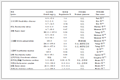
Initially, the reaction of 1-methylquinoxalin-2(1H)-one (1a), styrene (2a), and ethyl diazoacetate (3a) was carried out to optimize the reaction conditions in the presence of water with the irradiation of 3 W blue LED lamps (445–465 nm). Gratifyingly, the desired ester-containing quinoxalin-2(1H)-one 4aa was obtained in 34% yield when the reaction was conducted using 1,2,3,5-tetrakis(carbazol-9-yl)-4,6-dicyanobenzene (4CzIPN, 2 mol%) as photocatalyst in the presence of DIPEA in CH3CN (Table 1, entry 1). Encouraged by this result, the influence of the base was firstly investigated. The screening of other bases such as DABCO, DBU, Cs2CO3, KOH, and K3PO4 disclosed that DBU could give product 4aa in relatively higher yield (Table 1, entry 3). Then, a series of photocatalysts were examined to improve the reaction efficiency and the result showed that 4CzIPN was still the best photocatalyst (Table 1, entries 7–14). Next, the solvent effect was tested to improve the reaction efficiency. Among various solvents such as CH2Cl2, THF, 1,4-dioxane, EtOAc, DCE, acetone, DMF, DME, MeOH, DMSO, EtOH and H2O examined, CH2Cl2 was found to be the best reaction medium to afford product 4aa in 63% yield (Table 1, entry 15, and details in Supporting information). No transformation was observed without visible-light irradiation (Table 1, entry 16). Further investigation of reaction condition was performed under the irradiation of other blue LED lamps with different wavelength ranges (Table 1, entries 17–20). The results demonstrated 10 W blue LED lamps (450–455 nm) was the optimal light source to give the product 4aa in 70% yield (Table 1, entry 20). The optimization of the loading of photocatalyst found that the highest yield of 4aa (77%) was obtained when 1 mol% 4CzIPN was employed in this reaction (Table 1, entry 22). The desired product 4aa was not detected in the absence of photocatalyst (Table 1, entry 23). Finally, when the model reaction was conducted in air, the desired product could also be obtained in 61% yield (Table 1, entry 24).
|
Table 1 Screening of the reaction conditions.a |


With the optimal conditions in hand, we subsequently evaluated the reactivities of various alkenes under the optimized reaction conditions. As shown in Scheme 2, a series of substituted aromatic alkenes including electron-donating groups and electron-deficient groups reacted smoothly to provide the corresponding products (4ab-4am) in moderate to good yields. The reaction efficiency was obviously affected by steric hindrance. In comparison with para- and meta-methyl substituted styrenes, ortho-methyl substituted styrene exhibited a relatively lower reaction efficiency leading to the desired product (4ad) in 55% yield. Halides with fluoro, bromo, chloro and trifluoromethyl substituents on the benzene ring of aromatic alkenes were well compatible with the reaction conditions, resulting in the desired products (4ag-4al) in 63%–79% yields. Reaction with 2-vinylnaphthalene underwent smoothly to afford the product (4an) in 60% yield. Notably, aliphatic alkene such as allylbenzene also readily participated in this reaction, affording the corresponding γ-ester-containing quinoxalin-2(1H)-one (4ao) in 74% yield. Only a trace amount of products were detected when 1-vinylnaphthalene and 2-vinylthiophene were investigated. Unfortunately, none of the desired product (4ar) was observed when internal alkene such as (E)-prop-1-enylbenzene was employed in this reaction.

|
Download:
|
| Scheme 2. Substrate scope of alkenes. Reaction condition: 1a (0.1 mmol), 2 (0.2 mmol), 3a (0.3 mmol), H2O (0.5 mmol), 4CzIPN (1 mol%), DBU (0.1 mmol), DCM (2 mL), 10 W blue LED lamps (450–455 nm), r.t., N2, 24 h. Isolated yields based on 1a. | |

The scope of various quinoxalin-2(1H)-ones and diazo compounds was further examined (Scheme 3). In addition to N-methyl group, quinoxalin-2(1H)-ones containing other N-protecting groups such as N-ethyl, N-esteryl, and N-cyanomethyl groups could also be well-tolerated in this reaction conditions, providing the desired products (4ba-4da) in 60%–70% yields. It should be noted that N-free quinoxalin-2(1H)-one could also be employed to deliver the desired product (4ea) in 51% yield. It can be seen that quinoxalin-2(1H)-ones bearing both electron-rich and electron-withdrawing substituents at the aromatic ring can work smoothly under the standard conditions to provide products (4fa-4ka) in moderate to good yields. As expected, in addition to ethyl diazoacetate, other diazo compounds such as tert-butyl diazo acetate and dimethyl diazomalonate all worked well to give the corresponding products (4la and 4ma) in 85% and 71% yields, respectively. In addition, 2-diazo-1-phenylethanone was also suitable substrate, affording the desired product (4na) in 56% yield.

|
Download:
|
| Scheme 3. Substrate scope of quinoxalin-2(1H)-ones and diazo compounds. Reaction condition: 1 (0.1 mmol), 2a (0.2 mmol), 3 (0.3 mmol), H2O (0.5 mmol), 4CzIPN (1 mol%), DBU (0.1 mmol), DCM (2 mL), 10 W blue LED lamps (450–455 nm), r.t., N2, 24 h. Isolated yields based on 1. | |

In order to investigate the possible reaction mechanism, some control experiments were performed. First, the model reaction was obviously inhibited when a radical scavenger BHT (2,6-di-tert-butyl-4-methylphenol) was added into reaction system, and BHT-trapped complex A and B were observed by LC-MS (Scheme 4a). This result suggested that this multi-component reaction might undergo a radical process. Subsequently, the hydrogen atom source of α-position of ester was investigated by deuterium experiment using D2O (Scheme 4b). The deuterated product with 98%D at α-position of ester was observed, which indicated that water was used as hydrogen donor in this reaction.

|
Download:
|
| Scheme 4. Control experiments. | |

Moreover, fluorescence quenching phenomenon between excited 4CzIPN and quinoxalin-2(1H)-one was observed in the presence of visible-light irradiation (Fig. 1, Fig. 2), suggesting that photocatalytic electron transfer process might exist between quinoxalin-2(1H)-one and excited photocatalyst.

|
Download:
|
| Fig. Scheme 1. Quenching of 4CzIPN fluorescence emission in the presence of 1a. | |


|
Download:
|
| Fig. 2. Stern–Volmer plots. | |

On the basis of the above experimental results and previous reports [29-31, 70-72], a possible mechanism was proposed as presented in Scheme 5. Firstly, photocatalyst 4CzIPN was converted into its corresponding excited state 4CzIPN* under irradiation of visible light. Subsequently, the interaction of excited state of 4CzIPN* with quinoxalin-2(1H)-one 1a afforded nitrogen radical cation 5a and 4CzIPN•−. Then, the formed 4CzIPN•− underwent a single electron transfer to ethyl diazoacetate 3a giving 4CzIPN to accomplish the catalytic cycle. Meanwhile, ethyl diazoacetate 3a would undergo PCET process to produce a carbon-centered radical 6a through the sequential release of nitrogen and protonation by water. Next, the addition of carbon-centered radical 6a to alkene 2a would lead to the formation of radical intermediate 7a. Finally, the interaction of radical cation 5a and alkyl radical 7a provided a nitrogen cation intermediate 8a, which was deprotonated by DBU to afford the desired product 4aa.

|
Download:
|
| Scheme 5. Possible reaction pathway. | |

In summary, we have successfully developed a new visible-light-driven multi-component reaction of alkenes, quinoxalin-2(1H)-ones, and diazo compounds for the synthesis of ester-containing quinoxalin-2(1H)-ones at room temperature. This photocatalytic tandem reaction, which utilizes 4CzIPN as metal-free photocatalyst and water as the hydrogen donor, provides a convenient approach to construct a series of ester-containing quinoxalin-2(1H)-ones under mild conditions. Preliminary mechanistic studies indicated that a photoinduced proton-coupled electron transfer (PCET) process of diazo compounds was involved in this multi-component reaction. This methodology will enrich diazo chemistry through radical intermediates in organic synthesis.
Declaration of competing interestThe authors declare that they have no known competing financial interests or personal relationships that could have appeared to influence the work reported in this paper.
CRediT authorship contribution statementQiang Feng: Writing – original draft, Resources, Funding acquisition, Formal analysis, Data curation, Conceptualization. Jindong Hao: Methodology, Investigation. Ya Hu: Investigation, Formal analysis, Data curation. Rong Fu: Investigation, Formal analysis, Data curation. Wei Wei: Writing – review & editing, Validation, Supervision, Funding acquisition, Formal analysis, Conceptualization. Dong Yi: Writing – review & editing, Supervision, Methodology, Funding acquisition, Conceptualization.
AcknowledgmentsThis work was supported by Sichuan Science and Technology Program (No. 2023NSFSC0101), the 2024 Provincial platform project of Chengdu Normal University (No. GNFZ202404), Natural Science Foundation of Shandong Province (No. ZR2021MB065), and National Natural Science Foundation of China (No. 22101237).
Supplementary materialsSupplementary material associated with this article can be found, in the online version, at doi:10.1016/j.cclet.2024.110582.
| [1] |
R.I. Cukier, D.G. Nocera, Annu. Rev. Phys. Chem. 49 (1998) 337-369. DOI:10.1146/annurev.physchem.49.1.337 |
| [2] |
M.H.V. Huynh, T.J. Meyer, Chem. Rev. 107 (2007) 5004-5064. DOI:10.1021/cr0500030 |
| [3] |
E.C. Gentry, R.R. Knowles, Acc. Chem. Res. 49 (2016) 1546-1556. DOI:10.1021/acs.accounts.6b00272 |
| [4] |
S.J. Mora, E. Odella, G.F. Moore, et al., Acc. Chem. Res. 51 (2018) 445-453. DOI:10.1021/acs.accounts.7b00491 |
| [5] |
K.A. Mix, M.R. Aronoff, R.T. Raines, ACS Chem. Biol. 11 (2016) 3233-3244. DOI:10.1021/acschembio.6b00810 |
| [6] |
Q. Cheng, Y. Deng, M. Lankelma, M.P. Doyle, Chem. Soc. Rev. 46 (2017) 5425-5443. DOI:10.1039/C7CS00324B |
| [7] |
Y. Xia, D. Qiu, J. Wang, Angew. Chem. Int. Ed. 59 (2020) 12282-12292. DOI:10.1002/anie.202003081 |
| [8] |
Y. Xia, D. Qiu, J. Wang, Chem. Rev. 117 (2017) 13810-13889. DOI:10.1021/acs.chemrev.7b00382 |
| [9] |
J. Jiang, J. Liu, L. Yang, et al., Chem. Commun. 51 (2015) 14728-14731. DOI:10.1039/C5CC05183E |
| [10] |
Y. He, Z. Huang, K. Wu, et al., Chem. Soc. Rev. 51 (2022) 2759-2852. DOI:10.1039/d1cs00895a |
| [11] |
Z. Zhang, V. Gevorgyan, Chem. Rev. 124 (2024) 7214-7261. DOI:10.1021/acs.chemrev.3c00869 |
| [12] |
B.G. Cai, J. Xuan, Chin. J. Org. Chem. 41 (2021) 4565-4574. DOI:10.6023/cjoc202109040 |
| [13] |
Z. Yang, M.L. Stivanin, I.D. Jurberg, R.M. Koenigs, Chem. Soc. Rev. 49 (2020) 6833-6847. DOI:10.1039/d0cs00224k |
| [14] |
J. Durka, J. Turkowska, D. Gryko, ACS Sustain. Chem. Eng. 9 (2021) 8895-8918. DOI:10.1021/acssuschemeng.1c01976 |
| [15] |
R. Liu, S. Fu, X. Chu, et al., Chin. J. Org. Chem. 42 (2022) 2462-2470. DOI:10.6023/cjoc202204014 |
| [16] |
Z.L. Chen, Y. Xie, J. Xuan, Eur. J. Org. Chem. 2022 (2022) e202201066. DOI:10.1002/ejoc.202201066 |
| [17] |
Y. Lv, H. Ding, J. You, et al., Chin. Chem. Lett. 35 (2024) 109107. DOI:10.1016/j.cclet.2023.109107 |
| [18] |
Z. Wang, N. Meng, Y. Lv, et al., Chin. Chem. Lett. 34 (2023) 107599. DOI:10.1016/j.cclet.2022.06.022 |
| [19] |
Y.L. Su, G.X. Liu, J.W. Liu, et al., J. Am. Chem. Soc. 142 (2020) 13846-13855. DOI:10.1021/jacs.0c05183 |
| [20] |
P. Li, R. Chang, F. Guan, et al., J. Org. Chem. 88 (2023) 8703-8708. DOI:10.1021/acs.joc.3c00574 |
| [21] |
S. Li, L. Zhou, Chin. J. Org. Chem. 42 (2022) 3944-3958. DOI:10.6023/cjoc202206058 |
| [22] |
Y. Xie, J. Xuan, Chin. J. Org. Chem. 42 (2022) 4247-4256. DOI:10.6023/cjoc202207016 |
| [23] |
C. Empel, C. Pei, R.M. Koenigs, Chem. Commun. 58 (2022) 2788-2798. DOI:10.1039/d1cc06521a |
| [24] |
Y. Xie, Y.P. Bao, X.Y. Zhuo, J. Xuan, Org. Lett. 26 (2024) 1393-1398. DOI:10.1021/acs.orglett.3c04331 |
| [25] |
W. Xu, Z. Zheng, G. Bao, et al., Org. Lett. 25 (2023) 4050-4055. DOI:10.1021/acs.orglett.3c01213 |
| [26] |
H.B. Ye, X.Y. Zhou, L. Li, X.K. He, J. Xuan, Org. Lett. 24 (2022) 6018-6023. DOI:10.1021/acs.orglett.2c02313 |
| [27] |
Y.L. Su, G.X. Liu, L. De Angelis, et al., ACS Catal. 12 (2022) 1357-1363. DOI:10.1021/acscatal.1c05611 |
| [28] |
G.X. Liu, H.C. Liang, X. Fu, et al., Org. Lett. 24 (2022) 4908-4913. DOI:10.1021/acs.orglett.2c01751 |
| [29] |
N. Ma, L. Guo, D. Qi, et al., Org. Lett. 23 (2021) 6278-6282. DOI:10.1021/acs.orglett.1c02071 |
| [30] |
B. Zhang, J.Q. Qi, Y. Liu, Z. Li, J. Wang, Org. Lett. 24 (2022) 279-283. DOI:10.1021/acs.orglett.1c03941 |
| [31] |
Y. Liu, K. Zhu, J. Zhao, P. Li, Org. Lett. 24 (2022) 6834-6838. DOI:10.1021/acs.orglett.2c02749 |
| [32] |
W.T. Ouyang, F. Xiao, L.J. Ou, W.M. He, Curr. Opin. Green Sustain. 40 (2023) 100760. DOI:10.1016/j.cogsc.2023.100760 |
| [33] |
S. Han, L. Zhao, X. Zhou, et al., Org. Chem. Front. 11 (2024) 6064-6068. DOI:10.1039/d4qo01081g |
| [34] |
X.Y. Qin, X. Hao, H. Han, et al., J. Med. Chem. 58 (2015) 1254-1267. DOI:10.1021/jm501484b |
| [35] |
M.I. Shahin, D.A. Abou El Ella, N.S.M. Ismailand, K.A.M. Abouzid, Bioorg. Chem. 56 (2014) 16-26. DOI:10.1016/j.bioorg.2014.05.010 |
| [36] |
S.A. Galal, S.H.M. Khairat, F.A.F. Ragab, et al., Eur. J. Med. Chem. 86 (2014) 122-132. DOI:10.1016/j.ejmech.2014.08.048 |
| [37] |
N. Udilova, A.V. Kozlov, W. Bieberschulte, et al., Biochem. Pharmacol. 65 (2003) 59-65. DOI:10.1016/S0006-2952(02)01452-1 |
| [38] |
H. Nohl, W. Bieberschulte, B. Dietrich, N. Udilova, A.V. Kozlov, J. Heterocycl. Chem. 43 (2006) 541-548. DOI:10.1002/jhet.5570430304 |
| [39] |
X.K. He, J. Lu, A.J. Zhang, et al., Org. Lett. 22 (2020) 5984-5989. DOI:10.1021/acs.orglett.0c02080 |
| [40] |
W.T. Ouyang, H.T. Ji, J. Jiang, et al., Chem. Commun. 59 (2023) 14029-14032. DOI:10.1039/d3cc04020h |
| [41] |
L.Y. Xie, S. Peng, T.G. Fan, et al., Sci. China Chem. 62 (2019) 460-464. DOI:10.1007/s11426-018-9446-1 |
| [42] |
Q. Yan, W. Cui, J. Li, et al., Org. Chem. Front. 9 (2022) 2653-2658. DOI:10.1039/d1qo01910d |
| [43] |
H.F. Liu, M.X. He, H.T. Tang, Org. Chem. Front. 9 (2022) 5955-5961. DOI:10.1039/d2qo01281b |
| [44] |
L.Y. Xie, L.L. Jiang, J.X. Tan, et al., ACS Sustain. Chem. Eng. 7 (2019) 14153-14160. DOI:10.1021/acssuschemeng.9b02822 |
| [45] |
C.P. Yuan, Z.Z. Xie, Y. Zheng, et al., Chem. Commun. 59 (2023) 10125-10128. DOI:10.1039/d3cc02744a |
| [46] |
L. Wang, P. Bao, W. Liu, et al., Chin. J. Org. Chem. 38 (2018) 3189-3196. DOI:10.6023/cjoc201807014 |
| [47] |
Y. Lv, H. Cui, N. Meng, et al., Chin. Chem. Lett. 33 (2022) 97-114. DOI:10.1117/12.2642676 |
| [48] |
X. Chen, L. Song, J. Pan, et al., Chin. Chem. Lett. 35 (2024) 110112. DOI:10.1016/j.cclet.2024.110112 |
| [49] |
J. Li, C. Chen, X. Li, et al., Chin. Chem. Lett. 35 (2024) 109732. DOI:10.1016/j.cclet.2024.109732 |
| [50] |
M. Zhang, G. Nan, X. Zhao, W. Wei, Chin. J. Org. Chem. 42 (2022) 4315-4322. DOI:10.6023/cjoc202209013 |
| [51] |
Y.H. Lu, Z.T. Zhang, H.Y. Wu, et al., Chin. Chem. Lett. 34 (2023) 108036. DOI:10.1016/j.cclet.2022.108036 |
| [52] |
L.Y. Xie, Y.S. Liu, H.R. Ding, et al., Chin. J. Catal. 41 (2020) 1168-1173. DOI:10.1016/S1872-2067(19)63526-6 |
| [53] |
H.Y. Song, J. Jiang, C. Wu, et al., Green Chem. 25 (2023) 3292-3296. DOI:10.1039/d2gc04843d |
| [54] |
H.Y. Song, Z.T. Zhang, H.Y. Tan, et al., Asian J. Org. Chem. 12 (2023) e202200658. DOI:10.1002/ajoc.202200658 |
| [55] |
K. Sun, F. Xiao, B. Yu, W.M. He, Chin. J. Catal. 42 (2021) 1921-1943. DOI:10.1016/S1872-2067(21)63850-0 |
| [56] |
C. Ma, H. Meng, J. Li, et al., Chin. J. Chem. 40 (2022) 2655-2662. DOI:10.1002/cjoc.202200386 |
| [57] |
K.L. Wang, H.T. Ji, L.J. Ou, W.M. He, Eur. J. Org. Chem. 26 (2023) e202300752. |
| [58] |
Q. Yang, B. Wang, M. Wu, Y.Z. Lei, Molecules 28 (2023) 2513. DOI:10.3390/molecules28062513 |
| [59] |
F. Xiang, D. Wang, K. Xu, C.C. Zeng, Org. Lett. 26 (2024) 411-415. DOI:10.1021/acs.orglett.3c04124 |
| [60] |
N. Meng, L. Wang, Q. Liu, et al., J. Org. Chem. 85 (2020) 6888-6896. DOI:10.1021/acs.joc.9b03505 |
| [61] |
C.H. Ma, Y. Ji, J. Zhao, et al., Chin. J. Catal. 43 (2022) 571-583. DOI:10.1016/S1872-2067(21)63917-7 |
| [62] |
W.T. Ouyang, J. Jiang, Y.F. Jiang, et al., Chin. Chem. Lett. 35 (2024) 110038. DOI:10.1016/j.cclet.2024.110038 |
| [63] |
L. Yao, D. Zhua, L. Wang, et al., Chin. Chem. Lett. 32 (2021) 4033-4037. DOI:10.1016/j.cclet.2021.06.005 |
| [64] |
R. Gao, F. Wang, X. Geng, et al., Org. Lett. 24 (2022) 7118-7122. DOI:10.1021/acs.orglett.2c02703 |
| [65] |
W.B. He, S.J. Zhao, J.Y. Chen, et al., Chin. Chem. Lett. 34 (2023) 107640. DOI:10.1016/j.cclet.2022.06.063 |
| [66] |
Y. Lv, J. Luo, M. Lin, et al., Adv. Synth. Catal. 363 (2021) 5122-5128. DOI:10.1002/adsc.202100876 |
| [67] |
L. Lin, P. Wang, T. Dong, et al., Org. Lett. 25 (2023) 1088-1093. DOI:10.1021/acs.orglett.2c04315 |
| [68] |
S. Peng, L.Y. Xie, L. Yang, Org. Biomol. Chem. 20 (2022) 1462-1474. DOI:10.1039/D1OB02143E |
| [69] |
J. Hao, Y. Lv, S. Tian, et al., Chin. Chem. Lett. 35 (2024) 109513. DOI:10.1016/j.cclet.2024.109513 |
| [70] |
N. Meng, Y. Lv, Q. Liu, et al., Chin. Chem. Lett. 32 (2021) 258-262. DOI:10.1016/j.cclet.2020.11.034 |
| [71] |
Z. Wang, Q. Liu, R. Liu, et al., Chin. Chem. Lett. 33 (2022) 1479-1482. DOI:10.1016/j.cclet.2021.08.036 |
| [72] |
B.G. Cai, C. Empel, W.Z. Yao, R.M. Koenigs, J. Xuan, Angew. Chem. Int. Ed. 62 (2023) e202312031. DOI:10.1002/anie.202312031 |