 2025, Vol. 36


b Analyzing and Test Center, Jiangsu Normal University, Xuzhou 221116, China
Medium-sized rings (MSRs), namely, 8–11-membered cyclic systems, are widely distributed in a wide range of important natural products, bioactive substances and other industrially relevant compositions of matter [1-7]. In direct comparison with smaller- or larger-sized rings, medium-sized rings, because of their inherent structural rigidity and disparity in three-dimensional spatial properties, demonstrate special characteristics in binding affinities to biological receptors or cell permeability [8]. Remarkably, molecules incorporating MSRs are widely applied for pharmaceutical purposes because they exhibit a broad spectrum of biological activities [9-11]. Among MSRs, ten-membered lactams are highly valuable molecules in both academia and industry and play a significant role in modern organic chemistry [12-20], due to their occurrence in nature (Fig. 1) [21, 22] and versatile utility as synthetic intermediates [23]. These contributions have been observed in ten-membered lactams, which has intensified interest in their synthetic accessibility. As a consequence of unfavorable factors associated with torsional and transannular strain as well as competing pathways preferring the formation of normal rings [24-27], the synthesis of ten-membered lactams is rather challenging. In this regard, there are only limited examples, which mainly focus on intramolecular photocylization [28, 29], ring-closing olefin metathesis [30, 31], ring expansion [32-34], the Ugi reaction [35] and recent palladium-catalyzed decarboxylative [5 + 5] cyclization [36]. Despite these limited advances, the development of novel catalytic strategies for the modular and viable construction of ten-membered lactam skeletons is in great demand, considering the significance of enriching synthetic toolboxes to access MSRs, as well as the potential for downstream studies utilizing these lactams to find new bioactive lead compounds in pharmaceutical chemistry.

|
Download:
|
| Fig. 1. Representative fused ten-membered lactams. | |
In recent decades, oxidative N-heterocyclic carbene (NHC) catalyzed annulations have been recognized as powerful synthetic tools for unconventional access to heterocyclic targets [37-46], which often involve several commonly used catalytic cyclization modes, including formal [2 + 2] [47-49], [3 + 2] [50-52], [3 + 3] [43, 53-55], [4 + 2] [56-59], and [4 + 3] [60-63] annulation via α, β-unsaturated/alkynyl acylazoliums, to access small- to normal-sized and seven-membered rings under oxidative conditions (Scheme 1a). In sharp contrast, NHC-catalyzed high-order cyclization to form MSRs (8–11-membered rings), especially those with ten-membered lactam motifs, has rarely been investigated [64, 65]. To continue our interest in high-order cyclization cascades [66-68], we envisioned that privileged polyarene-fused ten-membered lactams could be synthesized through an NHC-catalyzed [7 + 3] annulation reaction starting from suitable γ-indolyl nucleophiles bearing 1, 7-dinucleophilic sites and α, β‐alkynals as alkynyl acylazolium precursors (Scheme 1b). Such a catalytic approach may suffer from problems in the choice of 1, 7- or 1, 3-dinucleophilic indolyl substrates and control of regioselectivity. Herein, we report an organocatalytic high-order [7 + 3] annulation reaction of γ-indolyl phenols with α, β‐alkynals, leading to the regioselective synthesis of unprecedented polyarene-fused ten-membered lactams bearing two vicinal chiral axes in moderate to good yields. Notably, the current high-order annulation reaction features complete regioselectivity, enabling the direct fabrication of rotationally hindered bridged aryl-aryl-indole scaffolds.

|
Download:
|
| Scheme 1. Access to polyarene-fused ten-membered lactams. | |
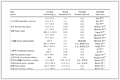
Initially, γ−2-indolyl phenol 1a and α, β‐alkynal 2a were chosen as model substrates for screening the reaction conditions (Table 1). The catalytic transformation of 1a with 2a was investigated under NHC catalysis using 3, 3′, 5, 5′-tetra‑tert-butyldiphenoquinone (DQ) as the oxidant (Table 1). We were encouraged to find that the reaction using the triazolium salt C as an NHC precursor and DBU as a base in the presence of Sc(OTf)3 provided the desired pentacyclic ten-membered lactam 3a in 65% yield without observing its regioisomer 3a', revealing that the reaction demonstrates complete regioselectivity (entry 1). Based on these preliminary results, various reaction parameters, such as the NHC source, base, solvent and additive, were then carefully investigated. Exchanging triazolium salt C with imidazolium salt C or thiazolium salt C returned inferior yields of 3a (entries 2 and 3). After screening several bases commonly used in NHC catalysis, 4-dimethylaminopyridine (DMAP) was found to be the best choice for this transformation (80%, entry 5), as reactions involving other organic (Et3N) and inorganic (Cs2CO3 and K2CO3) bases were tested but resulted in traces or no desired products (entries 4, 6 and 7). The application Mg(OTf)2 and Zn(OTf)2 as Lewis acid catalysts could make this reaction to proceed readily; however, the yields of 3a obtained with both catalysts remain inferior to those achieved with Sc(OTf)₃ (entries 8 and 9 vs. entry 5). Next, the effect of the solvents was evaluated. The yields of product 3a associated with Pre-NHC C in the presence of Sc(OTf)3 and DMAP in several solvents are summarized as follows (entries 10–15): MeCN (60%), ethyl acetate (EA, 67%), toluene (58%), 1, 2-dichloroethane (DCE, trace), and 1, 4-dioxane (54%), indicating that none of them can improve the efficiency of this transformation as compared with THF. Decreasing the amount of Sc(OTf)3 (10 mol%) or DMAP (1.0 equiv.) resulted in a markedly reduced yield of 3a (entries 15 and 16). Without Sc(OTf)3, the yield of 3a decreased remarkably to 57%, showing that Sc(OTf)3 plays an important role in increasing the yield of 3a (entry 17). The reaction did not proceed with the use of MnO2 or 2, 3-dichloro-5, 6-dicyano-1, 4-benzoquinone (DDQ) as the oxidant (entry 18). Control experiments carried out without the NHC precursor or DQ did not yield 3a, indicating the indispensable role of the carbene catalyst as well as the oxidant in this reaction (entries 19 and 20).
|
Table 1 Screening of reaction conditions for the reaction of 1a with 2a.a |


With the optimized reaction conditions (as stated in Table 1, entry 5), we sought to examine the generality and limitations of the organocatalytic high-order annulation with respect to γ-indolyl phenols and α, β‐alkynals. The results are summarized in Scheme 2. First, the electronic properties and positions of the substituents on the arene ring of α, β‐alkynals were carefully surveyed by repeating the reactions of 1a, which afforded a wide range of pentacyclic ten-membered lactams 3b-3o with good functional group compatibility and complete regioselectivity. The reaction proceeded readily with various substituents, such as methyl (2b, 2c and 2d), ethyl (2e), tert‑butyl (2f), methoxy (2g and 2h), chloro (2i and 2j), bromo (2k and 2l) and nitro (2m) at the para- or meta-positions of the phenyl ring. Among them, a substrate bearing a strong electron-donating (methoxy 2g) group at the para-position seems reluctant to undergo this process, as demonstrated by the generation of product 3g in 31% yield, which may be caused by unfavorable Michael addition of the hydroxyl group of γ-indolyl phenols to α, β‐alkynals when a strong electron donating group exists in the latter. Moreover, an inferior outcome was observed (3m, 33%) when a strong electron-withdrawing group, such as nitro (2m) was used. The presence of a nitro group is detrimental to the yield of the product, probably due to its ability to greatly enhance the reactivity of α, β‐alkynals, increasing the complexity of the reaction. In addition to the mono-substituent in the phenyl ring of α, β‐alkynals, this protocol is also applicable for disubstituted counterparts, such as 3, 5-dimethyl (2n), albeit with a moderate yield. Moreover, the thienyl-incorporating substrate 2o was possible in this transformation, affording product 3o in 51% yield. However, n‑butyl substituted α, β‐alkynal 2p was not suitable for this transformation.

|
Download:
|
| Scheme 2. Substrate scope for the synthesis of products 3. Reactions were conducted with 1 (0.20 mmol), 2 (0.60 mmol), DQ (3.0 equiv.), Pre-NHC C1 (15 mol%), DMAP (2.0 equiv.), 4 Å MS (200 mg), Sc(OTf)3 (20 mol%), and dry THF (4 mL) at 25 ℃ under air conditions for 4 days. Yield of the isolated products based on substrate 1. | |

Subsequently, swapping the phenyl group with the N-Ts indolyl functionality on the α, β‐alkynal moiety enabled regioselective access to a series of unprecedented pentacyclic ten-membered lactams 3q-3v with yields ranging from 64% to 73%. Specifically, the substituent variation in the N-Ts protected indole ring of substrate 2 was briefly investigated by combining γ-indolyl phenol 1a under standard conditions. Different substituents, such as C5-methyl (2r), C6‑methoxy (2s), C5-fluoro (2t), and chloro (C5, 2u; C6, 2v) were tested, and all of these compounds performed well to further demonstrate the compatibility of this transformation. Next, a brief investigation was conducted on the possible structural changes in the indole ring and the internal arene ring of the γ-indolyl phenols. For the internal arene ring, both methyl (1b and 1c) and methoxy (1d) groups at the C4- or C5-position were accommodated in this transformation, delivering corresponding products 3w-3z as single regioisomers in 68%–73% yields. As exemplified by product 3y, this organocatalytic high-order annulation is also adaptable to γ-indolyl phenol 1e anchored by a sterically crowded naphthalene linkage in good yield. For the indole ring, substituents, such as methyl (1f) and chloro (1g), at the C5 position were compatible with this catalytic system, giving pentacyclic ten-membered lactams 3aa and 3bb in 67% and 70% yields, respectively. In the case of 3z, its structure was unambiguously determined by X-ray diffraction analysis (CCDC 2372468, see Supporting information).
To demonstrate the synthetic utility of this transformation, a scale-up reaction of 1a with 2a was conducted on a 1.5 mmol scale, leading to a slightly decreased yield of product 3a (73%) (Scheme 3a). Next, the bromination of 3a in the presence of 1, 3-dibromo-5, 5-dimethylhydantoin (DBDMH) gave brominated pentacyclic ten-membered lactam 4a in 90% yield (Scheme 3b). The Suzuki–Miyaura cross-coupling reaction of 4a with p-tolylboronic acid was conducted by using Pd(PPh3)4 as the catalyst, affording product 5a in 94% yield (Scheme 3c) [69].

|
Download:
|
| Scheme 3. Scale-up reaction and bromination of 3a. | |

Based on the control experiments (Table 1, entries 17, 19 and 20) and previous reports [70, 71], a plausible mechanism is proposed in Scheme 4. With γ-indolyl phenol 1a and α, β‐alkynal 2a as representative examples, this process initially involves in-situ-generation of a free NHC catalyst from Pre-NHC C under basic conditions, and the subsequent addition of the NHC catalyst to 2a generates Breslow intermediate I, which is oxidized by DQ in the presence of Sc(OTf)3 to form alkynyl acyl azolium-[Sc]-complex II. The Michael addition of the oxygen anion of γ-indolyl phenolic anion Ⅲ, derived from 1a under basic conditions, to intermediate II affords allenolate intermediate Ⅳ, which undergoes proton transfer (PT) and subsequent lactamization to afford product 3a and simultaneously regenerates the NHC catalyst and [Sc]-complex for the next catalytic cycles.

|
Download:
|
| Scheme 4. Proposed reaction pathway. | |

In summary, we have illustrated a new oxidative NHC catalytic high-order [7 + 3] annulation strategy using γ-indolyl phenols as 1, 7-dinucleophiles and α, β‐alkynals with the aid of Sc(OTf)3, producing a wide range of unprecedented polyarene-fused ten-membered lactams in moderate to good yields with complete regioselectivity. The reaction proceeds under mild conditions via NHC catalysis, is highly regioselective for constructing polycyclic medium-sized lactams incorporating vicinal biaxially chiral bridged aryl-aryl-indole motif and shows good substrate scope around each of the reacting functional groups. Further investigations to apply this reaction to biologically active targets and its asymmetric version are currently underway in our laboratory.
Declaration of competing interestThe authors declare that they have no known competing financial interests or personal relationships that could have appeared to influence the work reported in this paper.
CRediT authorship contribution statementChen-Chang Cui: Writing – original draft, Investigation, Formal analysis, Data curation. Shao-Qing Shi: Investigation, Formal analysis. Lu-Yao Wang: Data curation. Feng Lin: Investigation, Data curation. Man-Su Tu: Supervision, Project administration, Investigation, Funding acquisition, Formal analysis. Wen-Juan Hao: Writing – review & editing, Supervision, Project administration. Bo Jiang: Writing – review & editing, Supervision, Methodology, Funding acquisition.
AcknowledgmentsWe are grateful for National Natural Science Foundation of China (Nos. 21971090 and 22271123), the NSF of Jiangsu Province (No. BK20230201), the Natural Science Foundation of Jiangsu Education Committee (No. 22KJB150024) and the Natural Science Foundation of Jiangsu Normal University (No. 21XSRX010).
Supplementary materialsSupplementary material associated with this article can be found, in the online version, at doi:10.1016/j.cclet.2024.110541.
| [1] |
R.L. Reyes, T. Iwai, M. Sawamura, Chem. Rev. 121 (2021) 8926-8947. DOI:10.1021/acs.chemrev.0c00793 |
| [2] |
J.T. Chen, N. Lin, L. Xu, et al., Org. Chem. Front. 11 (2024) 1299-1304. DOI:10.1039/d3qo01793a |
| [3] |
J.R. Donald, W.P. Unsworth, Chem. Eur. J. 23 (2017) 8780-8799. DOI:10.1002/chem.201700467 |
| [4] |
T. Yao, J. Li, C. Jiang, et al., Chem. Catal. 2 (2022) 2929-2964. DOI:10.1016/j.checat.2022.07.021 |
| [5] |
F. Kopp, C.F. Stratton, L.B. Akella, et al., Nat. Chem. Biol. 8 (2012) 358-365. DOI:10.1038/nchembio.911 |
| [6] |
A.K. Clarke, W.P. Unsworth, Chem. Sci. 11 (2020) 2876-2881. DOI:10.1039/d0sc00568a |
| [7] |
J. Du, Y.F. Li, C.H. Ding, Chin. Chem. Lett. 34 (2023) 108401. DOI:10.1016/j.cclet.2023.108401 |
| [8] |
K.R. Romines, K.D. Watenpaugh, P.K. Tomich, et al., J. Med. Chem. 38 (1995) 1884-1891. DOI:10.1021/jm00011a008 |
| [9] |
Y.J. Hu, L.X. Li, J.C. Han, et al., Chem. Rev. 120 (2020) 5910-5953. DOI:10.1021/acs.chemrev.0c00045 |
| [10] |
V. Lysenko, K. Nazarenko, S. Shishkina, et al., Chem. Commun. 59 (2023) 9396-9399. DOI:10.1039/d3cc02849f |
| [11] |
I. Zalessky, J.M. Wootton, J.K.F. Tam, et al., J. Am. Chem. Soc. 146 (2024) 5702-5711. DOI:10.1021/jacs.4c00659 |
| [12] |
V. Dubovik, A. Dalinova, A. Berestetskiy, Nat. Prod. Rep. 41 (2024) 85-112. DOI:10.1039/d3np00013c |
| [13] |
N. Aimi, N. Uchida, N. Ohya, et al., Tetrahedron Lett. 32 (1991) 4949-4952. DOI:10.1016/S0040-4039(00)93504-4 |
| [14] |
S. Kawamura, R.L. Palte, H.Y. Kim, et al., Bioorg. Med. Chem. 66 (2022) 116820. DOI:10.1016/j.bmc.2022.116820 |
| [15] |
Q.L. Zhang, Q. Xiong, M.M. Li, et al., Angew. Chem. Int. Ed. 59 (2020) 14096-14100. DOI:10.1002/anie.202005313 |
| [16] |
J. Wang, L. Zhao, C. Zhu, et al., Chin. Chem. Lett. 33 (2022) 4549-4558. DOI:10.1016/j.cclet.2022.01.063 |
| [17] |
L. Shi, Q. Xiong, S.Y. Wu, et al., Org. Lett. 25 (2023) 2030-2035. DOI:10.1021/acs.orglett.3c00374 |
| [18] |
J. Cheng, X. Jiang, S. Ma, Org. Lett. 13 (2011) 5200-5203. DOI:10.1021/ol202074e |
| [19] |
B. Zhang, K.B. Wang, W. Wang, et al., Nature 568 (2019) 122-126. DOI:10.1038/s41586-019-1021-x |
| [20] |
Y.N. Wang, L.C. Yang, Z.Q. Rong, et al., Angew. Chem. Int. Ed. 57 (2018) 1596-1600. DOI:10.1002/anie.201711648 |
| [21] |
P. García-Domínguez, P. Lorenzo, R. Álvarez, et al., J. Org. Chem. 87 (2022) 12510-12527. DOI:10.1021/acs.joc.2c01227 |
| [22] |
Z.W. Wang, X.J. Shi, Y. Mu, et al., Fitoterapia 119 (2017) 8-11. DOI:10.1016/j.fitote.2017.01.017 |
| [23] |
E.D. Edstrom, Tetrahedron Lett. 32 (1991) 5709-5712. DOI:10.1016/S0040-4039(00)93536-6 |
| [24] |
G. Illuminati, L. Mandolini, Acc. Chem. Res. 14 (1981) 95-102. DOI:10.1021/ar00064a001 |
| [25] |
G.A. Molander, Acc. Chem. Res. 31 (1998) 603-609. DOI:10.1021/ar960101v |
| [26] |
L. Yet, Chem. Rev 100 (2000) 2963-3008. DOI:10.1021/cr990407q |
| [27] |
M.F. Li, S.Q. Shi, T. Xu, et al., Chin. Chem. Lett. 34 (2023) 107751. DOI:10.1016/j.cclet.2022.107751 |
| [28] |
Y. Okuno, O. Yonemitsu, Tetrahedron Lett. 13 (1974) 1169-1172. |
| [29] |
T.A. Palazzo, R. Mose, K.A. Jørgensen, Angew. Chem. Int. Ed. 56 (2017) 10033-10038. DOI:10.1002/anie.201701085 |
| [30] |
H. Bieräugel, T.P. Jansen, H.E. Schoemaker, et al., Org. Lett. 4 (2002) 2673-2674. DOI:10.1021/ol0261579 |
| [31] |
S. Wakchaure, J. Einsiedel, R. Waibel, et al., Synthesis 44 (2012) 2682-2694. DOI:10.1055/s-0032-1316758 |
| [32] |
R.J. Friary, J.H. Schwerdt, Tetrahedron 47 (1991) 9981-9984. DOI:10.1016/S0040-4020(01)96046-6 |
| [33] |
F. Kopp, C.F. Stratton, L.B. Akella, et al., Nat. Chem. Biol. 8 (2012) 358-365. DOI:10.1038/nchembio.911 |
| [34] |
A. Sapegin, A. Osipyan, M. Krasavin, Org. Biomol. Chem. 15 (2017) 2906-2909. DOI:10.1039/C7OB00535K |
| [35] |
E.M.M. Abdelraheem, R. Madhavachary, A. Rossetti, et al., Org. Lett. 19 (2017) 6176-6179. DOI:10.1021/acs.orglett.7b03094 |
| [36] |
X.H. Fu, J. Liao, Z.H. Wang, et al., Org. Chem. Front. 11 (2024) 4131-4137. DOI:10.1039/d4qo00609g |
| [37] |
K.J.R. Murauski, A.A. Jaworski, K.A. Scheidt, Chem. Soc. Rev. 47 (2018) 1773-1782. DOI:10.1039/c7cs00386b |
| [38] |
D.M. Flanigan, F. Romanov-Michailidis, N.A. White, Chem. Rev. 115 (2015) 9307-9387. DOI:10.1021/acs.chemrev.5b00060 |
| [39] |
A.T. Biju, N. Kuhl, F. Glorius, Acc. Chem. Res. 44 (2011) 1182-1195. DOI:10.1021/ar2000716 |
| [40] |
D. Enders, O. Niemeier, A. Henseler, Chem. Rev. 107 (2007) 5606-5655. DOI:10.1021/cr068372z |
| [41] |
H. Cai, X. Yang, S.C. Ren, et al., ACS Catal. 14 (2024) 8270-8293. DOI:10.1021/acscatal.4c01973 |
| [42] |
Y. Liu, Y. Wang, X. Wu, et al., Chem. Rev. 23 (2023) e202200219. |
| [43] |
J. Gao, S. Zhang, D. Du, Chem. Rev. 23 (2023) e202300046. |
| [44] |
C. De Risi, A. Brandolese, G. Di Carmine, et al., Chem. Eur. J. 29 (2023) e202202467. DOI:10.1002/chem.202202467 |
| [45] |
T. Pavithra, E.S. Devi, C.U. Maheswari, et al., Asian J. Org. Chem. 10 (2021) 1861-1883. DOI:10.1002/ajoc.202100289 |
| [46] |
B. Zhang, J. Wang, Sci. China Chem. 65 (2022) 1691-1703. DOI:10.1007/s11426-022-1291-2 |
| [47] |
R.C. Johnston, D.T. Cohen, C.C. Eichman, et al., Chem. Sci. 5 (2014) 1974-1982. DOI:10.1039/C4SC00317A |
| [48] |
X. Wu, L. Hao, Y. Zhang, et al., Angew. Chem. Int. Ed. 56 (2017) 4201-4205. DOI:10.1002/anie.201700045 |
| [49] |
J. Xu, S. Yuan, J. Peng, et al., Chem. Commun. 53 (2017) 3430-3433. DOI:10.1039/C7CC01232B |
| [50] |
J. Jin, X. Huang, J. Xu, et al., Org. Lett. 23 (2021) 3991-3996. DOI:10.1021/acs.orglett.1c01191 |
| [51] |
S.Y. Zhu, H. Zhang, Q.W. Ma, et al., Chem. Commun. 55 (2019) 298-301. DOI:10.1039/c8cc08578a |
| [52] |
S. Yuan, Y. Luo, J. Peng, et al., Org. Lett. 19 (2017) 6100-6103. DOI:10.1021/acs.orglett.7b02948 |
| [53] |
T. Li, Z. Jin, Y.R. Chi, Sci. China Chem. 65 (2022) 210-223. DOI:10.1007/s11426-021-1133-5 |
| [54] |
D. Xie, L. Yang, Y. Lin, et al., Org. Lett. 17 (2015) 2318-2321. DOI:10.1021/acs.orglett.5b00726 |
| [55] |
T. Li, C. Mou, P. Qi, et al., Angew. Chem. Int. Ed. 60 (2021) 9362-9367. DOI:10.1002/anie.202010606 |
| [56] |
S. Perveen, Z. Zhao, G. Zhang, et al., Org. Lett. 19 (2017) 2470-2473. DOI:10.1021/acs.orglett.7b00555 |
| [57] |
A. Ghosh, S. Shee, S. Barik, et al., Org. Lett. 23 (2021) 5223-5228. DOI:10.1021/acs.orglett.1c01761 |
| [58] |
C.L. Zhang, Z.H. Gao, Z.Q. Liang, et al., Adv. Synth. Catal. 358 (2016) 2862-2866. DOI:10.1002/adsc.201600531 |
| [59] |
H. Huang, Q.Z. Li, Y.Q. Liu, et al., Org. Chem. Front. 7 (2020) 3862-3867. DOI:10.1039/d0qo00868k |
| [60] |
Y.F. Han, Z.H. Gao, C.L. Zhang, et al., Org. Lett. 22 (2020) 8396-8400. DOI:10.1021/acs.orglett.0c03026 |
| [61] |
M. Wang, Z. Huang, J. Xu, et al., J. Am. Chem. Soc. 136 (2014) 1214-1217. DOI:10.1021/ja411110f |
| [62] |
C. Dai, S. Xia, X. Chen, et al., Chin. J. Org. Chem. 43 (2023) 1084-1090. DOI:10.6023/cjoc202301011 |
| [63] |
W. Li, H. Yuan, Z. Liu, et al., Adv. Synth. Catal. 360 (2018) 2460-2464. DOI:10.1002/adsc.201800337 |
| [64] |
F. Xia, Z.H. Gao, C.L. Zhang, et al., Adv. Synth. Catal. 361 (2019) 2291-2294. DOI:10.1002/adsc.201801679 |
| [65] |
K. Balanna, K. Madica, S. Mukherjee, et al., Chem. Eur. J. 26 (2020) 818-822. DOI:10.1002/chem.201905177 |
| [66] |
Q. Li, K. Yan, Y. Zhu, et al., Chin. Chem. Lett. 34 (2023) 108014. DOI:10.1016/j.cclet.2022.108014 |
| [67] |
L.Q. Chen, C.F. Zhu, S. Zhang, et al., Chin. Chem. Lett. 34 (2023) 108398. DOI:10.1016/j.cclet.2023.108398 |
| [68] |
C.L. Ji, W.J. Hao, J. Zhang, et al., Org. Lett. 21 (2019) 6494-6498. DOI:10.1021/acs.orglett.9b02367 |
| [69] |
D.A. Gutierrez, G. Toth-Williams, C.J. Laconsay, et al., Angew. Chem. Int. Ed. 63 (2024) e202407114. DOI:10.1002/anie.202407114 |
| [70] |
T. Li, C. Mou, P. Qi, et al., Angew. Chem. Int. Ed. 60 (2021) 9362-9367. DOI:10.1002/anie.202010606 |
| [71] |
C. Zhao, D. Guo, K. Munkerup, et al., Nat. Commun. 9 (2018) 1-10. DOI:10.1038/s41467-017-02088-w |