 2025, Vol. 36


Spiropyrazolones and heterocyclic-fused analogues are important molecular scaffolds in natural products, biologically active molecules, and pharmaceuticals (Scheme 1a) [1-4]. Consequently, considerable efforts have been devoted to the asymmetric synthesis of five-membered spiropyrazolones. For example, Lu's group developed the first phosphine-catalyzed enantioselective [4 + 1] annulation of substituted allenoates for the formation of enriched 4-spiro-5-pyrazolones [5]. Whereas Enders and co-workers reported an organocatalytic Michael addition/Ag-catalyzed Conia-ene reaction between alkyne-tethered nitroalkenes and pyrazolones [6]. The same group also described an asymmetric NHC-catalyzed [3 + 2] annulation of cinnamaldehyde derivatives with pyrazolones [7]. Particularly, You's group pioneered the asymmetric rhodium-catalyzed C(sp2)–H functionalization of 4-aryl-5-pyrazolones and subsequent annulation with alkynes for the asymmetric synthesis of highly enantioenriched five-membered-ring 4-spiro-5-pyrazolones (Scheme 1b) [8].

|
Download:
|
| Scheme 1. Selected bioactive spiropyrazolones and general outline of the strategy in asymmetric synthesis of spiropyrazolones. | |
In recent years, catalytic asymmetric [4 + 1] annulation have been developed for the synthesis of five-membered rings [9-11]. Widely utilized C4 synthons, including allenyl acetates [12-15], 1,3-dienes [16-21], 1,4-diones [22-24], and cyclobutanols [25-30], have played integral roles in asymmetric [4 + 1] cyclization processes. Metal-allenylidene intermediates, which are more reactive, and widely employed in nucleophilic substitution reactions [31-50] and annulation reactions [51-56]. With C=C bond installed in propargylic esters, which offered numerous opportunities for chemists to explore new activation modes and create new chiral chemicals. In 2012, Haak's group reported the ruthenium-catalyzed [4 + 1] annulation of cyclic 1,3-dicarbonyl compounds with 1-vinyl propargyl alcohols, wherein the first metal-vinylallenylidene intermediates was proposed [57-59]. In 2022, Fang's group successfully synthesized a series of racemic yne-allylic substituted products using yne–allylic esters as a C4 synthon which [60]. Recently, our group successfully achieved copper-catalyzed asymmetric [4 + 1] annulation of yne–allylic esters with 1,3-dicarbonyl compounds for chiral spirocycles by challenging remote stereocontrol [61]. Yne-allylic esters regarded as a novel C4 synthon for asymmetric copper-catalyzed remote transformations [62-69]. On the basis of our interest in asymmetric copper catalysis [70-76], we envisaged the remote asymmetric annulation of yne–allylic acetates with pyrazolones for highly enantioenriched spiropyrazolones using earth-abundant copper catalyst.
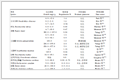
Our investigations were implemented with yne–allylic acetate 1a and 1,3-diphenyl-pyrazolone 2a (Table 1). The investigation revealed that the Ph-PyBox ligand L1 delivered the desired product 3a in 99% yield, albeit with moderate enantiocontrol in the presence of a Cu(Ⅰ) catalyst with DIPEA as the base in MeOH (entry 1). The ee value of 3a with less steric hindrance Me-PyBox ligand L2 could be enhanced to 92%/91% ee with 54:46 dr (entry 2). Further investigation of the C4-substitution effect of the pyridine moieties in the Me-PyBox ligands indicated that both enantioselectivity and diastereoselectivity were affected. With the ligand L3 gave the highest enantioselectivity (entries 3–6). Screening different bases showed that Et3N provided promising results in terms of ee and dr values (entries 7–9). After further optimization of reaction parameters, such as reaction temperature and time, we found that the ee and dr values of 3a could be enhanced to 96%/97% and 72:28, respectively, at –10 ℃ (entries 10–12).
|
Table 1 Optimization of reaction conditions.a |


With the optimal conditions in hand, we then probed the scope of yne–allylic acetates for this asymmetric [4 + 1] annulation reaction (Scheme 2). A series of aryl yne–allylic acetates with electron-donating or -withdrawing substituents reacted smoothly, affording spiropyrazolones in excellent yields with good enantioselectivities and moderated diastereoselectivities. Halogens and cyano group at the para-position in yne–allylic acetates were compatible, giving the spirocycles products 3b–3d in good yields with excellent ee values. The reaction tolerated meta- and ortho-substituted aryl yne–allylic acetates (3e–3h) very well. Even yne–allylic acetetes adjacent to the more sterically bulky 2,6-dimethylphenyl group reacted smoothly, resulting in the desired product 3i with an excellent yield, albeit with a decreased ee value. However, the less reactive aliphatic yne–allylic acetates led to diminished yield. The Me-substituted yne–allylic acetate provided annulation product 3j in 99%/99% ee values. However, the ee values of the more sterically bulky t-Bu-substituted substrate decreased to 82%/61% (3k). Remarkably, thiophenyl-substituted yne–allylic ester delivered the corresponding product 3l with good yield and excellent ee values. Subsequently, various pyrazolones were explored in the asymmetric [4 + 1] annulation (Scheme 3). Different aryl-substituents at the 3-position of the pyrazolones, delivered the desired spiropyrazolones 3m, 3n, and 3o in good yields with excellent ee values. Notably, the bulky isopropyl at the 3-position of the pyrazolones also showed good compatibility, yielding the desired annulation product 3p in excellent yield, albeit with a decrease in ee. Various N-aryl groups of the pyrazolones were well-tolerated, giving 3q–3u in good yields and moderate enantioselectivity. Importantly, N-alkyl group of the pyrazolones also reacted well, albeit with low dr values (3v, 3w). Notably, two diastereomers of syn-3w and anti-3w can be isolated by column chromatography. We are delighted to observe that our developed method enables the isolation of some products. Finally, the absolute configurations of product syn-3w (CCDC: 2306695) and anti-3w (CCDC: 2306696) were unambiguously assigned by X-ray diffraction analysis (Scheme 4).

|
Download:
|
| Scheme 2. Scope of yne–allylic esters. a Separate the diastereomers: syn-3j = 45%, anti-3j = 22%. | |


|
Download:
|
| Scheme 3. Scope of pyrazolones. a Separate the diastereomers: syn-3w = 43%, anti-3w = 41%. | |


|
Download:
|
| Scheme 4. X-ray diffraction analysis syn-3w and anti-3w. | |

To demonstrate the synthetic utility of this method, the obtained spiropyrazolones were subjected to a selection of derivatizations (Scheme 5a). The amide group in 3a was successfully reduced with DIBAL-H, affording the pyrazoline derivative 4 in 85% yield with 71:29 dr and 96%/96% ee. The Suzuki coupling of 3o with boronic acid 5 resulted in the formation of chiral-preserving coupling product 6.

|
Download:
|
| Scheme 5. Product transformations and proposed mechanism. | |

The reaction of methyl-substituted pyrazolones 7 gave rise to the γ-substituted yne–allylic product 8 in 69% yield with 60% ee under the standard conditions. The result revealed that the reaction probably went through a stepwise process and the enantio–determining accompanied in the first nucleophilic substitution step (Scheme 5b).
Based on previous reports, a putative catalytic cycle for the reaction was proposed (Scheme 5c). Initially, the reaction of the chiral copper catalyst with the terminal alkyne 1a afforded a catalytically active copper acetylide species Ⅰ, which then underwent the elimination of an acetyl group to form the copper- allenylidene intermediate Ⅱ along with its resonance form acetylide intermediate Ⅱ′. Subsequently, an in situ-formed enolate anion 2a′ underwent nucleophilic addition at the ε site of the copper-allenylidene species, genernating the intermediate Ⅲ. Next, the protodemetalation of intermediate Ⅲ delivered the intermediate Ⅳ. Subsequently, the Conia-ene reaction of intermediate Ⅴ was occurred to deliver the intermediate Ⅵ. Finally, intermediate Ⅵ underwent protodemetalation to provide the desired product 3a and regenernated the chiral copper catalyst for the next catalytic cycle.
In summary, we have described a copper-catalyzed asymmetric [4 + 1] annulation of yne–allylic esters with pyrozalones by remote stereocontrol in high yields (up to 99%) with excellent enantioselectivities (up to 99%/99% ee) and moderate diastereoselectivities (up to 82:18 dr). This method enables the transformation of yne–allylic esters into highly enantioenriched spiropyrazolones containing all-carbon quaternary sterogenic centers.
Declaration of competing interestThe authors declare that they have no known competing financial interests or personal relationships that could have appeared to influence the work reported in this paper.
CRediT authorship contribution statementGuang Xu: Writing – original draft, Data curation, Conceptualization. Cuiju Zhu: Writing – review & editing, Supervision, Funding acquisition. Xiang Li: Investigation. Kexin Zhu: Investigation. Hao Xu: Writing – review & editing, Supervision, Resources, Funding acquisition.
AcknowledgmentThe authors acknowledge financial support from the National Natural Science Foundation of China (Nos. 21801087 and 22201089).
Supplementary materialsSupplementary material associated with this article can be found, in the online version, at doi:10.1016/j.cclet.2024.110114.
| [1] |
E. Amata, N.D. Bland, R.K. Campbell, M.P. Pollastri, Tetrahedron Lett. 56 (2015) 2832-2835. DOI:10.1016/j.tetlet.2015.04.061 |
| [2] |
H. Zou, Z.L. Wang, Y. Cao, G. Huang, Chin. Chem. Lett. 29 (2018) 1355-1358. DOI:10.1016/j.cclet.2017.10.034 |
| [3] |
W. Luo, B. Shao, J. Li, et al., Org. Chem. Front. 7 (2020) 1016-1021. DOI:10.1039/d0qo00140f |
| [4] |
S. Zhang, G. Xu, H. Yan, et al., Chin. Chem. Lett. 33 (2022) 5128-5131. DOI:10.1016/j.cclet.2022.04.006 |
| [5] |
X. Han, W. Yao, T. Wang, et al., Angew. Chem. Int. Ed. 53 (2014) 5643-5647. DOI:10.1002/anie.201311214 |
| [6] |
D. Hack, A.B. Dürr, K. Deckers, et al., Angew. Chem. Int. Ed. 55 (2016) 1797-1800. DOI:10.1002/anie.201510602 |
| [7] |
L. Wang, S. Li, P. Chauhan, et al., Chem. Eur. J. 22 (2016) 5123-5127. DOI:10.1002/chem.201600515 |
| [8] |
J. Zheng, S.B. Wang, C. Zheng, S.L. You, Angew. Chem. Int. Ed. 56 (2017) 4540-4544. DOI:10.1002/anie.201700021 |
| [9] |
J.R. Chen, X.Q. Hu, L.Q. Lu, W.J. Xiao, Chem. Rev. 115 (2015) 5301-5365. DOI:10.1021/cr5006974 |
| [10] |
C. Zhu, Y. Ding, L.W. Ye, Org. Biomol. Chem. 13 (2015) 2530-2536. DOI:10.1039/C4OB02556C |
| [11] |
B. Xiang, Y. Wang, C. Xiao, F. He, Y. Huang, Chin. Chem. Lett. 35 (2024) 108777. DOI:10.1016/j.cclet.2023.108777 |
| [12] |
D.T. Ziegler, L. Riesgo, T. Ikeda, Y. Fujiwara, G.C. Fu, Angew. Chem. Int. Ed. 53 (2014) 13183-13187. DOI:10.1002/anie.201405854 |
| [13] |
Q. Zhang, L. Yang, X. Tong, J. Am. Chem. Soc. 132 (2010) 2550-2551. DOI:10.1021/ja100432m |
| [14] |
S. Kramer, G.C. Fu, J. Am. Chem. Soc. 137 (2015) 3803-3806. DOI:10.1021/jacs.5b01944 |
| [15] |
L. Li, P. Luo, Y. Deng, Z. Shao, Angew. Chem. Int. Ed. 58 (2019) 4710-4713. DOI:10.1002/anie.201901511 |
| [16] |
X.N. Zhang, H.P. Deng, L. Huang, Y. Wei, M. Shi, Chem. Commun. 48 (2012) 8664-8666. DOI:10.1039/c2cc34619b |
| [17] |
X.N. Zhang, G.Q. Chen, X.Y. Tang, Y. Wei, M. Shi, Angew. Chem. Int. Ed. 53 (2014) 10768-10773. DOI:10.1002/anie.201406100 |
| [18] |
Y.Y. Zhou, C. Uyeda, Science 363 (2019) 857-862. DOI:10.1126/science.aau0364 |
| [19] |
M.J. Behlen, C. Uyeda, J. Am. Chem. Soc. 142 (2020) 17294-17300. DOI:10.1021/jacs.0c08262 |
| [20] |
Z. Zhang, F. Xiao, H.M. Wu, X.Q. Dong, C.J. Wang, Org. Lett. 22 (2020) 569-574. DOI:10.1021/acs.orglett.9b04341 |
| [21] |
Q.Y. Liao, C. Ma, Y.C. Wang, et al., Chin. Chem. Lett. 34 (2023) 108371. DOI:10.1016/j.cclet.2023.108371 |
| [22] |
L. Zhang, J. Zhang, J. Ma, D.J. Cheng, B. Tan, J. Am. Chem. Soc. 139 (2017) 1714-1717. DOI:10.1021/jacs.6b09634 |
| [23] |
K.W. Chen, Z.H. Chen, S. Yang, et al., Angew. Chem. Int. Ed. 61 (2022) e202116829. DOI:10.1002/anie.202116829 |
| [24] |
Y. Gao, L.Y. Wang, T. Zhang, B.M. Yang, Y. Zhao, Angew. Chem. Int. Ed. 61 (2022) e202200371. DOI:10.1002/anie.202200371 |
| [25] |
S. Matsumura, Y. Maeda, T. Nishimura, S. Uemura, J. Am. Chem. Soc. 125 (2003) 8862-8869. DOI:10.1021/ja035293l |
| [26] |
M. Shigeno, T. Yamamoto, M. Murakami, Chem. Eur. J. 15 (2009) 12929-12931. DOI:10.1002/chem.200902593 |
| [27] |
N. Ishida, S. Sawano, Y. Masuda, M. Murakami, J. Am. Chem. Soc. 134 (2012) 17502-17504. DOI:10.1021/ja309013a |
| [28] |
N. Ishida, S. Sawano, M. Murakami, Nat. Commun. 5 (2014) 3111. DOI:10.1038/ncomms4111 |
| [29] |
Y. Xia, Z. Liu, Z. Liu, et al., J. Am. Chem. Soc. 136 (2014) 3013-3015. DOI:10.1021/ja500118w |
| [30] |
A. Yada, S. Fujita, M. Murakami, J. Am. Chem. Soc. 136 (2014) 7217-7220. DOI:10.1021/ja502229c |
| [31] |
C. Zhang, X.H. Hu, Y.H. Wang, et al., J. Am. Chem. Soc. 134 (2012) 9585-9588. DOI:10.1021/ja303129s |
| [32] |
L. Shao, Y.H. Wang, D.Y. Zhang, J. Xu, X.P. Hu, Angew. Chem. Int. Ed. 55 (2016) 5014-5018. DOI:10.1002/anie.201510793 |
| [33] |
X. Gao, R. Cheng, Y.L. Xiao, X.L. Wan, X. Zhang, Chem 5 (2019) 2987-2999. DOI:10.1016/j.chempr.2019.09.012 |
| [34] |
R.Z. Li, D.Q. Liu, D. Niu, Nat. Catal. 3 (2020) 672-680. DOI:10.1038/s41929-020-0462-9 |
| [35] |
L. Peng, Z. He, X. Xu, C. Guo, Angew. Chem. Int. Ed. 59 (2020) 14270-14274. DOI:10.1002/anie.202005019 |
| [36] |
S.J. Li, J. Huang, J.Y. He, et al., RSC Adv. 10 (2020) 38478-38483. DOI:10.1039/d0ra07698h |
| [37] |
J. Huang, H.H. Kong, S.J. Li, et al., Chem. Commun. 57 (2021) 4674-4677. DOI:10.1039/d1cc00663k |
| [38] |
J.T. Xia, L. Li, X.P. Hu, ACS Catal. 11 (2021) 11843-11848. DOI:10.1021/acscatal.1c03421 |
| [39] |
W. Guo, L. Zuo, M. Cui, B. Yan, S. Ni, J. Am. Chem. Soc. 143 (2021) 7629-7634. DOI:10.1021/jacs.1c03182 |
| [40] |
Z. Li, D. Li, H. Xiang, et al., Chin. Chem. Lett. 33 (2022) 867-870. DOI:10.1016/j.cclet.2021.08.009 |
| [41] |
X. Pu, Q.D. Dang, L. Yang, X. Zhang, D. Niu, Nat. Commun. 13 (2022) 2457. DOI:10.1038/s41467-022-29986-y |
| [42] |
H.D. Qian, Z.H. Li, S. Deng, et al., J. Am. Chem. Soc. 144 (2022) 15779-15785. DOI:10.1021/jacs.2c06560 |
| [43] |
R.Q. Wang, C. Shen, X. Cheng, X.Q. Dong, C.J. Wang, Chem. Commun. 58 (2022) 8552-8555. DOI:10.1039/d2cc01695h |
| [44] |
T. Liu, S. Ni, W. Guo, Chem. Sci. 13 (2022) 6806-6812. DOI:10.1039/d2sc02318k |
| [45] |
W. Dong, Z. Zhao, C.Z. Gu, et al., J. Am. Chem. Soc. 145 (2023) 27539-27554. DOI:10.1021/jacs.3c09155 |
| [46] |
G. Tian, M. Ji, F. Wu, et al., Org. Lett. 25 (2023) 4666-4671. DOI:10.1021/acs.orglett.3c01521 |
| [47] |
C. Gui, Y. Peng, Y. Zhou, et al., ACS Catal. 13 (2023) 13735-13742. DOI:10.1021/acscatal.3c03814 |
| [48] |
T. Wang, Y. You, Z.H. Wang, et al., Org. Lett. 25 (2023) 1274-1279. DOI:10.1021/acs.orglett.3c00075 |
| [49] |
Z.Q. Geng, C. Zhao, H.D. Qian, et al., Org. Lett. 25 (2023) 4504-4509. DOI:10.1021/acs.orglett.3c01524 |
| [50] |
Q. Cai, H. Rao, S.J. Li, et al., Chem 10 (2024) 265-282. DOI:10.1016/j.chempr.2023.09.006 |
| [51] |
D.Y. Zhang, L. Shao, J. Xu, X.P. Hu, ACS Catal. 5 (2015) 5026-5030. DOI:10.1021/acscatal.5b01283 |
| [52] |
T.R. Li, B.Y. Cheng, Y.N. Wang, et al., Angew. Chem. Int. Ed. 55 (2016) 12422-12426. DOI:10.1002/anie.201605900 |
| [53] |
X. Lu, L. Ge, C. Cheng, et al., Chem. Eur. J. 23 (2017) 7689-7693. DOI:10.1002/chem.201701741 |
| [54] |
H. Chen, X. Lu, X. Xia, et al., Org. Lett. 20 (2018) 1760-1763. DOI:10.1021/acs.orglett.8b00253 |
| [55] |
Z.J. Zhang, L. Zhang, R.L. Geng, et al., Angew. Chem. Int. Ed. 58 (2019) 12190-12194. DOI:10.1002/anie.201907188 |
| [56] |
B.C. Wang, T. Fan, F.Y. Xiong, et al., J. Am. Chem. Soc. 144 (2022) 19932-19941. DOI:10.1021/jacs.2c08090 |
| [57] |
A. Jonek, S. Berger, E. Haak, Chem. Eur. J. 18 (2012) 15504-15511. DOI:10.1002/chem.201202414 |
| [58] |
N. Thies, M. Gerlach, E. Haak, Eur. J. Org. Chem. 2013 (2013) 7354-7365. DOI:10.1002/ejoc.201300803 |
| [59] |
N. Thies, E. Haak, Angew. Chem. Int. Ed. 54 (2015) 4097-4101. DOI:10.1002/anie.201412207 |
| [60] |
S. Niu, Y. Luo, C. Xu, et al., ACS Catal. 12 (2022) 6840-6850. DOI:10.1021/acscatal.2c00911 |
| [61] |
H.H. Kong, C. Zhu, S. Deng, et al., J. Am. Chem. Soc. 144 (2022) 21347-21355. DOI:10.1021/jacs.2c09572 |
| [62] |
M.D. Li, Z.H. Wang, H. Zhu, et al., Angew. Chem. Int. Ed. 62 (2023) e202313911. DOI:10.1002/anie.202313911 |
| [63] |
S.Y. Luo, G.Q. Lin;, Z.T. He, Org. Chem. Front. 11 (2024) 690-695. DOI:10.1039/d3qo01749d |
| [64] |
H.Y. Lu, Y.W. Chen, W.C. Zhao, et al., Nat. Synth. 2 (2023) 37-48. |
| [65] |
C. Xu, Y. Luo, S. Niu, et al., Green Synth. Catal. 5 (2024) 303-309. DOI:10.1016/j.gresc.2023.10.003 |
| [66] |
H. Zhu, L. Xu, B. Zhu, et al., Org. Lett. 25 (2023) 9213-9218. DOI:10.1021/acs.orglett.3c03871 |
| [67] |
Y.Z. Sun, Z.Y. Ren, Y.X. Yang, et al., Angew. Chem. Int. Ed. 62 (2023) e202314517. DOI:10.1002/anie.202314517 |
| [68] |
D. Luo, S. Niu, F. Gong, et al., ACS Catal. 14 (2024) 2746-2757. DOI:10.1021/acscatal.3c06146 |
| [69] |
H.D. Qian, X. Li, T. Yin, et al., Sci. China Chem. 67 (2024) 1175-1180. DOI:10.1007/s11426-023-1922-5 |
| [70] |
J. Song, Z.J. Zhang, L.Z. Gong, Angew. Chem. Int. Ed. 56 (2017) 5212-5216. DOI:10.1002/anie.201700105 |
| [71] |
J. Ren, C. Pi, Y. Wu, X. Cui, Org. Lett. 21 (2019) 4067-4071. DOI:10.1021/acs.orglett.9b01246 |
| [72] |
Z.L. Li, G.C. Fang, Q.S. Gu, X.Y. Liu, Chem. Soc. Rev. 49 (2020) 32-48. DOI:10.1039/c9cs00681h |
| [73] |
X. Chang, Y. Yang, C. Shen, et al., J. Am. Chem. Soc. 143 (2021) 3519-3535. DOI:10.1021/jacs.0c12911 |
| [74] |
Y.H. Wen, Z.J. Zhang, S. Li, J. Song, L.Z. Gong, Nat. Commun. 13 (2022) 1344. DOI:10.1038/s41467-022-29059-0 |
| [75] |
Z. Zhang, P. Chen, G. Liu, Chem. Soc. Rev. 51 (2022) 1640-1658. DOI:10.1039/d1cs00727k |
| [76] |
Z. Yu, Z. Li, C. Yang, Q. Gu, X. Liu, Acta Chim. Sin. 81 (2023) 955-966. DOI:10.6023/a23040161 |