 2025, Vol. 36


b Guangdong Provincial Key Laboratory of Research and Development of Natural Drugs, The First Dongguan Affiliated Hospital, School of Pharmacy, Guangdong Medical University, Dongguan 523808, China;
c State Key Laboratory of Chemical Biology and Drug Discovery, Department of Applied Biology and Chemical Technology, The Hong Kong Polytechnic University, Hong Kong SAR 999077, China
Polycyclic nitrogen heterocyclic skeletons are widely found in naturally occurring compounds and also have applications as luminescent materials and semiconductors [1–3]. The discovery of new polycyclic nitrogen heterocyclic skeletons offers more possibilities for the screening of drug molecules and luminescent materials, as well as an important means of exploring organic chemistry. However, the development of simple and practical new methods for the direct assembly of novel large π-conjugated molecules of this type using readily available substrates has long been a challenge [4–6].
The development of novel reaction modes enables the discovery of new reaction mechanism and unknown skeletons [7,8]. Enaminones are emerging synthetic building blocks capable of providing multiple nucleophilic or electrophilic reaction sites and thus have the potential to allow new reactions modes. In recent years, numerous elegant research works have been reported by Wan and Yu et al., and the multiple reactivity of enaminone has been deeply investigated [9–17]. Specifically, the currently reported mono-functionalisation reactions of enaminones were mainly focused on the regionally selective modification of the α- or β-positions of C═C with heteroatoms to construct C—X bonds (Scheme 1a) [18–23]. As shown in this scheme, there are numerous reaction modes available for the bi-functionalization of enaminones. (a) Using “CO” and β-positions as triatomic synthons for the construction of five- or six-membered rings [24–31]. (b) On the basis of the cleavage of a C—N bond at the β-position, the β,β-disubstituted phenylacetones or 2-substituted chromones can also be obtained [32–36]. (c) The different activities of α- and β-positions can be used to achieve the installation of bifunctional groups [37,38], the construction of heterocycles by [2 + n] cyclization reactions [39–46], and abundant use of o-hydroxyphenyl enaminones to construct 3-substituted chromone skeletons (Scheme 1b) [47–53]. In contrast, tri-functionalization reactions of enaminones are rarely and only a few examples have been reported. Among these, works involving the “CO”, α- and β-positions have allowed the synthesis of trisubstituted pyrazoles and pyrrolo[3,4-c]quinolineones. Recently, our group achieved the construction of chromeno[2,3-b]pyrrolones skeleton using o-hydroxyphenyl enaminones via multiple cyclization reactions at the α-, β- and β-positions (Scheme 1c) [54–57]. However, the higher order functionalization reaction mode of enaminones has been undiscovered even to date. Here, we exhaustively used the four reaction sites, “CO”, α-, β-, and β-positions, to successfully achieve the tetra-functionalization reaction of enaminones, resulting the discovery of the unknown furo[2′,3′:4,5]pyrimido[1,2-b]indazole skeleton. Furthermore, this efficiently assembled synthetic method provided a new strategy for the design of luminescent materials for the obtained polycyclic heterocyclic skeleton showed typical AIE feature (Scheme 1d).

|
Download:
|
| Scheme 1. Related research work of enaminones. | |
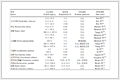
To evaluate the viability of this proposal, the reaction conditions were optimized using acetophenone (1a), 3-(dimethylamino)-1-phenylprop-2-en-1-one (2a) and 1H-indol-3-amine (3a) as model substrates (Table 1). First, the reaction was mediated only by I2 and the isolated yield of the target product was only 38% (entry 1). When Brönsted acids or Lewis acids were used as additives, the optimal yield of product is achieved with FeCl3 (entries 2–11). Then the equivalents of I2 and FeCl3 were optimized and found that 1.5 equiv. of I2 and 1.0 equiv. of FeCl3 were the optimum (entries 12–17). Finally, by comparing the reaction at different temperatures, 110 ℃ was determined to be the best (entries 18–21).
|
Table 1 Optimization of reaction conditions.a |


Subsequent trials investigated the ranges of arylmethyl ketones, enaminones and 3-aminoindazoles (Scheme 2). Firstly, acetophenone with alkyl and alkoxy substitutions at different sites on the benzene ring could be readily converted to the target products (4a-4k, 64%–77%). In addition, with halogen, methylthio and phenyl substituted acetophenones, the target products were obtained smoothly (4l-4q, 54%–69%). For 1-acetylnaphthalene, 2-acetylnaphthalene and 2-acetylfluorene with condensed ring structures the target molecules were obtained in relatively high yields (4r-4t, 73%–76%). Fortunately, heterocycles with furan, thiophene and their derived structures were also converted to the products in moderate yields (4u-5a, 55%–70%). Furthermore, the compatibility of aryl and alkyl enaminones was also assessed. The substitution of alkyl and alkoxy groups on the benzene ring of the enaminones allowed the formation of the target products (5b-5i, 71%–78%). Phenyl enaminones having halogen, trifluoromethoxy, methylthio and phenyl substituents were also compatible with the reaction (5j-5o, 61%–70%). Aromatic enaminones with non-benzene rings such as naphthalene, furan and thiophene could also be converted to the target structures successfully (5p-5s, 61%–67%). Fortunately, alkyl type enaminones incorporating tert-butyl, cyclopentyl, cyclohexyl, 4-tetrahydropyranyl and 1-adamantyl groups also yield the products satisfactorily (5t-5x, 60%–74%). The structure of product 5v was confirmed by X-ray single crystal diffraction (CCDC: 2290671). Finally, the range of substrates for substituted 3-aminoindazoles were examined and found that both 5-Me and 6-Me substituted 3-aminoindazoles gave the target products in appreciable yields (5y and 5z, 72% and 75%). Moreover, the polycyclic nitrogen heterocyclic were also successfully achieved when using 4-, 5-, 6-, 7-site halogen-substituted 3-aminoindazole as substrates (6a-6f, 56%–70%). It is noteworthy that the product 4r obtained from 1-acetylnaphthalene (1r) was scaled up on a 5.0 mmol scale and the isolated yield was still maintained at 62%.

|
Download:
|
| Scheme 2. Scope of the substrates. Reaction conditions: 1 (1.2 mmol), 2 (1.0 mmol), 3 (1.0 mmol), I2 (1.5 mmol), FeCl3 (1.0 mmol), DMSO (4 mL), 110 ℃, and 8 h. Isolated yield. | |

The photophysical properties of the unknown molecules were also investigated (Fig. 1). These trials primarily explored the AIE properties and solvated fluorescence characteristics of products 4r and 4a at 360 nm (see Supporting information for details). Molecules 4r was examined in equal concentrations of MeCN/H2O mixed solvents with different water fractions, when the water fraction increased from 0 to 60% its fluorescence emission intensity gradually weakened. However, the fluorescence intensity increased rapidly when the f went from 70% to 98% (Fig. 1a). Further, the trend of maximum emission intensity with water fraction was showed in Fig. 1b, which demonstrates the weakest fluorescence intensity occurred at 60% water fraction. The tendency of first reducing and then increasing of the emission intensity may be caused by the superposition of the intrinsic AIE effect and the solvent effect of fluorescence [58–60]. These results demonstrated their typical AIE properties and have potencial in organic functional luminophores [61–63].

|
Download:
|
| Fig. 1. (a) Photoluminescence (PL) spectra of 4r MeCN/H2O mixtures with different water fractions (fw). (b) Maximum fluorescence emission intensity of 4r as a function of fw. Inset: Luminescence photographs of 4r in MeCN/H2O mixtures (fw = 0%, 50% and 98%) taken under 365 nm excitation. | |

The reaction mechanism was examined by performing a series of controll experiments (Scheme 3). In initial trials, acetophenone (1a) was almost quantitatively converted to phenylglyoxal (1ab) or phenylglyoxal monohydrate (1ac) mediated by I2 and DMSO (Scheme 3a) [64–66]. These experiments further confirmed that α-iodoacetophenone (1ad) and phenylglyoxal monohydrate (1ac) were intermediates in the reaction (Schemes 3b and c). In the case that intermediate 1ac was used as substrate, FeCl3 was found to play a more important role than I2, whereas the target product could not be obtained if both were absent (Scheme 3c). The generation of substituted furan 7a under the standard conditions, indirectly proved the existence of ketenimine cation B-H, which may experience self-cyclization and subsequent deprotonation process (Scheme 3d). Finally, the use of deuterated acetophenone-d (1a-D) as substrate gave the deuterated product 4a-D in 68% isolated yield and the retention of deuterium atoms up to 90% in the product. This result demonstrated that the mechanism involved the cleavage of two C—D bonds, meaning that the only retained C—D bond in phenylglyoxal monohydrate (1ac) remains unbroken during the reaction (Scheme 3e).

|
Download:
|
| Scheme 3. Mechanistic studies. | |

On the basis of these control experiments and related literature, we propose a reaction mechanism around the capture of ketenimine cation (Scheme 4) [67–75]. In this process, the deuterated acetophenone-d (1a-D) is initially converted to phenylglyoxal-d (1ab-D) via intermediate α-iodoacetophenone-d (1ad-D), mediated by I2 and DMSO. Subsequently, intermediate 1ab-D is attacked by the electron-rich α-site of enaminone (2a) to afford the unstable cationic intermediate A. The intermediate A convert to the key ketenimine cation B with the release of water. The imine structure of intermediate B is then attacked by the amino group of 3-aminoindazole (3a) to form C, following intramolecular nucleophilic addition to yield intermediate D with the coordination of FeCl3. The tautomerism of D occurs to generate the enol form E, which subsequently undergoes dehydration to give intermediate F. Then, the two nitrogen atoms of the intermediate F may coordinate with FeCl3, increasing the electrophilicity of the carbon atom between the two nitrogen atoms, thus allowing the hydroxyl group to undergo nucleophilic cyclization to form intermediate G. Finally, intermediate G along with the lost HNMe2 gas under heating to form the target product 4a-D. Delightedly, intermediates A, B, G and product 4a-D were detected in situ during analysis of the reaction solution by high-resolution mass spectrometry, providing evidence for the proposed mechanism.

|
Download:
|
| Scheme 4. Proposed mechanism. | |

In conclusion, this work utilized arylmethyl ketones and enaminones to generate ketenimine cations in situ, which subsequently captured by 3-aminoindazole to achieve the bicyclization process. This transformation realized the first-ever tetra-functionalization reaction of enaminones, allowing the construction of novel polycyclic nitrogen heterocyclic furo[2′,3′:4,5]pyrimido[1,2-b]indazole skeletons. The photophysical properties of the new skeletons were further investigated and shown favorable AIE properties, which may have potential applications in the organic functional luminescent materials. Research to develop synthetic novel molecular skeletons and assessments of the photophysical properties are currently underway in our laboratory.
Declaration of competing interestThe authors declare that they have no known competing financial interests or personal relationships that could have appeared to influence the work reported in this paper.
CRediT authorship contribution statementYou Zhou: Conceptualization, Data curation, Formal analysis, Investigation, Methodology, Project administration, Resources, Software, Supervision, Validation, Visualization, Writing – original draft, Writing – review & editing. Li-Sheng Wang: Data curation, Formal analysis, Supervision, Writing – review & editing. Shuang-Gui Lei: Data curation, Formal analysis, Investigation, Supervision, Writing – review & editing. Bo-Cheng Tang: Investigation, Methodology, Writing – review & editing. Zhi-Cheng Yu: Formal analysis, Supervision, Writing – review & editing. Xing Li: Data curation. Yan-Dong Wu: Conceptualization, Funding acquisition, Investigation, Methodology, Project administration, Supervision, Validation, Writing – review & editing. Kai-Lu Zheng: Investigation, Methodology, Project administration, Resources, Software, Supervision, Validation, Visualization, Writing – review & editing. An-Xin Wu: Conceptualization, Funding acquisition, Investigation, Methodology, Project administration, Resources, Software, Supervision, Validation, Visualization, Writing – review & editing.
AcknowledgmentsThis work was supported by the National Natural Science Foundation of China (Nos. 21971080, 22171098). This work was also supported by Chengdu Guibao Science & Technology Co., Ltd. This work was also supported by the 111 Project (No. B17019).
Supplementary materialsSupplementary material associated with this article can be found, in the online version, at doi:10.1016/j.cclet.2024.109799.
| [1] |
A.C. Flick, H.X. Ding, C.J. O'Donnell, et al., J. Med. Chem. 60 (2017) 6480-6515. DOI:10.1021/acs.jmedchem.7b00010 |
| [2] |
A. Chino, R. Seo, Y. Amano, et al., Chem. Pharm. Bull. 66 (2018) 286-294. DOI:10.1248/cpb.c17-00836 |
| [3] |
T. Yakaiah, B.P.V. Lingaiah, B. Narsaiah, et al., Eur. J. Med. Chem. 43 (2008) 341-347. DOI:10.1016/j.ejmech.2007.03.031 |
| [4] |
K. Hong, Z.X. Yu, X. Xu, et al., Nat. Commun. 14 (2023) 6378. DOI:10.1038/s41467-023-42032-9 |
| [5] |
M. Grzybowski, I. Deperasińska, D.T. Gryko, et al., Chem. Commun. 52 (2016) 5108-5111. DOI:10.1039/C6CC01017B |
| [6] |
M. Balci, Tetrahedron Lett. 61 (2020) 151994. DOI:10.1016/j.tetlet.2020.151994 |
| [7] |
G. Thoma, D.P. Curran, S.V. Geib, et al., J. Am. Chem. Soc. 115 (1993) 8585-8591. DOI:10.1021/ja00072a010 |
| [8] |
M. Zhang, Y. Qiao, D. Wei, et al., Org. Chem. Front. 8 (2021) 3268-3273. DOI:10.1039/d1qo00413a |
| [9] |
Y. Han, L. Zhou, J.P. Wan, et al., Chin. Chem. Lett. 35 (2024) 108977. DOI:10.1016/j.cclet.2023.108977 |
| [10] |
L. Fu, J.P. Wan, Tetrahedron Lett. 130 (2023) 154766. DOI:10.1016/j.tetlet.2023.154766 |
| [11] |
Y. Liu, L. Deng, J.P. Wan, et al., Org. Lett. 26 (2024) 46-50. DOI:10.1021/acs.orglett.3c03581 |
| [12] |
Y. Guo, Y. Liu, J.P. Wan, Chin. Chem. Lett. 33 (2022) 855-858. DOI:10.1016/j.cclet.2021.08.003 |
| [13] |
M. Zhang, L. Chen, F. Yu, et al., New J. Chem. 47 (2023) 12274. DOI:10.1039/d3nj02073h |
| [14] |
M. Zhang, L. Chen, F. Yu, et al., Org. Lett. 25 (2023) 7298-7303. DOI:10.1021/acs.orglett.3c02515 |
| [15] |
W.B. He, X. Xu, W.M. He, et al., Chin. Chem. Lett. 34 (2023) 107640. DOI:10.1016/j.cclet.2022.06.063 |
| [16] |
H.C. Li, X.L. Chen, B. Yu, et al., Org. Chem. Front. 11 (2024) 135-141. DOI:10.1039/D3QO01575K |
| [17] |
H.C. Li, X.L. Chen, B. Yu, et al., Org. Lett. 25 (2023) 8067-8071. DOI:10.1021/acs.orglett.3c03121 |
| [18] |
J.P. Wan, S. Zhong, L. Xie, et al., Org. Lett. 18 (2016) 584-587. DOI:10.1021/acs.orglett.5b03608 |
| [19] |
Q. Yu, Y. Liu, J.P. Wan, Chin. Chem. Lett. 32 (2021) 3514-3517. DOI:10.1016/j.cclet.2021.04.037 |
| [20] |
T. Liu, J.P. Wan, Y. Liu, Chem. Commun. 57 (2021) 9112-9115. DOI:10.1039/d1cc03292e |
| [21] |
X. Li, F. Yu, J. Huang, et al., J. Org. Chem. 87 (2022) 10349-10358. DOI:10.1021/acs.joc.2c00096 |
| [22] |
Y. Guo, Y. Xiang, J.P. Wan, et al., Org. Lett. 20 (2018) 3971-3974. DOI:10.1021/acs.orglett.8b01536 |
| [23] |
T. Liu, Y. Liu, J.P. Wan, et al., J. Org. Chem. 86 (2021) 9861-9868. DOI:10.1021/acs.joc.1c00862 |
| [24] |
X. Li, F. Yu, J. Huang, et al., Org. Lett. 24 (2022) 7372-7377. DOI:10.1021/acs.orglett.2c02905 |
| [25] |
Q. Zhang, S. Yan, F. Yu, et al., Eur. J. Org. Chem. 2020 (2020) 1154-1159. DOI:10.1002/ejoc.201901886 |
| [26] |
E.A. Sokolova, A.A. Festa, E.V. Van der Eycken, et al., Molecules 25 (2020) 5984-5987. DOI:10.3390/molecules25245984 |
| [27] |
Y. Hu, J. Wang, A. Wu, et al., Tetrahedron 128 (2022) 133124. DOI:10.1016/j.tet.2022.133124 |
| [28] |
Z. Xu, X. Geng, L. Wang, et al., J. Org. Chem. 87 (2022) 6562-6572. DOI:10.1021/acs.joc.2c00136 |
| [29] |
S. Kantevari, S.R. Patpi, D. Addla, et al., ACS Comb. Sci. 13 (2011) 427-435. DOI:10.1021/co2000604 |
| [30] |
S. Das, S. Khanikar, S. Kaping, et al., Eur. J. Chem. 11 (2020) 304-313. DOI:10.5155/eurjchem.11.4.304-313.2033 |
| [31] |
X. Lu, C. Wan, J.P. Wan, et al., Chin. J. Org. Chem. 41 (2021) 4444-4449. DOI:10.6023/cjoc202107028 |
| [32] |
S. Zhong, Y. Lu, J.P. Wan, et al., Org. Biomol. Chem. 14 (2016) 6270-6273. DOI:10.1039/C6OB01038E |
| [33] |
Z. Xu, L. Fu, J.P. Wan, et al., Org. Lett. 23 (2021) 5049-5053. DOI:10.1021/acs.orglett.1c01581 |
| [34] |
T. Luo, J.P. Wan, Y. Liu, Org. Chem. Front. 7 (2020) 1107-1112. DOI:10.1039/d0qo00065e |
| [35] |
Y. Lin, J.P. Wan, Y. Liu, J. Org. Chem. 88 (2023) 4017-4023. DOI:10.1021/acs.joc.3c00206 |
| [36] |
X.Y. Chen, X. Zhang, J.P. Wan, Org. Biomol. Chem. 20 (2022) 2356-2369. DOI:10.1039/d2ob00126h |
| [37] |
D. Cao, J.P. Wan, Y. Liu, et al., Chem. Commun. 59 (2023) 6383-6386. DOI:10.1039/d3cc01427d |
| [38] |
J. Ye, J. Luo, J.P. Wan, et al., Org. Lett. 25 (2023) 8451-8456. DOI:10.1021/acs.orglett.3c03353 |
| [39] |
L. Yang, L. Wei, J.P. Wan, Chem. Commun. 54 (2018) 7475-7478. DOI:10.1039/c8cc03514h |
| [40] |
K. Yan, M. Liu, J. Wen, et al., New J. Chem. 46 (2022) 7329-7333. DOI:10.1039/d2nj00663d |
| [41] |
P. Zhao, X. Wu, A.X. Wu, et al., Org. Lett. 21 (2019) 2708-2711. DOI:10.1021/acs.orglett.9b00685 |
| [42] |
Y. Zhou, L.S. Wang, A.X. Wu, et al., Org. Chem. Front. 9 (2022) 4416-4420. DOI:10.1039/d2qo00676f |
| [43] |
Z. Yang, T. Yang, C. Zhou, et al., J. Org. Chem. 84 (2019) 16262-16267. DOI:10.1021/acs.joc.9b02866 |
| [44] |
S.G. Lei, Y. Zhou, A.X. Wu, et al., J. Org. Chem. 88 (2023) 11150-11160. DOI:10.1021/acs.joc.3c01118 |
| [45] |
Y. Sun, Y. Wang, F. Yu, et al., Chem. Eur. J. 29 (2023) e202300297. DOI:10.1002/chem.202300297 |
| [46] |
S.B. Wakade, D.K. Tiwari, D.K. Tiwari, et al., Tetrahedron 75 (2019) 4024-4030. DOI:10.1016/j.tet.2019.06.030 |
| [47] |
Q. Yu, Y. Liu, J.P. Wan, Org. Chem. Front. 7 (2020) 2770-2775. DOI:10.1039/d0qo00855a |
| [48] |
B. Zhang, F. Yu, S. Yan, et al., Adv. Synth. Catal. 364 (2022) 1602-1606. DOI:10.1002/adsc.202200089 |
| [49] |
M.O. Akram, S. Bera, N.T. Patil, Chem. Commun. 52 (2016) 12306-12309. DOI:10.1039/C6CC07119H |
| [50] |
L. Fu, J.P. Wan, Y. Liu, et al., Org. Lett. 22 (2020) 9518-9523. DOI:10.1021/acs.orglett.0c03548 |
| [51] |
J. Wan, Z. Tu, Y. Wang, Chem. Eur. J. 25 (2019) 6907-6910. DOI:10.1002/chem.201901025 |
| [52] |
M. Zhang, X. Chen, F. Yu, et al., Adv. Synth. Catal. 364 (2022) 4440-4446. DOI:10.1002/adsc.202201154 |
| [53] |
S. Mkrtchyan, V.O. Iaroshenko, J. Org. Chem. 86 (2021) 4896-4916. DOI:10.1021/acs.joc.0c02294 |
| [54] |
L. Tian, J.P. Wan, S. Sheng, ChemCatChem 12 (2020) 2533-2537. DOI:10.1002/cctc.202000244 |
| [55] |
F.C. Yu, B. Zhou, Y. Shen, et al., Tetrahedron 71 (2015) 1036-1044. DOI:10.1016/j.tet.2014.12.100 |
| [56] |
S.G. Lei, Y. Zhou, A.X. Wu, et al., Org. Chem. Front. 10 (2023) 4843-4847. DOI:10.1039/d3qo01149f |
| [57] |
H. Xu, B. Zhou, F.C. Yu, et al., Chem. Commun. 52 (2016) 8002-8005. DOI:10.1039/C6CC02659A |
| [58] |
X. Zhou, Z.H. Lu, C. Yang, et al., J. Mater. Chem. C 7 (2019) 6607-6615. DOI:10.1039/c9tc00346k |
| [59] |
W. Qin, B. Liu, B.Z. Tang, et al., Adv. Funct. Materials 24 (2013) 635-643. |
| [60] |
H.J. Kim, M.J. Cho, D.H. Choi, et al., Chem. Commun. 55 (2019) 9475-9478. DOI:10.1039/c9cc05391c |
| [61] |
Z. Zhao, H. Zhang, B.Z. Tang, et al., Angew. Chem. Int. Ed. 59 (2020) 9888-9907. DOI:10.1002/anie.201916729 |
| [62] |
D. Yan, D. Wang, B.Z. Tang, et al., Angew. Chem. Int. Ed. 60 (2021) 15724-15742. DOI:10.1002/anie.202006191 |
| [63] |
Y. Xie, Z. Li, Natl. Sci. Rev. 8 (2021) nwaa199. DOI:10.1093/nsr/nwaa199 |
| [64] |
Y.P. Zhu, M. Lian, A.X. Wu, et al., Chem. Commun. 48 (2012) 9086-9088. DOI:10.1039/c2cc34561g |
| [65] |
Y.P. Zhu, F.C. Jia, A.X. Wu, et al., Org. Lett. 14 (2012) 5378-5381. DOI:10.1021/ol302613q |
| [66] |
Q. Gao, S. Liu, A.X. Wu, et al., Org. Lett. 16 (2014) 4582-4585. DOI:10.1021/ol502134u |
| [67] |
Y. Zhou, S.G. Lei, A.X. Wu, et al., Org. Lett. 25 (2023) 3386-3390. DOI:10.1021/acs.orglett.3c00886 |
| [68] |
Q. Cai, M.C. Liu, A.X. Wu, et al., Chin. Chem. Lett. 26 (2015) 881-884. DOI:10.1016/j.cclet.2014.12.016 |
| [69] |
P. Zhao, Z.C. Yu, A.X. Wu, et al., J. Org. Chem. 87 (2022) 15197-15209. DOI:10.1021/acs.joc.2c01724 |
| [70] |
P. Zhao, Y. Zhou, A.X. Wu, et al., J. Org. Chem. 89 (2024) 2505-2515. DOI:10.1021/acs.joc.3c02539 |
| [71] |
X. Geng, Z. Xu, L. Wang, et al., Org. Lett. 23 (2021) 8343-8347. DOI:10.1021/acs.orglett.1c03076 |
| [72] |
J. Huo, X. Geng, L. Wang, et al., Org. Lett. 25 (2023) 512-516. DOI:10.1021/acs.orglett.2c04227 |
| [73] |
Y. Guo, Q. Ga, Org. Biomol. Chem. 20 (2022) 7138-7150. DOI:10.1039/d2ob01348g |
| [74] |
P. Zhao, L. Wang, Y. Ma, et al., Org. Lett. 25 (2023) 3314-3318. DOI:10.1021/acs.orglett.3c01145 |
| [75] |
W. Zuo, X. Geng, L. Wang, et al., Org. Lett. 25 (2023) 6062-6066. DOI:10.1021/acs.orglett.3c02305 |