 2025, Vol. 36


Enantiomerically enriched ketal structures bearing quaternary stereocenter is highly sought-after in the field of drug discovery and development due to their prevalence in bioactive molecules and natural products [1]. Many potential drugs, such as Obtusin [2], Eudesmanolides [3], dioxole derivatives [4], Ossamycin [5], Fimbricalyxlactones [6], and Preussomerin K [7], contain this important structural unit. As one of the most attractive precursor, γ-hydroxy butenolides [8] have found widespread applications in organic synthesis, materials science, and medicinal chemistry [9]. They also serve as valuable intermediates for synthesizing complex molecules [10]. Additionally, they can be modified into five-carbon sugar analogs [11], and be made into ideal drug carriers for targeted delivery and controlled release of therapeutic agents [12]. However, asymmetric synthesis of cyclic ketal compounds with quaternary stereocenter is a challenging task due to the difficulty in controlling stereochemistry and activity during the reaction [13], [14].
Dynamic kinetic resolution (DKR) [15-18], employing various catalysts including biological enzymes [19], chiral DMAPs [20], [21], carbenes [22], and imidazoles [23], is an effective approach for studying the enantioselective acylation of hemiacetals. In 1995, Kellogg and Feringa demonstrated that lipase R immobilized on Hyflo Super Cell could catalyze the conversion of 5-hydroxy-5H-furan-2-one to acetic acid 5-oxo-2,5-dihydrofuran-2-yl ester at ambient temperature by acylation with vinyl acetate (Scheme 1a) [19]. In recent years, the iterative development of organocatalysts [24] has significantly advanced the asymmetric acylation of cyclic hemiacetals. In 2008, Yamada and coworkers reported the catalytic DKR of hemiacetal using a chiral dimethylaminopyridine (DMAP) catalyst (Scheme 1b, left) [20,21]. In 2019, Chi and coworkers developed a new catalytic DKR strategy for the asymmetric acylation of hydroxyphthalides using a chiral acyl azolium intermediate derived from a carbene catalyst (Scheme 1b, middle) [22]. Very recently, Zhang’s group reported a new method for synthesizing chiral phthalidyl ester prodrugs using a chiral bicyclic imidazole organocatalyst and a continuous injection process (Scheme 1b, right) [23]. These elegant examples are mostly based on the asymmetric acylation reaction of hemiacetals with tertiary stereocenter. So far, the asymmetric acylation of hemiketal compounds containing quaternary stereocenter based on DKR remains challenges. First, the existence of steric hindrance [25] often limits the conversion of hemiketals to chiral ketals. Second, the unstable intermediate formed in this reaction can undergo external aggregation [26]. Third, hemiketal compounds bearing quaternary stereocenter have low activity and are not easily racemized [27].

|
Download:
|
| Scheme 1. Asymmetric DKR acylation of hemiacetals and hemiketals. | |
Enzymes exhibit a high degree of specificity towards their substrates [28]. The successful enzymatic catalysis of DKR [19] has provided insight into our development a new strategy for the asymmetric transformation of hemiketals to chiral ketals. Based on our previous work [29], [30], we hypothesize to use the enzyme-like properties of amino acid-derived bifunctional organocatalyst for chiral recognition of the hemiketals. At the same time, enantiomer of the hemiketals that are difficult to recognize will undergo rapid racemization. This idea may contribute to the efficient DKR conversion of hemiketals. Rationally, we propose that the bifunctional organocatalyst first recognizes the (S)-enantiomer of the hemiketal through binding to the R3NH+ ammonium group and through hydrogen-bond interactions with the hemiketal substrate. Then, the rapid racemization of the unrecognized (R)-enantiomer facilitates smooth DKR. Therefore, we have developed a novel strategy for the DKR asymmetric acylation of γ-hydroxy-γ-perfluoroalkyl butenolides [31]/phthalides under mild conditions. The process utilizes a bifunctional organocatalyst derived from amino acids as the catalysts for substrates chiral recognition, and does not require the addition of other bases (Scheme 1c). The transformation of hemiketals into chiral ketals occurs via hydrogen-bond regulation.
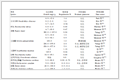
Initially, the DKR reaction of the hemiketal 1a with acid anhydrides 2b was selected as the model reaction (Table 1). Preliminarily, the desired hemiketal acylation product 3a was obtained using 10 mol% of the L-tert-leucine derived urea-tertiary amine bifunctional catalyst C1 in toluene at 25 ℃. Despite its moderate (63%) yield, it provided an ordinary (45%) enantioselective result (Table 1, entry 1). This result indicates that the hydrogen-bond donors and acceptor of urea and tertiary amine functional groups are suitable for the asymmetric DKR system of hemiketals, and it also confirms our speculation that bifunctional organocatalyst are capable of catalyzing such DKR reaction. Then L-tert-leucine-derived thiourea-tertiary amine bifunctional catalyst C2 afforded the corresponding product 3a in 42% yield with 21% ee (Table 1, entry 2). When the five-membered ring of the tertiary amine on the catalyst was replaced by a six-membered ring C3-C4, the expected yield and enantioselectivity were not obtained (entries 3 and 4). To further improve the yield and enantioselectivity, we attempted to increase the hydrogen-bond of the bifunctional organocatalyst L-tert-leucine-derived bifunctional organocatalyst C5-C8 (entries 5–8), containing multiple hydrogen-bond donors and tertiary amine, were screened for their catalytic activity in toluene at room temperature for 96 h. It was found that the L-tert-leucine derived urea-tertiary amine catalyst C7 improved both the yield and enantioselectivity (Table 1, entry 7; 72% yield, 90% ee). Accordingly, we selected C7 as the catalyst to screen solvent (entries 9–13, see Supporting information for details). The solvent cyclopentyl methyl ether (CPME) provided product 3a in 75% yield with 95% ee (entry 13). To further increase the yield of the reaction (entries 14–16, see Supporting information for more details), it was discovered that incorporating 5Å MS (molecular sieves) as an additive significantly improved the activity of the reaction. This resulted in the formation of 3a in 93% yield with 94% ee (entry 16).
|
Table 1 Optimization of reaction conditions.a |


With the optimal reaction conditions in hand (Table 1, entry 16), a substrate screening was conducted to investigate the reactivity of various hemiketal 1 and acid anhydrides 2 combinations. As shown in Scheme 2, all substrates underwent smooth, resulting in the desired chiral ketal products in good yields with excellent enantioselectivities. The reaction tolerated neutral, electron-withdrawing, and electron-donating substituents at the ortho-, meta-, and para-positions on the aromatic ring of hemiketal 1, affording the corresponding acylation product ketals 3a-3r in 74%–95% yields with 74%–96% ee values. 2,5- and 3,5-disubstituted 1s-1u gave the corresponding products 3s-3u in 89%–93% yields with 85%–95% ee values. 2-Naphthyl-substituted 1v could afford 3v in 87% yield with 89% ee within 80 h. Hemiketals bearing different thienyl and furyl substituents (2-thienyl 1w, 3-thienyl 1x, 2-furyl 1y and 3-furyl 1z) also showed good reactivities (83%–92% yields, 88%–96% ee values, 3w–3z). Furthermore, we attempted to catalyze this reaction using the enantiomer of the catalyst under standard conditions, and successfully obtained the enantiomer of the chiral ketal ent-3a in 91% yield and 89% ee.

|
Download:
|
| Scheme 2. Substrate scope of ketal products. Reaction conditions: 1 (0.1 mmol), C7 (0.01 mmol), 2 (0.2 mmol), additive (20 mg) and solvent (1.0 mL). Yield of isolated product. Determined by HPLC analysis on a chiral stationary phase. a Reaction conditions: 6 (0.1 mmol), C5 (0.01 mmol), 2 (0.2 mmol), additive (20 mg) and solvent (1.0 mL). Yield of isolated product. Determined by HPLC analysis on a chiral stationary phase. b C5 (0.02 mmol), 60 ℃. | |

Subsequently, we investigated the substituents on the 3- or 4-position of the hemiketal moiety and found that the reaction proceeded smoothly. The product 3za-3zc could still be obtained in 53%–77% yields with 79%–89% ee. On the other hand, acid anhydride 2 was also shown to have a broad range of applicability under standard conditions, with ketal products of 3zd-3zg being obtainable in 55%–88% yields with 81%–95% ee. The absolute configurations of these adducts were assigned based on the crystal structure of 3a, determined by single crystal X-ray diffraction analysis (CCDC: 2254748). In addition, Considering the importance of fluorine substituents in pharmaceutical chemistry [32], we also evaluated the effect of in 4-aryl-5-hydroxy-5-(pentafluoroethyl)furan-2(5H)-ones 4 with propionic anhydride 2a. Subsequently, an investigation was conducted on the scope of substrate applicability. All reactions with substituents proceeded smoothly, and afforded the acylation products 5a-5f in 72%–90% yields with 87%–95% ee. Based on previous asymmetric studies of hydroxyphthalides [20], we aim to challenge the DKR of 3-substituted hydroxyphthalides 6 to achieve asymmetric acylation reaction at the quaternary stereocenter (see Supporting information for more details). The anhydride was adjusted to acetic anhydride, propanoic anhydride, butyric anhydride, isobutyric anhydride, and n-valeric anhydride, respectively, and obtained the corresponding chiral products 7a-7e in 75%–91% yields with 57%–94% ee. The results indicate that increasing the steric hindrance of the anhydride can affect the reaction activity. Changes in the substituents on the benzene ring can also lead to chiral products 7f in 72% yields with 83% ee. Naphthyl group could also afford ketal product 7g in 83% yield with 81% ee within 96 h. Furthermore, we attempted the DKR of a six-membered ring tetrasubstituted hemiketal under standard reaction conditions, which resulted in the chiral ketal product 7h in 65% yield with 69% ee. The absolute configurations of these adducts were assigned based on the crystal structure of 7f, determined by single crystal X-ray diffraction analysis (CCDC: 2254753). Subsequent research focused on methylphenyl peptides and found that increasing temperature and using 20 mol% of C5 resulted in 81% yield with 99% ee.
To further understand this reaction, we selectively performed the methylation experiment on the N–H bond and found that the catalyst C9-C12 had a relatively large effect on the reaction (Scheme 3). The ketal 3a was obtained in 5%–8% yield with 0–4% ee. It proves that the N–H bond was not only important for the activity, but also critical for the enantioselectivity. Subsequently, the reaction mixture of catalyst C7 with hemiketals 1a was investigated by using NMR. The analysis revealed an interaction between the pyridine nitrogen as a hydrogen bond acceptor and the hemiketal (see Supporting information for details).

|
Download:
|
| Scheme 3. The effect of hydrogen bonds in catalyst. | |

γ-Hydroxy butenolides can be converted to corresponding five-carbon sugar analogues in the field of biochemistry. To further evaluate the synthetic potential of these asymmetric catalytic systems, we carried out a gram-scale synthesis using catalyst C7 to synthesize chiral ketal 3a from 5-hydroxy-3-methyl-4-phenyl-5-(trifluoromethyl)furan-2(5H)-one 1a (4 mmol) and propionic anhydride 2b (8 mmol). The desired product 3a was produced in 94% yield (1.2 g) with 93% ee under standard conditions (Scheme 4a). Treatment of the chiral ketal 3a with AIBN (2.0 equiv.), NBS (2.0 equiv) in CCl4 at 80 ℃ resulted in the substitution occurring smoothly, and afforded the brominated product 8 in 78% yield with 95% ee. The hydrolysis of compound 8 in the presence of sodium formate successfully converted it into alcohol 9, which could be directly benzylated to obtain the product 10 in 36% yield with 4% ee. Then a one-pot, two-step procedure involving selective reduction of the carbon group then yielded acetyl protected ketal 11. Subsequent Vorbrîggen reaction with thymine furnished the nucleoside 12 in 72% yield with 2% ee (Scheme 4b). Nucleoside derivatives have shown significant activity in the fields of anti-tumor and anti-viral medicine [33-35]. Nucleoside analog 12 were evaluated for their cytotoxic activity against three human cancer cell lines (A549, HepG2, and MCF-7 cells) in vitro using the CCK-8 assay. IC50 data analysis showed that compound 12 exhibited strong cytotoxicity against A549, HepG2, and MCF-7 cells, with IC50 values of 14.62, 11.97, and 14.59 µmol/L, respectively. Therefore, such nucleoside analog may serve as potential anticancer agents and require further research.

|
Download:
|
| Scheme 4. Gram-scale and synthetic transformations. | |

In conclusion, we have established a DKR strategy for acylation reaction of hemiketals containing quaternary stereocenter through hydrogen-bond catalysis mode, and successfully achieved the transformation of hemiketals to chiral ketals. The chiral products can be applied to the synthesis of related valuable derivatives with good biological activity. This research has shown that the key to achieving such DKR reaction lies in the use of chiral bifunctional organocatalyst controlled by hydrogen-bond. Further exploration of practical synthesis of other valuable chiral building blocks is currently ongoing in our laboratory.
Declaration of competing interestThe authors declare that they have no known competing financial interests or personal relationships that could have appeared to influence the work reported in this paper.
AcknowledgmentsThis work was supported by the National Natural Science Foundation of China (Nos. 82130103, 82151525 and 81903465), the Central Plains Scholars and Scientists Studio Fund (2018002), the Natural Science Foundation of Henan Province (No. 212300410051), and the Science and Technology Major Project of Henan Province (No. 221100310300). We also acknowledge financial support from the Henan Key Laboratory of Organic Functional Molecules and Drug Innovation.
Supplementary materialsSupplementary material associated with this article can be found, in the online version, at doi:10.1016/j.cclet.2024.109781.
| [1] |
Y.J. Wu, N.A. Meanwell, J. Med. Chem. 64 (2021) 9786-9874. DOI:10.1021/acs.jmedchem.1c00790 |
| [2] |
M. Norte, J.J. Fernández, J.Z. Ruano, Tetrahedron 45 (1989) 5987-5994. DOI:10.1016/S0040-4020(01)89125-0 |
| [3] |
G. Xu, L.Y. Peng, X.L. Shen, et al., Helvetica. Chim. Acta 93 (2010) 1773-1778. DOI:10.1002/hlca.200900453 |
| [4] |
L. Alig, J. Alsenz, M. Andjelkovic, et al., J. Med. Chem. 51 (2008) 2115-2127. DOI:10.1021/jm701487t |
| [5] |
E. Honjo, N. Kutsumura, Y. Ishikawa, et al., Tetrahedron 64 (2008) 9495-9506. DOI:10.1016/j.tet.2008.07.078 |
| [6] |
W. Sun, S. Kayal, W.A.T. Raimbach, et al., Chem. Commun. 58 (2022) 1546-1549. DOI:10.1039/d1cc06800h |
| [7] |
E. Quesada, M. Stockley, R.J.K. Taylor, Tetrahedron Lett. 45 (2004) 4877-4881. DOI:10.1016/j.tetlet.2004.04.143 |
| [8] |
D. Naidoo, M. Pošta, P. Kar, et al., J. Mol. Struct. 1269 (2022) 133831. DOI:10.1016/j.molstruc.2022.133831 |
| [9] |
H. Zhang, M.M. Conte, X.C. Huang, et al., Org. Biomol. Chem. 10 (2012) 2656-2663. DOI:10.1039/c2ob06747a |
| [10] |
S. De Marino, M. Iorizzi, F. Zollo, et al., J. Nat. Prod. 63 (2000) 322-326. DOI:10.1021/np990374+ |
| [11] |
P. Liang, M. Cao, J. Li, et al., Biotechnol. Adv. 64 (2023) 108105. DOI:10.1016/j.biotechadv.2023.108105 |
| [12] |
Q. Dang, B.S. Brown, P.D. van Poelje, et al., Bioorg. Med. Chem. Lett. 9 (1999) 1505-1510. DOI:10.1016/S0960-894X(99)00239-5 |
| [13] |
J. Szeto, V. Sriramurthy, O. Kwon, Org. Lett. 13 (2011) 5420-5423. DOI:10.1021/ol201730q |
| [14] |
Y. Chen, W. Liu, X. Yang, Chin. J. Org. Chem. 42 (2022) 679-697. DOI:10.6023/cjoc202110009 |
| [15] |
W. Liu, X. Yang, Asian J. Org. Chem. 10 (2021) 692-710. DOI:10.1002/ajoc.202100091 |
| [16] |
H. Pellissier, Eur. J. Org. Chem. 2022 (2022) e202101561. DOI:10.1002/ejoc.202101561 |
| [17] |
L.C. Yang, H. Deng, H. Renata, Org. Process. Res. Dev. 26 (2022) 1925-1943. DOI:10.1021/acs.oprd.1c00463 |
| [18] |
X. Yue, Y. Li, D. Sang, et al., Chin. Chem. Lett. 34 (2023) 108178. DOI:10.1016/j.cclet.2023.108178 |
| [19] |
H. Deen, A.D. Cuiper, R.P. Hof, et al., J. Am. Chem. Soc. 118 (1996) 3801-3803. DOI:10.1021/ja953812h |
| [20] |
S. Yamada, K. Yamashita, Tetrahedron Lett. 49 (2008) 32-35. DOI:10.1272/jnms.75.32 |
| [21] |
M.S. Xie, B. Huang, N. Li, et al., J. Am. Chem. Soc. 142 (2020) 19226-19238. DOI:10.1021/jacs.0c09075 |
| [22] |
Y. Liu, P.K. Majhi, R. Song, et al., Angew. Chem. Int. Ed. 59 (2020) 3859-3863. DOI:10.1002/anie.201912926 |
| [23] |
M. Zhou, T. Gridneva, Z. Zhang, et al., Angew. Chem. Int. Ed. 60 (2021) 1641-1645. DOI:10.1002/anie.202012445 |
| [24] |
M. Wang, M. Zhou, L. Zhang, et al., Chem. Sci. 11 (2020) 4801-4807. DOI:10.1039/d0sc00808g |
| [25] |
J.W. Hollett, A. Kelly, R.A. Poirier, J. Phys. Chem. A 110 (2006) 13884-13888. DOI:10.1021/jp066011h |
| [26] |
E. O’Loughlin, E.J. Valente, J. Chem. Crystallogr. 49 (2019) 193-205. DOI:10.1007/s10870-019-00798-1 |
| [27] |
Y.Y. Gao, C.L. Zhang, L. Dai, et al., Org. Lett. 23 (2021) 1361-1366. DOI:10.1021/acs.orglett.1c00024 |
| [28] |
D. Cuiper, M.L. Kouwijzer, P.D. Grootenhuis, et al., J. Org. Chem. 64 (1999) 9529-9537. DOI:10.1021/jo991062e |
| [29] |
X. Xu, Y. He, J. Zhou, et al., J. Org. Chem. 85 (2020) 574-584. DOI:10.1021/acs.joc.9b02676 |
| [30] |
B. Zhu, H. Sun, H. Fan, et al., Org. Chem. Front. 9 (2022) 6631-6639. DOI:10.1039/d2qo01527g |
| [31] |
B. Zhu, T. Zhang, Y. Yu, et al., Org. Chem. Front. 9 (2022) 2955-2962. DOI:10.1039/d2qo00321j |
| [32] |
L. Li, B. Zhu, H. Fan, et al., Org. Chem. Front. 7 (2020) 1343-1348. DOI:10.1039/d0qo00348d |
| [33] |
L. Sun, Y. Peng, W. Yu, et al., J. Med. Chem. 63 (2020) 8554-8566. DOI:10.1021/acs.jmedchem.0c00940 |
| [34] |
J. Chang, Acc. Chem. Res. 55 (2022) 565-578. DOI:10.1021/acs.accounts.1c00697 |
| [35] |
Q. Zhang, Y. Peng, J. Hou, et al., J. Med. Chem. 65 (2022) 9493-9505. DOI:10.1021/acs.jmedchem.2c00869 |