 2024, Vol. 35


b Zhejiang Wansheng Co. Ltd., Linhai 317000, China;
c National Engineering Research Center of Low-Carbon Processing and Utilization of Forest Biomass, Nanjing Forestry University, Nanjing 210037, China
Sulfur-containing compounds widely occur in natural products, and biologically active molecules. Therefore, seeking novel and efficient methods for the synthesis sulfur-containing skeletons has attracted the continuous attention of chemists [1-5]. Isothioureas are ubiquitous structural frameworks commonly found in natural products, agrochemicals, and pharmaceuticals [6]. In this structural family, S-arylisothioureas have also shown promising biological properties, such as anti-infective, antianginal and antiviral activities (Scheme 1a) [7,8]. In addition, isothiourea architectures are widely used as versatile synthons for natural products, bioactive molecules, herbicides, organocatalysts, and ligands [9]. In this respect, S-arylisothioureas are traditionally prepared by the reaction of arylthioureas with amines, benzensulfonic acid or alkyl halides [10,11]. Alternative method such as the reaction of aromatic thiols with benzotriazole-1-carboximidamides has also been developed [12]. Nevertheless, most of these methods still involve the use of toxic and unavailability of starting materials, harsh reaction conditions, and multi-step synthetic sequences. Therefore, the development of novel and efficient approach to S-arylisothioureas has received increased attention from biochemists and synthetic organic chemists. In 2014, Maes and co-workers reported a copper-catalyzed three-component reaction for the synthesis of S-aryl isothioureas starting from amines, isocyanides, and thiosulfonates (Scheme 1b) [13]. In 2017, Dong et al. developed an efficient copper-catalyzed S-arylation of thioureas leading to S-aryl isothioureas (Scheme 1c) [14,15]. Notably, very recently, Sun's group demonstrated an elegant approach to S-arylisothioureas from sulfoxides, isocyanides, and amines through a thermolysis-induced multicomponent tandem reaction (Scheme 1d) [16]. However, significant room still exists for improvement of these methods with regard to catalytic efficiency, generality, and reaction conditions.

|
Download:
|
| Scheme 1. Application and synthesis of isothioureas. | |
Organothianthrenium salts are a significant class of sulfur-containing compounds, containing a neutral sulfur atom and a positively charged sulfur atom [17-19]. In 2019, Ritter et al. reported an elegant and convenient site-selective C–H thianthrenation of arenes leading to aryl thianthrenium salts [20]. Since this pioneering work, tremendous progress has been made using thianthrenium salts as the precursors for the construction of carbon–carbon and carbon–heteroatom bonds [21-31]. Notably, in 2023, Wang and co-workers also developed a novel copper-mediated thianthrenation of arylborons with thianthrene leading to thianthrenium salts [32]. Clearly, chemical conversions using thianthrenium salts as the aryl sources indirectly realizes the Csp2-H bonds functionalization and arylboric acids activation. Therefore, the exploration of chemical transformations based on thianthrenium salts has important research value in the field of organic diversity synthesis.
In recent years, visible-light-induced organic transformations has been recognized as a sustainable and promising strategy for organic transformations via photoinduced single electron transfer (SET) or energy transfer (EnT) processes [33-43]. In this area, the visible-light-accelerated of electron donor–acceptor (EDA) complexes have aroused on-going interest of chemists due to their easy operation and the unique ability of the complexes which can undergo a reversible inner-sphere SET process affording two high active radical species without additional any photoredox catalysts [44-46]. Very recently, a series of interesting studies on the photochemical conversion of thianthrenium salts based on EDA complex activation process have been developed [47-54]. However, the EDA strategy in this regard mainly focuses on the reactions between two molecules, developing the multicomponent EDA strategies based on thianthrenium salts is still in its infancy. In pursuit of step economy, the domino reaction has replaced multi-step chemical transformations which has a significant impact on the synthesis of fine chemicals and pharmaceutical intermediates [55-58]. Obviously, a quantum leap in efficiency could be achieved in a single synthesis operation using multicomponent EDA strategy. Since thianthrenium salts have been reported to act as radical acceptor in EDA complexes, we envisage that S-arylisothioureas could be synthesized indirectly starting from readily available arenes and arylboronic acids (Scheme 1e). As our continuing studies on photoredox catalysis [59-64], we herein report an efficient visible-light-induced multicomponent reaction for the synthesis of S-arylisothioureas from thianthrenium salts, isothiocyanates and secondary amines in the absence of transition metals or other photocatalysts (Scheme 1e).
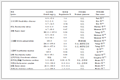
Our initial optimization for the anticipated multicomponent reaction of aryl thianthrenium salt 1a, isothiocyanatobenzene 2a, and morpholine 3a was summarized in Table 1. After a series of experiments, the desired product 4a was obtained in 73% isolated yield when using 2.0 equiv. of K3PO4 as the base and DMSO as the solvent under the irradiation of a blue LED (20 W, 455 nm) for 12 h (Table 1, entry 1, see Supporting information for more details). In the absence of a base, the yield of the reaction is significantly decreased (Table 1, entry 2). In addition, the reaction could not occur without light irradiation (Table 1, entry 3). Under air conditions, the efficiency of the reaction will be greatly reduced (Table 1, entry 4). It is noteworthy that when 455 nm was replaced by other wavelengths, the yield of the desired product decreased (Table 1, entry 5). Further investigation of the solvent revealed DMSO gave the best result, and the use of mixed solvents could not improve the yield of the reaction (Table 1, entries 6 and 7). Replacing K3PO4 with other bases did not promote the yield of the product (Table 1, entry 8). Finally, controlled experiments show that heating alone does not promote the reaction (Table 1, entry 9).
|
Table 1 Screening for the optimal conditions.a |


After obtaining the optimized conditions, efforts were paid to the substrate scope of this transformation. As demonstrated in Scheme 2, various aryl thianthrenium salts 1 bearing electron-withdrawing groups (F, Br, CF3, and CN) or electron-donating groups (Me and PhO) proceeded effectively with isothiocyanatobenzenes 2 and secondary amines 3 under the standard conditions giving the corresponding products in moderate to good yields (4a-4ae). However, the alkenyl or alkynyl thianthrenium salts were not compatible under the standard conditions (see Supporting information for more details). The exact structure of the product can be determined by single crystal X-ray diffraction (4j). Electron-effect and steric hindrance-effect have significant influence on the reaction efficiency. In general, aryl thianthrenium salts and aryl isothiocyanates bearing strong electron-deficient groups showed excellent reactivity in this transformation. Various cyclic or chain secondary aliphatic amines could participate in this reaction efficiently, show no obvious difference of reaction activity. Unfortunately, using alkyl isothiocyanate under the standard conditions delivered no desired products (see Supporting information for details). In addition, other types of amines were also investigated, only secondary amines could participate in the reaction (4ad) (see Supporting information for more details). More importantly, the visible-light-induced EDA complexation strategy was also applied to the late-stage functionalization of pharmaceuticals (4ae), suggesting the potential application value of this method.

|
Download:
|
| Scheme 2. The substrate scope. Reaction conditions: 1 (0.4 mmol), 2 (0.3 mmol), 3 (0.2 mmol), K3PO4 (0.4 mmol) at room temperature under irradiation with a 20 W blue LED (455 nm) for 12 h. Isolated yield. | |

To investigate the synthetic applications of this strategy, we implemented a gram-scale conversion by using the aryl thianthrenium salt 1c (10 mmol), isothiocyanato-4-nitrobenzene 2b (7.5 mmol), and morpholine 3a (5 mmol) under irradiation of two 20 W blue LED lamps (Scheme 3a). To our satisfaction, the reaction proceeded well and resulted in the formation of product 4p with a yield of 65%. Notably, thianthrene 5 was well recovered in quantitative yield which could react with arylboronic acids to produce thianthrenium salts. On the other hand, thianthrene 5 could also be oxidized into thianthrene 5-oxide which was used for further C–H thianthrenation of arenes (Scheme 3a). Furthermore, a sunlight-promoted experiment showed that the developed method could be carried out under sunlight conditions (Scheme 3b).

|
Download:
|
| Scheme 3. Synthetic applications. | |

In order to obtain more detailed information about the reaction mechanism, some control experiments were carried out. When 3.0 equiv. of radical inhibitor (2,2,6,6-tetramethylpiperidin-1-yl)oxidanyl (TEMPO) was added in the reaction system, the transformation was significantly suppressed, and a radical trapping intermediate 7 was detected by HRMS, suggesting aryl radical might be active radical species in the present transformation (Scheme 4). As seen in Fig. 1a, the 1b, 2a+3a did not show significant absorption in the visible light range, but a mixture of 1b+2a+3a displayed an obvious red shift, showing the formation of an electron donor-receptor complex between 6 and 1b. Subsequently, a Job's plot using UV–vis absorption experiments was drawn to evaluate the stoichiometry of the EDA complex between 1b and 6, where 6 was formed through the reaction of 2a and 3a. A Job's plot analysis confirmed the formation of a 1:1 complex between the 1b and 6 (Fig. 1b). Furthermore, an on/off light-irradiation experiment proved that the present transformation requires continuous illumination (Fig. 1c). Finally, upon addition of 6 formed in situ to 1b in DMSO‑d6, the proton signals of 1b showed obvious high-field shift. Thus, we confirmed that EDA complexes were formed between 1b and 6 in the photochemical process (Fig. 1d).

|
Download:
|
| Scheme 4. Radical trapping experiment. | |


|
Download:
|
| Fig. 1. (a) UV–vis absorption spectra of 1b, 2a+3a, and a mixture of 1b+2a+3a (10−4 mol/L in DMSO). (b) Job's plot of 1b and 6 in DMSO. (c) Visible light irradiation on/off experiment. (d) Titration experiments (1H NMR shift of 1b with 6). | |

On the basis of the above preliminary mechanistic studies, a plausible mechanism for this multicomponent reaction was proposed in Scheme 5. Firstly, in the presence of the K3PO4, secondary amines 3 reacted with isothiocyanatobenzenes 2 affording the corresponding thiolate A. Then, the electron-poor aryl thianthrenium salts 1 and electron-rich A thiolate anion associated to produce an EDA complex B which absorbed the energy of visible light to reach the excited state C. Subsequently, this excited EDA complex underwent a SET (single electron transfer) from the thiolate anion to the arylthianthrenium salt to give thiyl radical D, and aryl radical E. Finally, thiyl radical coupled with aryl radical, delivering the desirable product 4.

|
Download:
|
| Scheme 5. Plausible mechanism. | |

In conclusion, we have demonstrated an efficient visible-light-induced EDA complex process for the synthesis of S-arylisothioureas under mild conditions. Compared with the previously reported methods, this light-driven one-pot multicompound domino reaction does not require any transition-metals or photocatalysts. Mechanism investigations support the strategy involving a photoinduced EDA complex and photocatalytic intermolecular charge transfer pathway. We also envisage that our results will provide more inspiration and ideas for the application of EDA mediated multi-component reactions in photocatalysis.
Declaration of competing interestThe authors declare that they have no known competing financial interests or personal relationships that could have appeared to influence the work reported in this paper.
CRediT authorship contribution statementGuoju Guo: Writing – original draft, Data curation, Conceptualization. Xufeng Li: Methodology, Data curation. Jie Ma: Methodology. Yongjia Shi: Writing – original draft, Supervision. Jian Lv: Project administration, Investigation. Daoshan Yang: Writing – review & editing, Validation, Supervision, Methodology, Formal analysis, Conceptualization.
AcknowledgmentsThis work was supported by the National Natural Science Foundation of China (No. 22271170), and the Scientific Research Foundation of Qingdao University of Science and Technology.
Supplementary materialsSupplementary material associated with this article can be found, in the online version, at doi:10.1016/j.cclet.2024.110024.
| [1] |
S. Huang, M. Wang, X. Jiang, Chem. Soc. Rev. 51 (2022) 8351-8377. DOI:10.1039/D2CS00553K |
| [2] |
M. Wang, X. Jiang, ACS Sustainable Chem. Eng. 10 (2022) 671-677. DOI:10.1021/acssuschemeng.1c07636 |
| [3] |
Y. Lv, H. Cui, N. Meng, et al., Chin. Chem. Lett. 33 (2022) 97-114. DOI:10.1016/j.cclet.2021.06.068 |
| [4] |
X. Wang, J. Zhang, Q. Chen, et al., Chin. Chem. Lett. 33 (2022) 4860-4864. DOI:10.1016/j.cclet.2022.02.025 |
| [5] |
J. Zhang, X. Wang, P. Wang, et al., Sci. China Chem. 67 (2024) 908-913. DOI:10.1007/s11426-023-1814-2 |
| [6] |
C.R. McElroy, A. Constantinou, L.C. Jones, et al., Green Chem. 17 (2015) 3111-3121. DOI:10.1039/C5GC00340G |
| [7] |
C. Ma, A. Wu, Y. Wu, et al., Arch. Pharm. 346 (2013) 891-900. DOI:10.1002/ardp.201300276 |
| [8] |
V.K. Srivastava, P. Kumar, J.C. Agarwal, et al., Die Pharmazie 36 (1981) 441-441. |
| [9] |
J.E. Taylor, S.D. Bull, J.M.J. Williams, Chem. Soc. Rev. 41 (2012) 2109-2121. DOI:10.1039/c2cs15288f |
| [10] |
D.K. Ley, D.U. Eholzer, Angew. Chem. Int. Ed. 78 (1966) 672-673. DOI:10.1002/ange.19660781304 |
| [11] |
K. Biswas, M.F. Greaney, Org. Lett. 13 (2011) 4946-4949. DOI:10.1021/ol202049v |
| [12] |
A.R. Katritzky, B. Rogovoy, C. Klein, et al., J. Org. Chem. 66 (2001) 2854-2857. DOI:10.1021/jo001685o |
| [13] |
P. Mampuys, Y. Zhu, T. Vlaar, et al., Angew. Chem. Int. Ed. 53 (2014) 12849-12854. DOI:10.1002/anie.201406717 |
| [14] |
X. Liu, H. Zhu, S.B. Zhang, et al., Tetrahedron Lett. 59 (2018) 3165-3170. DOI:10.1016/j.tetlet.2018.07.012 |
| [15] |
H. Zhu, X. Liu, C.Z. Chang, et al., Synthesis 49 (2017) 5211-5216. DOI:10.1055/s-0036-1590879 |
| [16] |
S. Wu, X. Lei, E. Fan, et al., Org. Lett. 20 (2018) 522-525. DOI:10.1021/acs.orglett.7b03593 |
| [17] |
D. Kaiser, I. Klose, R. Oost, et al., Chem. Rev. 119 (2019) 8701-8780. DOI:10.1021/acs.chemrev.9b00111 |
| [18] |
Z.Y. Tian, Y.T. Hu, H.B. Teng, et al., Tetrahedron Lett. 59 (2018) 299-309. DOI:10.1016/j.tetlet.2017.12.005 |
| [19] |
H. Xu, J. Zhang, J. Zuo, et al., Chin. J. Org. Chem. 42 (2022) 4037-4059. DOI:10.6023/cjoc202209004 |
| [20] |
F. Berger, M.B. Plutschack, J. Riegger, et al., Nature 567 (2019) 223-228. DOI:10.1038/s41586-019-0982-0 |
| [21] |
P.S. Engl, A.P. Häring, F. Berger, et al., J. Am. Chem. Soc. 141 (2019) 13346-13351. DOI:10.1021/jacs.9b07323 |
| [22] |
X. Li, C. Golz, M. Alcarazo, Angew. Chem. Int. Ed. 60 (2021) 6943-6948. DOI:10.1002/anie.202014775 |
| [23] |
R. Fan, C. Tan, Y. Liu, et al., Chin. Chem. Lett. 32 (2021) 299-312. DOI:10.1016/j.cclet.2020.06.003 |
| [24] |
C. Huang, J. Feng, R. Ma, et al., Org. Lett. 21 (2019) 9688-9692. DOI:10.1021/acs.orglett.9b03850 |
| [25] |
Y. Lu, Q. Liu, Z.X. Wang, et al., Angew. Chem. Int. Ed. 61 (2022) e202116071. DOI:10.1002/anie.202116071 |
| [26] |
M.S. Liu, H.W. Du, W. Shu, Chem. Sci. 13 (2022) 1003-1008. DOI:10.1039/D1SC06577G |
| [27] |
Z.H. Lin, Y.F. Yao, C.P. Zhang, Org. Lett. 24 (2022) 8417-8422. DOI:10.1021/acs.orglett.2c03541 |
| [28] |
M. Zhang, L. Liu, B. Wang, et al., ACS Catal. 13 (2023) 11580-11588. DOI:10.1021/acscatal.3c03096 |
| [29] |
X.Y. Chen, X. Kuang, Y. Wu, et al., Chin. J. Chem. 41 (2023) 1979-1986. DOI:10.1002/cjoc.202300188 |
| [30] |
J. Zhang, X. Wang, Q. Chen, et al., Eur. J. Med. Chem. 232 (2022) 114197-114206. DOI:10.1016/j.ejmech.2022.114197 |
| [31] |
X. Wang, W. Zhou, W. Xie, et al., Chin. Chem. Lett. 34 (2023) 107984-107988. |
| [32] |
X.Y. Chen, Y.N. Li, Y. Wu, et al., J. Am. Chem. Soc. 145 (2023) 10431-10440. DOI:10.1021/jacs.3c03413 |
| [33] |
C.K. Prier, D.A. Rankic, D.W.C. MacMillan, Chem. Rev. 113 (2013) 5322-5363. DOI:10.1021/cr300503r |
| [34] |
X.Y. Yu, J.R. Chen, W.J. Xiao, Chem. Rev. 121 (2021) 506-561. DOI:10.1021/acs.chemrev.0c00030 |
| [35] |
Y. Xi, H. Yi, A. Lei, Org. Biomol. Chem. 11 (2013) 2387-2403. DOI:10.1039/c3ob40137e |
| [36] |
L. Shi, W. Xia, Chem. Soc. Rev. 41 (2012) 7687-7697. DOI:10.1039/c2cs35203f |
| [37] |
R. Yi, W. He, Chin. J. Org. Chem. 43 (2023) 2985-2987. DOI:10.6023/cjoc202300047 |
| [38] |
A. Ghosh, P. Pyne, S. Ghosh, et al., Green Chem. 24 (2022) 3056-3080. DOI:10.1039/D1GC04384F |
| [39] |
R.N. Yi, W.M. He, Chin. Chem. Lett. 35 (2024) 109253. DOI:10.1016/j.cclet.2023.109253 |
| [40] |
Y.H. Lu, C. Wu, J.C. Hou, et al., ACS Catal. 13 (2023) 13071-13076. DOI:10.1021/acscatal.3c02268 |
| [41] |
H.T. Ji, K.L. Wang, W.T. Ouyang, et al., Green Chem. 25 (2023) 7983-7987. DOI:10.1039/D3GC02575F |
| [42] |
H.Y. Song, F. Xiao, J. Jiang, et al., Chin. Chem. Lett. 34 (2023) 108509. DOI:10.1016/j.cclet.2023.108509 |
| [43] |
R. Yi, W. He, Chin. J. Org. Chem. 42 (2022) 1565-1566. DOI:10.6023/cjoc202200024 |
| [44] |
G.E.M. Crisenza, D. Mazzarella, P. Melchiorre, J. Am. Chem. Soc. 142 (2020) 5461-5476. DOI:10.1021/jacs.0c01416 |
| [45] |
T. Li, K. Liang, J. Tang, et al., Chem. Sci. 12 (2021) 15655-1566. DOI:10.1039/D1SC03667J |
| [46] |
R. Yi, W. He, Chin. J. Org. Chem. 42 (2022) 2590-2592. DOI:10.6023/cjoc202200040 |
| [47] |
M.J. Cabrera-Afonso, A. Granados, G.A. Molander, Angew. Chem. Int. Ed. 61 (2022) e202202706. DOI:10.1002/anie.202202706 |
| [48] |
Y. Zhang, S. Xia, W.X. Shi, et al., Org. Lett. 24 (2022) 7961-7966. DOI:10.1021/acs.orglett.2c03077 |
| [49] |
B. Li, K. Wang, H. Yue, et al., Org. Lett. 24 (2022) 7434-7439. DOI:10.1021/acs.orglett.2c03008 |
| [50] |
K. Sun, A. Shi, Y. Liu, et al., Chem. Sci. 13 (2022) 5659-5666. DOI:10.1039/D2SC01241C |
| [51] |
M. Liu, Y. Qian, Y. Wu, et al., Green Chem. 25 (2023) 3852-3856. DOI:10.1039/D3GC00336A |
| [52] |
M. Zhang, B. Wang, Y. Cao, et al., Org. Lett. 24 (2022) 8895-8900. DOI:10.1021/acs.orglett.2c03736 |
| [53] |
H. Xu, X. Li, J. Ma, et al., Chin. Chem. Lett. 34 (2023) 108403. DOI:10.1016/j.cclet.2023.108403 |
| [54] |
H. Xu, X. Li, Y. Dong, et al., Org. Lett. 25 (2023) 3784-3789. DOI:10.1021/acs.orglett.3c01303 |
| [55] |
J.M. Lee, Y. Na, H. Han, et al., Chem. Soc. Rev. 33 (2004) 302-312. DOI:10.1039/b309033g |
| [56] |
Y. Lv, H. Ding, J. You, et al., Chin. Chem. Lett. 35 (2024) 109107. DOI:10.1016/j.cclet.2023.109107 |
| [57] |
Z. Wang, N. Meng, Y. Lv, et al., Chin. Chem. Lett. 34 (2023) 107599. DOI:10.1016/j.cclet.2022.06.022 |
| [58] |
H.C. Li, G.N. Li, H.S. Wang, et al., Org. Chem. Front. 11 (2024) 135-141. DOI:10.1039/D3QO01575K |
| [59] |
W. Cui, X. Li, G. Guo, et al., Org. Lett. 24 (2022) 5391-5396. DOI:10.1021/acs.orglett.2c02078 |
| [60] |
Q. Yan, W. Cui, X. Song, et al., Org. Lett. 23 (2021) 3663-3668. DOI:10.1021/acs.orglett.1c01050 |
| [61] |
Z. Gan, G. Li, Q. Yan, et al., Green Chem. 22 (2020) 2956-2962. DOI:10.1039/D0GC00070A |
| [62] |
D. Yang, Q. Yan, E. Zhu, et al., Chin. Chem. Lett. 33 (2022) 1798-1816. DOI:10.1016/j.cclet.2021.09.068 |
| [63] |
Z. Gan, G. Li, X. Yang, et al., Sci. China Chem. 63 (2020) 1652-1658. DOI:10.1007/s11426-020-9811-6 |
| [64] |
H. Xu, X. Li, Y. Wang, et al., Org. Lett. 26 (2024) 1845-1850. DOI:10.1021/acs.orglett.4c00017 |