 2024, Vol. 35


b Department of Chemistry and State Key Laboratory of Synthetic Chemistry, The Chinese University of Hong Kong, Hong Kong, China
γ-Spirolactones are essential and distinctive functional heterocyclic units embodied in many biologically active and natural products [1–5], clinical pharmaceuticals (such as spironolactones) and chemiluminescent materials [6–10]. Considerable research has been dedicated to investigating synthetic pathways for reaching these valuable compounds, for instance intramolecular oxidative dearomatisation [11–22], N-heterocyclic carbene (NHC)-catalysed heteroannulation [23–27], metal-catalysed cyclisation/spirolactonisation [28–32] and other reactions [33–36]. Despite these remarkable progresses, it is highly desirable to explore a versatile and efficient synthetic protocol aiming at the direct construction of γ-spirolactones.
In 2013, Krische and co-workers reported a Ru(0)-catalysed hydrohydroxyalkylation of acrylates with diols for accessing the γ-spirolactones (Scheme 1A-i) [37]. Later, Marchalín and Daïch showed the synthesis of the γ-spirolactones using a multi-step Pt(II)-catalysed carbocyclisation of benzaldehyde bearing alkyne-nitrile (Scheme 1A-ii) [38]. Recently, γ-spirolactones with contiguous sterocenters were made through a specially designed dinuclear zinc complex-catalysed asymmetric tandem reaction of α-hydroxy-1-indanone (Scheme 1A-iii) [39].

|
Download:
|
| Scheme 1. Previous methods and our design for γ-spirolactones synthesis. | |
In fact, the synthesis of γ-spirolactones with tri-carbonyl group remains sporadically investigated. In 2000, Chatani and Murai unveiled prominent research on the ruthenium-catalysed intermolecular cyclocoupling between indane-1,2,3-trione, ethylene (3 atm) and carbon monoxide (5 atm), leading to the formation of the γ-spirolactone in 51% yield (Scheme 1B-i) [40]. Kim independently reported a similar transformation using an indium-mediated protocol (Scheme 1B-ii) [41]. Nevertheless, the reaction between allylic bromide and ninhydrin gave rise to mixtures of γ-hydroxyester derivatives and the target γ-spirolactones. After column separation and the treatment with pyridinium p-toluenesulfonate (PPTS), the γ-spirolactones was isolated in 64% yield. Despite these attempts to synthesize γ-spirolactones, the development of more concise synthetic route under milder reaction conditions remains challenging. In addition, the construction of α, β-disubstituted γ-spirolactones is still less explored (one example of 4-methylene-3-phenyl-3,4-dihydro-5H-spiro[furan-2,2′-indene]−1′, 3′, 5-trione (66%) was shown [41]. Hence the exploration of an operationally simple strategy for accessing these valuable γ-spirolactones remains a prominent goal in organic synthesis. In continuation of our former works on heterocycle construction [42–45] and annulation reaction [46–48], herein we present an oxidative annulation of 2-arylidene-1,3-indanediones for the divergent synthesis of γ-spirolactones (Scheme 1C).
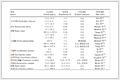
Our initial attempt employed 2-benzylideneindane-1,3-dione (1a) and Meldrum's acid (2) as the prototypical substrates for optimizing the oxidative annulation reaction parameters (Table 1). The choice of catalyst and oxidant were critical to succeed this coupling reaction. TBHP and DTBP gave the desired product 3a in 55% and 52% yield, respectively (entries 1 and 4), while TBPB was entirely ineffective in this reaction (entry 3). The spirolactonisation did not occur in the absence of ligand (entry 2). The addition of 4,4′-dimethyl-2,2′-dipyridyl (L3) was found to be superior in affording the product 3a in 71% yield (entry 7). Other copper salts, such as CuBr, Cu(OAc)2 and Cu2O were also evaluated, yet their efficacy were less than CuI (entries 7 vs. 11−13). Increasing the copper catalyst loading to 20 mol% gave comparable result to that of 10 mol% (entries 7 vs. 14). A brief survey of solvents showed that DCE is the most appropriate solvent. Increasing the reaction temperature to 90 ℃ led to a slightly lower yield of 3a (entry 19).
|
Table 1 Optimization of the reaction conditions.a |


With the optimised reaction conditions, we next commenced to investigate the scope of 2-arylidene-1,3-indanediones 1 with Meldrum's acid (2) and the results are summarized in Scheme 2. Various 2-arylidene-1,3-indanediones were subjected in the spirolactonisation and the corresponding γ-spirolactones were successfully delivered. To further evaluate the practical utility of this methodology, a gram-scale experiment was conducted, producing 3a in 65% yield. The structure of 3a was unambiguously confirmed by single-crystal X-ray diffraction analysis (CCDC: 2175973). It is worth noting that this reaction protocol tolerated the chloro- (products 3b, 3g) and bromo-groups (products 3h, 3i), providing an excellent opportunity for further functionalisation via well-known cross-coupling processes. Despite the possible steric hindrance arising from the substitution at the ortho-position of the phenyl ring, 1i was a feasible coupling partner that did not affect the reaction efficiency, yielding the desired product in 64% yield.

|
Download:
|
| Scheme 2. Copper-catalysed spirolactonisation of 2-benzylideneindane-1,3-diones. Reaction conditions: 1 (0.3 mmol), 2 (0.2 mmol), CuI (10 mol%), L3 (4,4′-dimethyl-2,2′-dipyridyl) (20 mol%), and TBHP (0.6 mmol, 70% aqueous solution) in DCE (1 mL) at 80 ℃ for 5 h. Isolated yields were reported. a A gram-scale experiment was conducted. | |

The outcome of a chemical transformation can often be divergent when the reaction conditions are modified. To our delight, under the reciprocal metal-free conditions, a new series of product 4 was successfully attained (Scheme 3). This product framework thus even provides more manipulation opportunity for possible functionalization, such as diarylation at the α-position [49]. Attempt conducting the reaction with 1a and 2 under TBAI (20 mol%) and 3 equiv. of H2O2 in the solvent mixture of DCE/GVL (γ-valerolactone) at 100 ℃, the desired product 4a was obtained in 81% yield (see Supporting information for optimization of reaction conditions). Encouraged by this fruitful result, representative substrates with substituents at the ortho-, meta-, and para-position of the phenyl ring were tested (products 4b-4f). Substrates bearing halo substituent at ortho- and/or para-position were also well-tolerated with good product yields (products 4b, 4g, 4h and 4i). Particularly noteworthy is that this transformation was able to accommodate thienyl-, furyl-, and styryl-containing substrates, providing the corresponding products 4j, 4k and 4l, respectively.

|
Download:
|
| Scheme 3. TBAI-catalysed spirolactonisation of 2-benzylideneindane-1,3-diones. Reaction conditions: 1 (0.2 mmol), 2 (0.3 mmol), TBAI (20 mol%), and H2O2 (0.6 mmol, 30% aqueous solution) in DCE/GVL (v/v = 1:1, 1 mL) at 100 ℃ for 5 h. Isolated yields were reported. | |

Flow chemistry has become a valuable tool in many organic syntheses [50–52] and often enriches the productivity by improving the reactivity through better heat and mass transfer. To demonstrate the synthetic utility of spirolactonisation, we examined the reaction in a continuous flow protocol using a Vapourtec flow reactor (Scheme 4). Under the flow conditions, the reaction proceeded efficiently to give the corresponding γ-spirolactones in improved yields with a significantly shorten reaction time (10 min vs. 5 h) when compared to previous studies.

|
Download:
|
| Scheme 4. TBAI-catalysed spirolactonisation of 2-benzylideneindane-1,3-dione in flow conditions. Reaction conditions: Mixture A: 1 (5.0 mmol), 2 (7.5 mmol) in DCE: GVL = 1:1 (20 mL). Mixture B: 30 wt% H2O2 (15.0 mmol), TBAI (1.0 mmol) in DCE: GVL = 1:1 (20 mL). Mixture A and B were each pumped at 0.5 mL/min and the streams were combined in a T-mixer followed by a coiled reactor with the rate of 1 mL/min (vol = 10 mL; tR = 10 min; T = 100 ℃) equipped with a 5 bar back pressure valve. Isolated yields were reported. | |

To elucidate the reaction mechanism, radical-trapping experiments were performed (Scheme 5A). When 3.0 equiv. of radical scavengers, such as TEMPO, BHT, or 1,1-diphenylethylene (DPE) was added to the reaction, the product yields of 3a and 4a were decreased. The corresponding radical-quenched products were also detected using electrospray ionisation-time-of-flight-mass spectrometry (ESI-TOF-MS) (see Supporting information for details), suggesting that the reaction likely involves a radical mechanism. Furthermore, product 5 was isolated in the copper-catalysed spirolactonisation of 2-benzylideneindane-1,3-diones with the addition of TEMPO (Scheme 5A, a(i)). Based on the aforementioned mechanistic studies [53] and experimental results, a postulated mechanism is illustrated in Scheme 5B. Initially, radical intermediate A is generated through the Cu(I)/TBHP oxidation system (Scheme 5B, for Scheme 2 pathway). Alternatively, the reaction is suggested to begin with the decomposition of H2O2 catalysed by TBAI to generate hydroxyl radical and I2, which capture an α-hydrogen atom from Meldrum's acid 2 to form radical intermediate A (Scheme 5B, for Scheme 3 pathway). Species A then generates radical B via a C=C bond addition step. The resulting B reacts with copper(II) species, followed by reductive elimination to afford product 5 [54]. Subsequently, radical B undergoes a radical addition to the C=O bond to give the geometry-favored five-membered ring radical C. The radical C is likely thermally-unstable and can be easily converted to radical D with an expulsion of acetone. With the help of t-BuO·, the radical trapping reaction occurs with D, resulting in the formation of product 3a. Otherwise, in the absence of trapping species t-BuO· (i.e., Scheme 3 pathway), the intermediate D thus undergoes a decarbonylation pathway and subsequent proton abstraction to give product 4a. It is of note that all the proposed intermediates A, B, C, D and E were successfully captured by radical scavengers, and the resulting intermediates were detected by ESI-TOF-MS (see Supporting information for details).

|
Download:
|
| Scheme 5. Radical-trapping experiments and proposed mechanism. | |

In summary, we have developed a divergent method for accessing β-arylspirolactones with a spirocenter at the γ-position to the lactone-moiety. Interestingly, the CuI/L3/TBHP catalyst system provided a range of γ-spirolactones 3 in good yields, while the metal-free system allowed for the synthesis of various γ-spirolactones 4 with complementary structures. The mild reaction conditions offered decent functional group compatibility, especially the remained intact –Br and –Cl groups which are advantages to the inherent shortcomings of existing metal-catalyzed protocols. Notably, the metal-free protocol was found applicable even in a flow system, resulting in significantly shorter reaction times. Mechanistic investigation revealed that this annulation process proceeds through a radical pathway, with specific intermediates being detected by ESI-TOF-MS.
Declaration of competing interestThe authors declare that they have no known competing financial interests or personal relationships that could have appeared to influence the work reported in this paper.
AcknowledgmentsWe gratefully acknowledge the National Natural Science Foundation of China (No. 22078150) and the Natural Science Foundation of Jiangsu Province, Frontier Project (No. BK20212003) for their financial support. FYK thanks the RGC of Hong Kong (No. 14308922), the Guangdong Research Fund (No. 2022A1515010955) and CUHK Direct Grant (No. 4053559).
Supplementary materialsSupplementary material associated with this article can be found, in the online version, at doi:10.1016/j.cclet.2024.109565.
| [1] |
A. Bartoli, F. Rodier, L. Commeiras, J. Parrain, G. Chouraqui, Nat. Prod. Rep. 28 (2011) 763-782. DOI:10.1039/c0np00053a |
| [2] |
A. Quintavalla, Curr. Med. Chem. 25 (2018) 917-962. DOI:10.2174/0929867324666171106162259 |
| [3] |
P. Liu, S. Hong, S.M. Weinreb, J. Am. Chem. Soc. 130 (2008) 7562-7563. DOI:10.1021/ja802700z |
| [4] |
Y. Fan, H. Zhang, Y. Zhou, et al., J. Am. Chem. Soc. 137 (2015) 138-141. DOI:10.1021/ja511813g |
| [5] |
S.S. Thorat, M.N. Palange, R. Kontham, ACS Omega 3 (2018) 7036-7045. DOI:10.1021/acsomega.8b00701 |
| [6] |
C.M. Marson, Chem. Soc. Rev. 40 (2011) 5514-5533. DOI:10.1039/c1cs15119c |
| [7] |
K. Hiesinger, D. Dar'in, E. Proschak, M. Krasavin, J. Med. Chem. 64 (2021) 150-183. DOI:10.1021/acs.jmedchem.0c01473 |
| [8] |
B. Bister, D. Bischoff, M. Ströbele, et al., Angew. Chem. Int. Ed. 43 (2004) 2574-2576. DOI:10.1002/anie.200353160 |
| [9] |
A.M. Sherwood, R.S. Crowley, K.F. Paton, et al., J. Med. Chem. 60 (2017) 3866-3878. DOI:10.1021/acs.jmedchem.7b00148 |
| [10] |
T.Z. Li, X.T. Yang, J.P. Wang, et al., Org. Lett. 23 (2021) 8380-8384. DOI:10.1021/acs.orglett.1c03120 |
| [11] |
S. Rodriguez, P. Wipf, Synthesis 17 (2004) 2767-2783. |
| [12] |
W.T. Wu, L. Zhang, S.L. You, Chem. Soc. Rev. 45 (2016) 1570-1580. DOI:10.1039/C5CS00356C |
| [13] |
A. Yoshimura, V.V. Zhdankin, Chem. Rev. 116 (2016) 3328-3435. DOI:10.1021/acs.chemrev.5b00547 |
| [14] |
R. Kumar, F.V. Singh, N. Takenaga, T. Dohi, Chem. Asian J. 17 (2022) e202101115. DOI:10.1002/asia.202101115 |
| [15] |
M. Uyanik, T. Yasui, K. Ishihara, Angew. Chem. Int. Ed. 49 (2010) 2175-2177. DOI:10.1002/anie.200907352 |
| [16] |
M. Uyanik, T. Yasui, K. Ishihara, Angew. Chem. Int. Ed. 52 (2013) 9215-9218. DOI:10.1002/anie.201303559 |
| [17] |
T. Dohi, N. Takenaga, T. Nakae, et al., J. Am. Chem. Soc. 135 (2013) 4558-4566. DOI:10.1021/ja401074u |
| [18] |
C. Hempel, C. Maichle-Mössmer, M.A. Pericàsc, B.J. Nachtsheim, Adv. Synth. Catal. 359 (2017) 2931-2941. DOI:10.1002/adsc.201700246 |
| [19] |
T. Dohi, H. Sasa, K. Miyazaki, et al., J. Org. Chem. 82 (2017) 11954-11960. DOI:10.1021/acs.joc.7b02037 |
| [20] |
H. Li, E. Subbotina, A. Bunrit, F. Wang, J.S.M. Samec, Chem. Sci. 10 (2019) 3681-3686. DOI:10.1039/C8SC05476B |
| [21] |
M. Uyanik, T. Kato, N. Sahara, O. Katade, K. Ishihara, ACS Catal. 9 (2019) 11619-11626. DOI:10.1021/acscatal.9b04322 |
| [22] |
C. Zhang, F. Bu, C. Zeng, et al., CCS Chem. 4 (2022) 1199-1207. DOI:10.31635/ccschem.021.202100860 |
| [23] |
Y. Liu, X. Zhang, R. Zeng, et al., Molecules 22 (2017) 1882. DOI:10.3390/molecules22111882 |
| [24] |
J.L. Li, B. Sahoo, C.G. Daniliuc, F. Glorius, Angew. Chem. Int. Ed. 53 (2014) 10515-10519. DOI:10.1002/anie.201405178 |
| [25] |
Y. Gao, Y. Ma, C. Xu, et al., Adv. Synth. Catal. 360 (2018) 479-484. DOI:10.1002/adsc.201701413 |
| [26] |
H. Zhang, Q. Ma, D. Liu, X. Hui, Chem. Commun. 55 (2019) 298-301. DOI:10.1039/C8CC08578A |
| [27] |
Y. Gao, D. Liu, Z. Fu, W. Huang, Org. Lett. 21 (2019) 926-930. DOI:10.1021/acs.orglett.8b03892 |
| [28] |
Y. Mostinski, D. Lankri, D. Tsvelikhovsky, Synthesis 49 (2017) 2361-2373. DOI:10.1055/s-0036-1588783 |
| [29] |
Q. Deng, H. Wadepohl, L.H. Gade, J. Am. Chem. Soc. 134 (2012) 2946-2949. DOI:10.1021/ja211859w |
| [30] |
Y. Qiu, B. Yang, T. Jiang, C. Zhu, J.E. Bäckvall, Angew. Chem. Int. Ed. 56 (2017) 3221-3225. DOI:10.1002/anie.201612384 |
| [31] |
N.A. Weires, Y. Slutskyy, L.E. Overman, Angew. Chem. Int. Ed. 58 (2019) 8561-8565. DOI:10.1002/anie.201903353 |
| [32] |
B. Lin, T. Yang, D. Zhang, et al., Angew. Chem. Int. Ed. 61 (2022) e202201739. DOI:10.1002/anie.202201739 |
| [33] |
S. Sternativo, A. Calandriello, F. Costantino, et al., Angew. Chem. Int. Ed. 50 (2011) 9382-9385. DOI:10.1002/anie.201104819 |
| [34] |
B. Cui, J. Zuo, J. Zhao, et al., J. Org. Chem. 79 (2014) 5305-5314. DOI:10.1021/jo500432c |
| [35] |
J. Cao, S. Dong, D. Jiang, et al., J. Org. Chem. 82 (2017) 4186-4193. DOI:10.1021/acs.joc.7b00153 |
| [36] |
X. Sun, M. Zhou, J. Zhu, et al., Org. Chem. Front. 9 (2022) 2316-2321. DOI:10.1039/D1QO01952J |
| [37] |
E.L. McInturff, J. Mowat, A.R. Waldeck, M.J. Krische, J. Am. Chem. Soc. 135 (2013) 17230-17235. DOI:10.1021/ja410533y |
| [38] |
P. Šafá?, Š. Marchalín, M. Šoral, J. Moncol, A. Daïch, Org. Lett. 19 (2017) 4742-4745. DOI:10.1021/acs.orglett.7b01881 |
| [39] |
M.M. Liu, X.C. Yang, Y.Z. Hua, J.B. Chang, M.C. Wang, Org. Lett. 21 (2019) 7089-7093. DOI:10.1021/acs.orglett.9b02658 |
| [40] |
M. Tobisu, N. Chatani, T. Asaumi, et al., J. Am. Chem. Soc. 122 (2000) 12663-12674. DOI:10.1021/ja003018i |
| [41] |
K.Y. Lee, D.Y. Park, J.N. Kim, Bull. Korean Chem. Soc. 27 (2006) 1489-1492. DOI:10.5012/bkcs.2006.27.9.1489 |
| [42] |
Q. Wu, L. Li, B. Xu, et al., Green Synth. Catal. 4 (2023) 150-153. DOI:10.1016/j.gresc.2023.01.001 |
| [43] |
G. Xu, C. Jia, X. Wang, et al., Org. Lett. 24 (2022) 1060-1065. DOI:10.1021/acs.orglett.1c04308 |
| [44] |
J. Duan, G. Xu, B. Rong, et al., Green Synth. Catal. 2 (2021) 237-240. DOI:10.1016/j.gresc.2021.03.001 |
| [45] |
S. Zhang, G. Xu, H. Yan, et al., Chin. Chem. Lett. 33 (2022) 5128-5131. DOI:10.1016/j.cclet.2022.04.006 |
| [46] |
M. Li, F.Y. Kwong, Angew. Chem. Int. Ed. 57 (2018) 6512-6516. DOI:10.1002/anie.201801706 |
| [47] |
T. Liu, K.B. Gan, R.L. Zhong, X. He, F.Y. Kwong, Org. Lett. 24 (2022) 6805-6809. DOI:10.1021/acs.orglett.2c02728 |
| [48] |
X. He, R. Li, P.Y. Choy, et al., Chem. Sci. 13 (2022) 13617-13622. DOI:10.1039/D2SC04431E |
| [49] |
P.Y. Yeung, K.H. Chung, F.Y. Kwong, Org. Lett. 13 (2011) 2912-2915. DOI:10.1021/ol2009522 |
| [50] |
M.B. Plutschack, B. Pieber, K. Gilmore, P.H. Seeberger, Chem. Rev. 117 (2017) 11796-11893. DOI:10.1021/acs.chemrev.7b00183 |
| [51] |
C.A. Hone, C.O. Kappe, Chem. Methods 1 (2021) 454-467. DOI:10.1002/cmtd.202100059 |
| [52] |
W.C. Fu, P.M. MacQueen, T.F. Jamison, Chem. Soc. Rev. 50 (2021) 7378-7394. DOI:10.1039/D0CS00670J |
| [53] |
A.S. Ivanov, Chem. Soc. Rev. 37 (2008) 789-811. DOI:10.1039/b716020h |
| [54] |
S. Manna, A.P. Antonchick, Angew. Chem. Int. Ed. 54 (2015) 14845-14848. DOI:10.1002/anie.201502872 |