 2024, Vol. 35


b Qinghai Provincial Key Laboratory of Tibetan Medicine Research and CAS Key Laboratory of Tibetan Medicine Research, Northwest Institute of Plateau Biology, Xining 810008, China;
c Green Pharmaceutical Technology Key Laboratory of Luzhou City, School of Pharmacy, Southwest Medical University, Luzhou 646000, China
Sulfur- and phosphorus-containing compounds are ubiquitously present in many natural products, pharmaceutical molecules, and biologically active compounds, which have been extensively utilized in agricultural and industrial communities [1-9]. Among them, phosphorodithioates have received special attention in terms of their remarkable antiviral and insecticidal properties [10-17]. As shown in Fig. 1, some representative phosphorodithioates such as dimethoate, phorate sulfone, piperophos, and morphthion have served as marketed pesticides or candidate agrochemicals [18,19].

|
Download:
|
| Fig. 1. Representative examples of bioactive phosphorodithioates. | |
Phosphorodithioates are traditionally prepared by the substitution reaction of RSH with (RO)2P(=S)Cl, the reaction of ammonium salt of thiophosphate with RX, and the nucleophilic reaction of potassium O, O-dialky phosphorodithioate with chloro carbonyl compounds (Schemes 1a and b) [20-25]. Nevertheless, these methods generally involve the use of strong base and metal reagents. Alternative synthetic strategies using other phosphorodithiolation reagents have also been developed through phosphorodithiolation of silyl enol ethers with bromodithiophosphonates [26,27] and ring-opening of epoxides with dithiophosphorus acids (Schemes 1c and d) [28]. In 2021, Wu also described an efficient method for the synthesis of β-amino vinyl phosphorodithioates via copper-promoted thioamination of maleimides with amines and diethylphosphorodithioate (Scheme 1e) [29]. P4S10 is a cheap and commercially available reagent, which has been elegantly utilized in the synthesis of various sulfur- and phosphorus-containing compounds [2,30-34]. Although some obvious advances have been made in these methodologies, the development of the new and efficient method for the synthesis of diverse phosphorodithioates from simple and easily available starting materials is still highly desirable.

|
Download:
|
| Scheme 1. The methods for the synthesis of phosphorodithioates. | |
Sulfoxonium ylides are easily available, safe, and bench-stable compounds, which play significant roles in the field of pharmaceuticals, organic synthesis, and functional materials [35-41]. As surrogates of dangerous diazo compounds, sulfoxonium ylides have also exhibited wide applications in various organic transformations including cyclopropanation, insertion, dimerization, epoxidation, aziridination, and others [42-49]. On the other hand, three-component tandem reactions have been developed as a powerful protocol to construct a variety of organic frameworks due to their atom- and step-economic advantages [50-55]. In continued our interests in the synthesis of sulfur- and phosphorus-containing compounds [56-61], herein, we wish to present a simple and efficient three-component reaction of sulfoxonium ylides, P4S10 and alcohols to access a series of β-keto phosphorodithioates, which are an important class of phosphorodithioates that possess interesting biological properties [62,27] and useful synthetic applications (Scheme 1f) [63].
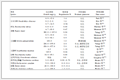
Our investigation started with the model reaction of benzoyl sulfoxonium ylide 1a, P4S10 2, and EtOH 3a to optimize reaction conditions at room temperature in air. When the model reaction was conducted in EtOH by using of CuI (10 mol%) as catalyst, the desired product 4aa was obtained in 43% yield (Table 1, entry 1). Further screening of other catalysts such as CuCl2, FeCl3, and I2 found that the reaction efficiency was not obviously improved (Table 1, entries 2–4). The addition of bases such as DBU and Cs2CO3 did also not promote this reaction (Table 1, entries 5 and 6). To our delight, the yield of 4aa would be increased to 57% in the absence of any additive (Table 1, entry 7). Next, the solvent effect was further investigated. When the mixture of EtOH with other organic solvents (1/4) such as EtOH/THF, EtOH/DCE, EtOH/CH2Cl2, EtOH/EtOAc, EtOH/CH3CN, EtOH/1, 4-dioxane, EtOH/CHCl3, or EtOH/acetone were employed in this reaction system, the reaction generally afforded the product 4aa in good yield (Table 1, entries 8–15). Only a low yield was observed when the model reaction was carried out in the mixture solvent of EtOH/DMF, EtOH/DMSO or EtOH/H2O (Table 1, entries 16–18). Among a variety of reaction solvents studied above, the mixture of EtOH/CH2Cl2 was found to be superior reaction medium, affording the product 4aa in 78% yield (Table 1, entry 10). Then, the ratio of EtOH/CH2Cl2 was also further investigated (Table 1, entries 19–23), and the result showed that the highest yield of 88% was obtained when EtOH/CH2Cl2 (1/9) was used as reaction solvent (Table 1, entry 22). When the reaction temperature was increased to 60 ℃, the desired product 4aa was obtained in only a 63% yield (Table 1, entry 24). Product 4aa could be isolated in 71% yield when the model reaction was carried out under N2 (Table 1, entry 25).
|
Table 1 Screening of the reaction conditions.a |


After getting the optimized conditions, the scope and generality of the present transformation were further investigated (Scheme 2). Generally, benzoyl sulfoxonium ylides with electron-donating or electron-withdrawing groups at the phenyl rings proceeded efficiently under standard conditions, and the corresponding β-keto phosphorodithioates 4ba-4oa were obtained in moderate to good yields. Especially, this phosphorodithiolation was tolerated by some synthetically useful functionalities such as halogens (F, Cl, Br), CF3, NO2, and CN, which could be used for further transformations. Furthermore, the reaction efficiency was not obviously affected by the steric hindrance. Ortho-substituted benzoyl sulfoxonium ylides 1d and 1l worked well to afford the corresponding products (4da and 4la) in 85% and 75% yields. Moreover, sulfoxonium ylides with naphthyl, furyl, or thienyl units were also well compatible with this procedure, providing the desired products 4pa-4ra in 73%–83% yields. Notably, α, β-unsaturated carbonyl sulfoxonium ylide could also be used in this reaction procedure to give the product 4sa in 70% yield. In addition, aliphatic carbonyl sulfoxonium ylides also proved to be suitable substrates, affording the desired products 4ta-4va in 61%–85% yields. Nevertheless, when other sulfoxonium ylides containing amido or sulfonyl groups have been employed in this reaction system, none of the desired products 4wa and 4xa were observed.

|
Download:
|
| Scheme 2. Substrate scope. Reaction conditions: 1 (0.2 mmol), 2 (0.2 mmol), 3a (0.25 mL), CH2Cl2 (2.25 mL), air, r.t., 5 h. Isolated yields based on 1. | |

Furthermore, the scope of alcohols in this phosphorodithiolation reaction is also evaluated (Scheme 3). In addition to EtOH, other linear alkyl alcohols such as methanol, n-butanol, n-hexanol, and n-hepanol all reacted smoothly to afford the products 4ab-4ae. In addition, phenylmethanol, cyclohexanol, and more sterically demanding isopropanol were also found to be reactive and furnished the desired products 4af-4ah in 54%–69% yields.

|
Download:
|
| Scheme 3. Substrate scope. Reaction conditions: 1a (0.2 mmol), 2 (0.2 mmol), 3 (0.25 mL), CH2Cl2 (2.25 mL), air, r.t., 5 h. Isolated yields based on 1a. | |

A gram-scale reaction was carried out to evaluate the synthetic utility of this protocol. As demonstrated in Scheme 4, when the model reaction of benzoyl sulfoxonium ylide 1a, P4S10 2, and EtOH 3a was performed under standard conditions (5 mmol scale), the reaction efficiency was not obviously affected and the corresponding β-keto phosphorodithioate 4aa was obtained in 78% yield (1.19 g).

|
Download:
|
| Scheme 4. Gram scale reaction. | |

To get better insight into the mechanism of this three-component reaction, some control experiments were carried out (Scheme 5). Firstly, the reaction of P4S10 2 and EtOH 3a gave O, O-diethyl S-hydrogen phosphorodithioate 5a in 86% yield (Scheme 5a). Furthermore, treatment of O, O-diethyl S-hydrogen phosphorodithioate 5a with benzoyl sulfoxonium ylide 1a under optimal conditions obtained the desired product 4aa in 92% yield (Scheme 5b). Both results suggested that 5a should be a key intermediate in this procedure. Subsequently, when BHT (2, 6-di-tert-butyl-4-methylphenol) was added in the model reaction system, the model reaction was not obviously suppressed and the product 4aa was still obtained in 77% yield (Scheme 5c), which indicated that a radical pathway might not be involved in this transformation. Next, isotope labeling experiment was investigated in the presence of EtOD. The deuterium incorporation at the α-position of the carbonyl group was observed, suggesting that one hydrogen atom at the α-position of the carbonyl group originated from EtOH (Scheme 5d).

|
Download:
|
| Scheme 5. Control experiments. | |

Based on the above experimental results and previous reports [33,64], a possible reaction mechanism was proposed as shown in Scheme 6. Firstly, the reaction of P4S10 with alcohol gave the dialkylphosphorodithioate 5. Subsequently, the protonation of sulfoxonium ylide by dialkylphosphorodithioate 5 produced a reactive sulfoxonium ionic pair 6. Finally, nucleophilic displacement of DMSO by a free or contact ion pair phosphorodithioate would produce the desired product 4.

|
Download:
|
| Scheme 6. Possible reaction pathway. | |

In summary, a simple and straightforward synthetic strategy has been developed for the synthesis of β-keto phosphorodithioates through three-component reaction of sulfoxonium ylides with P4S10 and alcohols. The reaction proceeded smoothly under mild conditions to form various β-keto phosphorodithioates in moderate to good yields with no need for any external catalyst and additive. The present protocol illustrates the applicability at gram scale reaction. The advantage of operational simplicity, easily accessible starting materials, mild conditions and good functional group tolerance makes this strategy more attractive in synthetic chemistry.
Declaration of competing interestThe authors declare that they have no known competing financial interests or personal relationships that could have appeared to influence the work reported in this paper.
AcknowledgmentsThis work was supported by the Natural Science Foundation of Shandong Province (No. ZR2021MB065), Scientific Research Startup Foundation of Qufu Normal University and National Natural Science Foundation of China (No. 22101237).
Supplementary materialsSupplementary material associated with this article can be found, in the online version, at doi:10.1016/j.cclet.2024.109513.
| [1] |
N.S. Li, J.K. Frederiksen, J.A. Piccirilli, Acc. Chem. Res. 44 (2011) 1257-1269. DOI:10.1021/ar200131t |
| [2] |
T. Ozturk, E. Ertas, O. Mert, Chem. Rev. 110 (2010) 3419-3478. DOI:10.1021/cr900243d |
| [3] |
R. Xie, Q. Zhao, T. Zhang, et al., Bioorg. Med. Chem. 21 (2013) 278-282. DOI:10.1016/j.bmc.2012.10.030 |
| [4] |
H. Xu, X. Li, J. Ma, et al., Chin. Chem. Lett. 34 (2023) 108403. DOI:10.1016/j.cclet.2023.108403 |
| [5] |
C.M. Park, Y. Zhao, Z. Zhu, et al., Mol. BioSyst. 9 (2013) 2430-2434. DOI:10.1039/c3mb70145j |
| [6] |
Y. Lv, H. Cui, N. Meng, et al., Chin. Chem. Lett. 33 (2022) 97-114. DOI:10.1117/12.2642676 |
| [7] |
X. Wang, Z. Wang, Z. Li, K. Sun, Chin. Chem. Lett. 34 (2023) 108045. DOI:10.1016/j.cclet.2022.108045 |
| [8] |
J. Jiang, Z. Wang, W.M. He, Chin. Chem. Lett. 32 (2021) 1591-1592. DOI:10.1016/j.cclet.2021.02.067 |
| [9] |
X. Wang, J. Meng, D. Zhao, et al., Chin. Chem. Lett. 34 (2023) 107736. DOI:10.1016/j.cclet.2022.08.016 |
| [10] |
W.T. Wiesler, M.H. Caruthers, J. Org. Chem. 61 (1996) 4272-4281. DOI:10.1021/jo960274y |
| [11] |
W. Dbkowski, I. Tworowska, W. Dbkowski, M. Michalska, Chem. Commun. (1998) 427-428. |
| [12] |
O.J. Plante, P.H. Seeberger, J. Org. Chem. 63 (1998) 9150-9151. DOI:10.1021/jo981552r |
| [13] |
T.S. Kumar, T. Yang, S. Mishra, et al., J. Med. Chem. 56 (2013) 902-914. DOI:10.1021/jm301372c |
| [14] |
T.B. Gaines, Toxicol. Appl. Pharmacol. 14 (1969) 515-534. DOI:10.1016/0041-008X(69)90013-1 |
| [15] |
R.E. Menzer, Z.M. Iqbal, G.R. Boyd, J. Agric. Food Chem. 19 (1971) 351-356. DOI:10.1021/jf60174a034 |
| [16] |
Y.Z. Piao, Y.J. Kim, Y.A. Kim, et al., J. Agric. Food Chem. 57 (2009) 10004-10013. DOI:10.1021/jf901998y |
| [17] |
O. BrÜmmer, P. Wentworth Jr, D.R. Weiner, K.D. Janda, Tetrahedron Lett. 40 (1999) 7307-7310. DOI:10.1016/S0040-4039(99)01501-4 |
| [18] |
N.N. Melnikov, R.L. Busbey, F.A. Gunther, J.D. Gunther, Chemistry of Pesticides, Springer, New York, 2012.
|
| [19] |
M. Kazemi, A. Tahmasbi, R. Valizadeh, et al., Agric. Sci. Res. J. 2 (2012) 512-522. |
| [20] |
F. Li, D. Calabrese, M. Brichacek, et al., Angew. Chem. Int. Ed. 51 (2012) 1938-1941. DOI:10.1002/anie.201108261 |
| [21] |
D.J. Jones, E.M. O'Leary, T.P. O'Sullivan, Tetrahedron. Lett. 59 (2018) 4279-4292. DOI:10.1016/j.tetlet.2018.10.058 |
| [22] |
P. Carta, N. Puljic, C. Robert, et al., Tetrahedron 64 (2008) 11865-11875. DOI:10.1016/j.tet.2008.08.108 |
| [23] |
B. Kaboudin, Tetrahedron Lett. 43 (2002) 8713-8714. DOI:10.1016/S0040-4039(02)02136-6 |
| [24] |
B. Kaboudin, S. Emadi, A. Hadizadeh, Bioorganic. Chem. 37 (2009) 101-105. DOI:10.1016/j.bioorg.2009.05.002 |
| [25] |
V.A. Kozlov, S.G. Churusova, S.V. Yarovenko, et al., Zh. Obshch. Khim. 64 (1994) 1439. |
| [26] |
P. Dybowski, A. Skowronska, Synthesis (1990) 609-612. |
| [27] |
A. Skowronska, P. Dybowski, Heteroat. Chem. 2 (1991) 55-61. DOI:10.1002/hc.520020108 |
| [28] |
Z. Li, Z. Zhou, K. Li, et al., Tetrahedron Lett. 43 (2002) 7609-7611. DOI:10.1016/S0040-4039(02)01715-X |
| [29] |
Y. Xu, J. Gao, C. Wang, et al., Org. Chem. Front. 8 (2021) 3457-3462. DOI:10.1039/d1qo00346a |
| [30] |
B. Kaboudin, V. Yarahmadi, J.Y. Kato, T. Yokomatsu, RSC Adv. 3 (2013) 6435-6441. DOI:10.1039/c3ra23414b |
| [31] |
S.K. Bur, Top. Curr. Chem. 274 (2007) 125-171. |
| [32] |
A. Sudalai, S. Kanagasabapathy, B.C. Benicewicz, Org. Lett. 2 (2000) 3213-3216. DOI:10.1021/ol006407q |
| [33] |
C.K. Maurya, A. Mazumder, P.K. Gupta, Beilstein J. Org. Chem. 13 (2017) 1184-1188. DOI:10.3762/bjoc.13.117 |
| [34] |
J. Wang, F. Han, S. Hao, et al., J. Org. Chem. 87 (2022) 12844-12853. DOI:10.1021/acs.joc.2c01435 |
| [35] |
C.A.D. Caiuby, M.P. de Jesus, A.C.B. Burtoloso, J. Org. Chem. 85 (2020) 7433-7445. DOI:10.1021/acs.joc.0c00833 |
| [36] |
M. Barday, C. Janot, N.R. Halcovitch, et al., Angew. Chem. Int. Ed. 56 (2017) 13117-13121. DOI:10.1002/anie.201706804 |
| [37] |
R.H. Liu, Q.C. Shan, Y. Gao, et al., Chin. Chem. Lett. 32 (2021) 1411-1414. DOI:10.1016/j.cclet.2020.10.007 |
| [38] |
P. Ghosh, N.Y. Kwon, S. Kim, et al., Angew. Chem. Int. Ed. 60 (2021) 191-196. DOI:10.1002/anie.202010958 |
| [39] |
Y. Chen, S. Lv, R. Lai, et al., Chin. Chem. Lett. 32 (2021) 2555-2558. DOI:10.1016/j.cclet.2021.02.052 |
| [40] |
J.E. Baldwin, R.M. Adlington, C.R.A. Godfrey, et al., Synlett (1993) 51-53. |
| [41] |
I.K. Mangion, I.K. Nwamba, M. Shevlin, M.A. Huffman, Org. Lett. 11 (2009) 3566-3569. DOI:10.1021/ol901298p |
| [42] |
J. Vaitla, A. Bayer, K.H. Hopmann, Angew. Chem. Int. Ed. 56 (2017) 4277-4281. DOI:10.1002/anie.201610520 |
| [43] |
L.G. Furniel, A.C.B. Burtoloso, Tetrahedron 76 (2020) 131313. DOI:10.1016/j.tet.2020.131313 |
| [44] |
S.S. Zhang, H. Xie, B. Shu, et al., Chem. Commun. 56 (2020) 423-426. DOI:10.1039/c9cc08795h |
| [45] |
A.H. Li, L.X. Dai, V.K. Aggarwal, Chem. Rev. 97 (1997) 2341-2372. DOI:10.1021/cr960411r |
| [46] |
M.L. Jamieson, N.Z. Brant, M.A. Brimble, D.P. Furkert, Synthesis 49 (2017) 3952-3956. DOI:10.1055/s-0036-1588814 |
| [47] |
E.D. Butova, A.V. Barabash, A.A. Petrova, et al., J. Org. Chem. 75 (2010) 6229-6235. DOI:10.1021/jo101330p |
| [48] |
W. Yuan, W. Xie, J. Xu, Mol. Catal. 510 (2021) 111687. DOI:10.1016/j.mcat.2021.111687 |
| [49] |
W.B. He, S.J. Zhao, J.Y. Chen, et al., Chin. Chem. Lett. 34 (2023) 107640. DOI:10.1016/j.cclet.2022.06.063 |
| [50] |
S. Mu, H. Li, Z. Wu, et al., Chin. J. Org. Chem. 42 (2022) 4292-4299. DOI:10.6023/cjoc202211002 |
| [51] |
Y.H. Lu, Z.T. Zhang, H.Y. Wu, et al., Chin. Chem. Lett. 34 (2023) 108036. DOI:10.1016/j.cclet.2022.108036 |
| [52] |
Y.H. Lu, C. Wu, J.C. Hou, et al., ACS Catal. 13 (2023) 13071-13076. DOI:10.1021/acscatal.3c02268 |
| [53] |
H.T. Ji, Q.X. Luo, K.L. Wang, et al., Green Chem. 25 (2023) 7983-7987. DOI:10.1039/d3gc02575f |
| [54] |
N. Meng, Y. Lv, Q. Liu, et al., Chin. Chem. Lett. 32 (2021) 258-262. DOI:10.1016/j.cclet.2020.11.034 |
| [55] |
Z. Wang, N. Meng, Y. Lv, et al., Chin. Chem. Lett. 34 (2023) 107599. DOI:10.1016/j.cclet.2022.06.022 |
| [56] |
Z. Wang, Q. Liu, R. Liu, et al., Chin. Chem. Lett. 33 (2022) 1479-1482. DOI:10.1016/j.cclet.2021.08.036 |
| [57] |
Q. Liu, Y. Lv, R. Liu, et al., Chin. Chem. Lett. 32 (2021) 136-139. DOI:10.1016/j.cclet.2020.11.059 |
| [58] |
D. Yi, L. He, Z. Qi, et al., Chin. J. Chem. 39 (2021) 859-865. DOI:10.1002/cjoc.202000549 |
| [59] |
Y. Lv, H. Ding, J. You, et al., Chin. Chem. Lett. 35 (2024) 109107. DOI:10.1016/j.cclet.2023.109107 |
| [60] |
T. Zou, Y. He, R. Liu, et al., Chin. Chem. Lett. 34 (2023) 107822. DOI:10.1016/j.cclet.2022.107822 |
| [61] |
C. Fest, K.J. Schmidt, The Chemistry of Organophosphorus Pesticides, Springer-Verlag, Berlin, Heidelberg, New York, 1973.
|
| [62] |
M. Kado, T. Maeda, E. Yoshinoga, Japanese Patent 7327468; C. A 80 (1974) 12924.
|
| [63] |
Á. Szabó, G. Szarka, L. Trif, et al., Int. J. Mol. Sci. 23 (2022) 15963. DOI:10.3390/ijms232415963 |
| [64] |
R.M.P. Dias, A.C.B. Burtoloso, Org. Lett. 18 (2016) 3034-3037. DOI:10.1021/acs.orglett.6b01470 |