 2024, Vol. 35


b Department School of Chemistry and Chemical Engineering, Henan Normal University, Xinxiang 453007, China
Nitrogen-containing organic compounds have been widely found in ubiquitous pharmaceuticals, biologically active natural products and synthetic compounds, such as dyes, pesticides, functional materials [1]. The introduction of a CF3 group leads to changes in the chemical and physical properties of potential drug candidates, owing to its strong electron-withdrawing nature, high lipophilicity, and metabolic stability [2]. During the past several decades, many CF3-containing pharmaceuticals [3] and agrochemicals, such as Prevacid, Prozac, fluazinam, and norflurazon, have been developed. So far, a number of methods have been developed to incorporate a CF3 group into organic molecules [4-14], with a particular emphasis on the amine-containing functional molecules. In addition, β-trifluoromethyl primary amines are also the valuable structural skeletons of ubiquitous biologically active molecules [15,16]. Accordingly, the synthetic methods to access vicinal trifluoromethyl amines from simple and easily available raw materials have been of great interest to chemists. In this regard, the trifluoromethylamination of alkenes represents straightforward routes to an array of such useful scaffolds, given the facile accessibility of alkene starting materials and quickly increasing molecular complexity in a single step [17-20]. Among these protocols, several two-components intermolecular methods were independently developed to generate trifluoromethylated aziridines, pyrazolines and pyrrolidines [21-24]. In addition, the existing three-components intermolecular approaches either afforded trifluoromethylated amides and anilines via Ritter-type processes through β-trifluoromethyl carbenium ions [25-26], or alternatively gave trifluoromethylated azides [27-34] via transition-metal or photo-redox catalyzed azidotrifluoromethylation of alkenes (Scheme 1a, top).

|
Download:
|
| Scheme 1. Trifluoromethylamination of alkenes with benzophenone imine. | |
In recent years, N-centered radicals have received considerable attention from the synthetic community because these powerful species offer great opportunities for the construction of C—N bonds [35-42]. Among various developed nitrogen-centered radicals, the ambiphilic iminyl radicals have received considerable attention recently, which were generated by the cleavage of N—O bond of oxime derivatives via an electron-acceptor heterolytic pathway [43-46] or photoinduced energy-transfer homolytic manner [47-54]. Recently, the Molander group [55] and Yang group [56] disclosed two elegant examples on photochemical alkene trifluoromethylamination using prefunctionalized oxime esters or sulfonamides as linked N- & C-centered radicals precursors, respectively, to generate both CF3 and iminyl radicals via an energy-transfer fragmentation process (Scheme 1a, bottom).
Despite the precedents have been realized in this area, the synthetic utility was often limited due to the need for the expensive transition-metal catalysts or photocatalysts and extra photochemical ancillaries, requiring the circumscribed use of the functionalized substrates prior prepared in several steps. As such, new strategies to modularly access vicinal trifluoromethyl amines from commercially available starting materials under transition-metal- and photosensitizer-free conditions remain highly desirable and appears to be practical. Inspired by our ongoing sustainable chemical research on the synthesis of nitrogen-containing compounds [57-60], we envisioned that a three-components site-selective trifluoromethylimination of alkenes could be developed under transition-metal free conditions at room temperature directly from commercially available benzophenone imines without the need for substrate pre-functionalization, which were generally utilized as C-electrophiles and N-nucleophiles in previous studies [61,62]. Moreover, in terms of radical mechanism, either N—H or N-alkyl/aryl substituted benzophenone imines were typically employed to generate ketiminyl radical anions via electron-acceptor mode (accepting one electron) [63,64], in this current research, they would be innovatively employed as a nitrogen-radical precursor to generate diphenyliminyl radical via an electron-donor mode (donating one electron) (Scheme 1b).
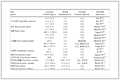
To validate our hypothesis, we set out to explore trifluromethylimination of olefins by employing α-methylstyrene 1a as the acceptor to capture the CF3 radical and iminyl radical. As our expectation, using bifunctional CF3-hypervalent iodine reagent (Togni-Ⅱ) as the trifluoromethyl radical precursor and the activator of unprotected ketimine to iminyl radical [57], Cs2CO3 as base, EtOAc as solvent, the reaction delivered the desired trifluoromethylaminative product 3a in 23% yield through a robust operation at ambient temperature (Table 1, entry 1). Further investigations were performed on commonly inorganic and organic bases such as LiOtBu, NaOtBu, LiOMe and DBU (entries 2–5). It revealed that the reaction was not only dependent on the basic property, but the lithium salts were also essential for this protocol. Other common solvents, for instance, THF, PhCl, dichloromethane and MeCN, were next examined, it found that EtOAc is the optimal one in terms of the efficiency and sustainability (entries 6–9). Of particular note is that the reaction occurred smoothly at higher temperature or using 1.0 equiv. of LiOtBu, giving similar yield (entries 10 and 11). Other CF3 radical precursors, such as 1-trifluoromethyl-dimethylbenziodoxole (Togni-Ⅰ) and (Trifluoromethyl)trimethylsilane (TMSCF3) in combination with (diacetoxyiodo)benzene (PIDA) were further explored, providing no product and 19% yield, respectively (entries 12 and 13).
|
Table 1 Optimization of reaction conditions.a |


With the optimal conditions in hand, the generality of this protocol was evaluated with a series of alkenes (Scheme 2). To our delight, a wide range of 1, 1-disubstituted styrene derivatives bearing various functional groups were amenable to this transformation. Typically, the regioselectivity of trifluoromethylimination was uniformly exclusive and the desired compounds 3a-3j can be isolated in moderate to good yields, basically independent of any electronic and steric perturbation. It is worth noting that the trifluoromethoxy, chloro, bromo, cyano and nitro groups were tolerated. The styrene bearing α-ethyl, isopropyl and phenyl substituents were viable substrates for the process (3k-3m). The imine products were relatively sensitive to acidic conditions and readily hydrolyzed to access valuable β-CF3 primary amines, which could be protected in-situ with benzoyl chloride to β-CF3 amide in high yield (3k, 3l). When 2-isopropenylnaphthalene and monosubstituted (hetero)aryl olefins were used as reaction components, all reactions proceeded smoothly under the mild conditions in good yield varying from 50% to 67% yield (3n-3r).

|
Download:
|
| Scheme 2. Scope of trifluoromethylamination of olefins. Reaction conditions: 1 (0.2 mmol), 2 (1.5 equiv.) and Togni-Ⅱ (1.2 equiv.), LiOtBu (1.0 equiv.) in EtOAc (2.0 mL) at r.t., 15 h. a The reaction mixture was treated with 20% citric acid (aq., 0.5 mL) at room temperature for 2 h, then the crude free amine was treated with benzoyl chloride (2.0 equiv.) at r.t. for 6 h. b Determined by 19F NMR analysis of crude reaction mixture. | |

To further illustrate the feasibility of this platform, variants of unactivated aliphatic alkenes and several complex alkenes were next surveyed, which proved to be quite productive. A variety of versatile aliphatic units, including long-chain alkyl, tert-butyldimethylsilyl (TBS) group and benzyl (Bn) group protected alcohol moieties, even amide unit were compatible in current protocol (3s-3v). In addition, the reactivity of monosubstituted aliphatic alkene was tested, e.g., with 1-octene as substrate. It also provided the target β-CF3 amination product 3w in 25% yield. The relatively low yield may be attributed to the instability of the secondary carbon radical. It is more encouraging to note that the complex olefins derived from natural products, such as β-pinene and estrone, reacted effectively (3x-3y). The ring-opening product 3x was smoothly formed by the cleavage of 4-member ring of β-pinene, albeit in a slightly diminished yield for the amination/hydrolysis/acylation cascade, demonstrating that a radical pathway is potentially involved in the reaction. When an 1, 3-enyne was served as substrate, excellent regioselective addition to the double bond was observed while retaining the triple bond, giving the internal alkyne 3z in moderate yield.
Referring to previous studies on the preparation of N-unprotected ketimines [65,66], we therefore chose the more facilely accessible and relatively stable bis(trimethylsilyl)amine (HMDS) as a nitrogen source to investigate the scope of diverse imines via sequential reactions directly from aryl ketones 4 (Scheme 3a). From the point view of reactivity of amination, the in situ generated ketimines appears to be an alternative option to be involved in this newly developed approache (as for 3a: 53% vs. 67% in Scheme 2). Other ketimines derived from diaryl ketones bearing various substituents with different electronic properties, were all smoothly compatible and delivered diverse fancy structures 3ab and 3ac in moderate yields, which would greatly extend the applicability of this amination method. However, when using benzaldehyde and TMS2NH as the precursors of aldehyde-derived imine to explore the sequential reaction under the standard conditions, the reaction only gave the target product in 14% NMR yield, which was further detected by gas chromatography-mass spectrometry (see Supporting information).

|
Download:
|
| Scheme 3. (a) Scope of diverse imines via sequential reactions directly from ketones and HMDS. Conditions for condensation: diaryl ketones (0.5 mmol), TMS2NH (0.6 mmol) and Sc(OTf)2 (5 mol%) in 1, 4-dioxane (0.5 mL) at 90 ℃, Ar. Standard conditions for the sequential amination with alkene 1a in 0.2 mmol scale. (b) Synthetic applications of products. | |

To demonstrate the synthetic potential of the β-trifluoromethyl imination products, several transformations were carried out (Scheme 3b). To our delight, the imine groups of products was readily hydrolyzed after a simple work-up procedure with citric acid to afford highly value-added β-CF3 primary amines (for 6 in 98% yield) [67,68], which could further undergo in-situ protections to amide 5 by benzoyl chloride and to dialkylated amine 7 via reductive amination process in high efficiency.
In order to gain insights into this difunctionalization mechanism, several control experiments were performed. The addition of 2, 2, 6, 6-tetramethylpiperidinooxy (TEMPO) as a free radical scavenger significantly interfered with this process, with no product 3a being formed, whereas the TEMPO—CF3 adduct 8 was generated in 75% yield. In this process, radical-radical cross-coupled product, CF3 substituted benzophenone imine 9, was evidently isolated, and the byproduct 10 from homo-coupling of iminyl radical was also detected by gas chromatography-mass spectrometry (Scheme 4a). These observations suggest a free radical mechanism seems reasonable, consistent with the previous results obtained via the ring-opening of β-pinene.

|
Download:
|
| Scheme 4. Mechanistic studies. (a) Radical trapping experiment with additional TEMPO under standard conditions. (b) In situ monitoring by 19F NMR via sequential addition of all components of the model reaction. Togni-Ⅱ: green ♣; 3a: blue ♥; 9 red ♦. | |

We next aimed at identifying the reaction pathway and intermediates by 19F NMR monitoring via the sequential addition of each reaction component to an NMR tube. This approach enabled the detection of the interaction between different compounds that are likely involved in this process. When Togni-Ⅱ reagent was mixed with benzophenone imine 2 in CD3CN/DMSO-d6 (9/1), no reaction occurred (Scheme 4, b-Ⅰ). However, upon the addition of 1.0 equiv. of LiOtBu to this mixture, a new signal obviously appeared and increased gradually while the Togni-Ⅱ signal decreased, which elucidates that there exists a subtle correlation between the hypervalent iodine reagent and benzophenone imine anion. The signal at −52.1 ppm corresponds to the compound identified as the adduct Ph2CN—CF3 9 on the basis of isolation (Scheme 4, b-Ⅱ and b-Ⅲ). While mixing the standard stoichiometric amounts of olefin 1a, benzophenone imine 2 and Togni-Ⅱ at room temperature led to the rapid appearance of two signals at −59.3 and −52.1 ppm, which were attributed to the product 3a and an accompanied generating two-free-radicals adduct 9, respectively (Scheme 4, b-Ⅳ and b-Ⅴ).
On the basis of the above mechanistic experiments, a putative mechanism for the reaction is outlined in Scheme 5. Initially, a single-electron-transfer (SET) process occurs between benzophenone imine anion A and hypervalent-iodine-CF3 reagent (path a), generating a CF3 radical and o-IC6H4CO2H anion along with the corresponding ambiphilic diphenyliminyl radical B. Followed by the addition of the CF3 radical to an alkene, the carbo-radical intermediate C is formed. Finally, the subsequent selective trapping steered by the "persistent radical effect" [69,70] with the iminyl radical B produces the corresponding trifluoromethylimination products 3.

|
Download:
|
| Scheme 5. Proposed mechanism. | |

In summary, we have disclosed a practical method for the trifluoromethylamination of activated and unactivated alkenes under transition-metal free and ambient conditions. This multicomponent reaction can be compatible with broad scope and a wide range of functional groups, excellent regioselectivities, which was enabled by a robust experimental operation. Monitoring of the reactions by NMR spectroscopy, supplemented by byproduct detection shed light on some of the mechanistic subtleties in this study. Notably, the imine unit could be readily converted to unprotected amines thereby facilitating downstream transformations. We believe that the described protocol will prove useful in an array of synthetic contexts and would be potential for finding applications in both academic research and industry.
Declaration of competing interestThe authors declare that they have no known competing financial interests or personal relationships that could have appeared to influence the work reported in this paper.
AcknowledgmentsFinancial support from the National Natural Science Foundation of China (Nos. 22201239, 22205192 and 22271244), the Hunan Provincial Natural Science Foundation of China (No. 2022JJ40429), the Scientific Research Fund of Hunan Provincial Education Department (No. 21B0130), the Open Research Fund of School of Chemistry and Chemical Engineering, Henan Normal University (No. 2022C02), the Process Intensification & Green Chemical Engineering Innovation Team Project of Hunan Province are gratefully acknowledged.
Supplementary materialsSupplementary material associated with this article can be found, in the online version, at doi:10.1016/j.cclet.2024.109502.
| [1] |
A. Ricci, Amino Group Chemistry: From Synthesis to the Life Sciences, Wiley, 2008.
|
| [2] |
Y. Zhou, J. Wang, Z. Gu, et al., Chem. Rev. 116 (2016) 422-518. DOI:10.1021/acs.chemrev.5b00392 |
| [3] |
J. He, Z. Li, G. Dhawan, et al., Chin. Chem. Lett. 34 (2023) 107578. DOI:10.1016/j.cclet.2022.06.001 |
| [4] |
T. Furuya, A.S. Kamlet, T. Ritter, Nature 473 (2011) 470-477. DOI:10.1038/nature10108 |
| [5] |
O.A. Tomashenko, V.V. Grushin, Chem. Rev. 111 (2011) 4475-4521. DOI:10.1021/cr1004293 |
| [6] |
L. Chu, F.L. Qing, Acc. Chem. Res. 47 (2014) 1513-1522. DOI:10.1021/ar4003202 |
| [7] |
J. Charpentier, N. Früh, A. Togni, Chem. Rev. 115 (2015) 650-682. DOI:10.1021/cr500223h |
| [8] |
X. Liu, C. Xu, M. Wang, Q. Liu, Chem. Rev. 115 (2015) 683-730. DOI:10.1021/cr400473a |
| [9] |
X. Yang, T. Wu, R.J. Phipps, F.D. Toste, Chem. Rev. 115 (2015) 826-870. DOI:10.1021/cr500277b |
| [10] |
C. Alonso, E.M. de Marigorta, G. Rubiales, F. Palacios, Chem. Rev. 115 (2015) 1847-1935. DOI:10.1021/cr500368h |
| [11] |
H. Xiao, Z. Zhang, Y. Fang, L. Zhu, C. Li, Chem. Soc. Rev. 50 (2021) 6308-6319. DOI:10.1039/d1cs00200g |
| [12] |
W. Wu, Y. You, Z. Weng, Chin. Chem. Lett. 33 (2022) 4517-4530. DOI:10.1016/j.cclet.2022.01.038 |
| [13] |
H. Wang, Y. Xie, Y. Zhou, N. Cen, W. Chen, Chin. Chem. Lett. 33 (2022) 221-224. DOI:10.1016/j.cclet.2021.06.008 |
| [14] |
X. Wang, W. Zhou, W. Xie, Q. Chen, J. Wu, Chin. Chem. Lett. 34 (2023) 107984. DOI:10.1016/j.cclet.2022.107984 |
| [15] |
Q. Li, W. Wang, K.B. Berst, et al., Bioorg. Med. Chem. Lett. 8 (1998) 1953-1958. DOI:10.1016/S0960-894X(98)00355-2 |
| [16] |
V.M. Vrudahula, P. Senliang, R. Rajamani, et al., Patent, US20160333006 A1, 2016.
|
| [17] |
F. Wang, P. Chen, G. Liu, Acc. Chem. Res. 51 (2018) 2036-2046. DOI:10.1021/acs.accounts.8b00265 |
| [18] |
T. Koike, M. Akita, Chem 4 (2018) 409-437. DOI:10.1016/j.chempr.2017.11.004 |
| [19] |
Y. Tian, S. Chen, Q.S. Gu, J.S. Lin, X.Y. Liu, Tetrahedron Lett. 59 (2018) 203-215. DOI:10.1016/j.tetlet.2017.12.034 |
| [20] |
H. Jiang, A. Studer, Chem. Soc. Rev. 49 (2020) 1790-1811. DOI:10.1039/c9cs00692c |
| [21] |
H. Egami, S. Kawamura, A. Miyazaki, M. Sodeoka, Angew. Chem. Int. Ed. 52 (2013) 7841-7844. DOI:10.1002/anie.201303350 |
| [22] |
S. Kawamura, H. Egami, M. Sodeoka, J. Am. Chem. Soc. 137 (2015) 4865-4873. DOI:10.1021/jacs.5b02046 |
| [23] |
Q. Wei, J.R. Chen, X.Q. Hu, et al., Org. Lett. 17 (2015) 4464-4467. DOI:10.1021/acs.orglett.5b02118 |
| [24] |
J.S. Lin, X.Y. Dong, T.T. Li, et al., J. Am. Chem. Soc. 138 (2016) 9357-9360. DOI:10.1021/jacs.6b04077 |
| [25] |
Y. Yasu, T. Koike, M. Akita, Org. Lett. 15 (2013) 2136-2139. DOI:10.1021/ol4006272 |
| [26] |
A. Carboni, G. Dagousset, E. Magnier, G. Masson, Org. Lett. 16 (2014) 1240-1243. DOI:10.1021/ol500374e |
| [27] |
F. Wang, X. Qi, Z. Liang, P. Chen, G. Liu, Angew. Chem. Int. Ed. 53 (2014) 1881-1886. DOI:10.1002/anie.201309991 |
| [28] |
R.R. Karimov, A. Sharma, J.F. Hartwig, ACS Cent. Sci. 2 (2016) 715-724. DOI:10.1021/acscentsci.6b00214 |
| [29] |
X.L. Yu, J.R. Chen, D.Z. Chen, W.J. Xiao, Chem. Commun. 52 (2016) 8275-8278. DOI:10.1039/C6CC03335K |
| [30] |
L.Z. Yu, Y. Wei, M. Shi, Chem. Common. 52 (2016) 13163-13166. DOI:10.1039/C6CC07394H |
| [31] |
X. Geng, F. Lin, X. Wang, N. Jiao, Org. Lett. 19 (2017) 4738-4741. DOI:10.1021/acs.orglett.7b02056 |
| [32] |
C.L. Zhu, C. Wang, Q.X. Qin, et al., ACS Catal. 8 (2018) 5032-5037. DOI:10.1021/acscatal.8b01253 |
| [33] |
H.G. Huang, W. Li, D. Zhang, et al., Chem. Sci. 12 (2021) 3210-3215. DOI:10.1039/d0sc06473d |
| [34] |
M. Zhang, J.H. Lin, J.C. Xiao, Org. Lett. 23 (2021) 6079-6083. DOI:10.1021/acs.orglett.1c02146 |
| [35] |
S.Z. Zard, Chem. Soc. Rev. 37 (2008) 1603-1618. DOI:10.1039/b613443m |
| [36] |
T. Xiong, Q. Zhang, Chem. Soc. Rev. 45 (2016) 3069-3087. DOI:10.1039/C5CS00852B |
| [37] |
J.R. Chen, X.Q. Hu, L.Q. Lu, W.J. Xiao, Chem. Soc. Rev. 45 (2016) 2044-2056. DOI:10.1039/C5CS00655D |
| [38] |
X. Zhu, S. Chiba, Chem. Soc. Rev. 45 (2016) 4504-4523. DOI:10.1039/C5CS00882D |
| [39] |
M.D. Kärkäs, ACS Catal. 7 (2017) 4999-5022. DOI:10.1021/acscatal.7b01385 |
| [40] |
Y. Zhao, W. Xia, Chem. Soc. Rev. 47 (2018) 2591-2608. DOI:10.1039/c7cs00572e |
| [41] |
Q.Q. Han, D.M. Chen, Z.L. Wang, et al., Chin. Chem. Lett. 32 (2021) 2559-2561. DOI:10.1016/j.cclet.2021.02.018 |
| [42] |
C. Pratley, S. Fenner, J.A. Murphy, Chem. Rev. 122 (2022) 8181-8260. DOI:10.1021/acs.chemrev.1c00831 |
| [43] |
J.C. Walton, Acc. Chem. Res. 47 (2014) 1406-1416. DOI:10.1021/ar500017f |
| [44] |
J.C. Walton, Molecules 21 (2016) 63-85. DOI:10.3390/molecules21010063 |
| [45] |
H.W. Huang, H.W. Cai, G.J. Deng, Org. Biomol. Chem. 14 (2016) 1519-1530. DOI:10.1039/C5OB02417J |
| [46] |
M.M. Jackman, Y. Cai, S.L. Castle, Synthesis 49 (2017) 1785-1795. DOI:10.1055/s-0036-1588707 |
| [47] |
V.K. Soni, S. Lee, J. Kang, et al., ACS Catal. 9 (2019) 10454-10463. DOI:10.1021/acscatal.9b03435 |
| [48] |
T. Patra, M. Das, C.G. Daniliuc, F. Glorius, Nat. Catal. 4 (2021) 54-61. DOI:10.1038/s41929-020-00553-2 |
| [49] |
S.Q. Lai, B.Y. Wei, J.W. Wang, W. Yu, B. Han, Angew. Chem. Int. Ed. 60 (2021) 21997-22003. DOI:10.1002/anie.202107118 |
| [50] |
G. Tan, M. Das, H. Keum, et al., Nat. Chem. 14 (2022) 1174-1184. DOI:10.1038/s41557-022-01008-w |
| [51] |
X.H. Wang, Y. Chen, P. Liang, J.Q. Chen, J. Wu, Org. Chem. Front. 9 (2022) 4328-4333. DOI:10.1039/d2qo00741j |
| [52] |
X.L. Luo, S.S. Li, Y.S. Jiang, et al., Org. Lett. 25 (2023) 1742-1747. DOI:10.1021/acs.orglett.3c00437 |
| [53] |
L. Wang, Y. Yu, L. Deng, K.P. Du, Org. Lett. 25 (2023) 2349-2354. DOI:10.1021/acs.orglett.3c00724 |
| [54] |
X.K. Qi, M.J. Zheng, C. Yang, et al., J. Am. Chem. Soc. 145 (2023) 16630-16641. DOI:10.1021/jacs.3c04073 |
| [55] |
J. Majhi, R.K. Dhungana, Á. Rentería-Gómez, et al., J. Am. Chem. Soc. 144 (2022) 15871-15878. DOI:10.1021/jacs.2c07170 |
| [56] |
Y. Zheng, Z. Liao, Z. Xie, et al., Org. Lett. 25 (2023) 2129-2133. DOI:10.1021/acs.orglett.3c00577 |
| [57] |
M. Yang, W. Shao, L. Zuo, et al., Org. Lett. 25 (2023) 2728-2732. DOI:10.1021/acs.orglett.3c00951 |
| [58] |
J. Chen, Y. Xu, W. Shao, et al., Org. Lett. 24 (2022) 8271-8276. DOI:10.1021/acs.orglett.2c02975 |
| [59] |
S. Wang, R. Li, S. Jiang, et al., Adv. Syn. Catal. 364 (2022) 1481-1487. DOI:10.1002/adsc.202101488 |
| [60] |
S. Wang, R. Li, S. Chen, et al., Green Synth. Catal. 5 (2024) 112-116. DOI:10.3390/bios14030112 |
| [61] |
A. Crespo, Synlett 14 (2006) 2345-2346. DOI:10.1055/s-2006-949619 |
| [62] |
Y. Kondo, H. Morimoto, T. Ohshima, Chem. Lett. 49 (2020) 497-504. DOI:10.1246/cl.200099 |
| [63] |
R.I. Rodríguez, L. Mollari, J. Alemán, Angew. Chem. Int. Ed. 60 (2021) 4555-4560. DOI:10.1002/anie.202013020 |
| [64] |
X. Fan, X. Gong, M. Ma, R. Wang, P.J. Walsh, Nat. Chem. 9 (2018) 4936. |
| [65] |
Y. Kondo, T. Kadota, Y. Hirazawa, et al., Org. Lett. 22 (2020) 120-125. DOI:10.1021/acs.orglett.9b04038 |
| [66] |
Y. Kondo, K. Morisaki, Y. Hirazawa, H. Morimoto, T. Ohshima, Org. Process Res. Dev. 23 (2019) 1718-1724. DOI:10.1021/acs.oprd.9b00226 |
| [67] |
X. Huo, J. Zhang, J. Fu, R. He, W. Zhang, J. Am. Chem. Soc. 140 (2018) 2080-2084. DOI:10.1021/jacs.8b00187 |
| [68] |
L. Wei, Q. Zhu, S.M. Xu, X. Chang, C.J. Wang, J. Am. Chem. Soc. 140 (2018) 1508-1513. DOI:10.1021/jacs.7b12174 |
| [69] |
H. Fischer, Chem. Rev. 101 (2001) 3581-3610. DOI:10.1021/cr990124y |
| [70] |
D. Leifert, A. Studer, Angew. Chem. Int. Ed. 59 (2020) 74-108. DOI:10.1002/anie.201903726 |