 2024, Vol. 35


b Department of Physics, Institute of Computational and Applied Physics, Taiyuan Normal University, Jinzhong 030619, China
A fundamental challenge in cluster research is to comprehend the process through which clusters form from atoms and molecules, ultimately transforming into bulk solid-state allotropes [1]. The investigations of the evolving trends in the structure and properties during the size evolution of clusters assumes significance in understanding the growth mechanism from single atoms to bulk materials. Phosphorus and arsenic, isoelectronic to CH [2], have the tendency to form multinuclear, trivalent, anionic clusters with chain or cage architectures, namely polypnictides [3,4]. A series of naked polyarsenides have been synthesized as solvated molecular systems and characterized crystallographically [5]. Among these, the repertoire of small-sized polyarsenic anions encompasses cyclic structures As42– [6,7] and As64– [8] as well as cage-like As73– [9,10], As102– [11], As113– (Scheme 1) [12] and As124– [11].

|
Download:
|
| Scheme 1. The structures of selected examples of (a) small-sized polyarsenides As42–, As73–, As113– and (b) medium-sized polyarsenides As144–, As224–; (c) theoretically predicted structure of As18; (d) the subunit of violet phosphorus. | |
As the intermediate between small-sized clusters and bulk materials, the isolation of medium-sized arsenic clusters is of importance to understand the structural transition occurs as cluster size increases. Until now, the synthesized medium-sized polyarsenides have been limited to As144– [13] and As224– [14], which are invariably formed by dimerization of small clusters As73– or As113–. Notably, these polyarsenides are structurally identical to their polyphosphides counterparts, P144– [13,15] and P224– [16]. Furthermore, over the past years, medium-sized polyphosphides featuring chain-like geometries such as P162– [17,18], P213– [19] and P264– [20,21] were observed, the synthetic routes of which involve nucleophilic cleavage of white phosphorus.
In contrast, in the case of arsenic, medium-sized chain-like homoatomic anions are rarely reported due to the light-sensitivity, instability and poor solubility of yellow arsenic [22]. Theoretical calculations confirm that chain-like homoatomic cluster As18 built by realgar-type As8 units and an As2 bridge prevail in energy, suggesting the feasibility of isolation [23,24]. The predicted As18 cluster show structural similarity with violet phosphorus and fibrous red phosphorus, as well as one of the predicted structures of amorphous red phosphorus, exhibiting the association with bulk solid-state allotropes [25–28]. However, attempts to isolate such polyarsenide species in the condensed phase have failed so far. The application of Zintl ions as precursors presents a promising alternative route for synthesizing anionic clusters [29–33]. This approach is anticipated to address existing shortcomings and facilitate the synthesis of polyarsenide species. Here we report the synthesis of cluster anions [As21]3– (1) and [As18Mo2(CO)8]4– (2) via a Zintl ion strategy, the former is formed through oxidative coupling of three As73– anions, representing the first naked trimeric example of polyarsenic anion. And the chain-like polyarsenide As184– was found in [As18Mo2(CO)8]4–, being stabilized by metal carbonyl groups.
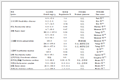
Reactions of Zintl phase K3As7 with 0.5 equiv. Ru(COD)nap (COD = 1,5-cyclooctadiene) in the presence of Bu4PBr yielded compound [Bu4P]3[As21] (1′), where Ru(COD)nap played a crucial role in the formation of the large chain-like polyarsenide. The compound 1′ was isolated as black plate-like crystals with yield of approximately 10%. Single-crystal X-ray diffraction revealed that cluster [As21]3– (1) crystallizes in the monoclinic space group P21/c with three [Bu4P]+ cations in the asymmetric unit. Moreover, the structure of 1 suffers from disorder and the disordered sites are divided into two equivalent groups, one with 57.4% occupancy and another 42.6%. Cluster [As21]3– represents a trimeric example of polyarsenic anion assembled through oxidative coupling of As73– anions, two of which remained nortricyclane-like geometry and the other has evolved into a norbornadiene-like cage (Fig. 1a). The three As7 units connected with each other via two exo-bonds. The cluster [As21]3– can be interpreted as a nanorod-like cluster with a length of approximately 1.37 nm (Fig. 1b), which is isostructural with lighter polyphosphides analogues [P21]3– [19] and the polycycloalkane C21H24 [34]. The As-As bond lengths among cluster anion [As21]3– fall in the range of 2.336–2.460 Å, which is comparable to those in other homoatomic polyarsenic clusters (Table 1). And the As-As distances are comparable to the sum of As atom radii (2.42 Å) [35], indicative of 2-center, 2-electron single bonds. Electrospray ionization mass spectrometry (ESI-MS) on compound 1′ was carried out but all attempts to get related characteristics failed due to the fact that compound 1′ may decompose rapidly in DMF or acetonitrile.

|
Download:
|
| Fig. 1. (a) ORTEP representation of the cluster anion [As21]3– (thermal ellipsoids are drawn at 50% probability). (b) Space-filling structure of the [As21]3– with van der Waals length of 1.37 nm. | |
|
Table 1 As-As bond lengths in polyarsenic anions (Å). |


The compound [K([2.2.2]crypt)]4[As18Mo2(CO)8] (2′) was obtained by reacting Zintl precursor K3As7 with Mo(CO)6 in ethylenediamine (en) at 75 ℃ in the presence of [2.2.2]crypt. The compound was isolated as small rhombus-like crystals and single-crystal X-ray diffraction revealed that cluster [As18Mo2(CO)8]4– (2) crystallizes in the monoclinic space group P21/n with four [K([2.2.2]crypt)]+ cations in the asymmetric unit. Cluster anion 2 can be interpreted as an 18-atom polyarsenic cluster coordinated by two Mo(CO)4 fragments (Fig. 2a). The As18 unit can be viewed as two realgar-type As8 (Fig. 2b) subunits connected by a dinuclear As-As dumbbell, which is in good accordance with the chain-like As18 structure predicted by theoretical calculations before [23]. The dinuclear bridged As18 cluster is "bent" at the two central bridging arsenic atoms (As9 and As10), and the two As8 units are oriented in the same direction ("up-up"), namely, atoms As2 and As17 point at the same direction. It is worth noting that the arrangement is similar to that of dinuclear bridged clusters such as P162– [17] and [MAs15]3– (M = Zn, Hg) [36,37]. The four-fold negative charge of cluster [As18Mo2(CO)8]4– can be rationalized by viewing As1, As3, As16 and As18 as pseudo-chalcogen atoms, each of which adopts a formal –1 charge. In this case, the polyarsenic cluster As18 carry a charge of –4. The polyarsenide As184– formed a nanorod with a length of approximately 1.04 nm (Fig. 2c). From another perspective, each of the two Mo(CO)4 is coordinated to the As18 moiety in an η2 mode via two formal As– atoms respectively and the coordination environment of each Mo atom is a distorted octahedron.

|
Download:
|
| Fig. 2. (a) ORTEP representation of the cluster anion [As18Mo2(CO)8]4– (thermal ellipsoids are drawn at 50% probability). (b) The fragment of realgar-type As8 in cluster anion 2 and selected bond distances are displayed. (c) Space-filling structure of the As18 fragment with van der Waals length of 1.04 nm. | |

The As-As bond lengths in cluster 2 span a range of 2.399–2.515 Å, comparable to those of realgar-type compound [(Cp*2Sm)4As8] (2.404–2.503 Å) [38], [{Cp*Cr(CO)3}4As8] (2.422–2.460 Å) [39] and binary Mo/As cluster anion [As7Mo2(CO)6]3– (2.563–2.569 Å) [40], indicative of single bonds. Notably, the distances of As2-As7 (2.511 Å) and As12-As17 (2.515 Å) are slightly longer than other As-As bonds in the cluster. Mo-As contacts fall in the range of 2.720–2.739 Å, close to those in [As7Mo2(CO)6]3– (2.745 Å, av) [40] but longer than Mo-As single bonds found in [Mo@As8]2– (2.564–2.569 Å) [41].
When reacting K3As7 with Mo(CO)6 or W(CO)6 by employing 18-crown-6 instead of [2.2.2]crypt with other reaction conditions unchanged, compound [K(18-crown-6)]3[As10]0.5[As4{M(CO)3}2]0.5·2en (M = Mo, 3′; M = W, 4′) were afforded. Given very similar structural characteristics of compound 3′ and 4′, the following discussion will mainly focus on 3′. Single-crystal X-ray diffraction analysis revealed the presence of three [K(18-crown-6)]+ cations in the asymmetric unit. Close inspection of the heavily disordered cluster site further revealed the co-crystallization of cluster anions [As10]2– (3a) and [As4{Mo(CO)3}2]4– (3b) in the compound (Fig. 3). The characteristics of the compound closely resemble those of the previously reported Mo/Sb compound [K(18-crown-6)]6[Sb10][Sb4{Mo(CO)3}2]·2en [42]. The isolated small-sized polyarsenide [As10]2– can be viewed as the fusion of two norbornadiene-like As7 units via four shared As atoms, exhibiting a pseudo-D2h symmetry. The polyarsenide [As10]2– (3a) was synthesized earlier by using AsCO as the source of arsenic, thus the bonding lengths will not be described in detail here [11]. The cluster anion [As4{Mo(CO)3}2]4– (3b) shows centrosymmetry, with a rectangular As4 plane being capped by two Mo(CO)3 fragments positioned above and below the plane. Notably, the longer side length (3.468 Å) of the rectangular As4 plane surpasses the sum of the atomic radii, indicating a non-bonding interaction. Thus, the [As4{Mo(CO)3}2]4– is virtually two As22– motifs capped by two metal carbonyl groups. The bond length of As1-As2 is 2.319 Å, shorter than the As-As bonds of cyclo-As42– (2.39 Å, av) [6] and the As-As single bonds found in [As7Mo2(CO)6]3– (2.563–2.569 Å) [40] and cluster 2 (2.399–2.515 Å). The As1-As2 contact is comparable to the described As-As double bonds in [CpMo(CO)2]2(μ, η2:2-As2) (2.312 Å) [43], and slightly longer than those found in [(Cp*2Sm)2As2(CptMo(CO)2)2] (Cpt represents the tBu substituted cyclopentadienyl) (2.238 Å) [44], thus exhibiting the characteristics of a double bond. In addition, the Mo-As bonds in cluster 3b range from 2.747 to 2.766 Å, comparable to the Mo-As contracts in cluster 2 (2.720–2.739 Å) and [As7Mo2(CO)6]3– (2.745 Å, av) [40]. ESI-MS of an acetonitrile solution of the crystals of [K(18-crown-6)]3[As10]0.5[As4{Mo(CO)3}2]0.5·2en (3′) was performed in negative-ion mode, where signal of [As5]– was found. The discovery of the ion peaks may come from the fragmentation of the parent anion [As10]2–. In addition, ion peaks containing metal carbonyl ligands such as [As5Mo(CO)2]– and [As5Mo(CO)3]– were found, presumably due to the rearrangement process in solution. The elemental compositions of compound 1′−4′ were confirmed by means of energy dispersive X-ray (EDX) analyses (Figs. S12-S15 in Supporting information).

|
Download:
|
| Fig. 3. (a) ORTEP representation of the cluster anion [As10]2–. (b) ORTEP representation of the cluster anion [As4{Mo(CO)3}2]4– (Thermal ellipsoids are drawn at 50% probability). | |

To understand the chemical bonding patterns and stability of the synthesized clusters, DFT calculations on clusters 1–3b were performed. The details of theoretical calculations are given in the Supporting Information. For cluster 1, the optimized structure show C2v symmetry, and it can be seen that the HOMO orbitals of [As21]3– are mainly composed of the p-orbitals of the atom As10 (Fig. 4). The As-As bond lengths for the optimized cluster are overestimated by ~0.1 Å. It is typical in calculations for highly anionic Zintl clusters, which is probably attributed to the absence of an explicit cationic environment in the computational model [45]. The optimized As-As bonds in 2 are comparable with those in the crystallographically determined structure, the optimized Mo-As bond lengths are slightly longer than the corresponding distances up to 0.03 Å. Despite the discrepancy, it is clear that the computational models capture the essential geometric features of these clusters. In addition, the optimized geometry of [As10]2– (3a) and [As4{Mo(CO)3}2]4– (3b) obtained through DFT calculations exhibited D2h and Ci symmetry, respectively. The large HOMO-LUMO gap of [As21]3– (2.84 eV), [As10]2– (2.82 eV) and [As4{Mo(CO)3}2]4– (3.51 eV) indicated the electronic stability of these clusters.

|
Download:
|
| Fig. 4. The calculated HOMO-LUMO gap and molecular orbitals in cluster anion 1. | |

To investigate the chemical bonding of cluster anions, adaptive natural density partitioning (AdNDP) analysis was performed on clusters 1–3b by employing Multiwfn 3.8 program [46,47]. For cluster anion [As21]3– (1), it is revealed that the 108 cluster valence electrons can be partitioned into twenty-two s-type lone pairs on As atoms with ONs = 1.82–1.96 |e|, thirty 2c-2e As-As σ-bonds with ONs = 1.95–1.97 |e|, and two 3c-2e As-As-As bonds with ONs = 1.85 |e| (Fig. 5a). The 3c-2e bond is formed by the linear combination of 4p orbitals from the As2 (As18) atom with 4p orbitals from the adjacent As atoms, As1 and As5 (As16 and As19). The As2 atom makes the predominant contribution to this bond (91.82%), with minor contributions from As1 (3.88%) and As5 (4.29%). Similar to [As21]3–, the bonding pattern of cluster 3a consists of ten s-type lone pairs on As atoms, fourteen 2c-2e As-As σ-bonds and two 3c-2e bonds (Fig. 5b). The bonding patterns indicate that clusters 1 and 3a were mainly composed of As-As single bonds.

|
Download:
|
| Fig. 5. Chemical bonding pictures and occupation numbers obtained for cluster anions (a) [As21]3– and (b) [As10]2–. | |

The cluster model of cluster 2 contains 186 valence electrons, which can be partitioned into 93 two-electron bonding elements. The chemical bonding was found to possess features: eighteen s-type lone pairs on As atoms with occupation numbers (ONs) of 1.93–1.95 |e|, classically bonded As18 framework with twenty-five 2c-2e As-As σ-bonds with ONs = 2.00 |e| and As atoms coordinate to Mo atoms to form four 3c-2e Mo-As-As σ-bonds with ONs = 1.77–1.81 |e| and 1.81 |e|, respectively (Fig. 6). The remaining d-electrons on Mo atoms participate in a back donation to CO ligands, the detailed AdNDP analysis of the Mo(CO)4 fragments could be seen in Fig. S16 (Supporting information). In cluster anion 3b, AdNDP analysis revealed the following bonding characteristics on Mo2As4 fragment: two classically bonded 2c-2e As-As σ-bonds with ONs = 1.97 |e|, four 3c-2e Mo-As-As σ-bonds with ONs = 1.93–1.94 |e| and two delocalized 5c-2e σ-bonds with ONs = 1.82 |e| (Fig. 7). Furthermore, by employing Wiberg bond indices (WBIs) analysis, the bond order of the As1-As2 link was determined to be 1.27, which exhibit a correlation with AdNDP results and the experimentally observed As-As bond lengths, indicative of the existence of As-As double bond in the cluster.

|
Download:
|
| Fig. 6. (a-c) Chemical bonding pictures and occupation numbers obtained for cluster anion [As18Mo2(CO)8]4–. | |


|
Download:
|
| Fig. 7. Chemical bonding pictures and occupation numbers obtained for Mo2As4 fragments in cluster anion [As4{Mo(CO)3}2]4–. | |

In summary, two medium-sized chain-like members of polyarsenic anions, As184– and As213–, have been isolated and characterized. The As184– can be viewed as formed by two realgar-type As8 subunits connected by an As-As dumbbell, realizing the transformation from theory to experiment. The As213– represents the first naked trimeric example of polyarsenic anion. As184– and As213– both show nano-scale characteristics and we anticipate that these polyarsenides may pave the way for experimentally synthesizing arsenic nanostructures.
Declaration of competing interestThe authors declare that they have no known competing financial interests or personal relationships that could have appeared to influence the work reported in this paper.
AcknowledgmentsThis work was supported by the National Natural Science Foundation of China (Nos. 92161102, 21971118 to Z.-M. Sun) and the Natural Science Foundation of Tianjin City (Nos. 20JCYBJC01560 and 21JCZXJC00140 to Z.-M. Sun). H.-M. He thanks the Fundamental Research Program of Shanxi Province (No. 202203021222248), and the Taiyuan Normal University College Students Science and Technology Innovation Project (No. CXCY2278).
Supplementary materialsSupplementary material associated with this article can be found, in the online version, at doi:10.1016/j.cclet.2023.108907.
| [1] |
H.L. Xu, N.V. Tkachenko, D.W. Szczepanik, et al., Nat. Commun. 13 (2022) 2149. DOI:10.1038/s41467-022-29626-5 |
| [2] |
X.H. Yue, W.X. Chen, T. Yang, et al., Nat. Synth. 2 (2023) 423-429. DOI:10.1038/s44160-023-00247-0 |
| [3] |
M.J. Strumolo, D.B. Eremin, S. Wang, et al., Inorg. Chem. 62 (2023) 6197-6201. DOI:10.1021/acs.inorgchem.3c00370 |
| [4] |
F. Guérin, D. Richeson, Inorg. Chem. 34 (1995) 2793-2794. DOI:10.1021/ic00115a002 |
| [5] |
R.S.P. Turbervill, J.M. Goicoechea, Chem. Rev. 114 (2014) 10807-10828. DOI:10.1021/cr500387w |
| [6] |
F. Kraus, N. Korber, Inorg. Chem. 45 (2006) 1117-1123. DOI:10.1021/ic0514445 |
| [7] |
T. Hanauer, F. Kraus, M. Reil, N. Korber, Monatsh. Chem. 137 (2006) 147-156. DOI:10.1007/s00706-005-0399-3 |
| [8] |
F. Kraus, T. Hanauer, N. Korber, Angew. Chem. Int. Ed. 44 (2005) 7200-7204. DOI:10.1002/anie.200502535 |
| [9] |
T. Hanauer, M. Grothe, M. Reil, N. Korber, Helv. Chim. Acta 88 (2005) 950-961. DOI:10.1002/hlca.200590088 |
| [10] |
A.W. Castleman, S.N. Khanna, A. Sen, et al., Nano. Lett. 7 (2007) 2734-2741. DOI:10.1021/nl071224j |
| [11] |
A. Hinz, J.M. Goicoechea, Angew. Chem. Int. Ed. 55 (2016) 8536-8541. DOI:10.1002/anie.201602310 |
| [12] |
C.H.E. Belin, J. Am. Chem. Soc. 102 (1980) 6036-6040. DOI:10.1021/ja00539a010 |
| [13] |
T. Hanauer, J.C. Aschenbrenner, N. Korber, Inorg. Chem. 45 (2006) 6723-6727. DOI:10.1021/ic060418j |
| [14] |
R.C. Haushalter, B.W. Eichhorn, A.L. Rheingold, S.J. Geib, J. Chem. Soc. Chem. Commun. (1988) 1027-1028. |
| [15] |
V. Miluykov, A. Kataev, O. Sinyashin, et al., Z. Anorg. Allg. Chem. 632 (2006) 1728-1732. DOI:10.1002/zaac.200600108 |
| [16] |
N. Korber, Phosphorus Sulfur Silicon Relat. Elem. 124 (1997) 339-346. DOI:10.1080/10426509708545639 |
| [17] |
M. Baudler, D. Düster, Z. Naturforsch. 42b (1987) 335-336. DOI:10.1515/znb-1987-0314 |
| [18] |
H.G. von Schnering, V. Manriquez, W. Hönle, Angew. Chem. Int. Ed. 20 (1981) 594-595. DOI:10.1002/anie.198105941 |
| [19] |
M. Baudler, D. Düster, K. Langerbeins, et al., Angew. Chem. Int. Ed. 23 (1984) 317-318. DOI:10.1002/anie.198403171 |
| [20] |
M. Baudler, R. Heumüller, D. Düster, et al., Z. Anorg. Allg. Chem. 518 (1984) 7-13. DOI:10.1002/zaac.19845181102 |
| [21] |
S.S. Du, J.Y. Hu, Z.Q. Chai, et al., Chin. J. Chem. 37 (2019) 71-75. DOI:10.1002/cjoc.201800482 |
| [22] |
M. Seidl, G. Balázs, M. Scheer, Chem. Rev. 119 (2019) 8406-8434. DOI:10.1021/acs.chemrev.8b00713 |
| [23] |
J.J. Zhao, Phys. Rev. B 73 (2006) 115418. DOI:10.1103/PhysRevB.73.115418 |
| [24] |
A.J. Karttunen, M. Linnolahti, T.A. Pakkanen, ChemPhysChem 8 (2007) 2373-2378. DOI:10.1002/cphc.200700376 |
| [25] |
H. Thurn, H. Kerbs, Angew. Chem. Int. Ed. 5 (1966) 1047-1048. |
| [26] |
M. Ruck, D. Hoppe, B. Wahl, et al., Angew. Chem. Int. Ed. 44 (2005) 7616-7619. DOI:10.1002/anie.200503017 |
| [27] |
M. Häser, U. Schneider, R. Ahlrichs, J. Am. Chem. Soc. 114 (1992) 9559-9568. DOI:10.1021/ja00050a040 |
| [28] |
S. Böcker, M. Häser, Z. Anorg. Allg. Chem. 621 (1995) 258-286. DOI:10.1002/zaac.19956210215 |
| [29] |
W.Q. Zhang, Z.S. Li, J.E. McGrady, Z.M. Sun, Angew. Chem. Int. Ed. 62 (2023) e202217316. DOI:10.1002/anie.202217316 |
| [30] |
W.Q. Zhang, N.V. Tkachenko, L. Qiao, A.I. Boldyrev, Z.M. Sun, Chin. J. Chem. 40 (2022) 65-70. DOI:10.1002/cjoc.202100682 |
| [31] |
N.V. Tkachenko, W.X. Chen, H.W.T. Morgan, et al., Chem. Commun. 58 (2022) 6223-6226. DOI:10.1039/d2cc01745h |
| [32] |
Y.N. Yang, L. Qiao, Z.M. Sun, Chin. Chem. Lett. 34 (2023) 107207. DOI:10.1016/j.cclet.2022.02.013 |
| [33] |
Y.S. Huang, D. Chen, J. Zhu, Z.M. Sun, Chin. Chem. Lett. 33 (2022) 2139-2142. DOI:10.1016/j.cclet.2021.08.038 |
| [34] |
J.J. Mrowca, T.J. Katz, J. Am. Chem. Soc. 88 (1966) 4012-4015. DOI:10.1021/ja00969a021 |
| [35] |
P. Pyykkö, J. Phys. Chem. A 119 (2015) 2326-2337. DOI:10.1021/jp5065819 |
| [36] |
S. Mandal, A.C. Reber, M. Qian, et al., Dalton Trans. 41 (2012) 12365-12377. DOI:10.1039/c2dt31286g |
| [37] |
M. Kaas, N. Korber, Z. Anorg. Allg. Chem. 643 (2017) 1331-1334. DOI:10.1002/zaac.201700171 |
| [38] |
C. Schoo, S. Bestgen, A. Egeberg, et al., Angew. Chem. Int. Ed. 58 (2019) 1-5. DOI:10.1002/anie.201813481 |
| [39] |
C. Schwarzmaier, A.Y. Timoshkin, G. Balázs, M. Scheer, Angew. Chem. Int. Ed. 53 (2014) 9077-9081. DOI:10.1002/anie.201404653 |
| [40] |
S. Mandal, M. Qian, A.C. Reber, et al., J. Phys. Chem. C. 115 (2011) 23704-23710. DOI:10.1021/jp207268x |
| [41] |
B.W. Eichhorn, S.P. Mattamana, D.R. Gardner, et al., J. Am. Chem. Soc. 120 (1998) 9708-9709. DOI:10.1021/ja9820700 |
| [42] |
H.P. Ruan, L.L. Wang, Z.Y. Li, L. Xu, Dalton Trans. 46 (2017) 7219-7222. DOI:10.1039/C7DT01135K |
| [43] |
P.J. Sullivan, A.L. Rheingold, Organometallics 1 (1982) 1547-1549. DOI:10.1021/om00071a032 |
| [44] |
N. Reinfandt, C. Schoo, L. Dütsch, et al., Chem. Eur. J. 27 (2021) 3974-3978. DOI:10.1002/chem.202003905 |
| [45] |
L. Qiao, C. Zhang, C.C. Shu, et al., J. Am. Chem. Soc. 142 (2020) 13288-13293. DOI:10.1021/jacs.0c04815 |
| [46] |
D.Y. Zubarev, A.I. Boldyrev, Phys. Chem. Chem. Phys. 10 (2008) 5207-5217. DOI:10.1039/b804083d |
| [47] |
T. Lu, F.W.M. Chen, J. Comput. Chem. 33 (2012) 580-592. DOI:10.1002/jcc.22885 |