 2024, Vol. 35


In recent years, the designs and synthesis of various transition metal catalysts have promoted the development of the olefin polymerization field [1-6], including the discoveries of new ligands and the improvements of literature-reported structures [7-9]. Recently, the emerging field of tuneable catalysis for olefin polymerization has attracted widespread attention in the academic community, the chemical reactivity of which can be selectively transformed between several different states via simple external stimulus [10-14]. The external stimulus often creates "on/off" behaviour or modulating the electronic and steric effects, affecting the polymerization process along with the properties of polymer products significantly [15-18].
There are some appealing external stimuluses employed to regulate transition metal catalyse olefin polymerization process, including photochemistry [19-21], acid/base [22-24], redox [25-30], supramolecular modulation [31,32], etc. For example, Chen et al. introduced the ferrocene units into the α-diimine palladium catalyst and utilized the stepwise redox of ferrocene units to modulate the catalyst properties during the polymerization and copolymerization of olefins (Scheme 1, Ⅰ) [33]. Long and co-workers also applied the reductant (or photo reductant) to α-diimine nickel catalyst with acenaphthene backbone, successfully adjusting the microstructure of polyethylene (Scheme 1, Ⅱ) [34,35]. In addition to redox-controlled olefin polymerization, Chen et al. also used external light stimulation to regulate the trans-cis isomeric behaviour of azobenzene unit to change the steric hindrance/electronic effect of the α-diimine catalyst, thereby regulating the activity of the catalyst and the topology of polyethylene products (Scheme 1, Ⅲ) [36]. Further, the extra addition of Lewis acid/base can regulate the electron cloud density of the catalyst metal centre to control olefin polymerization. For example, Jordan et al. added Lewis acid (B(C6F5)3) to the (phosphine-sulfonate) PdMe catalysts to enhance the chain growth and chain transfer rate of the catalyst in ethylene polymerization (Scheme 1, Ⅳ) [37]. And Do et al. investigated the positive role of secondary metal ions on metal-catalysed polymerization processes, which was conducive to increase in catalytic efficiency as well as enhancement in polymer molecular weight (Scheme 1, Ⅴ) [38-40].

|
Download:
|
| Scheme 1. A series of reported stimulus responsive transition metal catalysts for olefin polymerization. | |

These fascinating stimulus-responsive categories have been applied to synthesize switchable catalysts using for olefin polymerization. However, there are few studies focused on the synergistic effect of two different external stimulus strategies utilized in one catalyst structure. Brookhart-type α-diimine palladium and nickel complexes was a pioneer in producing polyethylene [41,42]. Structurally, the symmetrical structure of α-diimine ligand is conducive to introducing two different functional groups. For instance, Chen's group designed α-diimine palladium systems with both azobenzene unit and urea functional group to realize the light-mediated self-assembly process of the catalysts, adjusting the polymerization activity and molecular weight distribution of polyethylene products (Scheme 1, Ⅵ) [31]. Inspired by these reports, we further developed dual-regulated α-diimine palladium systems. In this contribution, we introduced two units with different stimulus responses into one catalyst system to explore the synergy between different regulatory methods. And these different stimulus response units can be combined into the catalyst structure through simple chemical reactions.
2,6-Diisopropyl-4-ferroceneaniline [43] and 8-(4-(phenyldiazenyl)phenyl)naphthalen-1-amine [36] were prepared according to published procedures. 4-(8-Aminonaphthalen-1-yl)benzonitrile and 4-(8-aminonaphthalen-1-yl)benzoic acid were synthesized by Pd-catalyzed coupling reaction. Then three ligands (L1-L3) were prepared by two steps of condensation reactions in high yields (Fig. 1a). The ligands were characterized by 1H NMR, 13C NMR analyses and HRMS. The corresponding palladium complexes (Pd1-Cl, Pd2-Cl and Pd3-Cl) were obtained in 78%−85% yields from the reaction of the corresponding ligands with one equivalent of (COD)PdMeCl (COD = 1,5-cyclooctadiene) respectively. The palladium complexes were characterized by 1H NMR, 13C NMR and MALDI-TOF-MS and X-ray diffraction. In order to elevate the operability of polymerization processes, single-component cationic palladium species Pd1-Pd3 was generated by reacting corresponding Pd-Cl with one equivalent of sodium tetrakis(3,5-bis(trifluoromethyl)phenyl)borate (NaBAF) in the presence of MeCN. The addition of 1 equiv. of AgBAF to Pd1-Pd3 led to the formation of Pd1+-Pd3+, which could be isolated and used in ethylene (co)polymerization subsequently. The changes in the redox potential of these palladium complexes before and after oxidation by AgBAF indicate changes in the oxidation valence state (Table S1 and Fig. S1 in Supporting information).

|
Download:
|
| Fig. 1. (a) Synthesis of functionalized ligands and metal complexes. X-ray crystallographic structures of (b) Pd1-Cl (CCDC No. 2244431): Pd1-Cl1 2.2882(14), Pd1-C10 2.028(5), Pd1-N1 2.165(4), Pd1-N2 2.033(4), N1-Pd1-N2 77.14(16), C10-Pd1-Cl1 89.29(16); (c) Pd2-Cl (CCDC No. 2244432): Pd1-C22 2.038(5), Pd1-Cl1 2.2948(12), Pd1-N1 2.148(4), Pd1-N3 2.035(4), N1-Pd1-N3 77.80(14), C22-Pd1-Cl1 90.79(14); (d) Pd3-Cl (CCDC No. 2244433): Pd1-C27 2.018(7), Pd1-C11 2.2924(19), Pd1-N1 2.022(5), Pd1-N2 2.154(6), N1-Pd1-N2 77.20(2), C27-Pd1-Cl1 89.20(2). | |

The single crystal of Pd1-Cl, Pd2-Cl and Pd3-Cl were shown in Figs. 1b-d. These palladium centers adopted spare-planar geometries, which are typical of reported α-diimine palladium complexes [44,45]. The most important structural feature of these complexes is that stimulus-responsive units Y lie on the axial position of the palladium centers. As such, light or additives (B(C6F5)3 and alkali cations) may directly influence the chemical environment of metal center, thereby influence its properties during ethylene polymerization.
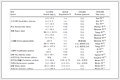
The complex Pd1 with ferrocene and azobenzene units showed moderate polymerization activity under dark condition at 20 ℃ (2.6 × 10⁴ g mol−1 h−1), offering polyethylene products with high branching density (96/1000C) and molecular weight (43.3 × 10³ g/mol, Table 1, entry 1). When being stimulated by light (UV, 365 nm), the catalytic activity decreased slightly, while the molecular weight of the produced polyethylene increased to 52.3 × 10³ g/mol (Table 1, entry 2). When being oxidized by AgBAF, the catalytic performance (activity and molecular weight) of Pd1+ obviously decreased (Table 1, entry 3). However, on the basis of the oxidized catalyst Pd1+, the introduction of UV light stimulation increased the molecular weight of the polymer (Table 1, entry 4). Above all, the complexes Pd1 showed adjustable catalytic performance in ethylene polymerization (Fig. 2a). Further research, the UV–vis absorption spectra (Fig. S2 in Supporting information) indicated fast and reversible trans-cis isomerization of Pd1 and Pd1+ when exposed to ultraviolet light (λ = 365 nm or 420 nm). It was demonstrated that the photoinduced trans-cis isomerization of azobenzene unit enhanced the steric hindrance of the Pd center, which may lead to an increase in the molecular weight of polymer [36-46]. Meanwhile, the 1H NMR studies of the palladium complex oxidized by AgBAF demonstrated the redox process (Fig. S3 in Supporting information).
|
Table 1 Ethylene polymerization in different conditions. a |

|
Download:
|
| Fig. 2. Performance of Pd1 or Pd1+ in (a) ethylene polymerization and (c) ethylene copolymerization. Performance of Pd3 or Pd3+ in (b) ethylene polymerization and (d) ethylene copolymerization. | |

In this work, B(C6F5)3 was chosen to investigate the effect of Lewis acid in ethylene polymerization. It has been reported that B(C6F5)3 can coordinate with -CN units and cause positive changes of catalysts [22-24,47]. Furthermore, significant chemical shift of Me-Pd was observed in the 1H NMR spectra of palladium complex after adding B(C6F5)3 (Fig. S4 in Supporting information). 19F NMR (Figs. S5 and S6 in Supporting information) spectra also provided evidence for the coordination between B(C6F5)3 and -CN units. Complexes Pd2-Cl and Pd2-Cl with B(C6F5)3 were analyzed by infrared spectroscopy, indicating desired interaction was formed (Fig. S7 in Supporting information). The catalyst Pd2 showed similar activities with Pd1, and the addition of B(C6F5)3 showed a positive effect on the molecular weight of polyethylene products (increasing to 35.0 × 10³ g/mol), while the activities of polymerization slightly decreased (Table 1, entries 5 and 6). This may be due to the increased steric hindrance of palladium center after coordination with B(C6F5)3. However, for the catalyst Pd2+, there was no visible change in catalytic performance after the addition of B(C6F5)3 (Table 1, entries 7 and 8).
It has been proved that the functional group of carboxylic acid can combine with different metal ions [48]. Herein, the catalyst Pd3-Na+/Pd3-K+ was generated from the reaction of Pd3 with 1.2 equiv. of NaH/HK in the presence of CH2Cl2 to synthesize the α-diimine palladium catalyst with both ferrocene unit and carboxylate functional group. The complexes Pd3 also showed tunable catalytic properties in ethylene polymerization (Fig. 2b). Specifically, Pd3 displayed a moderate activity in ethylene polymerization (1 × 10⁵ g mol−1 h−1, Table 1, entry 9), and the oxidized complex Pd3+ showed a decrease in both activity and molecular weight (Table 1, entry 10). Unexpected, Pd3-Na+ and Pd3-K+ derived from Pd3 exhibited higher activities (up to 1.5 × 10⁴ g mol−1 h−1) and molecular weight (up to 52.9 × 10³ g/mol) in ethylene polymerization (Table 1, entries 11 and 12). It was proved by density functional theory (DFT) calculation in the literature that the metal ion complexes to the O atom and forms a cation-π interaction with the electron-deficient aryl ring [49,50], which may improve the rigidity and stability of catalyst. Compared to Pd3+, the polymerization activities and the molecular weight of polyethylene products catalyzed by Pd3+-Na+and Pd3+-K+ also increased (Table 1, entries 13 and 14). Similar phenomena can also be observed in the polymerization process of the above three dual controllable palladium catalysts at other temperatures (Table S2 in Supporting information).
Furthermore, these Pd complexes can also catalyze the copolymerization of ethylene with polar monomers to produce functionalized polyolefin. Firstly, complex Pd1 can catalyze the copolymerization of ethylene and methyl acrylate (MA) in moderate activity (9.3 × 10³ g mol−1 h−1), generating the copolymer with the high comonomer incorporation (2.1 mol%) and high molecular weight (13.2 × 10³ g/mol, Table 2, entry 1). The molecular weight of the copolymer prepared under UV light increased to 16.9 × 10³ g/mol, while the comonomer incorporation decreased to 1.1 mol% (Table 2, entry 2). Unfortunately, the copolymerization performance (catalytic activity, molecular weight and comonomer incorporation) of the oxidized catalyst Pd1+ deteriorated (Table 2, entries 3 and 4). Bio-renewable methyl 10-undecenoate (MUA) was mildly poisoning due to its long spacer between the functional group and the double bond [51]. Pd1 produced E-MUA copolymer with high comonomer incorporation (3.3 mol%) and high molecular weight (24.0 × 10³ g/mol, Table 2, entry 5). With the control of UV light or oxidants, Pd1 regulated the copolymerization of ethylene and MUA similarly to that of ethylene and MA (Table 2, entries 6–8), which were shown in Fig. 2c directly.
|
|
Table 2 Ethylene copolymerization with different polar monomers. a |
Similarly, Pd2 can catalyze the copolymerization of ethylene with the comonomer MA and MUA in moderate activities up to 10.0 × 10³ g mol−1 h−1. The copolymers with moderate comonomer incorporation (up to 1.1 mol%) and high molecular weight (up to 12.3 × 10³ g/mol, Table 2, entries 9 and 13) were produced. Adding B(C6F5)3 to Pd2 resulted in decrease in the catalytic activities and comonomer in corporations, while the molecular weight of the copolymer increasing (Table 2, entries 10 and 14). Compared to Pd2, complex Pd2+ led to decrease copolymerization performance (Table 2, entries 11 and 15). The addition of B(C6F5)3 to the oxidized Pd2+ hindered the trend of performance decline (Table 2, entries 12 and 16).
For Pd3, copolymerization of ethylene and polar monomers (MA or MUA) can also be regulated (Fig. 2d). The Pd3-Na+obtained by adding alkali cations significantly improved the copolymerization performance of ethylene and polar monomers (MA or MUA, Table 2, entries 18 and 22), increasing copolymerization activity (up to 9.0 × 10³ g mol−1 h−1) and polar monomer incorporation (3.6 mol%) as well as copolymer molecular weight (19.7 × 10³ g/mol). This may be due to the cation-π interaction between metal ions and the electron-deficient aryl ring. The catalyst Pd3+ was similar to Pd1+ and Pd2+, of which the copolymerization performance was reduced. When introducing sodium ions into catalyst Pd3+, the copolymerization performance of Pd3+-Na+ was significantly improved (Table 2, entry 24).
In summary, we combined light regulation, Lewis acid regulation, or alkali cations regulation to oxidation regulation to synthesize three double stimulus responsive α-diimine palladium catalysts. These dual-regulated palladium catalysts can affect the ethylene polymerization process, regulating the molecular weight and branching density of polyethylene products. More importantly, these palladium complexes can catalyze the copolymerization of ethylene and polar monomers, such as methyl acrylate and methyl 10-undecenoate, and the comonomer incorporation can be regulated effectively. The research on these dual-regulated palladium complexes makes full use of prepared catalysts and provides new inspirations for regulating olefin polymerization.
Declaration of competing interestThe authors declare that they have no known competing financial interests or personal relationships that could have appeared to influence the work reported in this paper.
AcknowledgmentsThis work was supported by National Natural Science Foundation of China (No. 52203016), China Postdoctoral Science Foundation (Nos. 2021M703072 and 2022T150617), USTC Research Funds of the Double First-Class Initiative (No. YD9990002018). The Fundamental Research Funds for the Central Universities (No. WK9990000142).
Supplementary materialsSupplementary material associated with this article can be found, in the online version, at doi:10.1016/j.cclet.2024.109534.
| [1] |
A. Nakamura, T.M.J. Anselment, J. Claverie, et al., Acc. Chem. Res. 46 (2013) 1438-1449. DOI:10.1021/ar300256h |
| [2] |
H.L. Mu, G.L. Zhou, X.Q. Hu, Z.B. Jian, Coord. Chem. Rev. 435 (2021) 213802. DOI:10.1016/j.ccr.2021.213802 |
| [3] |
C.L. Chen, Nat. Rev. Chem. 2 (2018) 6-14. DOI:10.1038/s41570-018-0003-0 |
| [4] |
S.L.J. Luckham, K. Nozaki, Acc. Chem. Res. 54 (2021) 344-355. DOI:10.1021/acs.accounts.0c00628 |
| [5] |
C. Tan, C.L. Chen, Angew. Chem. Int. Ed. 58 (2019) 7192-7200. DOI:10.1002/anie.201814634 |
| [6] |
C.W. Hong, Z.H. Wang, H. Jiang, et al., Chin. Chem. Lett. 34 (2023) 107918. DOI:10.1016/j.cclet.2022.107918 |
| [7] |
S. Mecking, M. Schnitte, Acc. Chem. Res. 53 (2020) 2738-2752. DOI:10.1021/acs.accounts.0c00540 |
| [8] |
H.L. Mu, L. Pan, D.P. Song, Y.S. Li, Chem. Rev. 115 (2015) 12091-12137. DOI:10.1021/cr500370f |
| [9] |
Q. Wang, Z. Zhang, C. Zou, C.L. Chen, Chin. Chem. Lett. 33 (2022) 4363-4366. DOI:10.1016/j.cclet.2021.12.036 |
| [10] |
A.M. Doerr, J.M. Burroughs, S.R. Gitter, et al., ACS Catal. 10 (2020) 14457-14515. DOI:10.1021/acscatal.0c03802 |
| [11] |
A.J. Teator, D.N. Lastovickova, C.W. Bielawski, Chem. Rev. 116 (2016) 1969-1992. DOI:10.1021/acs.chemrev.5b00426 |
| [12] |
U. Lüning, Angew. Chem. Int. Ed. 51 (2012) 8163-8165. DOI:10.1002/anie.201204567 |
| [13] |
C.L. Chen, ACS Catal. 8 (2018) 5506-5514. DOI:10.1021/acscatal.8b01096 |
| [14] |
H. Suo, Z. Zhang, R. Qu, Y. Gu, Y. Qin, Catalysts 13 (2023) 670. DOI:10.3390/catal13040670 |
| [15] |
T.V. Tran, L.H. Do, Eur. Polym. J. 142 (2021) 110100. DOI:10.1016/j.eurpolymj.2020.110100 |
| [16] |
S. Deng, B.J. Jolly, J.R. Wilkes, et al., Nat. Rev. Methods Primers 3 (2023) 28. DOI:10.1038/s43586-023-00207-0 |
| [17] |
C. Tan, M. Chen, C.L. Chen, Trends Chem. 5 (2023) 147-159. DOI:10.1016/j.trechm.2022.12.007 |
| [18] |
F.A. Leibfarth, K.M. Mattson, B.P. Fors, H.A. Collins, C.J. Hawker, Angew. Chem. Int. Ed. 52 (2013) 199-210. DOI:10.1002/anie.201206476 |
| [19] |
J.M. Kaiser, J.M. Burroughs, B.K. Long, J. Am. Chem. Soc. 144 (2022) 21206-21212. DOI:10.1021/jacs.2c08548 |
| [20] |
Y.S. Liu, E. Harth, Angew. Chem. Int. Ed. 60 (2021) 24107-24115. DOI:10.1002/anie.202107039 |
| [21] |
L. Zhou, Y.J. Wu, K. Chen, et al., Org. Chem. Front. 10 (2023) 4854-4861. DOI:10.1039/d3qo00212h |
| [22] |
C. Tan, Q. Muhammad, W.M. Pang, C.L. Chen, Polym. Chem. 11 (2020) 411-416. DOI:10.1039/c9py00904c |
| [23] |
M. Chen, W.P. Zou, Z.G. Cai, C.L. Chen, Polym. Chem. 6 (2015) 2669-2676. DOI:10.1039/C5PY00010F |
| [24] |
N.D. Contrella, R.F. Jordan, Organometallics 33 (2014) 7199-7208. DOI:10.1021/om5009988 |
| [25] |
M. Abubekerov, S.M. Shepard, P.L. Diaconescu, Eur. J. Inorg. Chem. 15 (2016) 2634-2640. DOI:10.1002/ejic.201501295 |
| [26] |
R. Mundil, L.E. Wilson, D. Schaarschmidt, et al., Polymer 179 (2019) 121619. DOI:10.1016/j.polymer.2019.121619 |
| [27] |
W.C. Anderson, S.H. Park, L.A. Brown, J.M. Kaiser, B.K. Long, Inorg. Chem. Front. 4 (2017) 1108-1112. DOI:10.1039/C7QI00079K |
| [28] |
J.M. Kaiser, B.K. Long, Coord. Chem. Rev. 372 (2018) 141-152. DOI:10.1016/j.ccr.2018.06.007 |
| [29] |
M. Chen, B.P. Yang, C.L. Chen, Angew. Chem. Int. Ed. 54 (2015) 15520-15524. DOI:10.1002/anie.201507274 |
| [30] |
J. Bernauer, J. Pölker, A. Jacobi von Wangelin, ChemCatChem 14 (2022) e202101182. DOI:10.1002/cctc.202101182 |
| [31] |
G.H. Wang, D. Peng, Y. Sun, C.L. Chen, CCS Chem. 2 (2020) 2025-2034. |
| [32] |
J. Flapper, J.N.H. Reek, Angew. Chem. Int. Ed. 46 (2007) 8590-8592. DOI:10.1002/anie.200703294 |
| [33] |
M.H. Zhao, C.L. Chen, ACS Catal. 7 (2017) 7490-7494. DOI:10.1021/acscatal.7b02564 |
| [34] |
W.C. Anderson Jr, J.L. Rhinehart, A.G. Tennyson, B.K. Long, J. Am. Chem. Soc. 138 (2016) 774-777. DOI:10.1021/jacs.5b12322 |
| [35] |
J.M. Kaiser, W.C. Anderson, B.K. Long, Polym. Chem. 9 (2018) 1567-1570. DOI:10.1039/c7py01836c |
| [36] |
D. Peng, C.L. Chen, Angew. Chem. Int. Ed. 60 (2021) 22195-22200. DOI:10.1002/anie.202107883 |
| [37] |
Z.G. Cai, Z.L. Shen, X.Y. Zhou, R.F. Jordan, ACS Catal. 2 (2012) 1187-1195. DOI:10.1021/cs300147c |
| [38] |
Z.Z. Cai, D.W. Xiao, L.H. Do, J. Am. Chem. Soc. 137 (2015) 15501-15510. DOI:10.1021/jacs.5b10351 |
| [39] |
Z.Z. Cai, L.H. Do, Organometallics 36 (2017) 4691-4698. DOI:10.1021/acs.organomet.7b00516 |
| [40] |
T.V. Tran, E. Lee, Y.H. Nguyen, H.D. Nguyen, L.H. Do, J. Am. Chem. Soc. 144 (2022) 17129-17139. DOI:10.1021/jacs.2c07098 |
| [41] |
L.H. Guo, S.Y. Dai, X.L. Sui, C.L. Chen, ACS Catal. 6 (2016) 428. DOI:10.1021/acscatal.5b02426 |
| [42] |
F.Z. Wang, C.L. Chen, Polym. Chem. 10 (2019) 2354-2369. DOI:10.1039/c9py00226j |
| [43] |
U. Siemeling, B. Neumann, H.G. Stammler, O. Kuhnert, Polyhedron 18 (1999) 1815-1819. DOI:10.1016/S0277-5387(99)00057-1 |
| [44] |
S.Y. Dai, C.L. Chen, Angew. Chem. Int. Ed. 55 (2016) 13281. DOI:10.1002/anie.201607152 |
| [45] |
Y.X. Zhang, Z.B. Jian, Macromolecules 54 (2021) 3191-3196. DOI:10.1021/acs.macromol.1c00174 |
| [46] |
J.S. Yang, X.Q. Hu, Z.B. Jian, Chin. J. Chem. 40 (2022) 2919-2926. DOI:10.1002/cjoc.202200480 |
| [47] |
P. Zhang, M.H. Zhao, W.M. Pang, C.L. Chen, Sci. Chin. Chem. 62 (2019) 475-478. DOI:10.1007/s11426-018-9414-3 |
| [48] |
C. Tan, C. Zou, C.L. Chen, J. Am. Chem. Soc. 144 (2022) 2245-2254. DOI:10.1021/jacs.1c11817 |
| [49] |
X.Y. Zhang, G.O. Jones, J.L. Hedrick, R.M. Waymouth, Nat. Chem. 8 (2016) 1047-1053. DOI:10.1038/nchem.2574 |
| [50] |
D.A. Dougherty, Science 271 (1996) 163-168. DOI:10.1126/science.271.5246.163 |
| [51] |
L.M. de Espinosa, M.A. Meier, Eur. Polym. J. 47 (2011) 837-852. DOI:10.1016/j.eurpolymj.2010.11.020 |