 2024, Vol. 35


b State Key Laboratory Breeding Base of Green Chemistry-Synthesis Technology, Zhejiang University of Technology, Hangzhou 310014, China;
c State Key Laboratory of Elemento-Organic Chemistry, Nankai University, Tianjin 300071, China
Epoxides are among the most important building blocks in organic synthesis [1]. Due to its intrinsic ring strain and electrophilicity, the functionalization of epoxides has attracted much attention to generate complicated heteroatom-containing products [2]. On the other hand, CO2 is an ideal one-carbon (C1) building block in chemical synthesis in light of environmental protection and resource utilization [3–13]. The catalytic coupling and polymerization of CO2 and epoxides to yield cyclic carbonates or polycarbonates remain amongst the most successful examples for CO2 utilization as carbon resource (Scheme 1A) [14–24]. Traditionally, Lewis acid catalysts are required to activate epoxides to facilitate the ring-opening and following O-centered carboxylation in these process. With the development of the photo/electrochemistry over the past few years [25–36], single electron activation emerges as an alternative strategy for the transformation of epoxide [37–39]. Although the ring strain of epoxides makes them sensitive to both acids and bases, regioselective cleavage of C—O bond of epoxides via single electron activation strategy could generate C-centered radical for controllable functionalization rather than polymerization, isomerization and deoxygenation [2]. In 2023, Zhang, Lu and Qiu independently reported novel electroreductive ring-opening carboxylation of epoxides with CO2 in good chemoselectivity, providing valuable β-hydroxy acids and relevant drug molecules (Scheme 1B) [40,41]. However, these methods always need to use expensive platinum as cathode and magnesium as sacrificial anode, which might limit their applications. Recently, visible light photoredox catalysis has gained significant attention since it enables new chemical transformations under mild conditions. Motivated by the advancements in photocatalysis and our continuous interest in the carboxylation reactions with CO2 [42–50], we would like to achieve the reductive C-centered carboxylation of epoxides with CO2 via visible-light photoredox catalysis, which could provide a new way for conversion of epoxides with CO2. Herein, we report the first photocatalytic carboxylation of epoxides with CO2 via sequential single electron transfer (SSET) process (Scheme 1C) [51,52]. Many valuable β-hydroxy acids can be synthesized in high regioselectivities and yields. Furthermore, more challenging substrates, such as oxetanes, tetrahydrofurans and tetrahydropyrans, could also undergo reductive ring-opening carboxylation reaction with CO2, affording valuable γ-, δ-, ε-hydroxy acids.

|
Download:
|
| Scheme 1. Utilization of CO2 with epoxides in organic chemistry. | |
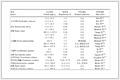
We commenced the studies by exploring the reductive carboxylation reaction using 2-([1,1′-biphenyl]−4-yl)oxirane (1a) as the model substrate. After extensive investigation, the desired product 2a was obtained in 71% yield using organo-dye 4CzTPN as the photosensitizer, Cs2CO3 as the base, available organic amine DIPEA as the electron donor and DMAc as the solvent under blue LED irradiation at room temperature for 12 h (Table 1, entry 1). Control experiments showed that the photosensitizer, DIPEA, light and CO2 were all necessary for this reaction to occur (Table 1, entries 2–5). The absence of Cs2CO3 led to a much lower yield of 2a (Table 1, entry 6). When using other photosensitizers such as 3DPAFIPN or fac-Ir(ppy)3, the yields of 2a decreased (Table 1, entries 7 and 8). Solvents were also evaluated, and DMAc was found to be the best out of a variety of solvents such as MeCN and DMSO (Table 1, entries 9 and 10). Varying the loading of DIPEA and Cs2CO3 could not improve the yield of 2a (Table 1, entries 11–14). Increasing the concentration of the reaction solution led to poor yield (Table 1, entry 15).
|
Table 1 Optimizations of reaction conditions.a |


With the optimized conditions in hand, we further investigated with the substrate scope of aryl epoxides (Scheme 2). For monosubstituted or 1,1-disubstituted epoxide, a variety of valuable functional groups, such as aryl (2a, 2i, 2l), ester (2b, 2d, 2e, 2h, 2j), trifluoromethyl (2m), alkoxy (2f), sulfone (2k), amide (2c) and fluorine (2g, 2n), were all tolerated well in this reaction, thus allowing for downstream chemistry. The manifolds provided the desired products in the presence of alkene decoration on the alkyl side-chain moiety (1e, 1f). In addition, 1,2-disubstituted epoxide 1o was also applicable to the reaction, delivering the product 2o in excellent chemo- and regioselectivities. Other disubstituted (1p) and trisubstituted (1q, 1r) epoxides also exhibited the capability to yield the desired products in commendable quantities. Furthermore, we also tested the aliphatic epoxide under the standard reaction conditions. However no desired product was observed (please see more details in Supporting information).

|
Download:
|
| Scheme 2. Substrate scope. Standard conditions: 1 (0.2 mmol), 4CzTPN (2 mol%), Cs2CO3 (0.2 mmol), DIPEA (0.4 mmol), DMAc (3 mL), CO2 (1 atm, closed), r.t., 12 h. The ester product was obtained by TMSCHN2 as the methylation reagent. Isolated yields are shown. a 4CzTPN was replaced by 3DPA2FBN. b 4CzTPN (5 mol%) was used. c 0 ℃. d 60 ℃, 36 h. e 60 ℃, 4CzTPN was replaced by 4DPAIPN, 36 h. f Cs2CO3 (2 equiv.) was used. | |

Encouraged by the above results, we next turned our attention to more challenging substrates, such as oxetanes (1s, 1t), tetrahydrofuran (1u) and tetrahydropyran (1v). To out delight, all of them reacted well, giving the corresponding γ, δ or ε-hydroxy acids in good yields. To confirm the feasibility of this method in late-stage functionalization, we further tested some aryl epoxide derivations from naturally occurring bioactive molecules, such as DL-isoborneol (1w), citronellol (1x), and DL-menthol (1y), resulting the desired products in good to excellent yields. It was worth noting that the alkyl-substituted oxirane group in 1x could also be well-accommodated in this reaction, which showed the good chemo-selectivity of this transformation. Besides, the scalability of the reaction is demonstrated in Scheme 3a, in which product 2a was prepared in 64% isolated yield with slight modification of the reaction conditions.

|
Download:
|
| Scheme 3. Gram-scale reaction and mechanism investigations. | |

To gain more insight into this reaction, a series of mechanistic experiments were carried out. Firstly, when radical scavenger 2,2,6,6-tetramethyl-1-piperdiny-1-oxy (TEMPO) was subjected to standard reaction, the carboxylation reaction was almost inhibited and the adduct of benzylic radical with TEMPO (3a) was detected by HRMS (Scheme 3b). These results indicated that benzylic radical intermediate might be involved in the reaction. Then we conducted the deuterium-labeling experiment (Scheme 3c). When the deuterium incorporation study was performed under a N2 atmosphere, the product 4a was obtained in 46% yield with 87% deuterium incorporation, indicating that the benzylic carbanion might exist in this transformation.
To further elucidate the photocatalytic cycle, the Stern-Volmer luminescence experiment was carried out. As shown in Scheme 4, DIPEA could reductively quench the excited photocatalyst more efficiently than the substrate 1a, indicating that single electron transfer (SET) between 4CzTPN* and DIPEA is responsible for the initiation of the carboxylation reaction.

|
Download:
|
| Scheme 4. Stern-Volmer fluorescence quenching experiment. | |

Based on the above experiments and previous work, we proposed a possible mechanism (Scheme 5). First, the photosensitizer 4CzTPN was excited under the irradiation of blue LED. Then the excited photosensitizer 4CzTPN* was quenched by DIPEA to give the reduced photosensitizer 4CzTPN•–. The substrate A could be reduced by 4CzTPN•– to generate ground state 4CzTPN and benzylic radical intermediate B, which underwent a SET reduction in another photocatalytic cycle to provide the benzylic carbanion C. Final nucleophilic attack of C on CO2 would give the desired product D.

|
Download:
|
| Scheme 5. Proposed mechanism. | |

In summary, we report the first example of visible-light photoredox-catalyzed carboxylation of aryl epoxides with CO2 to synthesize various important hydroxy acids. Besides the epoxides, the oxetane and more challenging tetrahydrofuran or tetrahydropyran could all provide desired products in high chemo- and regioselectivities under transition-metal-free conditions. And the mechanistic investigation indicated the key ring-opening procedure was achieved via SSET process. Notably, this reaction features high step- and atom-economy and good functional group tolerance, complementing other well-established methodologies for utilization of epoxide with CO2.
Declaration of competing interestThe authors declare that they have no known competing financial interests or personal relationships that could have appeared to influence the work reported in this paper.
AcknowledgmentsFinancial support is provided by the National Natural Science Foundation of China (Nos. 22225106, 22301193), Fundamental Research Funds from Sichuan University (No. 2020SCUNL102), and the Fundamental Research Funds for the Central Universities. We also thank Xiaoyan Wang from the Analysis and Testing Center of Sichuan University as well as Jing Li, Dongyan Deng and Qinfang Zhang from College of Chemistry at Sichuan University for compound testing.
Supplementary materialsSupplementary material associated with this article can be found, in the online version, at doi:10.1016/j.cclet.2023.109364.
| [1] |
L.P.C. Nielsen, E.N. Jacobsen, P. Crotti, et al., Aziridines and Epoxides in Organic
Synthesis, Wiley-VCH, Weinheim, Germany, 2006, doi: 10.1002/3527607862.
|
| [2] |
C.Y. Huang, A.G. Doyle, Chem. Rev. 114 (2014) 8153-8198. DOI:10.1021/cr500036t |
| [3] |
K. Huang, C.L. Sun, Z.J. Shi, Chem. Soc. Rev. 40 (2011) 2435-2452. DOI:10.1039/c0cs00129e |
| [4] |
L. Ackermann, Angew. Chem. Int. Ed. 50 (2011) 3842-3844. DOI:10.1002/anie.201007883 |
| [5] |
X.B. Lu, W.M. Ren, G.P. Wu, Acc. Chem. Res. 45 (2012) 1721-1735. DOI:10.1021/ar300035z |
| [6] |
G.Q. Yuan, C.R. Qi, W.Q. Wu, H.F. Jiang, Curr. Opin. Green Sustain. Chem. 3 (2017) 22-27. DOI:10.1016/j.cogsc.2016.11.006 |
| [7] |
B. Grignard, S. Gennen, C. Jérôme, A.W. Kleij, C. Detrembleur, Chem. Soc. Rev. 48 (2019) 4466-4514. DOI:10.1039/c9cs00047j |
| [8] |
B. Song, A.J. Qin, B.Z. Tang, Acta Chim. Sin. 78 (2020) 9-22. DOI:10.6023/a19090340 |
| [9] |
L. Zhang, Z.H. Li, M. Takimoto, Z.M. Hou, Chem. Rec. 20 (2020) 494-512. DOI:10.1002/tcr.201900060 |
| [10] |
Y. Cao, X. He, N. Wang, H.R. Li, L.N. He, Chin. J. Chem. 36 (2018) 644-659. DOI:10.1002/cjoc.201700742 |
| [11] |
G. Bertuzzi, A. Cerveri, L. Lombardi, M. Bandini, Chin. J. Chem. 39 (2021) 3116-3126. DOI:10.1002/cjoc.202100450 |
| [12] |
X. Kang, G. Fu, X.Z. Fu, J.L. Luo, Chin. Chem. Lett. 34 (2023) 107757. DOI:10.1016/j.cclet.2022.107757 |
| [13] |
Z. Yang, Y. Yu, L. Lai, et al., Green Synth. Catal. 2 (2021) 19-26. DOI:10.1016/j.gresc.2021.01.009 |
| [14] |
M.I. Childers, J.M. Longo, N.J.V. Zee, A.M. Lapointe, G.W. Coates, Chem. Rev. 114 (2014) 8129-8152. DOI:10.1021/cr400725x |
| [15] |
X.M. Yan, J.B. Xu, T. Zhang, et al., Chin. Chem. Lett. 34 (2023) 107851. DOI:10.1016/j.cclet.2022.107851 |
| [16] |
J. Herzberger, K. Niederer, H. Pohlit, et al., Chem. Rev. 116 (2016) 2170-2243. DOI:10.1021/acs.chemrev.5b00441 |
| [17] |
K. Zhang, X.F. Liu, W.Z. Zhang, W.M. Ren, X.B. Lu, Org. Lett. 24 (2022) 3565-3569. DOI:10.1021/acs.orglett.2c01267 |
| [18] |
X.F. Liu, K. Zhang, L. Tao, X.B. Lu, W.Z. Zhang, Green Chem. Eng. 3 (2022) 125-137. DOI:10.3390/catal12020125 |
| [19] |
C. Martín, G. Fiorani, A.W. Kleij, ACS Catal. 5 (2015) 1353-1370. DOI:10.1021/cs5018997 |
| [20] |
D.H. Lan, N. Fan, Y. Wang, et al., Chin. J. Catal. 37 (2016) 826-845. DOI:10.1016/S1872-2067(15)61085-3 |
| [21] |
J.E. Gómez, A.W. Kleij, Curr. Opin. Green Sustain. Chem. 3 (2017) 55-60. DOI:10.1016/j.cogsc.2016.11.005 |
| [22] |
J. Artz, T.E. Müller, K. Thenert, Chem. Rev. 118 (2018) 434-504. DOI:10.1021/acs.chemrev.7b00435 |
| [23] |
D. Prasada, K.N. Patil, N.K. Chaudhari, et al., Catal. Rev. 64 (2022) 356-443. DOI:10.1080/01614940.2020.1812212 |
| [24] |
M.R. Kember, A. Buchard, C.K. Williams, Chem. Commun. 47 (2011) 141-163. DOI:10.1039/C0CC02207A |
| [25] |
P. Bellotti, H.M. Huang, T. Faber, F. Glorius, Chem. Rev. 123 (2023) 4237-4352. DOI:10.1021/acs.chemrev.2c00478 |
| [26] |
M.H. Shaw, J. Twilton, D.W.C. MacMillan, J. Org. Chem. 81 (2016) 6898-6926. DOI:10.1021/acs.joc.6b01449 |
| [27] |
N.A. Romero, D.A. Nicewicz, Chem. Rev. 116 (2016) 10075-10166. DOI:10.1021/acs.chemrev.6b00057 |
| [28] |
W. Xiao, J. Wu, Chin. Chem. Lett. 31 (2020) 3083-3094. DOI:10.1016/j.cclet.2020.07.035 |
| [29] |
C.K. Prier, D.A. Rankic, D.W.C. MacMillan, Chem. Rev. 113 (2013) 5322-5363. DOI:10.1021/cr300503r |
| [30] |
J. Xuan, W.J. Xiao, Angew. Chem. Int. Ed. 51 (2012) 6828-6838. DOI:10.1002/anie.201200223 |
| [31] |
M. Yan, Y. Kawamata, P.S. Baran, Chem. Rev. 117 (2017) 13230-13319. DOI:10.1021/acs.chemrev.7b00397 |
| [32] |
R. Francke, R.D. Little, Chem. Soc. Rev. 43 (2014) 2492-2521. DOI:10.1039/c3cs60464k |
| [33] |
R.D. Little, K.D. Moeller, Chem. Rev. 118 (2018) 4483-4484. DOI:10.1021/acs.chemrev.8b00197 |
| [34] |
L.F.T. Novaes, J.J. Liu, Y.F. Shen, et al., Chem. Soc. Rev. 50 (2021) 7941-8002. DOI:10.1039/d1cs00223f |
| [35] |
C. Ma, P. Fang, Z.R. Liu, et al., Sci. Bull. 66 (2021) 2412-2429. DOI:10.1016/j.scib.2021.07.011 |
| [36] |
Y.Y. Chen, L.Q. Lu, D.G. Yu, C.J. Zhu, W.J. Xiao, Sci. China Chem. 62 (2019) 24-57. DOI:10.1007/s11426-018-9399-2 |
| [37] |
S.H. Lau, M.A. Borden, T.J. Steiman, et al., J. Am. Chem. Soc. 143 (2021) 15873-15881. DOI:10.1021/jacs.1c08105 |
| [38] |
M. Parasram, B.J. Shields, O. Ahmad, T. Knauber, A.G. Doyle, ACS Catal. 10 (2020) 5821-5827. DOI:10.1021/acscatal.0c01199 |
| [39] |
C. Huang, W. Ma, X.L. Zheng, et al., J. Am. Chem. Soc. 144 (2022) 1389-1395. DOI:10.1021/jacs.1c11791 |
| [40] |
K. Zhang, B.H. Ren, X.F. Liu, et al., Angew. Chem. Int. Ed. 61 (2022) e202207660. DOI:10.1002/anie.202207660 |
| [41] |
Y.W. Wang, S.Y. Tang, G.Q. Yang, et al., Angew. Chem. Int. Ed. 61 (2022) e202207746. DOI:10.1002/anie.202207746 |
| [42] |
C.K. Ran, L.L. Liao, T.Y. Gao, Y.Y. Gui, D.G. Yu, Curr. Opin. Green Sustain. Chem. 32 (2021) 100525. DOI:10.1016/j.cogsc.2021.100525 |
| [43] |
Z. Zhang, J.H. Ye, T. Ju, et al., ACS Catal. 10 (2020) 10871-10885. DOI:10.1021/acscatal.0c03127 |
| [44] |
J.H. Ye, T. Ju, H. Huang, L.L. Liao, D.G. Yu, Acc. Chem. Res. 54 (2021) 2518-2531. DOI:10.1021/acs.accounts.1c00135 |
| [45] |
J. Hou, J.S. Li, J. Wu, Asian J. Org. Chem. 7 (2018) 1439-1447. DOI:10.1002/ajoc.201800226 |
| [46] |
X. He, L.Q. Qiu, W.J. Wang, K.H. Chen, L.N. He, Green Chem. 22 (2020) 7301-7320. DOI:10.1039/d0gc02743j |
| [47] |
C.S. Yeung, Angew. Chem. Int. Ed. 58 (2019) 5492-5502. DOI:10.1002/anie.201806285 |
| [48] |
Y.Y. Gui, W.J. Zhou, J.H. Ye, D.G. Yu, ChemSusChem 10 (2017) 1337-1340. DOI:10.1002/cssc.201700205 |
| [49] |
S. Pradhan, S. Roy, B. Sahoo, I. Chatterjee, Chem. Eur. J. 27 (2021) 2254-2269. DOI:10.1002/chem.202003685 |
| [50] |
Z.N. Fan, Z.Y. Zhang, C.J. Xi, ChemSusChem 13 (2020) 6201-6218. DOI:10.1002/cssc.202001974 |
| [51] |
T. Ju, Y.Q. Zhou, K.G. Cao, et al., Nat. Catal. 4 (2021) 304-311. DOI:10.1038/s41929-021-00594-1 |
| [52] |
W.J. Zhou, Z.H. Wang, L.L. Liao, et al., Nat. Commun. 11 (2020) 3263. DOI:10.1038/s41467-020-17085-9 |