 2024, Vol. 35


Transition metal-catalyzed migratory hydrofunctionalization of alkenes has been an emerging synthetic method to introduce various functional groups at inert C(sp3)-H site away from the initial olefin position [1–10]. Among these transformations, the migratory hydroarylation provides a straightforward protocol to construct C(sp2)-C(sp3) bond [11–27], which constitutes the fundamental frame structure of chemicals. Due to the electronic or steric effect, the reaction predominantly promotes the aryl group at α-carbon adjacent to phenyl [28–29], borate ester [30–32], or terminal position (Scheme 1A) [33]. Notwithstanding the well-developed regioselective chain walking processes, it is highly desirable to develop new pattern for the migratory hydroarylation to prepare high-value compounds. Recently, a chelation-assisted strategy has been applied to a few examples of migratory functionalizations by several groups including us [34–39], with exceptional regioselectivity controlled by the formation of stable directing group-ligated metallacycles. However, the currently reported transformations are limited to hydroalklylation [40–48], hydroamination [49–53] and hydroboration [54,55].

|
Download:
|
| Scheme 1. Chelation-assisted migratory hydroarylation of alkenes. | |
Secondary N-α-aryl amides are ubiquitous structural motifs in many bioactive molecules, exhibiting potent biological and pharmacological activities (Scheme 1B) [56–59]. Simple, new, yet comprehensively useful preparation methods have long been sought [60–62]. While catalytic hydrogenation of vinylamides [63–65], C–N coupling between carboxylic acid derivatives and α-aryl-substituted amines [66,67], and Ni/photoredox dual-catalyzed α-arylation of benzamides [68–70] have been established for the rapid assembly of these challenging motifs, it is still highly desirable to develop direct catalytic platforms to access N-aryl amides. We questioned whether remote hydroarylation could be achieved from common and readily available olefin starting materials, therefore providing a new approach to these valuable products.
As an extension of our interest in the difunctionalization and hydrofunctionaliation of alkenyl amines [45,55,71–78], we turned our attention to the challenging remote hydroarylation, considering that the oxidative addition of aryl halide to electron-rich and sterically hindered Ni(Ⅰ)-alkyl intermediate is slow and more difficult [79]. Herein, we report a NiH-catalyzed [80–83] migratory hydroarylation of alkenyl amines with aryl iodides under mild conditions using native and monodentate amide as the directing group (Scheme 1C). The coordination of the directing group and the ligand promotes the α-C(sp3)-H arylation of alkenyl amides via a thermodynamically stable five-membered nickelacyle intermediate. The protocol has good functional group tolerance, and is amenable to alkene substrates with different chain lengths, providing an attractive and simple route for the synthesis of secondary N-α-aryl amide derivatives.
We set out to investigate the nickel-catalyzed remote hydroarylation using benzoyl-protected homoallylamine 1a and 4-methoxyiodobenzene electrophile as model substrates at room temperature (Table 1). After extensive research on nickel sources, ligands, bases, hydrogen sources and solvents (for details, see Supporting information), we found that with NiBr2·DME as the catalyst and 2,9-dimethyl-4,7-diphenyl-1,10-phenanthroline (L4) as the ligand, K2CO3 as the base, and (MeO)3SiH as the hydrogen source, the reaction in N,N-dimethylacetamide (DMA) at room temperature for 24 h can provide the desired α-arylbenzamide product in 89% yield with excellent selectivity (entry 1). Ligands play a very important role in promoting chain walking and improving regioselectivity. The yield of bipyridine ligands is less than 61%, while pyridine oxazoline, bisoxazoline and bisphosphine ligands cannot deliver the corresponding products. NiBr2 and Ni(cod)2 also gave the desired products, but the site selectivity and yield were slightly lower, and Ni(OTf)2 could not provide any desired products (entries 2−4). When the electrophile is replaced by 4-methoxybromobenzene, the reaction cannot occur (entry 5). Inferior results were obtained when using K3PO4 and CsF as the base instead of K2CO3 (entries 6 and 7) or (EtO)3SiH and MePh2SiH as the hydrogen source instead of (MeO)3SiH (entries 8 and 9). The effect of solvent was also probed, and we found that DMF resulted in poor yield and regioselectivity (entry 10). Finally, shortening the reaction time to 18 h led to a decrease in yield (entry 11).
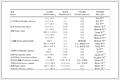
|
Table 1 Optimization of reaction conditions.a |


After establishing feasible conditions, we investigated the generality of this Ni-catalyzed remote hydroarylation reaction (Scheme 2). Initially, the substrate scope of alkenyl amides with different substituents was evaluated. Substrates with aromatic and aliphatic amides exhibit well-compatibility, delivering valuable secondary N-α-aryl amide products (2a-2u). In general, high levels of α-regioselectivity (up to 99:1 rr) were observed. For aromatic amides, electron-rich substituents on the phenyl rings gave higher yields than electron-deficient substituents (2b, 2c vs. 2d, 2e), with yields of 78%–87%. 2-Naphthyl amide also provided the desired product in moderate yields (2f). Under the existing optimized conditions, aliphatic amides with various substituents are also compatible, delivering the corresponding products in good yields and excellent regioselectivity (2g-2k). Remarkably, whether it is an internal olefin with Z or E configuration, the substrate can react with the electrophile to produce the desired target product (2l vs. 2m). It is observed that extending the carbon chain will reduce the reaction yield but still maintain a moderate state (2n-2q). Shortening the carbon chain, whether it is a terminal olefin or an internal olefin, will increase the reaction yield and make the reaction tend to complete (2r and 2s). When using 1,1-disubstituted alkene or cyclic alkene, the reaction can still give secondary N-α-aryl amide products in moderate yields (2t and 2u). Next, the range of aryl iodides with different substituents was evaluated, and a wide variety of aryl and heteroaryl iodides were found to be tolerated. Electron-rich and electron-poor aryl iodides react readily to provide the desired products in good to excellent yields (2v-2ao). We also examined alkenyl amines protected by carbamate groups such as Boc and Cbz. However, they did not generate any desired product. Ortho-substituted iodobenzenes were also found to be compatible, giving a high level of α-regioselectivity and yield (2w-2x). As expected, a wide variety of functional groups, including alkyl (2y, 2aj, 2ak), ester (2ag), ether (2z, 2an), fluoride (2aa), cyano (2ab), trifluoromethyl (2ac, 2am) and phenyl (2al), are easily accommodated. Notably, functional groups sensitive to cross-coupling, such as chlorine (2ad), bromine (2ae), iodine (2af), and easily reducible aldehydes (2ah) and ketones (2ai), remained intact, offering an opportunity for downstream transformations. Compounds containing heterocycles such as pyridine (2ap) and thiophene (2aq) can also participate effectively in the reaction. Through this protocol, several core structures of biologically active and drug molecules can be easily introduced into our products, such as diacetone-D-glucos (2ar), fenofibrate (2as), indomethacin (2at) and sulbactam (2au), which has potential application in the development of new drugs and the discovery of drug-like molecules [84,85].

|
Download:
|
| Scheme 2. Scope of α-C(sp3)-H arylation of amines. Reaction conditions: alkene 1 (0.2 mmol), Ar-I (2.0 equiv.), NiBr2•DME (10 mol%), L4 (12 mol%), (MeO)3SiH (2.5 equiv.), K2CO3 (2.0 equiv.) and DMA (1.0 mL) at room temperature for 24 h; yield of isolated product; rr (the ratio of the major product to the sum of all other isomers) was determined by NMR or GC–MS analysis of the crude products. | |

When alkene 3a bearing an oxygen atom spacer was tested (Scheme 3A), no α-selective hydroarylation products were obtained, indicating that chain-walking through β-H elimination/reinsertion was blocked. We then performed a series of controlled experiments to elucidate the chelating effect of the amide-directing group. When substrates 3b, 3c and 3d reacted under standard conditions, only substrate 3c delivered the hydroarylated product 4c in poor yield and regioselectivity, suggesting that both carbonyl group and N—H bond play a crucial role in the catalytic cycle. Without adding PMP-I, enamide 5a was obtained in high yield, supporting that the olefin isomerization does not depend on the presence of the aryl iodide and enamide might be the intermediate (Scheme 3B). No deuterium perturbation was observed at other positions when using deuterated substrates 1a–d, suggesting that hydrometalation proceeds with a Markovnikov regioselectivity and the chain walking may be irreversible (Scheme 3C). In addition, when subjecting the internal alkenes containing aryl groups (1av-1ax), the reaction occurred at the α-position exclusively (2av-2ax) under standard conditions, indicating that the directing effect of the amide group in this protocol is stronger than that of the traditional aryl directing group (Scheme 3D). Delightfully, the α-selective hydroarylation product 2a was obtained in high yields and rr, when using a mixture of butenamine isomers under standard conditions (Scheme 3E). Moreover, the preactivated catalyst [Ni] was obtained by complexing L4 with NiBr2·DME, and the hydroarylation using [Ni] gave results similar to our optimal conditions (Scheme 3F). This indicated that ligand complexation with the transition metal nickel plays a key role in regulating site selectivity. To further demonstrate the synthetic utility of this reaction, the reaction was successfully scaled up to 10 mmol with the same regioselectivity (Scheme 3G), albeit in a slower yield (76% yield).

|
Download:
|
| Scheme 3. Preliminary mechanistic study and synthetic utility. | |

Based on these mechanistic studies and previous reports, [45,55] a possible mechanism for the α-hydroarylation reaction was proposed, as shown in Scheme 4. This reaction may be initiated by the reaction of Ni(Ⅱ) with (MeO)3SiH to form L4NiH. The insertion of the nickel(Ⅰ) hydride L4NiH into the alkenyl amide (1) generates the alkylnickel intermediate (A), which then undergoes a chain-walking process to give a more stable five-membered nickelacyle (B). Subsequent oxidative addition with aryl iodides to the hypervalent Ar-Ni(Ⅲ)-alkyl intermediate followed by reductive elimination delivered the final α-hydroarylation product (2) and L4NiX. The active catalyst L4NiH is then regenerated by hydrosilane and continues to participate in the next catalytic cycle. On the other hand, other possible pathways involving Ni(Ⅱ)H insertion and transmetalation between the following generated alkylnickel(Ⅱ) and Ni(Ⅰ)H species could not be ruled out [25,29].

|
Download:
|
| Scheme 4. Proposed mechanism. | |

In summary, we have developed a nickel-catalyzed chain-walking hydroarylation of unactivated alkenes with precise regioselectivity via a ligand-enabled and directing-group-assisted strategy. The developed protocol is compatible with diverse native amide auxiliaries, delivering valuable secondary N-α-aryl amide derivatives. The formation of the ligated five-membered nickelacycle via nickel migration was believed to be the key step in achieving the site-selective transformation. The new protocol tolerates a variety of functional groups and displays broad alkene scope. We believe the methodology would expand the toolbox for migratory hydrofunctionalization of alkenes and find more applications in chemical synthesis.
Declaration of competing interestThe authors declare that they have no known competing financial interests or personal relationships that could have appeared to influence the work reported in this paper.
AcknowledgmentsThis work was supported by the National Natural Science Foundation of China (Nos. 21901185 and 22301216) and funds provided by Tianjin Normal University.
Supplementary materialsSupplementary material associated with this article can be found, in the online version, at doi:10.1016/j.cclet.2023.109333.
| [1] |
A. Vasseur, J. Bruffaerts, I. Marek, Nat. Chem. 8 (2016) 209-219. DOI:10.1038/nchem.2445 |
| [2] |
S.W.M. Crossley, C. Obradors, R.M. Martinez, R.A. Shenvi, Chem. Rev. 116 (2016) 8912-9000. DOI:10.1021/acs.chemrev.6b00334 |
| [3] |
N.A. Eberhardt, H. Guan, Chem. Rev. 116 (2016) 8373-8426. DOI:10.1021/acs.chemrev.6b00259 |
| [4] |
M.T. Pirnot, Y.M. Wang, S.L. Buchwald, Angew. Chem. Int. Ed. 55 (2016) 48-57. DOI:10.1002/anie.201507594 |
| [5] |
H. Sommer, F. Juliá-Hernández, R. Martin, I. Marek, ACS Cent. Sci. 4 (2018) 153-165. DOI:10.1021/acscentsci.8b00005 |
| [6] |
D. Janssen-Müller, B. Sahoo, S.Z. Sun, R. Martin, Isr. J. Chem. 60 (2020) 195-206. DOI:10.1002/ijch.201900072 |
| [7] |
D. Fiorito, S. Scaringi, C. Mazet, Chem. Soc. Rev. 50 (2021) 1391-1406. DOI:10.1039/d0cs00449a |
| [8] |
Y. Wang, Y. He, S. Zhu, Acc. Chem. Res. 55 (2022) 3519-3536. DOI:10.1021/acs.accounts.2c00628 |
| [9] |
Y. He, J. Chen, X. Jiang, S. Zhu, Chin. J. Chem. 40 (2022) 651-661. DOI:10.1002/cjoc.202100763 |
| [10] |
Y. He, R. Tao, S. Zhu, Synlett 33 (2021) 224-230. |
| [11] |
Y. Schramm, M. Takeuchi, K. Semba, Y. Nakao, J.F. Hartwig, J. Am. Chem. Soc. 137 (2015) 12215-12218. DOI:10.1021/jacs.5b08039 |
| [12] |
S.D. Friis, M.T. Pirnot, S.L. Buchwald, J. Am. Chem. Soc. 138 (2016) 8372-8375. DOI:10.1021/jacs.6b04566 |
| [13] |
K. Semba, K. Ariyama, H. Zheng, et al., Angew. Chem. Int. Ed. 55 (2016) 6275-6279. DOI:10.1002/anie.201511975 |
| [14] |
S.A. Green, J.L.M. Matos, A. Yagi, R.A. Shenvi, J. Am. Chem. Soc. 138 (2016) 12779-12782. DOI:10.1021/jacs.6b08507 |
| [15] |
S.D. Friis, M.T. Pirnot, L.N. Dupuis, S.L. Buchwald, Angew. Chem. Int. Ed. 56 (2017) 7242-7246. DOI:10.1002/anie.201703400 |
| [16] |
C. Wang, G. Xiao, T. Guo, et al., J. Am. Chem. Soc. 140 (2018) 9332-9336. DOI:10.1021/jacs.8b03619 |
| [17] |
L.J. Xiao, L. Cheng, W.M. Feng, et al., Angew. Chem. Int. Ed. 57 (2018) 461-464. DOI:10.1002/anie.201710735 |
| [18] |
H. Wang, Z. Bai, T. Jiao, et al., J. Am. Chem. Soc. 140 (2018) 3542-3546. DOI:10.1021/jacs.8b00641 |
| [19] |
Y.G. Chen, B. Shuai, X.T. Xu, et al., J. Am. Chem. Soc. 141 (2019) 3395-3399. DOI:10.1021/jacs.8b13524 |
| [20] |
H. Lv, H. Kang, B. Zhou, et al., Nat. Commun. 10 (2019) 5025. DOI:10.1038/s41467-019-12949-1 |
| [21] |
N.I. Saper, A. Ohgi, D.W. Small, et al., Nat. Chem. 12 (2020) 276-283. DOI:10.1038/s41557-019-0409-4 |
| [22] |
Z.Q. Li, Y. Fu, R. Deng, et al., Angew. Chem. Int. Ed. 59 (2020) 23306-23312. DOI:10.1002/anie.202010840 |
| [23] |
L. Cheng, M.M. Li, M.L. Li, et al., CCS Chem. 4 (2021) 2612-2619. |
| [24] |
Y. He, H. Song, J. Chen, S. Zhu, Nat. Commun. 12 (2021) 638. DOI:10.1038/s41467-020-20888-5 |
| [25] |
S. Cuesta-Galisteo, J. Schörgenhumer, X. Wei, E. Merino, C. Nevado, Angew. Chem. Int. Ed. 60 (2021) 1605-1609. DOI:10.1002/anie.202011342 |
| [26] |
L. Zhang, C. Luo, H. Shi, et al., Chem. Commun. 58 (2022) 13511-13514. DOI:10.1039/D2CC04932E |
| [27] |
D.M. Wang, L.Q. She, Y. Wu, C. Zhu, P. Wang, Nat. Commun. 13 (2022) 6878. DOI:10.1038/s41467-022-34675-x |
| [28] |
Y. He, Y. Cai, S. Zhu, J. Am. Chem. Soc. 139 (2017) 1061-1064. DOI:10.1021/jacs.6b11962 |
| [29] |
Y. He, J. Ma, H. Song, et al., Nat. Commun. 13 (2022) 2471. DOI:10.1038/s41467-022-30006-2 |
| [30] |
Y. Zhang, B. Han, S. Zhu, Angew. Chem. Int. Ed. 58 (2019) 13860-13864. DOI:10.1002/anie.201907185 |
| [31] |
S. Bera, X. Hu, Angew. Chem. Int. Ed. 58 (2019) 13854-13859. DOI:10.1002/anie.201907045 |
| [32] |
Y. Zhang, J. Ma, J. Chen, et al., Chem 7 (2021) 3171-3188. DOI:10.1016/j.chempr.2021.10.015 |
| [33] |
Y. He, B. Han, S. Zhu, Organometallics 40 (2021) 2253-2264. DOI:10.1021/acs.organomet.0c00819 |
| [34] |
Y.C. Luo, C. Xu, X. Zhang, Chin. J. Chem. 38 (2020) 1371-1394. DOI:10.1002/cjoc.202000224 |
| [35] |
J. Derosa, O. Apolinar, T. Kang, V.T. Tran, K.M. Engle, Chem. Sci. 11 (2020) 4287-4296. DOI:10.1039/c9sc06006e |
| [36] |
L.M. Wickham, R. Giri, Acc. Chem. Res. 54 (2021) 3415-3437. DOI:10.1021/acs.accounts.1c00329 |
| [37] |
S. Zhu, X. Zhao, H. Li, L. Chu, Chem. Soc. Rev. 50 (2021) 10836-10856. DOI:10.1039/d1cs00399b |
| [38] |
B.C. Lee, C.F. Liu, L.Q.H. Lin, et al., Chem. Soc. Rev. 52 (2023) 2946-2991. DOI:10.1039/d2cs00972b |
| [39] |
J. Han, R. He, C. Wang, Chem. Catal. 3 (2023) 100690. DOI:10.1016/j.checat.2023.100690 |
| [40] |
X. Chen, W. Rao, T. Yang, M.J. Koh, Nat. Commun. 11 (2020) 5857. DOI:10.1038/s41467-020-19717-6 |
| [41] |
X.X. Wang, Y.T. Xu, Z.L. Zhang, X. Lu, Y. Fu, Nat. Commun. 13 (2022) 1890. DOI:10.1038/s41467-022-29554-4 |
| [42] |
L. Zhao, Y. Zhu, M. Liu, et al., Angew. Chem. Int. Ed. 61 (2022) e202204716. DOI:10.1002/anie.202204716 |
| [43] |
J.W. Wang, D.G. Liu, Z. Chang, et al., Angew. Chem. Int. Ed. 61 (2022) e202205537. DOI:10.1002/anie.202205537 |
| [44] |
P.F. Yang, W. Shu, Angew. Chem. Int. Ed. 61 (2022) e202208018. DOI:10.1002/anie.202208018 |
| [45] |
J.W. Wang, Z. Li, D. Liu, et al., J. Am. Chem. Soc. 145 (2023) 10411-10421. DOI:10.1021/jacs.3c02950 |
| [46] |
J. Rodrigalvarez, H. Wang, R. Martin, J. Am. Chem. Soc. 145 (2023) 3869-3874. DOI:10.1021/jacs.2c12915 |
| [47] |
X. Wang, J. Xue, Z.Q. Rong, J. Am. Chem. Soc. 145 (2023) 15456-15464. DOI:10.1021/jacs.3c03900 |
| [48] |
C. Chen, W. Guo, D. Qiao, S. Zhu, Angew. Chem. Int. Ed. 62 (2023) e202308320. DOI:10.1002/anie.202308320 |
| [49] |
B. Du, Y. Ouyang, Q. Chen, W.Y. Yu, J. Am. Chem. Soc. 143 (2021) 14962-14968. DOI:10.1021/jacs.1c05834 |
| [50] |
Y. Hwang, S.B. Baek, D. Kim, S. Chang, J. Am. Chem. Soc. 144 (2022) 4277-4285. DOI:10.1021/jacs.2c00948 |
| [51] |
C. Lee, H. Seo, J. Jeon, S. Hong, Nat. Commun. 12 (2021) 5657. DOI:10.1038/s41467-021-25696-z |
| [52] |
Y.Luo Song, K. Wang, et al., ACS Catal. 13 (2023) 4409-4420. DOI:10.1021/acscatal.3c00238 |
| [53] |
L. Xie, J. Liang, H. Bai, et al., ACS Catal. 13 (2023) 10041-10047. DOI:10.1021/acscatal.3c01845 |
| [54] |
X. Yu, H. Zhao, S. Xi, et al., Nat. Catal. 3 (2020) 585-592. DOI:10.1038/s41929-020-0470-9 |
| [55] |
T.C. Jankins, R. Martin-Montero, P. Cooper, R. Martin, K.M. Engle, J. Am. Chem. Soc. 143 (2021) 14981-14986. DOI:10.1021/jacs.1c07162 |
| [56] |
K.Fukaya Iiyama, Y. Yamaguchi, et al., Org. Lett. 24 (2022) 202-206. DOI:10.1021/acs.orglett.1c03851 |
| [57] |
A.K. Ghosh, J. Takayama, Y. Aubin, et al., J. Med. Chem. 52 (2009) 5228-5240. DOI:10.1021/jm900611t |
| [58] |
D.S. Palacios, E. Meredith, T. Kawanami, et al., Med. Chem. Lett. 28 (2018) 365-370. DOI:10.1016/j.bmcl.2017.12.037 |
| [59] |
Y. Zhao, J. Chen, Q. Liu, Y. Li, Molecules 25 (2020) 406. DOI:10.3390/molecules25020406 |
| [60] |
J.H. Xie, S.F. Zhu, Q.L. Zhou, Chem. Rev. 111 (2011) 1713-1760. DOI:10.1021/cr100218m |
| [61] |
O.I. Afanasyev, E. Kuchuk, D.L. Usanov, D. Chusov, Chem. Rev. 119 (2019) 11857-11911. DOI:10.1021/acs.chemrev.9b00383 |
| [62] |
A. Trowbridge, S.M. Walton, M.J. Gaunt, Chem. Rev. 120 (2020) 2613-2692. DOI:10.1021/acs.chemrev.9b00462 |
| [63] |
K. Matsumura, H. Shimizu, T. Saito, H. Kumobayashi, Adv. Synth. Catal. 345 (2003) 180-184. DOI:10.1002/adsc.200390008 |
| [64] |
J. Zhang, Y. Li, Z. Wang, K. Ding, Angew. Chem. Int. Ed. 50 (2011) 11743-11747. DOI:10.1002/anie.201104912 |
| [65] |
Á. Chávez, S. Vargas, A. Suárez, E. Álvarez, A. Pizzano, Adv. Synth. Catal. 353 (2011) 2775-2794. DOI:10.1002/adsc.201000611 |
| [66] |
T.X. Métro, J. Bonnamour, T. Reidon, et al., Chem. Commun. 48 (2012) 11781-11783. DOI:10.1039/c2cc36352f |
| [67] |
D.C. Lenstra, D.T. Nguyen, J. Mecinović, Tetrahedron 71 (2015) 5547-5553. DOI:10.1016/j.tet.2015.06.066 |
| [68] |
A.W. Rand, H. Yin, L. Xu, et al., ACS Catal. 10 (2020) 4671-4676. DOI:10.1021/acscatal.0c01318 |
| [69] |
X. Shu, D. Zhong, Y. Lin, X. Qin, H. Huo, J. Am. Chem. Soc. 144 (2022) 8797-8806. DOI:10.1021/jacs.2c02795 |
| [70] |
Z. Li, L. Huan, J. Li, et al., Angew. Chem. Int. Ed. 62 (2023) e202305889. DOI:10.1002/anie.202305889 |
| [71] |
S. Wang, C. Luo, L. Zhao, et al., Cell Rep. Phys. Sci. 2 (2021) 100574. DOI:10.1016/j.xcrp.2021.100574 |
| [72] |
L. Xie, S. Wang, L. Zhang, et al., Nat. Commun. 12 (2021) 6280. DOI:10.1038/s41467-021-26527-x |
| [73] |
L. Zhao, X. Meng, Y. Zou, et al., Org. Lett. 23 (2021) 8516-8521. DOI:10.1021/acs.orglett.1c03210 |
| [74] |
L. Zhu, X. Meng, L. Xie, et al., Org. Chem. Front. 9 (2022) 3068-3074. DOI:10.1039/d2qo00396a |
| [75] |
X. Meng, L. Zhu, J. Liang, et al., Org. Lett. 24 (2022) 6962-6967. DOI:10.1021/acs.orglett.2c02768 |
| [76] |
Z.K. Zhang, Y.L. Feng, Z. Ruan, et al., Chem. Commun. 58 (2022) 11709-11712. DOI:10.1039/d2cc04382c |
| [77] |
J. Zhao, L. Bao, L. Zhu, et al., Org. Chem. Front. 9 (2022) 6556-6565. DOI:10.1039/d2qo01182d |
| [78] |
J. Han, Y. Tang, J. Huang, et al., Chin. J. Chem. 41 (2023) 631-636. DOI:10.1002/cjoc.202200647 |
| [79] |
J. Diccianni, Q. Lin, T. Diao, Acc. Chem. Res. 53 (2020) 906-919. DOI:10.1021/acs.accounts.0c00032 |
| [80] |
X. Lu, B. Xiao, Z. Zhang, et al., Nat. Commun. 7 (2016) 11129. DOI:10.1038/ncomms11129 |
| [81] |
Y. Cheng, Z. Gui, R. Tao, Y. Wang, S. Zhu, Green Synth. Catal. 3 (2022) 377-379. DOI:10.1016/j.gresc.2022.03.009 |
| [82] |
C. Sun, G. Yin, Chin. Chem. Lett. 33 (2022) 5096-5100. DOI:10.1016/j.cclet.2022.04.026 |
| [83] |
S.X. Ni, Y.L. Li, H.Q. Ni, et al., Chin. Chem. Lett. 34 (2023) 107614. DOI:10.1016/j.cclet.2022.06.037 |
| [84] |
G. Dong, S. Wang, Z. Miao, et al., J. Med. Chem. 55 (2012) 7593-7613. DOI:10.1021/jm300605m |
| [85] |
T. Cernak, K.D. Dykstra, S. Tyagarajan, P. Vachal, S.W. Krska, Chem. Soc. Rev. 45 (2016) 546-576. DOI:10.1039/C5CS00628G |