 2024, Vol. 35


b Laboratory for Marine Drugs and Bioproducts, Pilot National Laboratory for Marine Science and Technology, Qingdao 266237, China;
c Marine Biomedical Research Institute of Qingdao, Ocean University of China, Qingdao 266071, China
Recently, Cheng and Qiu reported the isolation of cochlearols A (1), B (2) and ganocins A-C (3-5) (Fig. 1) [1,2] from fungus ganoderma cochlear, a white rot fungus mainly distributed in tropical and subtropical areas of East Asia, which is used in traditional Chinese medicine for various diseases for centuries [3–6]. In addition to their unique motifs, these novel phenolic meroterpenoids containing multiple quaternary carbon centers and tetrasubstituted olefin fragments, have aroused the interest of both synthetic and pharmaceutical chemists owing to the synthetic challenges in their unique polycyclic skeleton structures, as well as the potential druggability in their potent anti-AChE activity and against chronic kidney disease activity [7–11]. Biological studies showed that (−)-cochlearol B (2) is a strong inhibitor of p-Smads, indicating renoprotective activities in TGF-β1 induced rat renal proximal tubular cells [1].

|
Download:
|
| Fig. 1. Representative ganoderma meroterpenoids. | |
Biosynthetic studies have revealed ganocin A (3) that is derived from fornicin C (6) (Fig. 2A). In a forward manner, fornicin C (6), which bears a conjugated diene moiety, could undergo a hetero Diels-Alder reaction to yield chromene 7. As a key intermediate in the biosynthesis of chromene 7 could further divert into various polycyclic compounds through free radical reactions [2]. In 1996, the Weyerstahl group reported that the italicene epoxides 9a or 9b rearranged with diluted HCl to the italicene ethers (epoxyacorenes). They assume that due to additional ring strain in the tetracyclic epoxide 9, fission of the cyclobutane ring takes place and synchronously the oxirane is opened to give the intermediate 11. Ring closure, which is simplified by the close neighborhood of the hydroxyl group and the double bond (as the Dreiding model and molecular modelling show), and elimination of water give the tetrahydrofuran 13 (Fig. 2B) [12]. Based on a concise intramolecular hetero-Diels–Alder reaction, Zhao and co-workers accomplished the divergent total synthesis of ganocins A-C in 2020 [13]. Later on, based on an oxidative cyclization and subsequent intramolecular [2 + 2] photo-cycloaddition strategy, Sugita's group accomplished a concise total synthesis of cochlearol B [14]. Schindler and co-workers achieved an enantioselective visible-light-mediated [2 + 2] photocyclo-addition closed the cyclobutane and formed the central bicyclo-[3.2.0]heptane core and then the asymmetric total synthesis of (+)-cochlearol B in the same year [15]. Recently, Hao and co-workers reported their bioinspired synthesis of cochlearol B and ganocins A-C [16].

|
Download:
|
| Fig. 2. (A) Biosynthesis of ganocin A. (B) Italicene epoxides 9a or 9b rearranged to ethers 13a or 13b. | |
Our long-standing interests in the biomimetic total synthesis of meroterpenoids led us to synthesize cochlearol B and ganocin A [17–19]. The proposed biosynthesis is summarised in Scheme 1, different with Qiu's point, that incorporates some changets as highlighted in red or blue. We envisioned that the tetrahydrofuran ring of ganocin A could be constructed by Lewis acid-mediated cyclization of tertiary alcohol 16 which derived from epoxide 17. Epoxide 17 would be formed by expoxidation of cochlearol B. Cochlearol B was envisaged as arising from the photochemical [2 + 2] cycloaddition of 2H-chromene 19 and subsequent allylic oxidation [20–22]. 2H-Chromene 19 could be achieved through an intramolecular hetero-[4 + 2] Diels-Alder (IMDA) reaction involving an o-QM intermediate 20 [23–29]. The latter would be assembled in a convergent manner from the two readily available building blocks. The intermediate 20 could be synthesized by the coupling between bromide 21 and nerolidol. Herein we report the details of our effort in realizing such a novel synthetic strategy to complete a concise and divergent total synthesis of cochlearol B (2) and ganocin A (3).

|
Download:
|
| Scheme 1. Retrosynthetic analysis of cochlearol B and ganocin A. | |
Our synthesis commenced with the Heck coupling of cheap and commercially available bromide 23 and nerolidol 22 (Scheme 2). Alcohol 24 could be rapidly established through palladium acetate catalysis with the reactant was treated at 100 ℃ for 2 h. With the intermediate 24 in hand, the stage was set for the key Lewis acid catalyzed hetero Diels–Alder reaction. As described in our previous work, unwanted benzopyran was formed as major product under strong acidic conditions and high temperatures [19]. To our delight, a high yield of 25 and its diastereomers (d.r. = 2:1) were observed when the reaction was done at low temperature with catalyzed amounts of TsOH to treat 24. The screening of conditions proved that low temperature and weak acid were important to the hetero Diels–Alder reaction for construction of 25 [30]. Active property of the aryl allylic hydroxyl results in the instability of alcohol 24 at room temperature. During the purification of 24, benzopyran byproduct was formed, reducing the overall yield of two-step reaction. Interestingly, by using one-pot method, that was adding equivalent trifluoroacetic acid to react with the crude product of 24, key tricyclic product 25 could be obtained with a yield of 58% over 2 steps.

|
Download:
|
| Scheme 2. Syntheses of 27, cochlearol F (30) and ganocochlearin C (31). Reagents and conditions: (a) 23 (1.0 equiv.), nerolidol (1.3 equiv.), Pd(OAc)2 (0.05 equiv.), Cs2CO3 (2.5 equiv.), DMF, 100 ℃, 2 h; then CF3COOH (2.0 equiv.), DCM, 0 ℃, 1 h, 58% over two steps; (b) 1, 4-BQ (2.5 equiv.), Cu(OAc)2 (0.1 equiv.), DCE, 50 ℃, 24 h, 61%; (c) Hg-lamp, DCM, r.t., 1 h, 82%; (d) DDQ (2.5 equiv.), DCM, r.t., 4 h, 92%; (e) DDQ (3.5 equiv.), PdCl2 (0.1 equiv.), DCE, 80 ℃, 2 h, 50%; (f) p-toluenethiol (2.0 equiv.), K2CO3 (1.0 equiv.), DMF, 150 ℃, 6 h, 67%; (g) p-toluenethiol (2.0 equiv.), K2CO3 (1.0 equiv.), DMF, 160 ℃, 8 h, 42%. DMF = N, N-dimethylformamide, DCM = dichloromethane, DCE = 1, 2-dichloroethane, 1, 4-BQ = 1, 4-benzoquinone, DDQ = 2, 3-dicyano-5, 6-dichlorobenzoquinone. | |
With chromene 25 in hand, we tried selective dehydrogenation to provide 2H-chromene 27. In 2022, Loewinger and co-works reported the preparation of dihydro-carmabinol by the oxidation of Δ9-tetrahydrocarmabinol with 3, 5-di-tert-butyl-o-benzoquinone [31]. 2010, Fu and co-works synthesized allyl aldehydes from allyl aromatics by Pd(Ⅱ) catalysis and DDQ oxidation of allyl C-H [32]. Inspired by them, we screened different quinones to dehydrogenate 25. It was observed that treatment of 25 with DDQ at room temperature provided only aromatized product 28. Then 28 was successfully demethylated with p-toluenethiol and K2CO3 in DMF at 150 ℃, providing cochlearol F (30) in 67% yield. If palladium chloride was added to the above aromatization reaction and reacts at 80 ℃, it could provide the product benzaldehyde 29. We demethylated 29 with similar conditions, which get ganocochlearin C (31) was a moderate yield. The spectral properties of synthetic compounds 30 and 31 were consistent with those of natural products [33,34]. As described in the Supporting information, the chemical shift of cochlearol F C-5′ (δC 136.9) was corrected by our work. Unfortunately, reducing DDQ and lowering the temperature does not provide 2H-chromene 27. Given the strong oxidation of DDQ, we planned to use less oxidizing quinone as the dehydrogenation reagent. Olefin 26, having a terminal double bond, was found after treatment of 25 with 1, 4-benzoquinone at 50 ℃. The catalytic amount of copper acetate can accelerate the completion of this reaction [35–39]. Inspired by Kalesse's total synthesis work at antroalbocin A, we were pleased to find that one hour of exposure to a high-pressure mercury lamp can provide a two-step 50% total yield of 2H-chromene 27 [40].
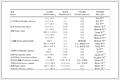
The stage was then set for the key steps, construction of the cyclobutane by intramolecular [2 + 2] photocycloaddition. Photocatalytic [2 + 2] reaction has been widely used in the synthesis of natural products [41–50]. When we added fac-tris(2-phenyl-pyridine)iridium as photocatalyst to the methanol solution of 27, which can provide cyclobutene 32 after the irradiation of incandescent lamp (Scheme 3) [51]. At the same time, this reaction provided byproduct 33, which was formed by Diels–Alder cycloaddition. However, efforts to optimize this transition were unable to overcome the formation of 33, which has a formation rate of up to 11% (Table 1, entry 4). With 32 in hand, the following challenge was the demethylation. Compound 32 with a cyclobutane structure proved challenging through strong acid or nucleophilic demethylation conditions. We refer to the Schindler's method, Phenol 18 could be achieved by reacting with neat MeMgI [15,52]. Finally, cochlearol B (2) was successfully obtained by allylic oxidation of 18 using SeO2 with a yield of 60%.

|
Download:
|
| Scheme 3. Syntheses of cochlearol B (2). Reagents and conditions: (a) Ir(ppy)3 (1% mol), white-LED, MeOH, r.t., 10 h, 78%; (b) MeMgI (20.0 equiv.), neat, 150 ℃, 1 h, 81%; (c) SeO2 (1.3 equiv.), 1, 4-dioxane, reflux, 2 h, 60%. Ir(ppy)3 = fac-Tris(2-phenylpyridine) iridium. | |
|
Table 1 Selective conditions for the [2 +2] cycloaddition.a |

After completing the synthesis of cochlearol B, we turned our attention to ganocin A (3). In 2005, Kabuto reported an electron-transfer reaction of 2, 2-dianisyl-3, 3-dimethyl-cyclobutanone in acetonitrile containing p-chloranil and water gave 2, 2-dianisyl-5, 5-dimethyldihydrofuran-3-one [53,54]. They speculated the reaction proceeded irreversibly via an oxatetramethylene-ethane radical cation derivative. Inspired by their work, we tried the electron-transfer reaction of cochlearol B (2) in different solvents and quinones (Scheme 4). Initial attempts to oxygenation rearrangement of cyclobutane cochlearol B (2) to generate tetrahydrofuran ganocin A (3) under previously reported p-chloranil and water conditions were unsuccessful. After an extensive screen of different quinones, we were pleased to find that treatment of cochlearol B with DDQ smoothly generated ganocin A with 38% yield (Table 2, entry 4) [55–57]. Different solvents and dosages optimization found that the desired ganocin A was obtained in 3.0 equiv. DDQ in MeCN/H2O mixed solution with 65% yield (Table 2, entry 5).

|
Download:
|
| Scheme 4. Syntheses of ganocin A (3). Reagents and conditions: (a) DDQ (3.0 equiv.), MeCN/H2O (2:1), r.t., 1.5 d, 65%; (b) NaBH4 (1.05 equiv.), MeOH, 0 ℃, 40 min, 96%; (c) m-CPBA (1.3 equiv.), DCM, r.t., 2 h, 83%; (d) (COCl)2 (1.1 equiv.), DMSO (2.2 equiv.), DCM, -70 ℃, 40 min, then Et3N (5.0 equiv.), 20 min, 74%; (e) 1 mol/L HCl (aq.), MeOH, r.t., 8 h, 40%. m-CPBA = 3-chloroperoxybenzoic acid, DMSO = dimethyl sulfoxide. | |
|
|
Table 2 Reaction optimization of rearrangement for ganocin A.a |


Next, we focused on the synthesis of ganocin A from rearrangement of epoxide 36 under Lewis acid. To our disappointment, the epoxidation of 2 to afford 36 was not feasible in our preliminary experiments. What was complex but feasible was that following a reduction of the aldehyde with NaBH4, epoxide 35 was achieved upon treatment with m-CPBA, then swern oxidation completed 36 in 59% yield over 3 steps. Ganocin A was not observed when AlCl3 or BF3·Et2O were added to an anhydrous solution of 36, which proved that the rearrangement requires water [12,57]. Unlike the original design, some Lewis acids, just as TsOH, gave the desired product 3, along with a considerable amount of side product [11]. The use of HCl instead of other acids in MeOH/H2O provided 40% yield and with much fewer side reactions (Scheme 4).
In summary, we have developed a biomimetic synthesis route of cochlearol B in 7 steps (12% overall yield) from commercially available 22 and 23. The key steps were intramolecular hetero Diels–Alder reaction to accomplish tricyclic structure, and [2 + 2] photocycloaddition for the construction of 4/5/6/6/6 skeleton. Cochlearol F and ganocochlearin C have also been synthesized via aromatization by making use of DDQ. Skeletal rearrangement of cochlearol B under oxidizing with DDQ or treating epoxide by Lewis acid was conducted generating unique 5/5/6/6/6 skeleton of ganocin A. Our work indicates the biosynthetic relationship, which ganocin A could be converted from cochlearol B.
Declaration of competing interestThe authors declare that they have no known competing financial interests or personal relationships that could have appeared to influence the work reported in this paper.
AcknowledgmentsThis work was supported by the National Natural Science Foundation of China (Nos. U2006204, 21772181, U1906212), Taishan Scholar Youth Expert Program in Shandong Province (No. tsqn201812021) and the Marine S&T Fund of Shandong Province for the Pilot National Laboratory for Marine Science and Technology (Qingdao) (No. 2022QNLM030003), the Hainan Provincial Joint Project of Sanya Yazhou Bay Science and Technology City (No. 2021CXLH0012).
Supplementary materialsSupplementary material associated with this article can be found, in the online version, at doi:10.1016/j.cclet.2023.109247.
| [1] |
M. Dou, L. Di, L.L. Zhou, et al., Org. Lett. 16 (2014) 6064-6067. DOI:10.1021/ol502806j |
| [2] |
X.R. Peng, J.Q. Liu, L.S. Wan, et al., Org. Lett. 16 (2014) 5262-5265. DOI:10.1021/ol5023189 |
| [3] |
R.R.M. Paterson, Phytochemistry 67 (2006) 1985-2001. DOI:10.1016/j.phytochem.2006.07.004 |
| [4] |
Z.L. Yang, B. Feng, Mycology 4 (2013) 1-4. DOI:10.1080/21501203.2013.774299 |
| [5] |
Y.L. Yang, Q.Q. Tao, J.J. Han, L. Bao, H.W. Liu, Recent advance on bioactive compounds from the edible and medicinal fungi in China, in: D. Agrawal, H.S. Tsay, L.F. Shyur, Y.C. Wu, S.Y. Wang (Eds. ), Medicinal Plants and Fungi: Recent Advances in Research and Development, Springer, Singapore, 2017, p. 253.
|
| [6] |
Z.B. Lin, Modern Research on Lingzhi. 2nd ed.. Beijing: Beijing Medical University Press, 2001.
|
| [7] |
Tetrahedron Lett. 61 (2020) 151845-151848. DOI:10.1016/j.tetlet.2020.151845 |
| [8] |
Mycosystema 31 (2012) 762-768. |
| [9] |
Org. Lett. 21 (2019) 6761-6764. DOI:10.1021/acs.orglett.9b02391 |
| [10] |
J. Org. Chem. 86 (2021) 5412-5416. DOI:10.1021/acs.joc.1c00205 |
| [11] |
Org. Biomol. Chem. 14 (2016) 10362-10365. DOI:10.1039/C6OB02049F |
| [12] |
Liebigs Ann. (1996) 1641-1644. DOI:10.1002/jlac.199619961022 |
| [13] |
Angew. Chem. Int. Ed. 59 (2020) 7419-7424. DOI:10.1002/anie.202000677 |
| [14] |
Angew. Chem. Int. Ed. 60 (2021) 24484-24487. DOI:10.1002/anie.202110556 |
| [15] |
Angew. Chem. Int. Ed. 61 (2022) e202201213. DOI:10.1002/anie.202201213 |
| [16] |
ChemRxiv (2022). DOI:10.26434/chemrxiv-2022-xxmgl |
| [17] |
J. Org. Chem. 82 (2017) 1545-1551. DOI:10.1021/acs.joc.6b02739 |
| [18] |
Org. Lett. 19 (2017) 3505-3507. DOI:10.1021/acs.orglett.7b01463 |
| [19] |
Org. Chem. Front. 10 (2023) 1042-1046. DOI:10.1039/d2qo01697d |
| [20] |
Tetrahedron Lett. 54 (2013) 4708-4711. DOI:10.1016/j.tetlet.2013.06.097 |
| [21] |
Phytochemistry 66 (2005) 1126-1132. DOI:10.1016/j.phytochem.2005.04.007 |
| [22] |
J. Nat. Prod. 73 (2010) 720-723. DOI:10.1021/np900539j |
| [23] |
J. Am. Chem. Soc. 131 (2009) 16640-16641. DOI:10.1021/ja907062v |
| [24] |
Angew. Chem. Int. Ed. 49 (2010) 6199-6202. DOI:10.1002/anie.201001862 |
| [25] |
J. Am. Chem. Soc. 135 (2013) 9291-9294. DOI:10.1021/ja4040335 |
| [26] |
J. Org. Chem. 50 (1985) 1695-1699. DOI:10.1021/jo00210a025 |
| [27] |
Org. Lett. 21 (2019) 8776-8778. DOI:10.1021/acs.orglett.9b03392 |
| [28] |
Environ. Sci. Pollut. Res. 22 (2015) 5677-5685. DOI:10.1007/s11356-014-3433-3 |
| [29] |
Org. Biomol. Chem. 18 (2020) 3203-3215. DOI:10.1039/d0ob00464b |
| [30] |
J. Chem. Soc., Perkin Trans. 1 (2002) 1564-1567. |
| [31] |
M. B. Loewinger, D. H. Young, R. Clair, Patent: US2022033373A1, 2022.
|
| [32] |
Org. Lett. 13 (2011) 922-924. |
| [33] |
Nat. Prod. Res. Dev. 28 (2016) 821-824. |
| [34] |
Food Chem. 171 (2015) 251-257. DOI:10.1016/j.foodchem.2014.08.127 |
| [35] |
Tetrahedron Lett. 45 (2004) 8653-8657. DOI:10.1016/j.tetlet.2004.09.142 |
| [36] |
Chem. Soc. Rev. 38 (2009) 3242-3272. DOI:10.1039/b816707a |
| [37] |
Angew. Chem. Int. Ed. 44 (2005) 1733-1735. DOI:10.1002/anie.200462227 |
| [38] |
J. Am. Chem. Soc. 128 (2006) 6790-6791. DOI:10.1021/ja061715q |
| [39] |
J. Am. Chem. Soc. 140 (2018) 5300-5310. DOI:10.1021/jacs.8b01886 |
| [40] |
Org. Lett. 24 (2022) 5812-5816. DOI:10.1021/acs.orglett.2c02347 |
| [41] |
Angew. Chem. Int. Ed. 53 (2014) 6419-6424. DOI:10.1002/anie.201403454 |
| [42] |
Org. Lett. 17 (2015) 6062-6065. DOI:10.1021/acs.orglett.5b03079 |
| [43] |
Org. Lett. 17 (2015) 5040-5043. DOI:10.1021/acs.orglett.5b02515 |
| [44] |
J. Org. Chem. 86 (2021) 3367-3376. DOI:10.1021/acs.joc.0c02742 |
| [45] |
Angew. Chem. Int. Ed. 58 (2019) 2791-2794. DOI:10.1002/anie.201814089 |
| [46] |
Org. Lett. 19 (2017) 3013-3016. DOI:10.1021/acs.orglett.7b01276 |
| [47] |
Phytochemistry 70 (2009) 2010-2016. DOI:10.1016/j.phytochem.2009.09.008 |
| [48] |
Org. Chem. Front. 6 (2019) 2850-2859. DOI:10.1039/c9qo00678h |
| [49] |
Chem. Commun. 48 (2012) 3530-3532. DOI:10.1039/c2cc17882f |
| [50] |
Org. Lett. 21 (2019) 6295-6299. DOI:10.1021/acs.orglett.9b02172 |
| [51] |
Org. Process Res. Dev. 20 (2016) 1156-1163. DOI:10.1021/acs.oprd.6b00101 |
| [52] |
J. Am. Chem. Soc. 122 (2000) 4982-4983. DOI:10.1021/ja000429q |
| [53] |
Tetrahedron Lett. 46 (2005) 2663-2667. DOI:10.1016/j.tetlet.2005.02.109 |
| [54] |
Tetrahedron Lett. 46 (2005) 3863-3866. DOI:10.1016/j.tetlet.2005.03.196 |
| [55] |
New J. Chem. 36 (2012) 1141-1144. DOI:10.1039/c2nj40021a |
| [56] |
Org. Lett. 23 (2021) 1135-1140. DOI:10.1021/acs.orglett.1c00154 |
| [57] |
Chem. Eur. J. 25 (2019) 8135-8148. DOI:10.1002/chem.201901304 |