 2024, Vol. 35


b School of Electrical Engineering, Xi'an Jiaotong University, Xi'an 710049, China;
c State Key Laboratory of Applied Organic Chemistry, Lanzhou University, Lanzhou 730000, China
The carbonylation reaction using CO as atom economy carbonyl source represents a robust and valuable chemical transformation in industry and academia, which is regarded as one of the most efficient tools for the synthesis of various kinds of carbonyl compounds such as carboxylic acids, esters, amides, and ketones. Thus, substantial efforts from chemists have been devoted to the development of highly efficient protocols for carbonylation reactions and significant progress has been made over past decades [1-6], especially the palladium-catalyzed carbonylations [7-9]. In the early stages, traditional palladium-catalyzed carbonylation reactions of C(sp3)-X bonds was more challenging than the C(sp2)-X bonds, due to the inherent slow oxidative addition to the metal and competitive β-H elimination of alkyl metal species (Scheme 1a) [10, 11]. To overcome these obstacles, organic chemists have developed the Pd/hv-assisted catalysis strategy [12-15]. For instance, Ryu disclosed a robust ultraviolet (UV) light-induced Pd-catalyzed atom transfer radical carbonylation reactions of alkyl iodides [16, 17]. Arndtsen demonstrated an elegant visible-light induced Pd-catalyzed radical carbonylation reaction of alkyl iodides [18]. Different with the traditional Pd catalysis, the Pd/hv-assisted catalysis strategy have altered the reaction pathway from two-electron redox events to single electron transfer, enabling carbonylation of alkyl iodides successfully under mild conditions. Benefiting from the flourishing development of free radical chemistry, the visible-light driven carbonylation reactions have been developed far beyond the alkyl halides and Pd catalysis [19-21]. For instance, a variety of photocatalytic carbonylation of alkyl radical precursors such as carboxylic acids, Katritzky salts, organosilicates and others have been reported by different research communities [22-29]. Among them, the group of Xiao and Chen presented the impressing photoinduced Cu or Ir-catalyzed aminocarbonylation of cycloketone oxime esters via a C−C cleavage process, providing a series of cyanoalkylated amides [28, 29]. Despite this significant progress, it still deserves to explore step- and atom-economy carbonylation reactions, allowing rapid construction of complex carbonyl derivatives from simple feedstocks [30-32].

|
Download:
|
| Scheme 1. Metal/hv-assisted catalyzed carbonylation of alkyl electrophiles with CO. | |
Since the pioneering works of Schreiber, Suginome and Suárez et al. in 1980s, the alkoxyl radical-mediated ring expansion strategy has emerged as an attractive approach to accessing medium-sized and macrolactones [33-35]. However, only few examples and applications of this strategy have been explored so far, probably due to the difficulty and challenging in the generation of alkoxyl radicals and the further functionalization of carbon-centered radicals (radical int I) generated through radical triggered ring-expension [33-38]. Recently, our group have successfully disclosed the redox-neutral ring expansion/cross-couplings of hemiketal hydroperoxides with diverse nucleophiles through Cu or Fe-catalyzed radical relay, enabling incorporation of diverse functional groups such as CN, N3, X and others into the lactones, especially macrolactones [39]. Encouraged by this success, we wonder whether the radical int I could engage in the carbonylation reaction with CO under Cu/hv catalytic system. The challenges for this cascade include the competitive H-atom abstraction, the possible β-H elimination, and the direct amination of radical int I (Scheme 1b). Herein, we present the first photoinduced Cu-catalyzed alkoxyl radical-mediated ring-expansion/aminocarbonylation cascade, offering a straightforward access to lactones bearing an acylamino group. Remarkably, this protocol enables the integration of lactone, especially macrolactone fragments with many amine drugs and drug fragments in good yields.
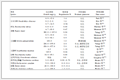
To verify this hypothesis, we conducted the aminocarbonylation reaction of hemiketal hydroperoxide 1a with aniline 2a and CO gas under the Cu/hv-assisted catalysis (Table 1). To our delight, the ring expansion/aminocarbonylation reaction proceeded successfully in the presence of CuCl (5 mol%) as the catalyst and 2,2′: 6′, 2″-Terpy (10 mol%, L1) as the ligand in CF3Ph with 4.0 MPa of CO under visible light irradiation, affording the desired lactone 3a in 58% yield (entry 1). Solvent screening indicated that MeOH gave better yield than CF3Ph and 1,4-dioxane, delivering the product 3a in 88% yield (entries 2 and 3). It is worthy to mention that the oxycarbonylation product (ester) was not detected in this copper-catalytic system, even MeOH is also a good nucleophile. Other copper catalysts such as CuI, Cu(OAc)2 and CuSO4 were also examined, and CuSO4 exhibited the best catalytic efficiency (entries 4–6). While the iron and cobalt catalysts were totally ineffective for this transformation (not shown). Apart from 2,2′: 6′, 2″-Terpy, other bidentate N ligands such as 2,2′-Bipy and 1,10-Phen were also effective, but resulted in relatively lower yields of 3a (entries 7 and 8). The pressure of CO had a significant impact on the reaction efficiency. Satisfactorily, the reaction still worked well under 0.5 MPa of CO (entry 9), but no reaction occurred when the pressure of CO was reduced to 0.1 MPa (not shown). Finally, control experiments revealed that the reaction could also took place without ligand or visible light irradiation, but gave very poor yield of 3a (entries 10 and 11). While no reaction took place in the absence of copper catalyst (entry 12).
|
Table 1 Optimization of reaction conditions.a |


With optimized conditions in hand, the aminocarbonylation of hemiketal hydroperoxide 1a with structurally diverse amines 2 was first evaluated. As shown in Scheme 2, a variety of aryl amines were engaged efficiently in this transformation, delivering the desired products 3a-3r in moderate to good yields. Aryl amines bearing electron-donating groups (Me, tBu and OMe) or weak electron-withdrawing groups (OCF3, Cl, Br and I) on para-, meta- and ortho-positions of aromatic ring all were amenable, affording the desired products 3a-3l in good to excellent yields. Valuable functional groups such as Br (3g and 3l) and I (3h) were survived under the present conditions, which offer opportunities for further functionalization. Disubstituted aryl amines also worked well to deliver the desired products 3m-3o. Heteroaryl amines such as benzo[d]thiazol-6-amine furnished the product 3q in 62% yield. Notably, the 4-amino benzyl alcohol reacted chemoselectively to afford the amide 3r in 63% yield. Satisfactorily, the scope of amines was not limited to aryl amines. Primary and secondary alkyl amines were also competent nucleophiles, furnishing the corresponding products 4a-4l in moderate to good yields. Functional groups such as CF3 (4c), carbon-carbon triple bond (4d) and ether (4e) were well-tolerated. Benzylamine and N-Me benzylamine furnished the products 4i and 4k in good yields. Remarkably, drug fragments and drugs containing amine moiety also participated in this reaction efficiently, affording the expected products 4m-4q in excellent yields, which highlight great application potential of this protocol for the modification of complex amine-containing molecules. However, when diaryl amine was subjected to the reaction system, no reaction was observed (not shown).

|
Download:
|
| Scheme 2. Scope of amines. Reaction conditions: 1a (0.3 mmol, 1.5 equiv.), 2 (0.2 mmol, 1.0 equiv.), CuSO4 (5 mol%), 2,2′: 6′, 2″-Terpy (10 mol%), CO (4 MPa) and MeOH (2 mL) under the irradiation of 2 × 30 W blue LEDs at room temperature for 12 h; isolated yields. a 0.5 MPa of CO was used. | |

Next, the aminocarbonylation of various hemiketal hydroperoxides were examined by using phenylamine 2a as the model nucleophile (Scheme 3). The ring expansion/amincarbonylation cascade proceeded smoothly to afford the desired CONHPh-containing lactones in moderate to good yields, which are difficult to obtain by other methods. A range of 9-, 10- and 11-membered lactones were easily synthesized by adjusting the ring size and substituents of substrates (5a-5i). Remarkably, this protocol is also applicable for the synthesis of CONHPh-functionalized 12-, 15- and 18-membered macrolactones (5j-5l).

|
Download:
|
| Scheme 3. Scope of hemiketal hydroperoxides. Reaction conditions: 1 (0.3 mmol, 1.5 equiv.), 2a (0.2 mmol, 1.0 equiv.), CuSO4 (5 mol%), 2,2′: 6′, 2″-Terpy (10 mol%), CO (4 MPa) and MeOH (2 mL) under the irradiation of 2 × 30 W blue LEDs at room temperature for 12 h; isolated yields. | |

Apart from the ring-expansion to lactones, the aminocarbonylation of monocyclic hydroperoxides 6 were also evaluated [40-48]. As expected, the reactions worked efficiently to afford a range of keto-functionalized amides (Scheme 4). Not only 1-aryl but also 1-alkyl substituted cyclopentyl hydroperoxides were efficient substrates (7a and 7b). When 1-methoxy-substituted substrate was subjected into the reaction, the anticipated ester-containing amide 7c was obtained in 96% yield. 1,2-Disubstituted substrate suffered the C−C cleavage regioselectively to afford the 7d as sole product in 76% yield. In terms of amines, aryl, alkyl and benzyl amines, as well as drugs were all compatible with this transformation, producing the corresponding amides 7e-7l in satisfied yields.

|
Download:
|
| Scheme 4. Scope of cycloalkyl hydroperoxides and amines. Reaction conditions: 6 (0.4 mmol, 2.0 equiv.), 2 (0.2 mmol, 1.0 equiv.), CuCl (5 mol%), 2,2′: 6′, 2″-Terpy (10 mol%), CO (4 MPa) and MeOH (2 mL) under the irradiation of 2 × 30 W blue LEDs at room temperature for 12 h; isolated yields. | |

To demonstrate the application potential of this protocol. Large-scale synthesis and derivatizations of 3a were performed. Conducting the model reaction of 1a and 2a on a 1.0 mmol scale did not damage the yield of 3a after prolonging the reaction time to 24 h. Treatment of 3a with Lawesson's reagent delivered the thioamide 8a in 85% yield. The carbonyl group in amide 7a could be reduced selectively to give the hydroxyl-contained amide 9a in almost quantitative yield. In addition, the Wittig reaction of 7a also proceeded efficiently to afford the unsaturated amide 9b in 69% yield (Scheme 5).

|
Download:
|
| Scheme 5. Large-scale synthesis and derivatizations of products. | |

According to the literature and our previous studies, we speculate that this C−C bond cleavage/aminocarbonylation cascade proceeded via a radical pathway. To confirm this inference, some control experiments were conducted. When 2.0 equiv. of TEMPO was added into the reaction of 1a and 2a, the formation of 3a was inhibited and the TEMPO-adduct 10a was isolated in 32% yield. The addition of BHT (2.0 equiv.) decreased the yield of 3a from 96% to 63% (Scheme 6a). These results provided support for the radical mechanism. To elucidate the impact of visible light irradiation on the reaction, the UV–vis spectra for each component of the reaction and different mixtures were measured (Scheme 6b). It was found that the single CuSO4 and ligand L did not absorb light in the visible region. While the complex of CuSO4/L showed an obvious bathochromic shift, which enabled the possible excitation with visible light. Further addition of the substrates (2a or 1a + 2a) to the complex mixture did not affect the absorption behavior of copper-ligand complex. These results suggested that the Cu/L complex was photoactive species in this domino catalytic cycle, which is consistent with fact that both Cu species and light irradiation were critical for the high efficiency of this reaction.

|
Download:
|
| Scheme 6. Mechanism studies. | |

Based on the primary experiments and literature [28, 49, 50], a possible catalytic cycle was proposed (Scheme 7). Initially, the CuIL complex is formed and is excited to an excited state [CuIL]* upon the visible light irradiation (path A), which under-goes the single-electron transfer (SET) event with 1a to afford the oxygen center radical 1a-A and the CuII species C. Then, the intermediate 1a-A engages in β-scission to give the carbon center radical 1a-B. After that, the radical 1a-B reacts with the species C to deliver the CuIII species D, which subsequently involves in a ligand exchange with amine 2a to provide the CuIII species E. Further sequential coordination and insertion of CO forms the acylcopper intermediate F or G. Finally, reductive elimination of F or G furnishes the final product 3a and regenerates the active CuIL catalyst. Luckily, some important metallic copper species including cationic [LCuI]+, [LCuII(OH)]+ and [LCuIII(C9H15O2)(OH)]+ could be successfully detected by HRMS. In view of the formation of 3a without the visible-light irradiation, we speculate that the ground state [CuIL] could also undergo the single-electron transfer (SET) event with 1a to afford the intermediate 1a-A (path B).

|
Download:
|
| Scheme 7. Proposed reaction mechanism. | |

In conclusion, we have developed a photoinduced, earth-abundant copper catalyzed alkoxyl triggered C−C bond cleav-age/aminocarbonylation cascade with CO under redox-neutral conditions. Through adjusting the structure of alkoxyl radical precursors, a series of valuable lactone or carbonyl group-functionalized amides were synthesized with good yields and excellent functional group tolerance under mild conditions. Remarkably, this protocol allowed the combination of lactone fragments with many amine drugs and drug fragments. Mechanism study revealed that the Cu/L complex was the photoactive species, and a CuI/CuII/CuIII-based catalytic cycle was involved for this transformation. This work is a significant and promising example in both the carbonylation and the radical ring-expansion fields.
Declaration of competing interestThe authors declare that they have no known competing financial interests or personal relationships that could have appeared to influence the work reported in this paper.
AcknowledgmentsFinancial support from the National Natural Science Foundation of China (Nos. 21971201, 22171220) and the Fundamental Research Funds of the Central Universities (No. xtr072022003) is greatly appreciated. We also thank Mr. Zhang, Miss Feng and Miss Bai at the Instrument Analysis Center of Xi'an Jiaotong University for their assistance with NMR and HRMS analysis.
Supplementary materialsSupplementary material associated with this article can be found, in the online version, at doi:10.1016/j.cclet.2023.109263.
| [1] |
J.B. Peng, F.P. Wu, X.F. Wu, Chem. Rev. 119 (2019) 2090-2127. DOI:10.1021/acs.chemrev.8b00068 |
| [2] |
J.B. Peng, H.Q. Geng, X.F. Wu, Chemistry 5 (2019) 526-552. DOI:10.1016/j.chempr.2018.11.006 |
| [3] |
Z. Yin, J.X. Xu, X.F. Wu, ACS Catal. 10 (2020) 6510-6531. DOI:10.1021/acscatal.0c01479 |
| [4] |
S.K. Zhang, H. Neumann, M. Beller, Chem. Soc. Rev. 49 (2020) 3187-3210. DOI:10.1039/C9CS00615J |
| [5] |
B. Gabriele, Carbon Monoxide in Organic Synthesis-Carbonylation Chemistry, Wiley-VCH, Weinheim, 2021, pp. 1–399.
|
| [6] |
X.F. Wu, B. Han, K. Ding, Z. Liu, The Chemical Transformations of C1 Compounds, Wiley-VCH, Weinheim, 2022, pp. 1–907.
|
| [7] |
S. Sumino, A. Fusano, T. Fukuyama, I. Ryu, Acc. Chem. Res. 47 (2014) 1563-1574. DOI:10.1021/ar500035q |
| [8] |
Q. Liu, X. Dong, J. Li, J. Xiao, Y.H. Dong, H. Liu, ACS Catal. 5 (2015) 6111-6137. DOI:10.1021/acscatal.5b01469 |
| [9] |
J.B. Peng, X.L. Liu, L. Li, X.F. Wu, Sci. China Chem. 65 (2022) 441-461. DOI:10.1007/s11426-021-1165-6 |
| [10] |
L. Wu, X. Fang, Q. Liu, R. Jackstell, M. Beller, X.F. Wu, ACS Catal. 4 (2014) 2977-2989. DOI:10.1021/cs500922x |
| [11] |
S.L. Zhao, N.P. Mankad, Catal. Sci. Technol. 9 (2019) 3603-3613. DOI:10.1039/C9CY00938H |
| [12] |
B. Cai, H.W. Cheo, T. Liu, J. Wu, Angew. Chem. Int. Ed. 60 (2021) 18950-18980. DOI:10.1002/anie.202010710 |
| [13] |
V. Botla, A. Voronov, E. Motti, et al., Catalysts 11 (2021) 918-953. DOI:10.3390/catal11080918 |
| [14] |
Y. Liu, C.H. Zhou, M.J. Jiang, B.A. Arndtsen, J. Am. Chem. Soc. 144 (2022) 9413-9420. DOI:10.1021/jacs.2c01951 |
| [15] |
W.W. Ding, Y. Zhou, S. Song, et al., Org. Lett. 24 (2022) 7350-7354. DOI:10.1021/acs.orglett.2c02877 |
| [16] |
T. Fukuyama, S. Nishitani, T. Inouye, et al., Org. Lett. 8 (2006) 1383-1386. DOI:10.1021/ol060123+ |
| [17] |
A. Fusano, S. Sumino, A. Nishitani, et al., Chem. Eur. J. 18 (2012) 9415-9422. DOI:10.1002/chem.201200752 |
| [18] |
G.M. Torres, Y. Liu, B.A. Arndtsen, Science 368 (2020) 318-323. DOI:10.1126/science.aba5901 |
| [19] |
J. Singh, S. Sharma, A. Sharma, J. Org. Chem. 86 (2021) 24-48. DOI:10.1021/acs.joc.0c02205 |
| [20] |
X. Zhao, X.L. Feng, F. Chen, et al., Angew. Chem. Int. Ed. 60 (2021) 26511-26517. DOI:10.1002/anie.202111061 |
| [21] |
K.E. Chami, Y. Liu, M.A. Belahouane, et al., Angew. Chem. Int. Ed. 62 (2023) 202213297. DOI:10.1002/anie.202213297 |
| [22] |
Q.Q. Zhou, W. Guo, W. Ding, et al., Angew. Chem. Int. Ed. 54 (2015) 11196-11199. DOI:10.1002/anie.201504559 |
| [23] |
Z.P. Yin, J. Rabeah, A. Brückner, et al., ACS Catal. 8 (2018) 10926-10930. DOI:10.1021/acscatal.8b03576 |
| [24] |
X. Jiang, M.M. Zhang, W. Xiong, et al., Angew. Chem. Int. Ed. 58 (2019) 2402-2406. DOI:10.1002/anie.201813689 |
| [25] |
A. Cartier, E. Levernier, V. Corce, et al., Angew. Chem. Int. Ed. 58 (2019) 1789-1793. DOI:10.1002/anie.201811858 |
| [26] |
F.Q. Zhao, C.L. Li, X.F. Wu, Chem. Commun. 56 (2020) 9182-9185. DOI:10.1039/D0CC04062B |
| [27] |
A.M. Veatch, S.B. Liu, E.J. Alexanian, Angew. Chem. Int. Ed. 61 (2022) 202210772. DOI:10.1002/anie.202210772 |
| [28] |
B. Lu, Y. Cheng, L.Y. Chen, et al., ACS Catal. 9 (2019) 8159-8164. DOI:10.1021/acscatal.9b02830 |
| [29] |
B. Lu, M.H. Xu, X.T. Qi, et al., J. Am. Chem. Soc. 32 (2022) 14923-14935. |
| [30] |
Z. Huang, J. Tang, X. Jiang, et al., Chin. Chem. Lett. 33 (2022) 4842-4845. DOI:10.1016/j.cclet.2022.01.080 |
| [31] |
C. Ma, Y. Tian, J. Wang, et al., Org. Lett. 24 (2022) 8265-8270. DOI:10.1021/acs.orglett.2c02949 |
| [32] |
H.C. Li, G.N. Li, K. Sun, et al., Org. Lett. 24 (2022) 2431-2435. DOI:10.1021/acs.orglett.2c00699 |
| [33] |
S.L. Schreiber, J. Am. Chem. Soc. 102 (1980) 6163-6165. DOI:10.1021/ja00539a041 |
| [34] |
S. Yamada, H. Suginome, Tetrahedron Lett. 26 (1985) 3715-3718. DOI:10.1016/S0040-4039(00)89231-X |
| [35] |
R. Hemhndez, J.J. Marrero, E. Suárez, et al., Tetrahedron Lett. 29 (1988) 5979-5982. DOI:10.1016/S0040-4039(00)82245-5 |
| [36] |
G.H. Posner, M.A. Hatcher, W.A. Maio, Org. Lett. 7 (2005) 4301-4303. DOI:10.1021/ol051854x |
| [37] |
G.H. Posner, M.A. Hatcher, W.A. Miao, Tetrahedron 72 (2016) 6025-6030. DOI:10.1016/j.tet.2016.05.063 |
| [38] |
J.B. Du, X.K. Yang, X. Wang, et al., Angew. Chem. Int. Ed. 60 (2021) 5370-5376. DOI:10.1002/anie.202012720 |
| [39] |
S. Liu, P. Ma, L. Zhang, et al., Chem. Sci. 14 (2023) 5220-5225. DOI:10.1039/D2SC06157K |
| [40] |
S.P. Morcillo, Angew. Chem. Int. Ed. 58 (2019) 14044-14054. DOI:10.1002/anie.201905218 |
| [41] |
X. Wu, C. Zhu, Chem. Commun. 55 (2019) 9747-9756. DOI:10.1039/C9CC04785A |
| [42] |
E. Tsui, H. Wang, R.R. Knowles, Chem. Sci. 11 (2020) 11124-11141. DOI:10.1039/D0SC04542J |
| [43] |
X.Y. Yu, J.R. Chen, W.J. Xiao, Chem. Rev. 121 (2021) 506-561. DOI:10.1021/acs.chemrev.0c00030 |
| [44] |
L. Chang, Q. An, L.F. Duan, et al., Chem. Rev. 122 (2022) 2429-2486. DOI:10.1021/acs.chemrev.1c00256 |
| [45] |
Q.X. Sun, H. Chen, S. Liu, et al., J. Org. Chem. 86 (2021) 11987-11997. DOI:10.1021/acs.joc.1c01366 |
| [46] |
S. Liu, M. Bai, P.F. Xu, et al., Chem. Commun. 57 (2021) 8652-8655. DOI:10.1039/D1CC03013B |
| [47] |
H. Xin, Z.H. Yuan, M.Y. Yang, et al., Green Chem. 23 (2021) 9549-9553. DOI:10.1039/D1GC03230E |
| [48] |
Q.C. Shan, S. Liu, Y.C. Shen, et al., Org. Lett. 24 (2022) 6653-6657. DOI:10.1021/acs.orglett.2c02663 |
| [49] |
F.P. Wu, Y. Yuan, X.F. Wu, Angew. Chem. Int. Ed. 60 (2021) 25787-25792. DOI:10.1002/anie.202112609 |
| [50] |
F.Q. Zhao, H.J. Ai, X.F. Wu, Angew. Chem. Int. Ed. 61 (2022) 202200062. DOI:10.1002/anie.202200062 |