 2024, Vol. 35


b Fujian University Key Laboratory of Molecule Synthesis and Function Discovery, College of Chemistry, Fuzhou University, Fuzhou 350108, China;
c State Key Laboratory of Organometallic Chemistry and Key Laboratory of Organofluorine Chemistry, Shanghai Institute of Organic Chemistry, Chinese Academy of Sciences, Shanghai 200032, China
1,4-Thiazine is a ubiquitous heterocyclic motif which exists in a broad range of pharmaceutical molecules (Fig. 1) [1,2]. For example, Chlorpromazine is the first worldwide used antipsychotic drug [2], nifurtimox is an anthelmintic for trypanosoma cruzi and has a potential utility for neuroblastoma cell research [3]. Moreover, it is widely known that the introduction of fluorine-containing moieties, for instance, difluoromethylene CF2 and in particular difluorothiomethylene SCF2, can usually enhance the pharmaceuticals' biological and physiological activities such as metabolic property, lipophilicity, and oxidative stability (Fig. 1) [4-12]. Accordingly, a practical method that can incorporate both two important moieties 1,4-thiazine and difluoromethylene in a single step will be appealing and of great value.

|
Download:
|
| Fig. 1. Drug molecules containing -SCF2- scaffolds and chemical medications contains 1,4-thiazine. | |
However, to the best of our knowledge, only a few synthetic methods have been developed for the construction of difluorothiomethylene-containing heterocyclic compounds. Typical synthetic routes include: DBU-catalyzed [4 + 2] annulation between gem-difluoroolefins and 2-mercaptobenzaldehydes (Scheme 1A, a) [13]; cyclization of difluorothiomethylene-containing precursors, which proceeded via a radical addition of difluoromethyl xanthate to terminal alkenes [14] or a visible-light-induced arylthiofluoroalkylations of unactivated heteroarenes and alkenes (Scheme 1A, b) [15]; three-component reaction of 2′-aminochalcone, sulfur, and ClCF2CO2Na in the presence of TEMPO, which proceeded through a radical anti-Michael addition and nucleophilic addition of difluorocarbanion to amide (Scheme 1A, c) [16].

|
Download:
|
| Scheme 1. Reaction modes of difluorocarbene. | |
Alternatively, we envisioned that those structures could be accessible via a difluorocarbene capture reaction of pyridinium 1,4-zwitterionic thiolates, because they have been proven to be versatile reagents that can proceed a series of novel reactions. For example, Cheng, Zhai et al. recently reported several beautiful works in which pyridinium 1,4-zwitterionic thiolates played as either five-membered or three-membered synthons to construct varied sulfur-containing heterocycles [17-25]. Moreover, employing difluorocarbene (: CF2) as difluoromethylene source has become a powerful synthetic platform in recent years [26,27]. Several strategies, including reacting with a nucleophile and an electrophile [28-40], Wittig reaction with carbonyls [41-44] and [2 + 1] cycloaddition with alkenes or alkynes [45] have been established to incorporate difluoromethylene moiety into a wide spectrum of organic molecules (Scheme 1B). Based on the above-mentioned works and our continuous interest in difluorocarbene-involved transformations [46,47], herein we present a cyclization of pyridinium 1,4-zwitterionic thiolates with difluorocarbene to rapidly and efficiently synthesize the target difluorothiomethylene-containing 1,4-thiazine derivatives (Scheme 1C).
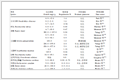
We employed (Z)-1,4-dimethoxy-1,4-dioxo-3-(pyridin-1-ium-1-yl)but-2-ene-2-thiolate 1a as model substrate and BrCF2CO2Et 2a as difluorocarbene source to explore the feasibility of our design (Table 1). Gratifyingly, when 1a and 3.0 equiv. of 2a were treated with 3.0 equiv. of base K2CO3 in CH3CN at 80 ℃, the desired product 3a was obtained in 58% isolated yield (entry 1). Then different bases (Na2CO3, K3PO4, Cs2CO3, NaHCO3) were evaluated (entries 2–5) and K2CO3 was proven to be optimal. To our delight, when the temperature was lowered to 50 ℃ and THF was used instead of CH3CN as solvent, the yield could be further improved to 78% (entries 6–11). Subsequent screening of other difluoromethylene-containing reagents such as BrCF2PO(OEt)2, BrCF2COOK, BrCF2COONa, ClCF2COONa, and TMSCF2Br showed that an excellent 93% yield was achieved when employing BrCF2PO(OEt)2 as difluorocarbene source (entries 12–16). Further studies showed that either reacting under air (entry 17) or reducing the amount of BrCF2PO(OEt)2 (entry 18) resulted in decreased yields.
|
Table 1 Optimization of the reaction conditions.a |


With the optimal reaction conditions in hand (Table 1, entry 12), we then investigated the substrate scope of pyridinium 1,4-zwitterionic thiolates. As shown in Scheme 2, the reaction exhibited good functional group compatibility. For example, a series of aliphatic and aromatic substituents on different positions of the pyridinium rings all did not affect the efficiency of the reaction, affording the target products (3b-3l) in moderate to good yields.

|
Download:
|
| Scheme 2. Substrate scope of pyridinium 1,4-zwitterionic thiolates 1. Reaction condition: 1 (0.2 mmol), 2b (0.6 mmol), THF (2 mL), K2CO3 (0.6 mmol), under N2 atmosphere at 50 ℃ for 12 h; Isolated yields. a The reaction was conducted on the gram scale. b Determined by 1H NMR. | |

However, the regioselectivities of the reaction were moderate, for instance, 2-methyl substituted substrate gave a mixture of two regioisomers 3b and 3bʹ with a 72:28 ratio. Similar results were also observed when 3-methyl or 3-phenyl substituted substrates were employed (3c and 3cʹ, 3f and 3fʹ). 4-Alkyl substituted, as well as 4-aryl substituted substrates bearing a series of electron-donating and electron-withdrawing substituents such as tert-butyl, nitryl, cyano, formyl, and halogens on the phenyl rings all reacted very well, furnishing the single isomers in good yields (3d, 3e, 3g–3l). Besides aliphatic and aromatic substituents, other functionalities were also compatible with the reaction. For example, 3-iodo/bromopyridinium thiolates both afforded the target products in good yields with 69:31 and 55:45 regioselectivities, respectively (3m and 3mʹ, 3n and 3nʹ). The exact structure of compound 3mʹ was unequivocally determined by single crystal X-ray diffraction. However, 4-methoxy- and 4-piperidinylpyridinium thiolates were failed to give the desired products, this may be attributed to that 4-methoxy- and 4-piperidinyl groups can stabilize the carbocation in pyridinium through resonance and hence decrease their electrophilicity (3o and 3p). Next, we explored the scope of different benzo pyridinium thiolates. For example, quinolinium 1,4-zwitterionic thiolates and its derivatives bearing different substituents such as alkyl, carboxylate and methoxy all smoothly cyclized under the standard conditions and furnished the corresponding products in 51%–75% yield (3q-3v). Besides, isoquinolinium 1,4-zwitterionic thiolates was also compatible and afforded the target product 3w in 79% yield, albeit N-methylimidazolium thiolate did not give the cyclization product 3x. Finally, the scope of the ester groups was studied and the resulted showed that ethyl, n-butyl, and more sterically hindered tert-butyl esters were all good candidates for this reaction (3y–3aa). Pyridinium thiolate bearing an ester and a ketone group was also found to be compatible, affording the desired product 3ab in 60% yields.
To better understand the mechanism of this reaction, we carried out a control experiment. When the difluorocarbene capture reagent benzimidazole (1c) was added to the reaction system, 1-(difluoromethyl)-1H-benzo[d]imidazole (1c') was isolated in good yields, while product 3a was not detected (Scheme 3), which suggests that difluorocarbene was generated in our transformations.

|
Download:
|
| Scheme 3. Control experiment. | |

On the basis of our experimental results and in combination with previous reports on difluoromethylation [46,47], a plausible mechanism is proposed in Scheme 4. Difluorocarbene, which is generated in situ from precursor compound 2b in the presence of a base, was first attacked by the sulfur anion in pyridinium 1,4-zwitterionic thiolates 1 to form intermediate A. Subsequent intramolecularly nucleophilic addition of the difluoro-carbanion to the iminium double bond hence furnishes the final product 3.

|
Download:
|
| Scheme 4. Plausible mechanism. | |

In summary, we have successfully developed a transition metal-free and additive-free practical method for the synthesis of a series of functionalized difluoromethylene-containing 1,4-thiazine derivatives using readily available diethyl bromodifluoromethanephosphonate (BrCF2P(O)(OEt)2) as difluorocarbene source. The in situ generated difluorocarbene was efficiently captured by pyridinium 1,4-zwitterionic thiolates, thus incorporating the difluoromethylene motif in a simple and atom-economic manner. Further studies on the highly efficient incorporation of difluorocarbene by employing different kinds of substrates and precursors are underway in our group.
Declaration of competing interestThe authors declare that they have no known competing financial interests or personal relationships that could have appeared to influence the work reported in this paper.
AcknowledgmentsFinancial support from National Natural Science Foundation of China (Nos. 21931013 and 22271105) and Natural Science Foundation of Fujian Province (No. 2022J02009) and Open Research Fund of School of Chemistry and Chemical Engineering, Henan Normal University are gratefully acknowledged. The authors also thank the Instrumental Analysis Center of Huaqiao University for analysis support. Z. Chen thank the Subsidized Project for Cultivating Postgraduates' Innovative Ability in Scientific Research of Huaqiao University.
Supplementary materialsSupplementary material associated with this article can be found, in the online version, at doi:10.1016/j.cclet.2023.108937.
| [1] |
E. Vitaku, D.T. Smith, J.T. Njardarson, et al., J. Med. Chem. 57 (2014) 10257-10274. DOI:10.1021/jm501100b |
| [2] |
S.W. Woods, J. Clin. Psychiatry 64 (2003) 663-667. |
| [3] |
J. Rodrigues Coura, S.L. de Castro, Mem. Inst. Oswaldo Cruz 97 (2002) 3-24. |
| [4] |
R. Berger, G. Resnati, P. Metrangolo, Chem. Soc. Rev. 40 (2011) 3496-3508. DOI:10.1039/c0cs00221f |
| [5] |
F. Wang, W. Huang, J. Hu, Chin. J. Chem. 29 (2011) 2717-2721. DOI:10.1002/cjoc.201100325 |
| [6] |
P.G. Eric, J.E. Kyle, A.M. Nicholas, J. Med. Chem. 58 (2015) 8315-8359. DOI:10.1021/acs.jmedchem.5b00258 |
| [7] |
C. Ni, M. Hu, J. Hu, Chem. Rev. 115 (2015) 765-825. DOI:10.1021/cr5002386 |
| [8] |
Z. Xu, W. Zhang, J. Lin, et al., Chin. J. Chem. 37 (2019) 1647-1650. |
| [9] |
G. Zhang, Q. Shi, Q. Song, et al., CCS Chem. 3 (2021) 1613-1621. |
| [10] |
D. Ge, Z. Jia, X. Chu, Green Synth. Catal. 3 (2022) 303-305. DOI:10.1016/j.gresc.2022.02.001 |
| [11] |
H. Sheng, J. Su, Q. Song, et al., CCS Chem. 4 (2022) 3820-3831. DOI:10.31635/ccschem.022.202101576 |
| [12] |
Y. Wang, S. Mu, Q. Song, et al., Chin. Chem. Lett. 33 (2022) 1511-1514. DOI:10.1016/j.cclet.2021.08.089 |
| [13] |
J. Li, C. Xu, N. Wei, et al., J. Org. Chem. 82 (2017) 11348-11357. DOI:10.1021/acs.joc.7b01635 |
| [14] |
P. Salomon, S.Z. Zard, Org. Lett. 16 (2014) 1482-1485. DOI:10.1021/ol5002939 |
| [15] |
Y. Choi, C. Yu, J. Kim, et al., Org. Lett. 18 (2016) 3246-3249. DOI:10.1021/acs.orglett.6b01495 |
| [16] |
P. Zhang, L. Yang, W. Chen, et al., Org. Lett. 23 (2021) 6094-6098. DOI:10.1021/acs.orglett.1c02160 |
| [17] |
B. Cheng, Y. Li, H. Zhai, et al., Chem. Commun. 55 (2019) 14606-14608. DOI:10.1039/C9CC08326J |
| [18] |
B. Cheng, B. Bao, H. Zhai, et al., Org. Biomol. Chem. 18 (2020) 2949-2955. DOI:10.1039/D0OB00224K |
| [19] |
B. Cheng, X. Duan, H. Zhai, et al., Eur. J. Org. Chem. 12 (2020) 1896-1906. |
| [20] |
B. Cheng, H. Li, H. Zhai, et al., Org. Biomol. Chem. 18 (2020) 6253-6257. DOI:10.1039/D0OB01398F |
| [21] |
B. Cheng, Y. Li, H. Zhai, et al., J. Org. Chem. 85 (2020) 6794-6802. DOI:10.1021/acs.joc.0c00374 |
| [22] |
B. Cheng, Y. Li, H. Zhai, et al., Org. Lett. 22 (2020) 5817-5821. DOI:10.1021/acs.orglett.0c01888 |
| [23] |
B. Cheng, X. Zhang, H. Zhai, et al., Adv. Synth. Catal. 362 (2020) 4668-4672. DOI:10.1002/adsc.202000655 |
| [24] |
B. Cheng, X. Zhang, H. Zhai, et al., Chem. Commun. 36 (2020) 8396-8399. |
| [25] |
S. Zhai, X. Zhang, H. Zhai, et al., Chem. Commun. 56 (2020) 3085-3088. DOI:10.1039/D0CC00262C |
| [26] |
L.S. Dana, P.D. William, Chem. Rev. 96 (1996) 1585-1632. DOI:10.1021/cr941141k |
| [27] |
C. Ni, J. Hu, Synthesis 46 (2014) 842-863. DOI:10.1055/s-0033-1340856 |
| [28] |
X. Deng, J. Lin, J. Zheng, et al., Chem. Commun. 51 (2015) 8805-8808. DOI:10.1039/C5CC02736E |
| [29] |
X. Fu, X. Xue, X. Zhang, et al., Nat. Chem. 11 (2019) 948-956. DOI:10.1038/s41557-019-0331-9 |
| [30] |
D.K. Mikhail, V.L. Vitalij, I.S. Marina, et al., Org. Lett. 16 (2014) 3784-3787. DOI:10.1021/ol501674n |
| [31] |
L. Li, F. Wang, C. Ni, et al., Angew. Chem. Int. Ed. 52 (2013) 12390-12394. DOI:10.1002/anie.201306703 |
| [32] |
H. Liang, R. Liu, M. Zhou, et al., Org. Lett. 22 (2020) 7047-7051. DOI:10.1021/acs.orglett.0c02688 |
| [33] |
S.T. Charles, R.D. William, J. Org. Chem. 78 (2013) 8904-8908. DOI:10.1021/jo401392f |
| [34] |
Q. Xie, C. Ni, R. Zhang, et al., Angew. Chem. Int. Ed. 56 (2017) 3206-3210. DOI:10.1002/anie.201611823 |
| [35] |
Q. Xie, Z. Zhu, C. Ni, et al., Org. Lett. 21 (2019) 9138-9141. DOI:10.1021/acs.orglett.9b03520 |
| [36] |
A.S. Maslov, V.O. Smirnov, M.I. Struchkova, et al., Tetrahedron Lett. 56 (2015) 5048-5050. DOI:10.1016/j.tetlet.2015.07.018 |
| [37] |
X. Yang, X. Zhang, D. Yin, et al., Tetrahedron Lett. 59 (2018) 2941-2944. DOI:10.1016/j.tetlet.2018.06.048 |
| [38] |
J. Yu, J. Lin, D. Yu, et al., Nat. Commun. 10 (2019) 5362. DOI:10.1038/s41467-019-13359-z |
| [39] |
Z. Feng, Q. Min, X. Zhang, Org. Lett. 18 (2016) 44-47. DOI:10.1021/acs.orglett.5b03206 |
| [40] |
Z. Feng, Q. Min, X. Fu, et al., Nat. Chem. 9 (2017) 918-923. DOI:10.1038/nchem.2746 |
| [41] |
S.A. Faqua, W.G. Duncan, R.M. Silverstein, et al., Tetrahedron Lett. 5 (1964) 1461-1463. DOI:10.1016/S0040-4039(01)89512-5 |
| [42] |
S. Krishnamoorthy, J. Kothandaraman, J. Saldana, et al., Eur. J. Org. Chem. 2016 (2016) 4965-4969. DOI:10.1002/ejoc.201601038 |
| [43] |
Y. Zhao, W. Huang, L. Zhu, et al., Org. Lett. 12 (2010) 1444-1447. DOI:10.1021/ol100090r |
| [44] |
J. Zheng, J. Lin, J. Cai, et al., Chem. Eur. J. 19 (2013) 15261-15266. DOI:10.1002/chem.201303248 |
| [45] |
W.R. Dolbier, M.A. Battiste, Chem. Rev. 103 (2003) 1071-1098. DOI:10.1021/cr010023b |
| [46] |
X. Ma, Q. Song, Chem. Soc. Rev. 49 (2020) 9197-9219. DOI:10.1039/D0CS00604A |
| [47] |
X. Ma, J. Su, Q. Song, et al., Acc. Chem. Res. 56 (2023) 592-607. DOI:10.1021/acs.accounts.2c00830 |