 2024, Vol. 35


b School of Applied Chemistry and Engineering, University of Science and Technology of China, Hefei 230026, China
Ring-opening polymerization (ROP) is one of the most effective paths to synthesis polymers under mild conditions with high atom economy and many industrially important polymers are produced via ROP [1]. As general monomers of ROP, cyclic ethers have been extensively studied and their usual polymerization mechanisms include cationic ROP (CROP), anionic ROP (AROP) and coordination–insertion ROP (CIROP) (Scheme 1) [2–7]. As a typical kind of metal complex in CIROP, metal alkoxides always leave a free site on central metal to combine the monomer and have a reactive ligand to insert the monomer. And the replacement of central element, e.g., from the salen-Fe to salen-Co, is a common strategy to adjust the performance of catalyst [8,9]. However, compared with the extensive research on metallic elements, only few studies have focused on CIROP under non-metallic catalysts, although the metallicity of non-metallic elements has been studied for a lot [10,11]. Therefore, the research on features of CIROP in non-metallic centers is capable of filling gap in this area.

|
Download:
|
| Scheme 1. The structures of the growing chain end during ROP for a variety of mechanisms: (a) CROP of THF, (b) AROP of EO, (c) CIROP of PO, (d) CIROP of THF with central metalloid (this work). | |
As a classical and important polyether material, polytetrahydrofuran (PTHF) is generally considered to be obtained by CROP of tetrahydrofuran (THF) via oxonium ion [4]. PTHF industrial products are mainly oligomers and are used in the production of spandex and polyurethane elastomers [12]. Currently, there are fewer studies on high molecular weight PTHF homopolymers [13,14]. In those classical CROP systems, strong protonic acids (HSO3F, HSO3Cl HSO3CF3, etc.) or Lewis acids (BF3, PF5, SbF5, etc.) are used as catalysts and most of the PTHF obtained are low molecular weight [2,3]. Previously, there have been no reports of PTHF being obtained through CIROP. In comparison with other types of cyclic ethers, CIROP has the advantages of mild reaction conditions and controlled polymerization process [15,16]. And CIROP is more promising for copolymerization research.
Boron is the only non-metallic element in the third main group of the periodic table. And tris(pentafluorophenyl)borane (B(C6F5)3) has been frequently used as catalyst in various chemical synthesis [17,18]. As a sterically encumbered Lewis acid, B(C6F5)3 could usually combine with Lewis bases to form Lewis pairs, which can carry out catalytic hydrogenation and activation of CO2 as well as alkenes [19]. In addition, B(C6F5)3 can be used as a catalyst in the copolymerization of cyclic ethers [20]. In the presence of B(C6F5)3 and glycidyl phenyl ether (GPE) as Lewis base, THF will copolymerize with GPE via CROP mechanism (Scheme 2a).

|
Download:
|
| Scheme 2. The reaction of different oxirane-B(C6F5)3 zwitterions with THF. | |
Nonetheless, in the presence of B(C6F5)3 and another Lewis bases like Et3N, the ring of THF is opened and a zwitterionic complex of Et3N(CH2)4OB(C6F5)3 is obtained (Scheme 2b) [21]. This is a ring-opening process close to CIROP mechanism, except that the insertion reaction is intermolecular. It is therefore possible to obtain polytetrahydrofuran (PTHF) by CIROP, even though CROP was often thought to be the only way to achieve PTHF.
In order to achieve the CIROP of THF, figuring out the intramolecular insertion process is the primary goal. In this work, we try to substitute a -C6F5 moiety of B(C6F5)3 for -OPh moiety by referring to the characteristics of the metal alkoxides and B(C6F5)3, and then bis(pentafluorophenyl)(phenoxy)borane (PhOB(C6F5)2) was designed. This is a new type of borane catalyst which has a free site to combine the monomer as well as achieving coordination processes, and it also has a Ph-O-B fragment to achieve intramolecular insertion process. It is worth mentioning that a recent work realized the synthesis of alternating polyesters by using a Lewis acid-base pair [22]. Moreover, during this polymerization, oxygenated boron species of activating the monomers were generated in situ and the polymer was obtained by an anionic ring-opening mechanism. We used PhOB(C6F5)2 as catalyst to obtain PTHF successfully. And the mechanism was further investigated to verify a CIROP.
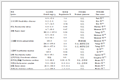
First, we investigate the ROP of THF catalyzed by PhOB(C6F5)2. When two equivalents of B(C6F5)3 and one equivalent of PhOH reacted in situ to produce PhOB(C6F5)2 as a catalyst, high molecular weight and narrow molecular weight distributions of PTHF were obtained successfully (Table 1, entry 1; Fig. S1 in Supporting information). In order to study the effect of residual B(C6F5)3 and PhOH in the in situ PhOB(C6F5)2 system on the ROP, the following strategy was used. When three equivalents of B(C6F5)3 were added, the molecular weight and yield of obtained PTHF made no remarkable change (Table 1, entry 2; Fig. S2 in Supporting information). This indicates that excess B(C6F5)3 has no contribution to catalytic activity in the PhOB(C6F5)2 catalyst system. When the THF feeding ratio was varied to carry out the polymerization, PTHFs of different molecular weights were obtained (Table S1 in Supporting information). It shows that the molecular weight of PTHF can be regulated according to the amount of THF input. While when only B(C6F5)3 or PhOH added into THF keeping other polymerization conditions constant, there were no PTHF generated (Table 1, entries 3 and 4). It suggests that neither B(C6F5)3 nor PhOH itself was catalytically active in the ROP of THF. Furthermore, when B(C6F5)3, PhOH and THF were added to the polymerization system at once, the PhOB(C6F5)2 cannot be synthesized, and no PTHF were obtained (Table 1, entry 5). It indicates that the synthesis process of PhOB(C6F5)2 is necessary before the polymerization of THF. According to the above results, we can conclude that only PhOB(C6F5)2 possesses the catalytic activity for the ROP of THF.
|
Table 1 Summary of PTHF catalyzed by PhOB(C6F5)2.a |


To further study the characteristics of the polymerization, in-situ attenuated total reflection infrared (ATR-IR) was used to monitor the reaction process. The 3D chart ATR-IR spectroscopy displays the emergence and growth of C—O—C groups stretch of PTHF with time based on the absorption peak at 1110 cm−1 [(C—O—C) PTHF] (Fig. 1a). Furthermore, as the reaction proceeded, the growth rate of absorbance at 1110 cm−1 gradually decreased. We speculated the phenomenon is associated with the decrease of stirring rate caused by the increase of viscosity in polymerization system. In the initial stage of polymerization, the absorbance at 1110 cm−1 was observed linearly dependence on time at 50 ℃ (Fig. 1b). This indicates that the monomer conversion rate is positively correlated with the polymerization time at low viscosity, which is the characteristic of living polymerization. Besides, similar results can be obtained under different temperature conditions (Figs. S10 and S11 in Supporting information).

|
Download:
|
| Fig. 1. The ATR-IR spectroscopy of THF ROP catalyzed by PhOB(C6F5)2. Reaction conditions: [B(C6F5)3]/[PhOH]/[THF] = 2:1:1000, and ATR-IR spectroscopy at the first minute was set as background. (a) 3D chart ATR-IR spectroscopy of the polymerization in 3.5 h, 50 ℃. (b) ATR-IR spectroscopy at 1110 cm−1 of PTHF in 1 h, 50 ℃. | |

For a new metal-free catalyst, the study of catalytic mechanisms is one of the most important means to understand the catalyst properties and expand the catalyst applications. To investigate the mechanism of the ROP of THF with PhOB(C6F5)2, matrix-assisted laser desorption/ionization time-of-flight (MALDI-TOF) mass spectrometry was used to verify the end groups of PTHF. The mass spectra of PTHF sample quenched by water with low degree of polymerization generated with PhOB(C6F5)2 is shown (Fig. 2). Only a single population of molecular ion repeating repeated in intervals of 72.1, equivalent with the sum of a repeat unit of PTHF, is obviously observed. Moreover, it can be observed through calculation that one of the end groups is phenoxy (—OPh), the other one is hydroxyl (—OH). It means that the one end group of PTHF comes from the catalyst PhOB(C6F5)2 and the other one comes from the quenched water. Differently, the both end groups of PTHF are usually two —OH groups via classical CROP mechanism quenched by water, only except the condition of using strong alkylating compounds (CF3SO3CH3, FSO3CH3, etc.) as initiators to get a methoxy (—OMe) end group [23]. Thus, based on the phenomenon, it is believed that there is a new polymerization mechanism with PhOB(C6F5)2.

|
Download:
|
| Fig. 2. MALDI-TOF MS spectrum of the low degreed PTHF at 1 h. Theoretical values were calculated by the following equation: Mn = 93.3 + n × 72.06 + 1.01 + 22.99, where n is the degree of polymerization and the mass values correspond to the segments/end groups comprising the PTHF chain as shown. | |

To further explore the reaction mechanism, we try to confirm the chain growth end group. Isotope labeling is a very useful method in structural elucidation and investigation of reaction mechanisms [24,25]. Therefore, O-18 for isotopic labeling was used during the following exploration. Here we speculated two different plausible mechanisms of polymerization, CROP and CIROP (Scheme 3). Moreover, when the polymerization system is quenched by water-18O, two different results will be produced correspondingly. Here, the polymerization was quenched by water-18O with 97% 18O isotope and 10 mL methanol was added 10 min later to get the labeled PTHF sediment. Afterwards, the sediment was separated by centrifugation and then 1 mg of it was dissolved in 1 mL methanol as a sample for high resolution electrospray ionization mass spectrometry (ESI-MS) test. The strongest signal appears at m/z 395.00991 which is considered as H18OB(C5F6)2(OMe) (Fig. 3). It shows that the -CH2O–PTHF–B(C5F6)2 fragment is the growing chain end of the PTHF. And, it also shows that the mechanism of the ROP of THF is CIROP. This is a new finding that PTHF could be obtained via CIROP.

|
Download:
|
| Scheme 3. The reaction of PTHF via the CROP route and the coordination–insertion ROP route quenched by water-18O. | |


|
Download:
|
| Fig. 3. ESI-MS spectrum of the polymerization quenched by water-18O, 97%. | |

These results enable the proposal of a mechanistic scheme accounting for the ring-opening polymerization of THF with PhOB(C6F5)2 via CIROP mechanism (Scheme 4). The electrophilic attack of PhOB(C6F5)2 to the nucleophilic THF leads to the formation of the complex CTHF1, achieves the coordination process. Then, the CTHF1 undergoes an intramolecular ring opening reaction to form a tetrameric ring transition state STHF1 and finally give the borane BTHF1 achieving the insertion process. During this initiation process, the —OPh group from PhOB(C6F5)2 transferred to the α-carbon of THF, forming a terminal —OPh, which could explain the terminal —OPh group on PTHF chain. On the basis of the result, we propose that the —CH2—O—B fragment in the borane BTHF1 is the active species mediating chain growth. Similarly, about the chain growth reaction, the electrophilic borane BTHF1 can react with THF constantly to obtain the electrophilic borane BTHFn. And throughout the chain growth reaction, the borane BTHFn with the —CH2—O—B fragment combines with THF to form the CTHFn+1 via the loss of the electrophilicity. And then, the CTHFn+1 can also transform the borane BTHFn+1, getting the electrophilicity again through a tetrameric ring transition state STHFn+1. Finally, the borane BTHFn+1 becomes to PTHF quenched by water. It just like the CIROP of cyclic ethers centered on metal ions such as Aluminum via coordination–insertion mechanism [4,26,27]. But in this polymerization system, non-metallic element boron is the central of polymerization instead of metal element. It is worth mentioning that this mechanism is the first proposed CIROP mechanism by the central metalloid Boron for THF.

|
Download:
|
| Scheme 4. Proposed mechanism for initiation and coordination-insertion ring-opening polymerization of THF with PhOB(C6F5)2. | |

In summary, Borate catalysis has been successfully applied to metal-free coordination–insertion ring-opening polymerization. PhOB(C6F5)2 promoted a well-controlled ROP of THF to obtain polymers with high molecular weight and linear architecture. The system also provided a new strategy to give PTHF via a CIROP mechanism with central Boron. The polymerization mechanism would be further extended to other cyclic monomers such as cyclic esters. Moreover, the copolymerization of THF and other cyclic monomers could be gained through coordination ROP mechanism with central Boron as well. A new method was provided here which expand potential applications of more useful polymer materials based on THF.
Declaration of competing interestThe authors declare that they have no known competing financial interests or personal relationships that could have appeared to influence the work reported in this paper.
AcknowledgmentsThis work was funded by the National Key R&D Program of China (No. 2021YFA1501700), the Science and Technology Development Plan of Jilin Province (Nos. 20230101042JC, 20210201059GX), the National Natural Science Foundation of China, Basic Science Center Program (No. 51988102), the National Natural Science Foundation of China (Nos. 52203017, 52073272 and 22293062) and Bureau of International Cooperation Chinese Academy of Sciences (No. 029GJHZ2023017MI).
Supplementary materialsSupplementary material associated with this article can be found, in the online version, at doi:10.1016/j.cclet.2023.109163.
| [1] |
D.J. Walsh, M.G. Hyatt, S.A. Miller, D. Guironnet, ACS Catal. 9 (2019) 11153-11188. DOI:10.1021/acscatal.9b03226 |
| [2] |
F. Gernot, K. Hiroshi, F. Kenichi, Bull. Chem. Soc. Jpn. 48 (1975) 6-12. DOI:10.1246/bcsj.48.6 |
| [3] |
S. Penczek, P. Kubisa, K. Matyjaszewski, Ring-Opening Polymerization of Heterocyclic Monomers 1. Mechanism. Berlin: Springer Verlag, 1980.
|
| [4] |
O. Nuyken, S.D. Pask, Polymers 5 (2013) 361-403. DOI:10.3390/polym5020361 |
| [5] |
Y.J. Huang, X.H. Zhang, Z.J. Hua, G.R. Qi, Chin. Chem. Lett. 21 (2010) 897-901. DOI:10.1016/j.cclet.2010.02.009 |
| [6] |
Z.Q. Jia, M. Zhao, C.G. Gao, Y.X. Zhao, Chin. Chem. Lett. 22 (2011) 105-108. DOI:10.1016/j.cclet.2010.09.007 |
| [7] |
X.M. Liao, W. Chu, Y. Li, F.D. Zhou, S.Z. Luo, Chin. Chem. Lett. 20 (2009) 344-347. DOI:10.1016/j.cclet.2008.11.032 |
| [8] |
Y. Liang, R.L. Duan, C.Y. Hu, et al., Chin. J. Polym. Sci. 36 (2018) 185-189. DOI:10.1007/s10118-018-2068-0 |
| [9] |
R.L. Duan, Y.C. Zhou, Z.Q. Sun, et al., Chin. J. Polym. Sci. 38 (2020) 1124-1130. DOI:10.1007/s10118-020-2451-5 |
| [10] |
X. Wang, J. Xu, Z. Li, et al., Chem. Sci. 12 (2021) 10732-10741. DOI:10.1039/D1SC02551A |
| [11] |
P.P. Power, Nature 463 (2010) 171-177. DOI:10.1038/nature08634 |
| [12] |
G. Bai, Mod. Chem. Ind. 25 (2005) 13. |
| [13] |
G.A. Olah, O. Farooq, C.X. Li, M. Farnia, J.J. Aklonis, J. Appl. Polym. Sci. 45 (1992) 1355-1360. DOI:10.1002/app.1992.070450805 |
| [14] |
M.P. Dreyfuss, P. Dreyfuss, J. Polym. Sci. A: Polym. Chem. 4 (1966) 2179. DOI:10.1002/pol.1966.150040913 |
| [15] |
T. Shen, X.F. Ni, J. Ling, Acta Polym. Sin. 52 (2021) 445-455. |
| [16] |
G. Shukla, R.C. Ferrier, J. Polym. 59 (2021) 2704-2718. DOI:10.1002/pol.20210514 |
| [17] |
G. Erker, Dalton Trans. (2005) 1883-1890. |
| [18] |
A. Rodriguez-Delgado, E.Y.X. Chen, Inorg. Chim. Acta 357 (2004) 3911-3919. DOI:10.1016/j.ica.2004.05.015 |
| [19] |
D.W. Stephan, G. Erker, Angew. Chem. Int. Ed. 49 (2010) 46-76. DOI:10.1002/anie.200903708 |
| [20] |
I. Asenjo-Sanz, A. Veloso, J.I. Miranda, et al., Macromolecules 48 (2015) 1664-1672. DOI:10.1021/acs.macromol.5b00096 |
| [21] |
B. Birkmann, T. Voss, S.J. Geier, et al., Organometallics 29 (2010) 5310-5319. DOI:10.1021/om1003896 |
| [22] |
H. Luo, Y. Zhou, Q. Li, B. Zhang, et al., Macromolecules 56 (2023) 1907-1920. DOI:10.1021/acs.macromol.3c00106 |
| [23] |
S. Penczek, P. Kubisa, K. Matyjaszewski, Adv. Polym. Sci. 37 (1980) 1-144. |
| [24] |
T. Okuyama, K. Senda, H. Takano, N. Ando, K. Ohnishi, T. Fueno, Heteroat. Chem. 4 (1993) 223-228. DOI:10.1002/hc.520040216 |
| [25] |
J.E. Parente, J.M. Risley, R.L. Van Etten, J. Am. Chem. Soc. 106 (1984) 8156-8161. DOI:10.1021/ja00338a026 |
| [26] |
Y. Liu, H.Y. Yu, X.B. Lu, Chem. Phys. 220 (2019) 1900377. |
| [27] |
H. Plommer, I. Reim, F.M. Kerton, Dalton Trans. 44 (2015) 12098-12102. DOI:10.1039/C5DT00220F |