 2024, Vol. 35


b State Key Laboratory of Organometallic Chemistry, Shanghai Institute of Organic Chemistry, Chinese Academy of Sciences, Shanghai 200032, China;
c School of Chemistry and Materials Science, Hangzhou Institute for Advanced Study, University of Chinese Academy of Sciences, Hangzhou 310024, China
The wide use of transition-metal-based catalysts in the synthesis of organic silicon compounds and polymers has intrigued explorations on transition-metal silyl compounds [1-4] that are the commonly proposed intermediates in the reactions of hydrosilylation [5], dehydrogenative couplings of hydrosilanes [6], double silylation [7] and boration-silylation of alkynes [8]. In the recent years, the renaissance of cobalt-catalyzed hydrosilylation reactions has thus fueled great research interests on cobalt silyl complexes [9-11].
The early exploration on cobalt silyl complexes has been focused on the Co(Ⅰ) carbonyl complexes Co(SiR3)(CO)4 that can be formed by the interaction of Co2(CO)8 with HSiR3 [12-14]. These coordinatively saturated silyl Co(Ⅰ) complexes exhibit considerable degree of stability at ambient conditions. Upon light-irradiation, Co(SiR3)(CO)4 dissociates CO to form coordinatively unsaturated Co(Ⅰ) silyl species that can then react with alkenes to produce β-silylalkyl cobalt species [15,16]. The addition reaction of a Co(Ⅰ) complex [K2(Et2O)2][Cp*Co(CNAr#)] (Ar# = 2, 6-(2, 4, 6-iPr3C6H2)2(C6H3)) with Me3SiCl was reported to yield silyl Co(Ⅰ) complex [K(Et2O)][Cp*Co(CNAr#)(SiMe3)] [17]. Alkane-elimination reactions between hydrosilanes and Co(Ⅰ) alkyl complexes can also serve as an effective route to silyl Co(Ⅰ) complexes. Examples of the silyl complexes prepared in this way include [(IAd)Co(PPh3)(SiHPh2)] [18], [(PNN)Co(PPh3)(SiHPh2)] [19], and [Co(PMe3)3(SiMe2C6H4-o-PPh2)] [20]. Rauchfuss's study on [(PNN)Co(PPh3)(SiHPh2)] showed that the silyl Co(Ⅰ) complex can effectively react with ethylene to yield the β-silylalkyl Co(Ⅰ) complex [(PNN)Co(PPh3)(CH2CH2SiHPh2)] and perform silane-exchange reaction with H3SiPh. Sun and Li's studies showed the reactions of Co(Ⅰ) complexes bearing chelating silyl ligands with alkyl halides lead to the formation of Co(Ⅱ) halide complexes.
Silyl Co(Ⅲ) complexes are the other type of commonly known cobalt silyl compounds. A number of Co(Ⅰ) complexes bearing cyclopentadienyl ligands, monodentate phosphines, PNP-, PCP-, PNN-, or CCC-pincer ligands can perform oxidative addition reactions with hydrosilanes to generate silyl Co(Ⅲ) hydride complexes. Reactivity studies on silyl Co(Ⅲ) complexes are scattering in literature. Guan noted (PCP)Co(H)(SiHPh2)(PMe3) decomposes at 50 ℃ to form a mixture of (PCP)Co(H)(SiH3)(PMe3), H2SiPh2, and (PCP)Co(PMe3) [21]. This reaction entails migration of the phenyl and H groups between Co and Si centers. Relevant substituent migration reactions were observed in the reactions of [((R2PCH2SiMe2)2N)Co] with H3SiPh [22], that of [Na(THF)6][(BP3iPr)CoI] (BP3iPr = κ3-PhB(CH2PiPr2)3−) with H3SiPh and p-(dimethylamino)pyridine [23], and that of CoCl(PMe3)3 with H2SiPh2 [24]. Fout and co-workers showed that the silyl Co(Ⅲ) complex featuring labile N2 ligand (CCC)Co(H)(SiHPh2)(N2) can react with 1-octene to give the hydrosilylation product 1-octyldiphenylsilane [25]. Gandon and co-workers found that the reaction of cyclometallated silyl Co(Ⅲ) complex [CpCo(CO)(o-C6H4CH2SiR2)] with alkynes can yield alkenylsilanes [26]. These reactions likely involve the migratory insertion reactions of unsaturated C—C bonds into Co-Si bonds, followed by reductive elimination reactions.
Studies on silyl Co(Ⅱ) complexes are relatively scarce. Fig. 1 lists some of the isolable silyl Co(Ⅱ) complexes. This type of silyl complexes is mainly known for those featuring chelating silyl-phosphine and phosphine-silyl-phosphine ligands. The reactions of Co(Ⅱ) compounds with chelating hydrosilanes in the presence of bases are a common synthetic route to these silyl Co(Ⅱ) complexes [27,28]. As a rare example, Co(Ⅱ) complexes bearing silyl-N-heterocyclic carbene chelating ligands were prepared from the reactions of cyclometallated N-heterocyclic carbene-Co(Ⅱ) complexes with primary and secondary hydrosilanes [29]. Oxidation reactions of Co(Ⅰ) complexes also proved effective for the synthesis of Co(Ⅱ) complexes featuring chelating silyl ligands. Co(Ⅱ) complexes featuring non-chelating silyl ligands are exceedingly rare. We had isolated a four-coordinate silyl Co(Ⅱ) hydride complex [(IMesCy)2Co(H)(SiHPh2)] (IMesCy = 1-(2′, 4′, 6′-trimethylphenyl)−3-cyclohexylimidazol-2-ylidene) from the reaction of the Co(0) complex [(IMesCy)2Co(vtms)] with H2SiPh2 at −20 ℃ [30]. The silyl Co(Ⅱ) complex is thermally labile and converts to silyl-functionalized NHC complex at room temperature. Lee reported the isolation of the silyl Co(Ⅱ) complex [(acriPNP)Co(SiH2Ph)] from the hydrogen atom abstraction reactions between the Co(Ⅰ) silane complex [(acriPNP)Co(SiH3Ph)] and [(acriPNP)Co] or [(acriPNP)Ni] [31]. Reactivity studies on silyl Co(Ⅱ) complexes are elusive. The limited knowledge on silyl Co(Ⅱ) complexes prompted our investigation toward new isolable silyl Co(Ⅱ) complexes with NHC ligation. In this regard, we report herein the synthesis, characterization and reactivity of the four coordinate disilyl Co(Ⅱ) complexes [trans-(ICy)2Co(SiHRRʹ)2].

|
Download:
|
| Fig. 1. Examples of silyl cobalt(Ⅱ) complexes. | |
Our previous study showed that the four-coordinate silyl Co(Ⅱ) hydride complex [(IMesCy)2Co(H)(SiHPh2)] readily undergoes benzylic C—H bond activation reaction and eventually converts into a Co(Ⅱ) silyl-functionalized NHC complex [30]. In order to prevent C—H activation reaction on the NHC ligand, a Co(0) complex featuring the N-cyclohexyl NHC ligands [(ICy)2Co(vtms)] was employed as the cobalt precursor. [(ICy)2Co(vtms)] was found to react rapidly with three equiv. of the primary and secondary hydrosilanes, H3SiMes, H3SiPh, H3SiCy, H2SiPh2 and H2SiEt2, in diethyl ether at room temperature to form green suspensions. After working up and recrystallization, the disilyl Co(Ⅱ) complexes [trans-(ICy)2Co(SiHRRʹ)2] (SiHRRʹ = SiH2Mes, 1; SiH2Ph, 2; SiH2Cy, 3; SiHPh2, 4; SiHEt2, 5) were isolated in 56%−90% yields as dark green crystals (Scheme 1). In addition to these disilyl Co(Ⅱ) complexes, alkene hydrosilylation products Me3SiCH2CH2SiHRRʹ and H2 were also detected by GC–MS and 1H NMR spectrum, respectively, as the byproducts. Quantitative analysis of the H2 gas formed in the reaction with H2SiPh2 by drainage method revealed a H2/Co(0) precursor ratio of 1:1. The reactions producing 1–5 can then be formulated (Scheme 1). In contrast to the facial reactions with the primary and secondary hydrosilanes, the Co(0) complex [(ICy)2Co(vtms)] is inert toward the tertiary silanes HSiEt3 and HSiPh3 at room temperature or 80 ℃.

|
Download:
|
| Scheme 1. Synthesis of the disilyl Co(Ⅱ) complexes 1–5. | |
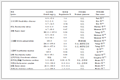
Complexes 1–5 are air and moisture sensitive. They have been characterized by 1H NMR spectroscopy, solution magnetic susceptibility measurement, infrared spectroscopy, absorption spectroscopy, combustion analysis, and single-crystal X-ray diffraction study. Complexes 1–5 are paramagnetic and their 1H NMR spectra exhibit broad paramagnetically shifted resonances in the range +20 to −20 ppm (Figs. S31-S35 in Supporting information). The IR spectra of 1–5 measured on KBr pellets exhibit Si−H stretching at 2015, 2019, 1971, 1963 and 1940 cm−1, respectively (Figs. S21-S25 in Supporting information). The molecular structures of 1, 2, and 4 established by X-ray crystallography revealed that they are square-planar cobalt(Ⅱ) complexes having two silyl ligands in trans-configuration as evidenced by the C(carbene)-Co-C(carbene) and Si-Co-Si angels that are nearly 180° (Table 1). Fig. 2 depicts the molecular structure of 4 as the representative. The Co-Si bond distances in 1, 2, and 4 are in the narrow range 2.3268(5) to 2.3639(5) Å, which are close to that of the chelating silyl-NHC Co(Ⅱ) complex [(CSiPhPh)Co(IMesʹ)] (2.327(1) Å) [29] and longer than that in [cis-(IMesCy)2Co(H)(SiHPh2)] (2.249(1) Å) [30]. [(SiPi3Pr2)CoCl] (2.2262(9) Å) [27], [(Ph2PSiP)CoCl] (2.259(1) Å) [28], and [(acriPNP)Co(SiH2Ph)] (2.302 Å) [31]. The long Co-Si bonds in 1, 2, and 4 can be ascribed to the strong trans-effect of the silyl ligands. The Co-C(carbene) distances in 1, 2, and 4 are also in the narrow range (1.9055(17) and 1.911(2) Å) and close to the correspongding distances in reported four-coordinate cobalt(Ⅱ) NHC complexes [32].
|
Table 1 Selected bond lengths (Å) and angles (deg) of [(ICy)2Co(SiH2Mes)2] (1), [(ICy)2Co(SiH2Ph)2] (2) and [(ICy)2Co(SiHPh2)2] (4). |


|
Download:
|
| Fig. 2. Molecular structure of 4 showing 30% probability ellipsoids. Except the hydrogen atoms on silicon, all other hydrogen atoms were omitted for clarity. Selected distances (Å) and angles (deg): Co(1)-Si(1) 2.3564(5), Co(1)-Si(2) 2.3639(5), Co(1)-C(1) 1.9067(18), Co(1)-C(2) 1.9070(18), Si(1)-Co(1)-Si(2) 170.72(2), C(1)-Co(1)-Si(1) 95.31(5), C(1)-Co(1)-Si(2) 85.59(5), C(1)-Co(1)-C(2) 179.29(8), C(2)-Co(1)-Si(1) 84.83(5), C(2)-Co(1)-Si(2) 94.16(5). | |

Complexes 1–5 are low-spin disilyl Co(Ⅱ) complexes. Their solution magnetic moments (ca. 2.3 μB) measured by Evans' method are slightly larger than the spin-only value of 1.73 μB for 3d metal ions with an S = 1/2 spin state. The X-band electron paramagnetic resonance (EPR) spectrum of the frozen toluene solution of 4 measured at 77 K displays noticeable 59Co (I = 7/2) nuclear hyperfine splitting (Fig. 3) and can be simulated as a S = 1/2 system with g1 = 3.01, g2 = 2.54, g3 = 1.93 and A_Co1 = 690.6 MHz, A_Co2 = 522.2 MHz, A_Co3 = 373.7 MHz, similar to those found for the low-spin Co(Ⅱ) complexes [Co(IEt)4][BF4]2 [32].

|
Download:
|
| Fig. 3. EPR spectra (black line) of [(ICy)2Co(SiHPh2)2] (4) recorded in toluene at 77 K. Instrumental parameters: ν = 9.37 GHz, modulation frequency = 100 kHz, modulation amplitude = 9.61 G, microwave power = 0.00796 mW, conversion time = 5.12 ms, time constant = 0 ms, sweep time = 20.97 s. Simulation (red line) provide g1 = 3.01, g2 = 2.54, g3 = 1.93; A_Co1 = 690.6 MHz, A_Co2 = 522.2 MHz, A_Co3 = 373.7 MHz; line width lw = 2.57 mT. | |

The formations of the disilyl Co(Ⅱ) complexes 1–5 might operate in the route shown in Scheme 2. The interaction of [(ICy)2Co(vtms)] with the hydrosilanes might afford the silyl Co(Ⅱ) hydride species (ICy)2Co(H)(SiHRR') (A) and vtms. A subsequent alkene insertion reaction could yield the alkyl intermediate (ICy)2Co(CH2CH2SiMe3)(SiHRR') (B) that can then interact with the second equiv. of hydrosilane to yield Me3SiCH2CH2SiHRRʹ and (ICy)2Co(H)(SiHRR') (A). The further reaction of the silyl Co(Ⅱ) hydride intermediate with the third equiv. of hydrosilane can yield a tetrahedral disilyl Co(Ⅱ) complexes (ICy)2Co(SiHRR')2 (C) and H2. The reactions of the Co(Ⅱ) intermediates with hydrosilanes could operate via either oxidative addition-reductive elimination or σ-bond metathesis mechanism. Considering the steric bulky nature of ICy, σ-bond metathesis mechanism seems to be more likely. C might undergo isomerization to form the trans-disilyl Co(Ⅱ) complexes 1–5. Relevant to the proposed tetrahedral to square planar isomerization process, the Fe(Ⅱ) aryl complexes (NHC)2Fe(Ar)2 have been known to undergo similar tetrahedral-(NHC)2Fe(Ar)2-trans-(NHC)2Fe(Ar)2 isomerization [33]. Relative stability of the geometric isomers of the Co(Ⅱ) species might be governed by the relative strength of the ligand-field (silyl versus hydride versus alkyl) and by the steric nature of the ligand sets.

|
Download:
|
| Scheme 2. Proposed route for the formation of the disilyl Co(Ⅱ) complexes 1–5. | |

Noting that the studies on silyl Co(Ⅱ) complexes, particularly their reactivity, are rarely known, we further investigated the reactivity of the four-coordinate disilyl Co(Ⅱ) complexes with 4 as the representative.
Complex 4 proved reactive toward potassium metal. Treatment of 4 with K in THF solution at room temperature gave brownish yellow solution. After further workup and recrystallization, the disilyl Co(Ⅲ) dihydride complex [K(THF)][(ICy)2Co(H)2(SiHPh2)2]n (6) was isolated in 77% yield as a brown solid (Scheme 3). Complex 6 has been characterized by 1H, 13C, and 29Si NMR spectroscopies, infrared (IR) spectroscopy, absorption spectroscopy, combustion analysis, and single-crystal X-ray diffraction study.

|
Download:
|
| Scheme 3. Reaction of 4 with K. | |

Complex 6 is diamagnetic. Its 1H NMR spectrum measured in d8-THF shows a sharp singlet at δ −14.20 ppm, which is assignable to Co-H. There are a double peaks at δ 5.13 ppm assignable to Si-H with 1:1 integral intensity relative to the Co-H signal. The hydrogen-coupling 29Si NMR spectrum of 6 exhibits a double peak at 4.5 ppm with JSi-H = 118 Hz. The 29Si-1H HSQC and 13C-1H HSQC spectra (Figs. S41 and S40 in Supporting information) further indicated that there is only one Si-H bond on the silyl ligands. The IR spectrum of 6 measured on KBr pellets also feature bands at 1671 and 1890 cm−1 assignable to the Co-H and Si-H stretching, respectively (Fig. S26 in Supporting information). Single-crystal X-ray diffraction study revealed that 6 is an anionic complex, in which the potassium cation is coordinating with one THF molecule and two phenyl group of the silyl ligands on the neighboring anions [(ICy)2Co(H)2(SiHPh2)2]− to form 1-D polymer chain (Fig. 4). Different from the trans-configuration of the silyl ligands in 4, the two silyl groups and two ICy ligands in the anions [(ICy)2Co(H)2(SiHPh2)2]− of 6 are in cis-form. The shorter Co-Si distances of 6 (2.167(4), 2.205(4), 2.161(4) and 2.198(4) Å) as compared with those in 4 (2.3564(5) and 2.3639(5) Å) seem to be in line with the higher oxidation state of the cobalt centers in 6 as compared with that in 4 (Co(Ⅲ) versus Co(Ⅱ)). The stronger trans-effect of silyl ligand over NHC should also contribute to the shorter Co-Si bonds in 6. The differentiated trans-effect of silyl ligand over NHC might also be the cause of the long Co-C(carbene) distances (1.911(13)−1.954(12) Å) in 6 versus their congeners in 4 (1.9067(18) and 1.9070(18) Å). While the hydride ligands on the cobalt center in 6 is hard to be identified by X-ray diffraction study, calculation studies on the 1H NMR spectrum of [K(THF)][(ICy)2Co(H)2(SiHPh2)2] based on the structure established by X-ray diffraction study can well reproduce the Co-H and Si-H signals, whereas the calculated 1H NMR spectrum of [K(THF)][(ICy)2Co(SiHPh2)2] does not exhibit signal in the range 0 to −20 ppm (Figs. S8 and S9 in Supporting information). The collected evidences from the aforementioned spectroscopies and calculation studies thus support the identity of 6 as a disilyl Co(Ⅲ) dihydride complex [K(THF)][(ICy)2Co(H)2(SiHPh2)2]n.

|
Download:
|
| Fig. 4. The structure of the asymmetric unit in the unit cell of 6, showing 30% probability ellipsoids. Except the hydrides on silicon and cobalt atoms, all other hydrogen atoms were omitted for clarity. Selected distances (Å) and angles (deg) for: Co(1)-H(1A) 1.2993, Co(1)-H 1.3017, Co(1)-Si(1) 2.167(4), Co(1)-Si(2) 2.205(4), Co(1)-C(1) 1.921(12), Co(1)-C(2) 1.952(14), Co(2)-H(3A) 1.3010, Co(2)-HA 1.1000, Co(2)-Si(3) 2.161(4), Co(2)-Si(4) 2.198(4), Co(2)-C(3) 1.911(13), Co(2)-C(4) 1.954(12), C(2)-Co(1)-Si(1) 156.6(5), C(2)-Co(1)-Si(2) 89.4(4), H(3A)-Co(2)-HA 155.2, Si(3)-Co(2)-H(3A) 54.8, Si(3)-Co(2)-HA 125.9, Si(3)-Co(2)-Si(4) 90.48(15), Si(4)-Co(2)-H(3A) 109.2, Si(4)-Co(2)-HA 95.5, C(3)-Co(2)-H(3A) 93.0, C(3)-Co(2)-HA 62.8, C(3)-Co(2)-Si(3) 90.6(3), C(3)-Co(2)-Si(4) 153.3(4), C(3)-Co(2)-C(4) 102.1(5), C(4)-Co(2)-H(3A) 99.5, C(4)-Co(2)-HA 81.8, C(4)-Co(2)-Si(3) 152.3(4), C(4)-Co(2)-Si(4) 89.0(4). | |

The presence of two hydride ligands in 6 indicates that the reaction of 4 with K has led to the incorporation of two addition hydrogen atom from external source. As the control reaction of 4 with K in toluene gave poor yield of 6, and GC–MS analysis on the quenched reaction run in THF indicated the presence of 3-buten-1-ol in the mixture. In addition, the reaction of 4 with K in d8-THF can also form the corresponding deuterated product. The 1H NMR and 2H NMR show the deuterium are existed on both cobalt centers and silyl ligands (Fig. S55 in Supporting information). It can be reasoned that the two additional hydrogen atoms on 6 should come from THF. It has been known that THF might be deprotonated by strong base to form tetrahydrofuran-2-yl carboanion that can undergo ring-opening reaction in retro 5-endo-trig route to transform into but‑3-enyl-1-oxide anion [H2C═CHCH2CH2O]−. Recently, Coles and co-workers isolated the but‑3-enyl-1-oxido product Al(NONDipp)(H)(μ-OCH2CH2CH═CH2)Li(THF)2 (NONDipp = [O(SiMe2NDipp)2]2−, Dipp = 2, 6-iPr2C6H3) from the reduction of Al(NONDipp)I with lithium metal in THF [34]. The hydride ligand was also evidenced in the final alumina complex. Accordingly, it can be proposed that the reduction of 4 with K in THF solvent might give the disilyl Co(Ⅰ) species K[trans-(ICy)2Co(SiHPh2)2] (D) that undergoes isomerization to form K[cis-(ICy)2Co(SiHPh2)2] (E) (Scheme 4). The Co(Ⅰ) intermediate can function as a strong base with its filled 3dz orbital to deprotonate the α-H on THF, yielding Co(Ⅲ) species (ICy)2Co(H)(SiHPh2)2 (F) and (tetrahydrofuran-2-yl)potassium. Intermediate F can further be reduced by 2 equiv. of K to yield the new silyl Co(Ⅰ) species K2[(ICy)2Co(H)(SiHPh2)2] (G) that again react with THF to produce 6 and (tetrahydrofuran-2-yl)potassium. The decomposition of (tetrahydrofuran-2-yl)potassium can then generate [H2C═CHCH2CH2OK]. Since the interaction of H2SiPh2 with K metal in THF at room temperature does not produce the THF-ring opening product, the silyl salt KSiHPh2 is less likely the strong base responsible for the THF deprotonation reaction.

|
Download:
|
| Scheme 4. Proposed route for the formation of the silyl cobalt complex 6. | |

Aiming to probe the ability of the di(NHC) di(silyl) ligands set to support high-valent cobalt species, the reaction of 4 with AgBF4 was examined, which, however, led to the isolation of a diphenylfluorosilyl Co(Ⅱ) complex [(ICy)2Co(THF)(SiFPh2)][BF4] (7) (Scheme 5). The reaction of 4 with 2 equiv. of AgBF4 in THF solution at room temperature gave a brown solution, from which 7 was isolated in 25% yield as brown crystals. NMR analysis on the reaction mixture indicated the co-formation of H2SiPh2. Lowering the amount of AgBF4 to 1 equiv. was found to leave 4 in a considerable amount in the resultant mixture.

|
Download:
|
| Scheme 5. The reaction of 4 with AgBF4. | |

Complex 7 has been characterized by 1H, 19F, 11B NMR spectroscopies, infrared (IR) spectroscopy, absorption spectroscopy, combustion analysis, and single-crystal X-ray diffraction study. The structure of the cation [(ICy)2Co(THF)(SiFPh2)]1+ in 7 revealed by X-ray crystallography is depicted in Fig. 5. The cobalt center displays a square planar geometry with the two ICy ligands in trans-alignment. The diphenylfluorosilyl ligand has a Co-Si distance of 2.2443 (7) Å, which is shorter than those in 4 (2.3564 (5) and 2.3639 (5) Å) and close to that in the silyl Co(Ⅱ) hydride complex [(IMesCy)2Co(H)(SiHPh2)] (2.249(1) Å) [30]. The Co-C(carbene) distances are 1.944 (2) and 1.940 (2) Å, which are slightly longer than the corresponding in 4 (1.9067 (18) and 1.9070 (18) Å). The 1H NMR spectrum of 7 exhibits broad signals in the range 15 to −15 ppm, pointing out its paramagnetic nature. The two 19F NMR signals appearing on its spectrum unambiguously prove the existence of the fluorinated silyl ligand and the anion [BF4]− (Fig. S43 in Supporting information).

|
Download:
|
| Fig. 5. The cation structure of 7 showing 30% probability ellipsoids. All hydrogen atoms are omitted for clarity. Selected bond lengths (Å) and angles (°): Co(1)-Si(1) 2.2443(7), Co(1)-O(1) 2.1102(16), Co(1)-C(1) 1.944(2), Co(1)-C(2) 1.940(2), O(1)-Co(1)-Si(1) 178.08(6), C(1)-Co(1)-Si(1) 92.35(7), C(1)-Co(1)-O(1) 88.26(8), C(2)-Co(1)-Si(1) 89.13(7), C(2)-Co(1)-O(1) 90.21(8), C(2)-Co(1)-C(1) 177.99(10). | |

The diphenylfluorosilyl cobalt complex 7 is proposed to be formed via cobalt silylene intermediates (Scheme 6). Two electron-oxidation of the disilyl Co(Ⅱ) complex 4 by 2 equiv. of AgBF4 followed by the coordination of the [BF4]− anion to the Co(Ⅳ) center gave an five-coordinate Co(Ⅳ) intermediate [(ICy)2Co(BF4)(SiHPh2)][BF4] (H). Intermediate H might expel a BF3 moiety to form the Co(Ⅳ) disilyl fluoride [(ICy)2Co(F)(SiHPh2)][BF4] (I) that might eliminate a H2SiPh2 molecule via the sequential process of α-H elimination and reductive elimination to form the Co(Ⅱ) silylene intermediate [(ICy)2Co(F)(SiPh2)][BF4] (J). The coordination of a THF on the cobalt center in K could then lead to the migration of the F− anion from Co to Si, generating the diphenylfluorosilyl cobalt complex 7. Cyclic voltammetry study on 4 indicated the presence of irreversible oxidation event with a peak potential at 0.38 V (vs. SCE), which supports the capability of AgBF4 (E(Ag+/Ag)1/2 = 0.96 V in THF, vs. SCE) (Fig. S10 in Supporting information) in oxidizing 4. Group/atom transfer between transition-metal and silicon atom via metal silylene intermediates is a well-known reactivity of transition-metal silyl complexes [35,36].

|
Download:
|
| Scheme 6. Plausible route for the formation of 7. | |

Silyl cobalt complexes are the key intermediates in cobalt-catalyzed hydrosilylation reactions that operate via modified Chalk-Harrod mechanism. Some silyl Co(Ⅰ) and Co(Ⅲ) complexes are known to react with alkenes to yield alkene-insertion or alkene-hydrosilylation products. Studies on the reactions of silyl Co(Ⅱ) complexes with alkenes or alkynes remain elusive. Noting this, the reactions of 4 with alkenes and alkynes have been studied. Complex 4 is found inert towards the alkenes, 1-octene, styrene and 3, 5-bis(trifluoromethyl)styrene, and also the internal alkynes, 3-hexyne and diphenyl acetylene at room temperature or 80 ℃. The reactions with terminal alkynes, however, can lead to the consumption of three equiv. of the alkynes as indicated by 1H NMR spectroscopy and the Co(Ⅱ) complexes [trans-(ICy)2Co(C≡CCy)2] (8), [trans-(ICy)2Co(C≡CSiMe3)((SiMe3)C═CH2)] (9), and [trans-(ICy)2Co(C≡CAr)((Ar)C═CH(SiHPh2)C═CHAr)] (Ar = 4-CF3C6H4) (10) have been isolated in 32%, 39% and 42% yields from the corresponding reaction (Scheme 7). Complexes 8–10 have been characterized by 1H NMR spectroscopies, absorption and infrared spectroscopies, elemental analysis as well as single crystal X-ray diffraction studies (Fig. 6,Fig. 7,Fig. 8). The low isolated yields of 8–10 are due to the poor crystallinity of these complexes in organic solvents since NMR scale reactions have showed the high yields of 8–10 when 4 was treated with 3 equiv. of the alkynes. Notably, in addition to the formation of these Co(Ⅱ) complexes, H2SiPh2 was observed as a byproduct in these reactions. The reactions yielding 8 and 9 are also found to yield the alkyne dehydrogenative silylation products CyC≡CSiHPh2 and Me3SiC≡CSiHPh2, respectively. The identities of the alkynylsilyl compounds were unambiguously confirmed by comparing their NMR spectra with those of the samples prepared by reported methods.

|
Download:
|
| Scheme 7. Reactions of 4 with CyC≡CH, Me3SiC≡CH and 4-CF3C6H4C≡CH. | |


|
Download:
|
| Fig. 6. Molecular structure of 8 showing 30% probability ellipsoids. Hydrogen atoms are omitted for clarity. Selected distances (Å) and angles (deg): Co(1)-C(1) 1.912(4), Co(1)-C(2) 1.918(5), Co(1)-C(3) 1.924(6), Co(1)-C(4) 1.930(6), C(4)-C(40) 1.107(9), C(3)-C(32) 1.211(8), C(1)-Co(1)-C(2) 179.1(4), C(1)-Co(1)-C(3) 91.0(2), C(1)-Co(1)-C(4) 89.4(2), C(2)-Co(1)-C(3) 89.3(2), C(2)-Co(1)-C(4) 90.3(2), C(3)-Co(1)-C(4) 179.1(3). | |


|
Download:
|
| Fig. 7. Molecular structure of 9 showing 30% probability ellipsoids. Hydrogen atoms are omitted for clarity. Selected distances (Å) and angles (deg): Co2-C6 1.8993, Co2-C5 1.9004, Co2-C7 1.9517, Co2-C8 1.9105, C7-C44 1.3819, C8-C76 1.2105, C(5)-Co(2)-C(6) 177.09, C(7)-Co(2)-C(8) 171.65, C(5)-Co(2)-C(7) 90.43, C(5)-Co(2)-C(8) 88.44, C(7)-Co(2)-C(6) 92.42, C(6)-Co(2)-C(8) 88.83. | |


|
Download:
|
| Fig. 8. Molecular structure of 10 showing 50% probability ellipsoids. Hydrogen atoms are omitted for clarity. Selected distances (Å) and angles (deg): Co(1)-C(1) 1.927(2), Co(1)-C(2) 1.920(2), Co(1)-C(3) 1.986(2), Co(1)-C(4) 1.908(2), C(3)-C(48) 1.346(3), C(4)-C(5) 1.213(3), C(49)-C(50) 1.342(3), C(1)-Co(1)-C(3) 93.73(9), C(2)-Co(1)-C(1) 175.89(9), C(2)-Co(1)-C(3), 90.31(9), C(4)-Co(1)-C(1) 87.02(9), C(4)-Co(1)-C(2) 88.95(9), C(4)-Co(1)-C(3) 178.78(9). | |

The reactions producing 8 and 9 have H2SiPh2 and alkynylsilanes RC≡CSiHPh2 as the byproducts, which suggests the involvement of similar intermediates in their reactions. It can be proposed that the reactions of 4 with RC≡CH (R = Cy, SiMe3) might yield the cobalt alkynyl silyl intermediate trans-(ICy)2Co(C≡CR)(SiHPh2) (R = Me3Si, Cy) (L) and H2SiPh2 upon σ-bond metathesis reactions (Scheme 8). While an oxidative addition-reductive elimination can also rationally lead to L and H2SiPh2, the small ionic radium of cobalt and steric demanding nature of ICy might render the oxidative addition reaction energetically unfavorable. The interaction of L with a second equiv. of the alkyne can induce Si-C bond-forming reductive elimination, yielding the alkynylsilanes RC≡CSiHPh2 and the Co(0) intermediates (ICy)2Co(η2-HC≡CR) (M). Further C(sp)-H bond oxidative addition in M can generate the hydride intermediates trans-(ICy)2Co(H)(C≡CR) (N, R = Cy, SiMe3) that can convert into the dialkynyl complex [trans-(ICy)2Co(C≡CCy)2] (8) upon σ-bond metathesis reaction with the third equiv. of the alkyne CyC≡CH or into the alkenyl alkynyl complex [trans-(ICy)2Co(C≡CSiMe3)((SiMe3)C═CH2)] (9) via alkyne-insertion reaction with Me3SiC≡CH. The detection of 8 and 9 in the NMR scale reactions of the Co(0) complex [(ICy)2Co(vtms)] with CyC≡CH and Me3SiC≡CH lend credence to the proposed steps of M to N and to 8/9 (Figs. S52 and S53 in Supporting information). Alternatively, complex 8 can be directly formed by intermediate L with 2 equiv. of CyC≡CH upon two consecutive σ-bond metathesis reactions. The different outcome might be related to the different polarity of the C(sp)-H bonds of the two alkynes. The different electronic nature of Me3Si versus Cy might also affect the thermodynamic gains of the two types of reactions (σ-bond metathesis or alkyne insertion). The formation of the dienyl cobalt complex 10 might also have M as an intermediate. The triple bond in the alkynylsilane RC≡CSiHPh2 (R = 4-CF3C6H4) is sterically less hindered and more π-accepting than CyC≡CSiHPh2 and Me3SiC≡CSiHPh2. Consequently, it might be able to react with M to yield the reductive coupling product (ICy)2Co(CR=CHC(SiHPh2)=CR) (O in Scheme 8). Intermediate O can further react with the third equiv. of the alkyne 4-CF3C6H4C≡CH to form dienyl alkynyl cobalt complex 10. In supportive to the conversions of M to O and to 10, a NMR-scale reaction of [(ICy)2Co(vtms)] with 4-CF3C6H4C≡CSiHPh2 and 4-CF3C6H4C≡CH (2 equiv.) is found to produce 10 (Fig. S54 in Supporting information).

|
Download:
|
| Scheme 8. The possible reaction routes for the reactions of 4 with CyC≡CH, Me3SiC≡CH and 4-CF3C6H4C≡CH alkynes. | |

In conclusion, we found the reaction of cobalt(0) complex [(ICy)2Co(vtms)] with hydrosilanes can produce four-coordinate disilyl Co(Ⅱ) complexes [trans-(ICy)2Co(SiHRRʹ)2] (SiHRRʹ = SiH2Mes, 1; SiH2Ph, 2; SiH2Cy, 3; SiHPh2, 4; SiHEt2, 5) that have low-spin (S = 1/2) ground spin-state. Reactivity study revealed that the reaction of 4 with potassium in THF can produce the disilyl Co(Ⅲ) dihydride complex [K(THF)][(ICy)2Co(H)2(SiHPh2)2]n (6) and the hydride ligand might origin from THF. The reaction of 4 with the oxidant AgBF4 (2 equiv.) in THF was found to yield a diphenylfluorosilyl Co(Ⅱ) complex [trans-(ICy)2Co(THF)(SiFPh2)][BF4] (7), whose formation hints at the transformation of high valent cobalt diphenylsilyl species into diphenylsilylene cobalt intermediate. Investigating the reactions of 4 with alkenes and alkynes revealed its inertness toward common alkenes and internal alkynes, which could be caused by steric hindrance in the four-coordinate disilyl cobalt complexes. Complex 4 can react with terminal alkynes RC≡CH (3 equiv.) to yield cobalt(Ⅱ) complex [trans-(ICy)2Co(C≡CCy)2] (8), [trans-(ICy)2Co(C≡CSiMe3)((SiMe3)C═CH2)] (9) and [trans-(ICy)2Co(C≡CAr)((Ar)C═CH(SiHPh2)C═CHAr)] (Ar = 4-CF3C6H4) (10). The co-formation of alkynylsilanes RC≡CSiHPh2 and H2SiPh2 in the reactions yielding 8 and 9 and the observation of 10 in the reaction of [(ICy)2Co(vtms)] with 4-CF3C6H4C≡CSiHPh2 and 4-CF3C6H4C≡CH point out that alkynylsilanes RC≡CSiHPh2 are the common product in reactions of the NHC—Co(Ⅱ) silyl species with terminal alkynes. The production of alknylsilanes, rather than alkenylsilane derivatives that can be formed by migratory insertion reactions of alkynes with silyl cobalt species, might be caused by steric hindrance exerted by the NHC ligands.
Declaration of competing interestThe authors declare that they have no known competing financial interests or personal relationships that could have appeared to influence the work reported in this paper.
AcknowledgmentsThe study was supported by the National Key Research and Development Program of the Ministry of Science and Technology of China (No. 2021YFA1500203), Natural Science Foundation of China (Nos. 22231010, 22061160464, 21821002, and 22201290), and Shanghai Sailing Program (No. 22YF1458200).
Supplementary materialsSupplementary material associated with this article can be found, in the online version, at doi:10.1016/j.cclet.2023.108682.
| [1] |
M.S. Eisen, Transition-metal silyl complexes, in: Z. Rappoport, Y. Apeloig (Eds.), The Chemistry of Organic Silicon Compounds, John Wiely & Sons, Ltd., New York, 1998, pp. 2037–2128.
|
| [2] |
T.D. Tilley, Acc. Chem. Res. 26 (1993) 22-29. DOI:10.1021/ar00025a004 |
| [3] |
P. Braunstein, M. Knorr, J. Organomet. Chem. 500 (1995) 21-38. DOI:10.1016/0022-328X(95)00530-4 |
| [4] |
J.Y. Corey, Chem. Rev. 111 (2011) 863-1071. DOI:10.1021/cr900359c |
| [5] |
B. Marciniec, Hydrosilyaltion: a comprehensive review on recent advances, in: J. Matisons (Ed. ), Adcance in Silicon Science, Springer, Berlin, 2009 Chapter 1.
|
| [6] |
V.K. Dioumaev, L.J. Procopio, P.J. Carroll, D.H. Berry, J. Am. Chem. Soc. 125 (2003) 8043-8058. |
| [7] |
M.B. Ansell, D.E. Roberts, F.G.N. Cloke, O. Navarro, J. Spencer, Angew. Chem. Int. Ed. 54 (2015) 5578-5582. DOI:10.1002/anie.201501764 |
| [8] |
M.B. Ansell, J. Spencer, O. Navarro, ACS Catal. 6 (2016) 2192-2196. DOI:10.1021/acscatal.6b00127 |
| [9] |
W. Ai, R. Zhong, X. Liu, Q. Liu, Chem. Rev. 119 (2019) 2876-2953. DOI:10.1021/acs.chemrev.8b00404 |
| [10] |
J. Guo, H. Wang, S. Xing, X. Hong, Z. Lu, Chem 5 (2019) 881-895. DOI:10.1016/j.chempr.2019.02.001 |
| [11] |
J. Guo, Z. Cheng, J. Chen, X. Chen, Z. Lu, Acc. Chem. Res. 54 (2021) 2701-2716. DOI:10.1021/acs.accounts.1c00212 |
| [12] |
A.J. Chalk, J.F. Harrod, J. Am. Chem. Soc. 89 (1967) 1640-1647. DOI:10.1021/ja00983a020 |
| [13] |
A.P. Hagen, A.G. MacDiarmid, Inorg. Chem. 6 (1967) 686-689. DOI:10.1021/ic50050a011 |
| [14] |
W.T. Robinson, J.A. Ibers, Inorg. Chem. 6 (1967) 1208-1213. DOI:10.1021/ic50052a031 |
| [15] |
F. Seitz, M.S. Wrighton, Angew. Chem. Int. Ed. 27 (1988) 289-291. |
| [16] |
B. Marciniec, I. Kownacki, D. Chadyniak, Inorg. Chem. Commun. 2 (1999) 581-583. |
| [17] |
C.C. Mokhtarzadeh, C.E. Moore, A.L. Rheingold, J.S. Figueroa, J. Am. Chem. Soc. 140 (2018) 8100-8104. DOI:10.1021/jacs.8b05019 |
| [18] |
Z. Mo, J. Xiao, Y. Gao, L. Deng, J. Am. Chem. Soc. 136 (2014) 17414-17417. DOI:10.1021/ja510924v |
| [19] |
W.Y. Chu, R. Gilbert-Wilson, T.B. Rauchfuss, M. van Gastel, F. Neese, Organometallics 35 (2016) 2900-2914. DOI:10.1021/acs.organomet.6b00457 |
| [20] |
S. Xu, P. Zhang, X. Li, et al., Chem. Asian J. 12 (2017) 1234-1239. DOI:10.1002/asia.201700144 |
| [21] |
Y. Li, J.A. Krause, H. Guan, Organometallics 39 (2020) 3721-3730. DOI:10.1021/acs.organomet.0c00553 |
| [22] |
S.S. Rozenel, R. Padilla, J. Arnold, Inorg. Chem. 52 (2013) 11544-11550. DOI:10.1021/ic4018882 |
| [23] |
R.C. Handford, P.W. Smith, T.D. Tilley, J. Am. Chem. Soc. 141 (2019) 8769-8772. DOI:10.1021/jacs.9b04265 |
| [24] |
S. Xie, Y. Dong, X. Du, et al., Organometallics 40 (2021) 286-293. DOI:10.1021/acs.organomet.0c00766 |
| [25] |
A.D. Ibrahim, S.W. Entsminger, L. Zhu, A.R. Fout, ACS Catal. 6 (2016) 3589-3593. DOI:10.1021/acscatal.6b01091 |
| [26] |
N. Agenet, J.H. Mirebeau, M. Petit, et al., Organometallics 26 (2007) 819-830. DOI:10.1021/om0607245 |
| [27] |
M.T. Whited, N.P. Mankad, Y. Lee, P.F. Oblad, J.C. Peters, Inorg. Chem. 48 (2009) 2507-2517. DOI:10.1021/ic801855y |
| [28] |
S. Wu, X. Li, Z. Xiong, et al., Organometallics 32 (2013) 3227-3237. DOI:10.1021/om400047j |
| [29] |
Z. Mo, Y. Liu, L. Deng, Angew. Chem. Int. Ed. 52 (2013) 10845-10849. DOI:10.1002/anie.201304596 |
| [30] |
J. Sun, Y. Gao, L. Deng, Inorg. Chem. 56 (2017) 10775-10784. DOI:10.1021/acs.inorgchem.7b01763 |
| [31] |
J. Choi, Y. Lee, Angew. Chem. Int. Ed. 58 (2019) 6938-6942. DOI:10.1002/anie.201901007 |
| [32] |
Z. Mo, Y. Li, H.K. Lee, L. Deng, Organometallics 30 (2011) 4687-4694. DOI:10.1021/om200527y |
| [33] |
Y. Liu, L. Luo, J. Xiao, et al., Inorg. Chem. 54 (2015) 4752-4760. DOI:10.1021/acs.inorgchem.5b00138 |
| [34] |
M.J. Evans, A. O'Reilly, M.D. Anker, M.P. Coles, Organometallics 41 (2022) 2657-2661. DOI:10.1021/acs.organomet.2c00329 |
| [35] |
C. Shan, S. Yao, M. Driess, Chem. Soc. Rev. 49 (2020) 6733-6754. DOI:10.1039/d0cs00815j |
| [36] |
R.J. Witzke, T.D. Tilley, Chem. Commun. 55 (2019) 6559-6562. DOI:10.1039/c9cc03128f |