 2024, Vol. 35


b State Key Laboratory of Chemo/Biosensing and Chemometrics, College of Chemistry and Chemical Engineering, Hunan University, Changsha 410082, China
Bisborylalkanes are versatile building blocks in synthetic chemistry and materials science via a variety of transformations of C−B bonds [1–4]. The most extensive application of bisborylalkane is to be used as a nucleophile, such as in the Suzuki−Miyaura couplings [5–8] and the boron-Wittig reactions [9–12], in which the 1,1-diboronates undergo deborylation in the presence of an alkoxide base to generate boron-stabilized carbanion intermediates that then react with a series of electrophiles [13–15], such as aldehydes, ketones, carboxylic acids, imines, and aromatic halides. To this end, the synthesis of bisborylalkanes has received lots of attentions from synthetic communities, and recent years we have witnessed great progress in developing synthetic methods of bisborylalkanes [16–29]. For instance, transition metal-catalyzed diboration of alkynes [30] and hydroboration (protoboration) of alkenyl boronic esters [31] provide efficient methods to access 1,1-diboronates (Fig. 1a). The formation of diboronate complexes from B2pin2 and alkyl halides (or carbamates) in the presence of a base leads to highly efficient construction of bisborylalkanes via 1,2-boron migration (Fig. 1a) [32,33]. Additionally, the Studer group disclosed that B-ate complexes generated from alkyl Grignard reagents and B2pin2 can also go through a 1,2-boron shift to give 1,1-diboronates by treatment of UV (365 nm) irradiation and CF3I [34]. Despite these significant advances, the synthesis of gem-diboronates from readily accessible starting materials is still in great demand given their broad applications.

|
Download:
|
| Fig. 1. (a) Traditional methods for the synthesis of gem-bisborylalkanes; (b) deoxygenative borylation of ketones to prepare gem-bisborylalkanes; (c) cobalt catalyzed deoxygenative borylation of diaryl ketones; (d) useful molecules with diarylalkane unit. | |
Ketones are among the largest volume platform chemicals in the commodity chemical industry and are incontrovertibly ideal synthetic precursors of bisborylalkanes [35,36]. To date, two strategies are available for converting the ketones to gem-diboronates. One of them is to synthesize hydrozones first, which then react with B2pin2 in the presence of a base via diazo intermediates (Fig. 1b) [37]. Another involves the diboration of ketones, resulting in the formation of C, O-bisborylated intermediates, which then undergo a 1,2-Bpin rearrangement with OBpin as a leaving group to deliver bisborylalkane products [38,39]. Of note is that these approaches are applicable to aryl alkyl ketones and dialkyl ketones, but diaryl ketones are incompatible (Fig. 1b). Taking into account that 1,1-diaryl-substituted gem-diboronates offer a rapid access to synthetically useful diarylalkanes, which represent an important pharmacophore in drugs and other bioactive molecules as well as materials, such as benadryl, tolpropamine, and tetraphenylethene (TPE, Fig. 1d), the preparation of 1,1-diaryl-substituted gem-1,1-diboronates from diaryl ketones is of great significance.
In view of our long interest in organoboron chemistry and our recent success in the deoxygenative borylation of ketones [40,41], here we report a cobalt catalyzed deoxygenative borylation of diaryl ketones under mild reaction conditions, which provides a practical method for the construction of 1,1-diaryl-substituted gem-diboronates. Noticeably, the preparation of diarylmethyl boronic ester was also achieved via a protodeboration of bisborylalkanes, indicating that the deoxygenative borylation of diaryl ketones can be used selectively to construct gem-diboronates or mono-boronates via fine-tuning the reaction conditions.
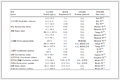
Our initial investigation started with the optimization of reaction conditions using diaryl ketone 1a as the model substrate, Co(acac)2 as the catalyst, CsOAc as the base, and B2pin2 as the boron source. As shown in Table 1, the ligands were first screened (Table 1, entries 3-11). Although no desired product was observed when 2,2′-dipyridyl (L1), 1,10-phenanthroline (L2) and Xantphos (L3) were employed, the diborylation product 2a was obtained in 81% yield by treatment with terpyridine (L4, Table 1, entries 3-6). Noticeably, the 1,1-diaryl-substituted gem-diboronate decomposed moderately on silica gel during column chromatography, leading to the moderate isolated yield. Other terpyridine ligands (L5-L9) were also evaluated, but none of them gave better result (Table 1, entries 7-11). We next turned our attention to examine the solvents. As depicted, only a trace amount of diborylated product was observed when nonpolar solvents such as cyclohexane and toluene were used (Table 1, entries 12 and 13). The base effect in this reaction was also investigated. The use of K2CO3, KOAc and LiOAc resulted in no desired product or forming only a trace amount of 2a (Table 1, entries 14-16). It is worth noting that no bisborylalkane 2a was observed in the absence of a base, indicating the important role of a base in the generation of product 2a (Table 1, entries 17). In addition, control experiments suggested that both B2pin2 and HBpin are critical in these deoxygenative borylation reaction, because no desired product 2a was observed in the absence of either B2pin2 or HBpin (Table 1, entries 18 and 19).
|
Table 1 Reaction optimization.a |


With the optimal reaction conditions in hand, we then started to explore the substrate scope for this cobalt catalyzed diborylation reaction. As demonstrated in Scheme 1, a diverse set of diaryl ketones successfully participated in this deoxygenative borylation to give the corresponding diboronate products in moderate to good yields. In addition to unsymmetrical diaryl ketones, symmetrical ketones with OMe, OBu and OTBS groups all proceeded smoothly to afford the bisborylalkane products 2b-2d in 45%-54% yields. Furthermore, disubstituted phenyl groups were also tolerated to furnish the corresponding products 2e-2g in moderate yields. It is worth mentioning that the mild reaction conditions were compatible with a fluorine atom (2h). In addition to phenyl groups, naphthalene can be readily introduced into the gem-diboronate product, leading to the formation of product 2i. We were pleased to find that the substrate derived from menthol could undergo the desired pathway to give the deoxygenative borylation product 2j.

|
Download:
|
| Scheme 1. Synthesis of gem-bisborylalkanes. Unless otherwise noted, all reactions were carried out with 1 (0.30 mmol), Co(acac)2 (0.015 mmol), L4 (0.018 mmol), B2pin2 (0.75 mmol), HBpin (0.24 mmol), and CsOAc (0.3 mmol) in 2.0 mL of THF at 110 ℃. Isolated yields were reported. | |

Given that the bisborylalkanes are prone to go through protodeboration to generate mono-borylalkanes on silica gel during column chromatography, we then investigated the deoxygenative mono-boration of diaryl ketones. We first optimized the reaction and determined the optimum condition to generate diarylmethyl boronate. The results indicated that diarylmethyl boronate was dominant in this deoxygenative borylation when the amount HBpin was increasd from 0.8 equiv. to 1.0 equiv. Similar to the deoxygenative diborylation, this reaction tolerated the diaryl ketones with a variety of functional groups including electron-donating or -withdrawing groups (Scheme 2), such as MeO, nBuO, OBn, OTBS, Cl, and F. Additionally, the substrates with naphthalene and dibenzofuran were capable to afford the borylation products 3q and 3r. To get further insight into the applicability of pharmaceutical relevance, ketoprofen methyl ester and (−)-menthol derived diaryl ketone were treated with the established optimal conditions. We were pleased to find that these two substrates were also suitable for this deoxygenative borylation to provide corresponding products 3s and 3t.

|
Download:
|
| Scheme 2. Synthesis of diarylmethyl boronates. Unless otherwise noted, all reactions were carried out with 1 (0.30 mmol), Co(acac)2 (0.015 mmol), L4 (0.018 mmol), B2pin2 (0.75 mmol), HBpin (0.3 mmol), and CsOAc (0.3 mmol) in 2.0 mL of THF at 110 ℃. Isolated yields were reported. a1q or 1j (0.2 mmol) was used. | |

The gram-scale deoxygenative borylation was conducted to probe the practicability of the developed process (Scheme 3a). The cobalt-catalyzed deoxygenative borylation of diaryl ketone 1a (1.49 g, 7.0 mmol) with B2pin2 under the standard reaction conditions afforded 3a with a yield of 46% (1.07 g, 3.3 mmol). Bisborylalkanes and diarylmethyl boronates could serve as valuable synthons in various organic transformations and be converted to various functionalized molecules. The obtained momo-borylation product 3a was employed as the useful building block. For instance, the Suzuki reaction of 3a with iodobenzene afforded the corresponding triaryl derivative 4 in good yield (Scheme 3b). The addition of an electron-rich aryl lithium reagent (2-lithiofuran) to the boronic ester followed by an elimination generated compound 5. Furthermore, the introduction of a vinyl group also proved to be efficient by vinylmagnesium bromide. Moreover, 3a was subjected to the Matteson homologation conditions at low temperature, and the homologated alcohol product was obtained after oxidation in reasonable yield. Meanwhile, aggregation-induced emission molecule TPE 8 could be readily generated by the reaction of diarylmethyl boronate 2a with benzophenone through boron-Witting olefination (Scheme 3c) [42].

|
Download:
|
| Scheme 3. Synthetic applications. Reaction conditions: (ⅰ) 1-iodo-4-methoxybenzene (1.6 equiv.), Pd(PPh3)4 (20 mol%), K2CO3 (1.6 equiv.), Ag2O (1.6 equiv.), 60 ℃, 36 h. (ⅱ) Furan (2.0 equiv.), nBuLi (2.0 equiv.), NBS (2.0 equiv.), -78 ℃ to r.t., 12 h. (ⅲ) Vinylmagnesium bromide (4.0 equiv.), I2 (4.0 equiv.), -78 ℃, 12 h. (ⅳ) Bromochloromethane (2.5 equiv.), nBuLi (2.3 equiv.), -78 ℃ to r.t., 4 h; NaOH (3.0 equiv.), H2O2 (3.0 equiv.). | |

Based on the literature reports and our experimental results [38,39], the mechanism for this deoxygenative borylation reaction is proposed and shown in Scheme 4. The reduction of Co(acac)2 with HBpin in the presence of ligand L generates an (L)Co(I)−H species [43], which can be converted to a cobalt boryl intermediate (L)Co-Bpin A via σ-bond metathesis with B2pin2 [44,45]. Following the coordination of ketone to the cobalt center, the insertion of the C=O group into the Co−B bond forms intermediate B, which then goes through 1,2-migration to give intermediate C [46,47]. The reaction of species C with B2pin2 affords the α‐OBpin benzylboronic ester intermediate and regenerates the cobalt(I) hydride A. Subsequently, 1,2-boron migration occurs in the α‐OBpin benzylboronic ester to generate gem-diboronate [38,39].

|
Download:
|
| Scheme 4. Proposed mechanism. | |

To verify the mechanistic hypothesis, we carried out control experiments to confirm the formation of the α‐OBpin benzylboronate intermediate. Although we failed to obtain the α‐OBpin benzylboronate under the standard conditions probably due to its fast subsequent reaction with B2pin2, we prepared the α‐OBpin benzylboronate using the procedure reported by Clark [48]. Pleasingly, the treatment of α‐OBpin benzylboronate with the standard reaction conditions delivered the desired product 2a in 23% yield (Scheme 5a). This result indicated that the α‐OBpin benzylboronate should be an intermediate in this transformation.

|
Download:
|
| Scheme 5. Control experiments. Reaction conditions: (i) B2pin2 (1.0 equiv.), ICyCuCl (3 mol%), t-BuONa (20 mol%), C6D6, 50 ℃, 18 h. (ii) Co(acac)2 (5 mol%), L4 (6 mol%), CsOAc (1.0 equiv.), B2pin2 (1.5 equiv.), THF, 110 ℃, 10 min. | |

As we observed that gem-bisborylalkanes could be converted into arylmethyl boronates, we carried out mechanistic studies on the transformations of these two compounds. Using DBpin instead of HBpin under the standard conditions, no deuterium incorporation was found (Scheme 5b). Furthermore, 71% deuterium incorporation at the methylene position was observed when D2O was used (Scheme 5c). Additionally, when gem-bisborylalkane was treated with CsOAc in a mixture solvent of D2O/THF, the product was isolated in 71% yield with 100% deuteration (Scheme 5d). These results revealed that the mono-borylalkanes was generated via the protodeboration of diboronates.
In conclusion, we have developed a cobalt-catalyzed deoxygenative borylation of diaryl ketones, providing a rapid access to a broad range of gem-bisborylalkanes and diarylmethyl boronates. The gem-bisborylalkanes can be transformed into diarylmethyl boronates with the subtle modification of the reaction conditions, which offers an alternative method for the preparation of diarylmethyl boronates. This reaction is suitable for gram-scale synthesis, and the products are easy-to-handle for further transformations. Further efforts to synthesize diarylmethyl boronates with high stereoselectivity are currently underway in our laboratory.
Declaration of competing interestThe authors declare that they have no known competing financial interests or personal relationships that could have appeared to influence the work reported in this paper.
AcknowledgmentsThe authors gratefully acknowledge financial support from the National Natural Science Foundation of China (Nos. 22271086 and 21971059), the National Program for Thousand Young Talents of China, and the Fundamental Research Funds for the Central Universities are greatly appreciated.
Supplementary materialsSupplementary material associated with this article can be found, in the online version, at doi:10.1016/j.cclet.2023.108631.
| [1] |
L. Xu, S. Zhang, P. Li, Chem. Soc. Rev. 44 (2015) 8848-8858. DOI:10.1039/C5CS00338E |
| [2] |
N. Miralles, R.J. Maza, E. Fernández, Adv. Synth. Catal. 360 (2018) 1306-1327. DOI:10.1002/adsc.201701390 |
| [3] |
R. Nallagonda, K. Padala, A. Masarwa, Org. Biomol. Chem. 16 (2018) 1050-1064. DOI:10.1039/C7OB02978K |
| [4] |
L. Zou, M. Fan, L. Wang, et al., Chin. Chem. Lett. 31 (2020) 1911-1913. DOI:10.1016/j.cclet.2019.12.016 |
| [5] |
K. Hong, X. Liu, J.P. Morken, J. Am. Chem. Soc. 136 (2014) 10581-10584. DOI:10.1021/ja505455z |
| [6] |
Z. Zhang, C. Yang, L. Liang, Org. Lett. 16 (2014) 6342-6345. DOI:10.1021/ol503111h |
| [7] |
A.J. Wommack, J.S. Kingsbury, Tetrahedron Lett. 55 (2014) 3163-3166. DOI:10.1016/j.tetlet.2014.03.135 |
| [8] |
K. Endo, M. Hirokami, T. Shibata, J. Org. Chem. 75 (2010) 3469-3472. DOI:10.1021/jo1003407 |
| [9] |
K. Endo, A. Sakamoto, T. Ohkubo, et al., Chem. Lett. 40 (2011) 1440-1442. DOI:10.1246/cl.2011.1440 |
| [10] |
J.R. Coombs, L. Zhang, J.P. Morken, Org. Lett. 17 (2015) 1708-1711. DOI:10.1021/acs.orglett.5b00480 |
| [11] |
T.C. Stephens, G. Pattison, Org. Lett. 19 (2017) 3498-3501. DOI:10.1021/acs.orglett.7b01474 |
| [12] |
Y. Li, D. Shen, H. Zhang, et al., Chin. Chem. Lett. 34 (2023) 108048. DOI:10.1016/j.cclet.2022.108048 |
| [13] |
Y. Hu, W. Sun, C. Liu, Synlett 30 (2019) 1105-1110. DOI:10.1055/s-0037-1611728 |
| [14] |
W. Jo, J.H. Lee, S.H. Cho, Chem. Commun. 57 (2021) 4346-4353. DOI:10.1039/D1CC01048D |
| [15] |
X. Liu, T.M. Deaton, F. Haeffner, et al., Angew. Chem. Int. Ed. 56 (2017) 11485-11489. DOI:10.1002/anie.201705720 |
| [16] |
W.J. Teo, S. Ge, Angew. Chem. Int. Ed. 57 (2018) 12935-12939. DOI:10.1002/anie.201805705 |
| [17] |
L. Li, T. Gong, X. Lu, et al., Nat. Commun. 8 (2017) 345-351. DOI:10.1038/s41467-017-00363-4 |
| [18] |
K. Endo, M. Hirokami, T. Shibata, Synlett 8 (2009) 1331-1335. |
| [19] |
Z. Zuo, Z. Huang, Org. Chem. Front. 3 (2016) 434-438. DOI:10.1039/C5QO00426H |
| [20] |
S. Lee, D. Li, J. Yun, Chem. Asian J. 9 (2014) 2440-2443. DOI:10.1002/asia.201402458 |
| [21] |
G. Gao, Z. Kuang, Q. Song, Org. Chem. Front. 5 (2018) 2249-2253. DOI:10.1039/C8QO00513C |
| [22] |
A.B. Cuenca, J. Cid, D. Garcia-Lopez, et al., Org. Biomol. Chem. 13 (2015) 9659-9664. DOI:10.1039/C5OB01523E |
| [23] |
S.H. Cho, J.F. Hartwig, Chem. Sci. 5 (2014) 694-698. DOI:10.1039/C3SC52824C |
| [24] |
W.N. Palmer, J.V. Obligacion, I. Pappas, et al., J. Am. Chem. Soc. 138 (2016) 766-769. DOI:10.1021/jacs.5b12249 |
| [25] |
M.R. Harris, H.M. Wisniewska, W. Jiao, et al., Org. Lett. 20 (2018) 2867-2871. DOI:10.1021/acs.orglett.8b00899 |
| [26] |
Y. Lee, J. Park, S.H. Cho, Angew. Chem. Int. Ed. 57 (2018) 12930-12934. DOI:10.1002/anie.201805476 |
| [27] |
B. Zhao, Z. Li, Y. Wu, et al., Angew. Chem. Int. Ed. 58 (2019) 9448-9452. DOI:10.1002/anie.201903721 |
| [28] |
L. Zhang, X. Si, F. Rominger, et al., J. Am. Chem. Soc. 142 (2020) 10485-10493. DOI:10.1021/jacs.0c03197 |
| [29] |
J. Dai, X. Teng, W. Fang, et al., Chin. Chem. Lett. 33 (2022) 1555-1558. DOI:10.1016/j.cclet.2021.09.011 |
| [30] |
M. Espinal-Viguri, C.R. Woof, R.L. Webster, Chem. Eur. J. 22 (2016) 11605-11608. DOI:10.1002/chem.201602818 |
| [31] |
X. Feng, H. Jeon, J. Yun, Angew. Chem. Int. Ed. 52 (2013) 3989-3992. DOI:10.1002/anie.201208610 |
| [32] |
H. Zhao, Tong M, H. Wang, et al., Org. Biomol. Chem. 15 (2017) 3418-3422. DOI:10.1039/C7OB00654C |
| [33] |
T. Hata, H. Kitagawa, H. Masai, Angew. Chem. Int. Ed. 40 (2001) 790-792. DOI:10.1002/1521-3773(20010216)40:4<790::AID-ANIE7900>3.0.CO;2-T |
| [34] |
D. Wang, C. Muck-Lichtenfeld, A. Studer, J. Am. Chem. Soc. 142 (2020) 9119-9123. DOI:10.1021/jacs.0c03058 |
| [35] |
C. Wu, J. Wang, Tetrahedron Lett. 59 (2018) 2128-2140. DOI:10.1016/j.tetlet.2018.04.061 |
| [36] |
Z. He, Y. Hu, C. Xia, C. Liu, et al., Org. Biomol. Chem. 17 (2019) 6099-6113. DOI:10.1039/C9OB01029G |
| [37] |
H. Li, X. Shangguan, Z. Zhang, et al., Org. Lett. 16 (2014) 448-451. DOI:10.1021/ol403338s |
| [38] |
L. Wang, T. Zhang, W. Sun, et al., J. Am. Chem. Soc. 139 (2017) 5257-5264. DOI:10.1021/jacs.7b02518 |
| [39] |
J. Li, H. Wang, Z. Qiu, et al., J. Am. Chem. Soc. 142 (2020) 13011-13020. DOI:10.1021/jacs.0c03813 |
| [40] |
L. Tao, X. Guo, J. Li, et al., J. Am. Chem. Soc. 142 (2020) 18118-18127. DOI:10.1021/jacs.0c07854 |
| [41] |
B. Zhang, X. Xu, L. Tao, et al., ACS Catal. 11 (2021) 9495-9505. DOI:10.1021/acscatal.1c02685 |
| [42] |
A.B. Cuenca, E. Fernández, Chem. Soc. Rev. 50 (2021) 72-86. DOI:10.1039/D0CS00953A |
| [43] |
S. Yu, C. Wu, S. Ge, J. Am. Chem. Soc. 139 (2017) 6526-6529. DOI:10.1021/jacs.7b01708 |
| [44] |
H. Ren, Y. Zhou, Y. Bai, et al., Chem. Eur. J. 23 (2017) 5663-5667. DOI:10.1002/chem.201605937 |
| [45] |
P. Ghosh, R. Schoch, M. Bauer, et al., Angew. Chem. Int. Ed. 61 (2022) e202110821. DOI:10.1002/anie.202110821 |
| [46] |
D.S. Laitar, E.Y. Tsui, J.P. Sadighi, J. Am. Chem. Soc. 128 (2006) 11036-11037. DOI:10.1021/ja064019z |
| [47] |
X. Guo, T. Yang, F.K. Sheong, et al., ACS Catal. 11 (2021) 5061-5068. DOI:10.1021/acscatal.1c00752 |
| [48] |
M.L. McIntosh, C.M. Moore, T.B. Clark, Org. Lett. 12 (2010) 1996-1999. DOI:10.1021/ol100468f |