 2024, Vol. 35


b Fujian Science & Technology Innovation Laboratory for Optoelectronic Information of China, Fuzhou 350108, China;
c University of Chinese Academy of Sciences, Beijing 100049, China
α-Amino acids (α-AAs) are an important class of natural chiral compounds which are essential building blocks of proteins and peptides. The modification of easily available α-AAs that provides new molecules bears great practical potential in chemistry, chemical biology, drug discovery and other disciplines [1-4]. In recent years, C–H activation catalysis has gradually emerged as a powerful tool for α-AAs [5-9] and peptides [10-12] modification in an atom- and step-economical manner. However, the existing methods via C–H activation often require installation of either directing auxiliaries or introducing protecting groups to manipulate the reactivity, the development of novel methods using native carboxyl or amino groups as directing groups has attracted substantial attention. In contrast to the steady progress of carboxylate-directed inert C–H activation [13-16] and its application in modifying α-AAs [17-21], free NH2-directed transformation is less studied [22-23].
In order to suppress the high propensity to form strong binding and less active bis-amine complexes of primary amines with metal catalysts [24], a protonation strategy of using acetic acid as the solvent [25] was employed by Shi to realize the NH2-directed γ-C(sp3)–H acetoxylation of aliphatic primary amines (Scheme 1a) [26]. Applying the same strategy to α-AAs modification, an efficient NH2-directed γ-C(sp3)–H arylation of α-amino esters was developed by Yao (Scheme 1b) [27,28], and substrates were further expanded to N-terminus unprotected oligopeptides [29,30]. Meanwhile, native amino-directed palladium-catalyzed C(sp2)–H arylation of primary amines had also been developed (Scheme 1c) [31,32]. Aryl substituted α-AAs are an important class of natural α-AAs (e.g., Phe, Trp, Tyr) and derivatives. However, at present, native NH2-directed C(sp2)–H functionalization of such α-AAs has rarely been discussed [32]. In this context, herein we report a native amino-directed palladium(Ⅱ)-catalyzed C(sp2)–H arylation of α-amino-β-aryl esters with various aryl iodides (Scheme 1d). A variety of chiral α-amino esters could be arylated by this method directly.

|
Download:
|
| Scheme 1. NH2-directed C–H functionalization of primary amines. | |
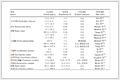
As shown in Table 1, the research was commenced with exploring the coupling reaction of model substrates (S)-phenylalanine methyl ester 1a and 4-methyliodobenzene 2a in the presence of palladium acetate (Pd(OAc)2, 5 mol%) and N-acetyl-glycine (N-Ac-Gly, 40 mol%) as a ligand, along with 1.2 equiv. of trifluoromethanesulfonic acid (TfOH) as the proton source and 1.25 equiv. of silver carbonate (Ag2CO3), warmed at 120 ℃ for 24 h in hexafluoroisopropanol (HFIP) under air. The desired ortho-arylated products 3a (mono-arylated) and 4a (di-arylated) were obtained in yields of 48% and 25% separately (entry 1). Then lots of control experiments were performed to find the optimal conditions (see Supporting information for more reaction conditions evaluation). Various mono-N-protected amino acids (MPAAs) [1,33] were examined (entries 1–5), N-acetyl-valine (N-Ac-Val) is the superior one that affords the highest yields of 3a and 4a (entry 3). The screening of acid additives showed that TfOH is the best choice (entries 6–8). It should be noteworthy that no target molecules were obtained without the addition of acid, suggesting the critical role of acid in inhibiting the strong binding of the amino group with palladium. A survey of inorganic bases revealed that Ag2CO3 significantly outperform others in promoting the reaction (entries 9–11), and silver salts play an irreplaceable role as iodide scavenger [34]. Other polar or nonpolar solvents were also tested, however, no positive effect was observed (entries 12 and 13). Extending reaction time to 36 h led to a little increase of the combined yields of 3a and 4a (entry 14), further extending reaction time to 48 h failed to take effect (entry 15). Besides, the use of other palladium-catalysts instead of Pd(OAc)2 led to an erosion in the yield (entries 16–18). The di-arylation increased significantly (> 60% yield) with the catalyst loading of Pd(OAc)2 increased to more than 20 mol%, while the mono-arylation was almost disappeared. The results indicate that the poor selectivity is caused by the lack of activity of the catalytic system.
|
Table 1 Optimization of reaction conditions.a |


With the optimal conditions (Table 1, entry 14), the generality of this C(sp2)–H arylated method was first evaluated with various α-amino-β-aryl esters (Scheme 2). In order to ensure the reliability of the yields, all data represent the average of (more than) two independent experiments. A variety of α-amino esters with electron-rich or -deficient aryl groups (1b-1n), naphthyl (1o), could react under the optimal conditions to generate the corresponding arylated products 3 and 4. Generally, the presence of an electron donating group (1b, 1c, 1h, 1l) led to a higher yield than that derived from an electron withdrawing group (1e-1g, 1i-1k, 1m-1n), which probably because the former can promote the reductive elimination. α-Amino-β-aryl ester bearing a para-substituent (1b-1g) would give a mixture of mono- and di-arylated products (3b-3g & 4b-4g), while ortho- and meta-substituted substrates (1h-1o) led to only mono-arylation (3h-3o). By now the method appears not applicable for site-selective C–H functionalization of peptides containing Phe as the N-terminus, both C(sp2)–H and C(sp3)–H arylation were observed after reactions (details see Supporting information).

|
Download:
|
| Scheme 2. Scope of α-amino-β-aryl esters. Reactions were performed on a 0.4 mmol scale. Yields are isolated yields. | |

Further investigation of coupling reagents, aryl iodides, was carried out under the optimal conditions with (S)-phenylalanine methyl ester 1a (Scheme 3). Various functional groups such as methoxy, alkyl, phenyl, trifluoromethyl, ester and halogen groups at the para- or meta-position were tolerated, generating mixtures of mono- and di-arylated products (3b'−3n' & 4b'−4n'). In contrast, ortho-substituted iodobenzene doesn't work in this reaction. Fluorenyl derivative (2o) also worked well to give the corresponding mono- and di-arylated products (3o' & 4o') in a moderate combined yield. Regrettably, the method is not applicable to heteroaryl iodides or α-amino-β-heteroaryl esters (e.g., Trp-OMe).

|
Download:
|
| Scheme 3. Scope of aryl iodides. Reactions were performed on a 0.4 mmol scale. Yields are isolated yields. | |

Chiral HPLC analysis of arylated products derived from (R)- and (S)-phenylalanine methyl esters showed that there is a little erosion in enantiomeric excess (di-arylated product 4a, 88% ee, see Supporting information), revealing that partial racemization occurred during the reaction due to the basicity and high temperature. In order to verify the directing effect of the native NH2, as shown in Scheme 4, methyl 3-phenylpropanoate 1p and N, N-dimethyl-Phe-OMe 1q were subjected to the reaction, and no observation of the desired C(sp2)–H arylation. The results exclude the possible ester-directed C–H activation.

|
Download:
|
| Scheme 4. Additional control experiments. | |

In summary, an efficient and practical Pd(Ⅱ)-catalyzed C(sp2)–H arylation of α-amino-β-aryl esters with various aryl iodides has been developed, using the native NH2 as the directing group. A variety of chiral α-amino esters could be functionalized by this method to give the corresponding mono- and di-arylated products with a little erosion in enantiomeric excess. The method features broad substrate scope, excellent functional group tolerance and mild conditions. Further exploration of this protocol for C(sp2)–H arylation of oligopeptides and structure modification of polypeptide drugs is currently underway in our laboratory.
Declaration of competing interestThe authors declare that they have no known competing financial interests or personal relationships that could have appeared to influence the work reported in this paper.
AcknowledgmentsThis work was supported by the National Key Research and Development Program of China (No. 2018YFA0704502), the National Natural Science Foundation of China (Nos. 21871261, 21931011), and Fujian Science & Technology Innovation Laboratory for Optoelectronic Information of China (No. 2021ZZ105).
Supplementary materialsSupplementary material associated with this article can be found, in the online version, at doi:10.1016/j.cclet.2023.108505.
| [1] |
Q. Shao, K. Wu, Z. Zhuang, S. Qian, J.Q. Yu, Acc. Chem. Res. 53 (2020) 833-851. DOI:10.1021/acs.accounts.9b00621 |
| [2] |
C.C. Hanna, Y.O. Hermant, P.W.R. Harris, M.A. Brimble, Acc. Chem. Res. 54 (2021) 1878-1890. DOI:10.1021/acs.accounts.0c00841 |
| [3] |
B.M. Cooper, J. Iegre, D.H. O'Donovan, M.Ö. Halvarsson, D.R. Spring, Chem. Soc. Rev. 50 (2021) 1480-1494. DOI:10.1039/d0cs00556h |
| [4] |
E. Rémond, C. Martin, J. Martinez, F. Cavelier, Chem. Rev. 116 (2016) 11654-11684. DOI:10.1021/acs.chemrev.6b00122 |
| [5] |
M. Zhang, S. Zhong, Y. Peng, et al., Org. Chem. Front. 8 (2021) 133-168. DOI:10.1039/d0qo00988a |
| [6] |
S. Shabani, Y. Wu, H.G. Ryan, C.A. Hutton, Chem. Soc. Rev. 50 (2021) 9278-9343. DOI:10.1039/d0cs01441a |
| [7] |
S. Mondal, S. Chowdhury, Adv. Synth. Catal. 360 (2018) 1884-1912. DOI:10.1002/adsc.201800011 |
| [8] |
G. He, B. Wang, W.A. Nack, G. Chen, Acc. Chem. Res. 49 (2016) 635-645. DOI:10.1021/acs.accounts.6b00022 |
| [9] |
X. Lu, B. Xiao, R. Shang, L. Liu, Chin. Chem. Lett. 27 (2016) 305-311. DOI:10.1016/j.cclet.2015.12.021 |
| [10] |
A. Correa, Eur. J. Inorg. Chem. 2021 (2021) 2928-2941. DOI:10.1002/ejic.202100374 |
| [11] |
B.B. Zhan, M.X. Jiang, B.F. Shi, Chem. Commun. 56 (2020) 13950-13958. DOI:10.1039/d0cc06133f |
| [12] |
W. Wang, M.M. Lorion, J. Shah, A.R. Kapdi, L. Ackermann, Angew. Chem. Int. Ed. 57 (2018) 14700-14717. DOI:10.1002/anie.201806250 |
| [13] |
J. Das, D.K. Mal, S. Maji, D. Maiti, ACS Catal. 11 (2021) 4205-4229. DOI:10.1021/acscatal.1c00176 |
| [14] |
A. Das, B. Maji, Chem. Asian J. 16 (2021) 397-408. DOI:10.1002/asia.202001440 |
| [15] |
A. Uttry, M. van Gemmeren, Synlett 29 (2018) 1937-1943. DOI:10.1055/s-0037-1610150 |
| [16] |
J. He, M. Wasa, K.S.L. Chan, Q. Shao, J.Q. Yu, Chem. Rev. 117 (2017) 8754-8786. DOI:10.1021/acs.chemrev.6b00622 |
| [17] |
G. Chen, Z. Zhuang, G.C. Li, et al., Angew. Chem. Int. Ed. 56 (2017) 1506-1509. DOI:10.1002/anie.201610580 |
| [18] |
K.K. Ghosh, M. van Gemmeren, Chem. Eur. J. 23 (2017) 17697-17700. DOI:10.1002/chem.201705449 |
| [19] |
Y. Zhu, X. Chen, C. Yuan, et al., Nat. Commun. 8 (2017) 14904. DOI:10.1038/ncomms14904 |
| [20] |
P.X. Shen, L. Hu, Q. Shao, K. Hong, J.Q. Yu, J. Am. Chem. Soc. 140 (2018) 6545-6549. DOI:10.1021/jacs.8b03509 |
| [21] |
Z. Zhuang, C.B. Yu, G. Chen, et al., J. Am. Chem. Soc. 140 (2018) 10363-10367. DOI:10.1021/jacs.8b06527 |
| [22] |
J. Albert, X. Ariza, T. Calvet, et al., Organometallics 32 (2013) 649-659. DOI:10.1021/om301140t |
| [23] |
B. López, A. Rodriguez, D. Santos, et al., Chem. Commun. 47 (2011) 1054-1056. DOI:10.1039/C0CC03478A |
| [24] |
A.D. Ryabov, Chew. Rev. 90 (1990) 403-424. DOI:10.1021/cr00100a004 |
| [25] |
A.P. Smalley, M.J. Gaunt, J. Am. Chem. Soc. 137 (2015) 10632-10641. DOI:10.1021/jacs.5b05529 |
| [26] |
K. Chen, D. Wang, Z.W. Li, et al., Org. Chem. Front. 4 (2017) 2097-2101. DOI:10.1039/C7QO00432J |
| [27] |
P.K. Pramanick, Z. Zhou, Z.L. Hou, B. Yao, J. Org. Chem. 84 (2019) 5684-5694. DOI:10.1021/acs.joc.9b00605 |
| [28] |
P.K. Pramanick, Z. Zhou, Z. Hou, Y. Ao, B. Yao, Chin. Chem. Lett. 31 (2020) 1327-1331. DOI:10.1016/j.cclet.2019.10.034 |
| [29] |
F. Yuan, Z.L. Hou, P.K. Pramanick, B. Yao, Org. Lett. 21 (2019) 9381-9385. DOI:10.1021/acs.orglett.9b03607 |
| [30] |
Z.L. Hou, F. Yuan, B. Yao, Org. Lett. 22 (2020) 8692-8696. DOI:10.1021/acs.orglett.0c03279 |
| [31] |
Y. Ding, S. Fan, X. Chen, et al., Org. Lett. 21 (2019) 4224-4228. DOI:10.1021/acs.orglett.9b01411 |
| [32] |
H. Lin, X. Pan, A.L. Barsamian, T.M. Kamenecka, T.D. Bannister, ACS Catal. 9 (2019) 4887-4891. DOI:10.1021/acscatal.8b04927 |
| [33] |
T.G. Saint-Denis, R.Y. Zhu, G. Chen, Q.F. Wu, J.Q. Yu, Science 359 (2018) eaao4798. |
| [34] |
N. Zhao, X. Jin, Y. Dang, Chin. Chem. Lett. 32 (2021) 3980-3983. DOI:10.1016/j.cclet.2021.04.044 |