 2024, Vol. 35


b School of Life Science and Technology, ShanghaiTech University, Shanghai 201210, China
The development of immunotherapy has been a milestone for the treatment of cancer. Successful immunotherapeutics include checkpoint inhibitors targeting the programmed death-1 (PD-1), programmed death-ligand 1 (PD-L1) and cytotoxic T lymphocyte-associated antigen-4 (CTLA-4). However, tumor has immune escaping mechanisms and the efficacy of existing strategy is limited. Therefore, the development of novel immunotherapeutics targeting alternative immune escaping pathways is urgent.
In the tumor microenvironment (TME), the critical mechanism of tumor immune escape has been shown to be mediated by the accumulation of extracellular adenosine [1,2]. Among the four subtypes of adenosine receptors, the A2AAR has been demonstrated as the major target that mediates the immunosuppressive effects of adenosine in TME, which is highly expressed on multiple T cells and natural killer cells [3–6]. Recently, a number of A2AAR antagonists have been developed and are undergoing extensive evaluations in clinical trials as potential cancer immunotherapies (e.g. PBF-509) (Fig. 1) [7,8]. However, A2AAR antagonists show limited antitumor effects and are more commonly tested in combination with cytotoxic drugs or other checkpoint inhibitors [7]. From a medicinal chemistry point of view, the design of polypharmacological molecules would be a better alternative to drug combinations, with advantages such as the absence of drug-drug interactions and better patient compliance [9].

|
Download:
|
| Fig. 1. Structures of the A2AAR antagonist PBF-509, HDAC inhibitors vorinostat and mocetinostat, and the design of dual A2AAR/HDAC inhibitors. | |
The histone deacetylases (HDACs) are validated epigenetic drug targets, and several HDAC inhibitors have been developed as antitumor drugs. Chemical structures of HDAC inhibitors (HDACis), for example vorinostat (SAHA) and mocetinostat (MGCD-0103), are commonly comprised of three parts: the surface recognition moiety (CAP), a linker group, and the terminal zinc-binding group (ZBG) (Fig. 1). These structural features have made HDACs a popular target for the design of bifunctional antitumor agents. For example, DNMT/HDAC [10,11], EGFR/HDAC [12,13], ErbB/HDAC [14], PI3K/HDAC [15], topisomerase/HDAC [16,17], and JAK/HDAC [18,19], have been reported. In our previous studies, a bifunctional strategy has been used for the design of novel A2AAR/HDAC dual-acting agents, which led to the discovery of potent antitumor agents [20,21]. Recently, based on the clinical agent PBF-509, we have initiated another campaign to design novel A2AAR/HDAC dual-acting compounds (Fig. 1).
Among the clinically investigated A2AAR antagonists, PBF-509 features a relatively low molecular weight (Mw = 305). To rationally design bifunctional compounds based on PBF-509, we first conducted a molecular docking study using the reported A2AAR-StaR2-bRIL562-AZD-4635 complex structure (PDB ID: pdb:6GT3) [22]. As shown in Fig. 2, the 2-pyrazole substituent of PBF-509 occupies a hydrophobic cleft at the bottom of the binding pocket. The 6-pyrazole substituent occupies the ribose-binding pocket. The NH2 group makes an H-bond interaction with the side chain of Asn2536.55. In addition, Phe168 on extracellular loop 2 (ECL2) forms π-π stacking interactions with the pyrimidine and 6-pyrazole, and the side chain of Met2707.35 makes a hydrophobic interaction from the opposite side. The NH2 group of PBF-509 points towards the solvent accessible surface, therefore providing a modification site for incorporating structural elements of HDACis. Based on this NH2 group, three types of linker groups were designed: amide, urea and carbamate.

|
Download:
|
| Fig. 2. Binding poses of PBF-509 in A2AAR predicted by molecular docking. Structure of A2AAR-StaR2-bRIL562 (PDB ID: 6GT3) is shown in pale gray, AZD-4635 in salmon, and compound PBF-509 in cyan, respectively. Key residues interacting with PBF-509 are highlighted. Nitrogen atoms are colored in blue, bromine in firebrick, fluorine in aquamarine and chlorine in green. | |
PBF-509 was prepared according to reported procedures [23], but coupling reactions of it with aliphatic acids failed to provide amide intermediates. So the bromo group was removed. Variations of the aromatic substituents on the pyrimidine core were incorporated, based on the results from reported structure-activity relationship studies [24–26]. As shown in Scheme 1 (details can be found in Supporting information), starting materials 1a-d were coupled with a variety of aliphatic acids to produce the key ester intermediates 2a-g. However, cleavage of the amide bond was observed when these ester intermediates were treated with aqueous hydroxylamine under basic condition. Therefore, the esters 2a-g were first hydrolyzed to acids 3a-g in the presence of LiI and pyridine [27]. Then 3a-g were coupled with O-(tetrahydropyran-2-yl)hydroxylamine to give 4a-g, and hydroxamic acids 5a-g were obtained after de-protection of the pyran group (Scheme 1, Ⅰ).

|
Download:
|
| Scheme 1. Synthesis of compounds 5a-g, 10a-i and 14a-d. Reagents and conditions: (a) (ⅰ) SOCl2, acid esters, benzotriazole, DCM, r.t., 1 h; (ⅱ) pyridine, DCM, r.t., 12 h; (b) LiI, pyridine, reflux, 12 h; (c) 2-(aminooxy)tetrahydro-2H-pyran, HATU, DIPEA, DCM, r.t., 12 h; (d) HCl (4 mol/L in 1,4-dioxane), DCM, 0 ℃ – r.t., 2 h; (e) phenyl chloroformate, pyridine, DCM, r.t., 12 h; (f) hydroxyl esters or amino esters, DIPEA, THF, CHCl3, reflux, 12 h; (g) LiOH·H2O, THF, H2O, r.t., 12 h. | |
To synthesize urea- and carbamate-linked compounds, the materials 1a-d were first coupled with phenyl chloroformate to provide intermediates 6a-d, then substituted with a variety of amines or alcohols to provide the key ureas 7a-i and carbamates 11a-d. These intermediates were then hydrolyzed to provide acids 8a-i and 12a-d, coupled with O-(tetrahydropyran-2-yl)hydroxylamine, and then hydrolyzed to afford the corresponding hydroxamic acids 10a-i and 14a-d (Scheme 1, Ⅱ and Ⅲ).
A combination of an urea group and a benzyl linker was also introduced, and the compounds were synthesized according to Scheme 2 (details can be found in Supporting information). The carbamates 6a-d were converted to ester intermediates 15a-e and then hydrolyzed to acids 16a-e. These acids were converted to hydroxamates 18a-e using similar conditions as described above. Acids 16a-d were also coupled with o-phenylenediamine to afford amide compounds 19a-d.

|
Download:
|
| Scheme 2. Synthesis of compounds 18a-e and 19a-d. Reagents and conditions: (a) hydroxyl esters or amino esters, DIPEA, THF, CHCl3, reflux, 12 h; (b) LiOH·H2O, THF, H2O, r.t., 12 h; (c) 2-(aminooxy)tetrahydro-2H-pyran, HATU, DIPEA, DCM, r.t., 12 h; (d) HCl (4 mol/L in 1,4-dioxane), DCM, 0 ℃–r.t., 2 h; (e) o-phenylenediamine, HATU, DIPEA, DCM, r.t., 12 h. | |
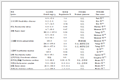
As shown in Table 1, most target compounds displayed potent dual-acting activities, with potent A2AAR binding affinity (PBF-509 as a positive control [28]) and HDAC1/HDAC6 inhibition (SAHA as a positive control), respectively. Among the three types of linker groups, amide connection provided the best activity (10d versus 5c, 14d). Regarding the length of the alkyl chain, 5c, 10d and 14c were the best with 6 or 5 carbon chains, while longer or shorter chains showed weaker activity (5c versus 5a, 5b, 5d; 10d versus 10a, 10b, 10c; 14c versus 14a, 14b, 14d). For ureas, alkyl substitution weakened the activity (10d versus 10e, 10f), and the same was true for aromatic linkers (18a versus 18e). For the ZBG group, compounds with 2-amino benzamide as the ZBG showed weaker HDAC activity than the hydroxamic acids. Finally, the furyl and pyrazol substituents on the pyrimidine core were replaced with pyridyl and phenyl groups, and appropriate linkers were incorporated to synthesize compounds 10g-i, 18b-d, and 19b-d. The activity of these pyridine and 2-methoxypyridine-containing compounds was slightly better.
|
Table 1 A2AAR and HDAC bifunctional activity of designed compounds.a |

The compounds with potent bifunctional activities were tested for their antiproliferative activities against both murine and human colon cancer cell lines (MC38, CT26 and HCT116). The results are shown in Table 2. Because A2AAR antagonists do not possess direct cytotoxicity against the tumor cells in vitro [29,30], the antiproliferative activity of these compounds were expected to be correlative to their HDAC inhibition potency. In these assays, compound PBF-509 showed no observable activity (GI50 > 30 µmol/L). Among the dual-acting compounds, 5a, 10c, 10d and 18a displayed the most potent activity against the three cell lines, being comparable to that of SAHA (GI50 = 2.7 µmol/L, 2.4 µmol/L and 0.30 µmol/L for MC38, CT26 and HCT116, respectively) and MGCD-0103 (GI50 = 1.8 µmol/L, 2.1 µmol/L and 0.53 µmol/L for MC38, CT26 and HCT116, respectively). These results showed that through the incorporation of HDAC inhibition activity, the bifunctional compounds acquired very potent antiproliferative activity against tumor cells in vitro. It worth pointing out that some compounds, for example 18d, showed very weak antiproliferative activity despite very potent HDAC inhibition. This might be due to their poor permeability properties.
|
|
Table 2 Antiproliferative activity in cancer cell lines (GI50, µmol/L).a |


To predict the binding modes of these bifunctional molecules at both A2AAR and HDACs, compound 5a was selected for molecular docking studies (Fig. 3). The 2-methylfuran substituent of 5a occupies the hydrophobic pocket, with the dimethylpyrazole substituent fitting into the ribose-binding pocket deeper inside the receptor. In addition, Phe168 on ECL2 forms a π-π stacking interaction with the pyrimidine moiety. Unexpectedly, the hydroxamate group makes H-bonding interactions with the side chain of Asp170 and the skeleton of Glu169. In HDAC1, the core structure of 5a lies outside of the binding pocket, with the alkyl chain inserting into the pocket and the hydroxamate group chelating with the zinc ion. The carbonyl group of the amide linker makes an H-bond with the side chain of His170. The hydroxamate group also makes H-bond interactions with the side chains of His131 and Gly295. The tri-substituted pyrimidine core lies on the enzyme surface and forms an edge-to-face π-π interaction with Phe200. These observations predicted the structural basis of the bifunctional activity of our new compounds.

|
Download:
|
| Fig. 3. Binding poses of 5a in A2AAR and HDAC1 predicted by molecular docking. Compound 5a is shown in yellow. Key residues interacting with 5a are highlighted. Nitrogen atoms are colored in blue and oxygen atoms in red. (A) The predicted binding pose of 5a in A2AAR. Structures of A2AAR-StaR2-bRIL562 (PDB ID: 6GT3) is shown in deepblue. (B) The predicted binding pose of 5a in HDAC1. Structures of HDAC1 (PDB ID: 1C3S) is shown in cyan, and the zinc ion is shown as gray sphere. | |

In summary, the incorporation of the key structural element for HDAC inhibition to the solvent-exposed position of A2AAR has culminated the discovery of a series of potent PBF-509-derived A2AAR/HDAC bifunctional inhibitors. Most compounds displayed nanomolar or subnanomolar inhibitory activity against both A2AAR and HDAC1. In addition, they exhibited equivalent antiproliferative activity to that of SAHA and MGCD-0103 against colon cancer cell lines. Based on the A2AAR/HDAC bifunctional activity of these compounds, they are promising leads for further studies as novel tumor immunotherapeutic agents.
Declaration of competing interestThe authors declare that they have no known competing financial interests or personal relationships that could have appeared to influence the work reported in this paper.
AcknowledgmentsThis work was supported by Lingang Laboratory (No. LG-QS-202205–03), ShanghaiTech University and the Shanghai Municipal Government. We acknowledge Dr. Lingyun Yang for his help in obtaining NMR data.
Supplementary materialsSupplementary material associated with this article can be found, in the online version, at doi:10.1016/j.cclet.2023.108136.
| [1] |
J. Blay, T.D. White, D.W. Hoskin, Cancer Res. 57 (1997) 2602-2605. |
| [2] |
D. Vijayan, A. Young, M. Teng, et al., Nat. Rev. Cancer 17 (2017) 709-724. DOI:10.1038/nrc.2017.86 |
| [3] |
B.B. Fredholm, A.P. Ijzerman, K.A. Jacobson, et al., Pharmacol. Rev. 63 (2017) 1-34. DOI:10.4324/9781315177151-1 |
| [4] |
A. Ohta, M. Sitkovsky, Nature 414 (2001) 916-919. DOI:10.1038/414916a |
| [5] |
A. Ohta, E. Gorelik, S.J. Prasad, et al., Proc. Natl. Acad. Sci. U. S. A. 103 (2006) 13132-13137. DOI:10.1073/pnas.0605251103 |
| [6] |
J. Kjaergaard, S. Hatfield, G. Jones, et al., J. Immunol. 201 (2018) 782-791. DOI:10.4049/jimmunol.1700850 |
| [7] |
J. Zhang, W. Yan, W. Duan, et al., Pharmaceuticals 13 (2020) 237. DOI:10.3390/ph13090237 |
| [8] |
F. Yu, C. Zhu, Q. Xie, et al., J. Med. Chem. 63 (2020) 12196-12212. DOI:10.1021/acs.jmedchem.0c00237 |
| [9] |
A. Anighoro, J. Bajorath, G. Rastelli, et al., J. Med. Chem. 57 (2014) 7874-7887. DOI:10.1021/jm5006463 |
| [10] |
Y. Ren, Q. Sun, Z. Yuan, et al., Chin. Chem. Lett. 30 (2019) 1233-1236. DOI:10.1016/j.cclet.2019.03.029 |
| [11] |
Q. Sun, Q. Dai, C. Zhang, et al., Chin. Chem. Lett. 32 (2021) 2479-2483. DOI:10.1016/j.cclet.2021.02.004 |
| [12] |
X. Cai, H.X. Zhai, J. Wang, et al., J. Med. Chem. 53 (2010) 2000-2009. DOI:10.1021/jm901453q |
| [13] |
C.J. Lai, R. Bao, T. Xu, et al., Cancer Res. 70 (2010) 3647-3656. |
| [14] |
C. Ding, D. Li, Y.W. Wang, et al., Chin. Chem. Lett. 28 (2017) 1220-1227. DOI:10.1016/j.cclet.2017.01.003 |
| [15] |
K. Sun, R. Atoyan, M.A. B.orek, et al., Mol. Cancer Ther. 16 (2016) 285-299. |
| [16] |
Y. Huang, S. Chen, S. Wu, et al., Acta Pharm. Sin. B 10 (2020) 1294-1308. DOI:10.1016/j.apsb.2019.11.011 |
| [17] |
S. Wu, Y. Huang, T. Wang, et al., J. Med. Chem. 65 (2022) 4818-4831. DOI:10.1021/acs.jmedchem.1c02026 |
| [18] |
Y. Huang, G. Dong, H. Li, et al., J. Med. Chem. 61 (2018) 6056-6074. DOI:10.1021/acs.jmedchem.8b00393 |
| [19] |
X. Liang, J. Zang, X. Li, et al., J. Med. Chem. 62 (2019) 3898-3923. DOI:10.1021/acs.jmedchem.8b01597 |
| [20] |
W. Yan, L. Ling, Y. Wu, et al., J. Med. Chem. 64 (2021) 16573-16597. DOI:10.1021/acs.jmedchem.1c01155 |
| [21] |
J. Zhang, Z. Luo, W. Duan, et al., Eur. J. Med. Chem. 236 (2022) 114326. DOI:10.1016/j.ejmech.2022.114326 |
| [22] |
A. Borodovsky, C.M. Barbon, Y. Wang, et al., J. ImmunoTher. Cancer 8 (2020) e000417. DOI:10.1136/jitc-2019-000417 |
| [23] |
J.A. Camacho Gomez, J.C. Castro-Palomino Laria, Patent, WO2011121418 A1, 2011.
|
| [24] |
D.H. Slee, Y. Chen, X. Zhang, et al., J. Med. Chem. 51 (2008) 1719-1729. DOI:10.1021/jm701185v |
| [25] |
D. Slee, M. Lanier, B.G. Vong, et al., Patent, WO2006110884 A2, 2006.
|
| [26] |
D. Slee, X. Zhang, J.K. Rueter, et al., Patent, WO2007084914 A2, 2007.
|
| [27] |
B. Bernet, P.M. Bishop, M. Caron, et al., Can. J. Chem. 63 (1985) 2818-2820. DOI:10.1139/v85-470 |
| [28] |
M. Mediavilla-Varela, J. Castro, A. Chiappori, et al., Neoplasia 19 (2017) 530-536. DOI:10.1016/j.neo.2017.02.004 |
| [29] |
P.A. B.eavis, N. Milenkovski, M.A. H.enderson, et al., Cancer Immunol. Res. 5 (2015) 506-517. |
| [30] |
R.D. L.eone, I.M. S.un, M.H. O.h, et al., Cancer Immunol. Immun. 67 (2018) 1271-1284. DOI:10.1007/s00262-018-2186-0 |