 2023, Vol. 34


Electro-organic synthesis is widely perceived as an efficient and eco-friendly tool for the preparation of high-value molecules [1–8]. In comparison with the traditional methods that often proceed at strong oxidative/reductive conditions with elevated temperature, electro-organic reactions are usually proceeded under milder conditions by precisely varying the applied electrode potential. Therefore, electro-synthesis not only displays more economy and environmental friendliness but also shows good functional group tolerance. Tremendous efforts have been made to develop novel electro-organic reactions for synthesizing high value chemicals during the past years [9–23].
Organoselenium compounds have elicited considerable interest from pharmaceutical during the past years, because of their diverse biological and pharmacologically activities [24,25]. It is well known that the incorporation of selenium substituents into organic molecules will sharply improve their physiological activities and physicochemical properties. Consequently, versatile great progresses have been made to develop novel strategies for their preparation in recent years [26–28].
Phenanthrene represents a core structural motif which is largely distributed in naturally occurring compounds and biologically active molecules [29–31]. As such, the quest for the development of effective approaches for constructing functionalized phenanthrenes has been actively pursued over the past decade [32–40]. Arylselanyl phenanthrenes are a significant class of unsymmetrical diaryl selenides and have revealed potential applications in pharmaceutical and materials science. Given its abundance and easy availability, diorganyl diselenide is considered as an attractive selanylation reagent for the synthesis of organoselenium compounds [41–50]. The groups of Zeni [51] and Arsenyan [52] reported the electrophilic selanylative annulation of 2-alkynyl biaryls with diselenides using FeCl3 and m-CPBA as the mediator/oxidant, respectively (Scheme 1a). Recently, Chatterjee and coworkers reported the radical selanylative annulation [53,54] with molecular iodine as the catalyst and hydrogen peroxide as the oxidant at 100 ℃ (Scheme 1b) [51]. Despite these significant achievements, from a practical point of view, these methods still suffer from some drawbacks, such as the use of chemical oxidant, inconveniently long reaction time as well as high reaction temperature. As a consequence, the development of more eco-friendly and practical synthetic strategy for arylselanyl phenanthrenes under mild conditions is still highly desirable.

|
Download:
|
| Scheme 1. Synthesis of phenyl(10-phenylphenanthren-9-yl)selane. | |
As part of our continuous efforts toward green synthesis [55–61], we herein report the electrochemical radical selenylative annulation of 2-alkynyl biaryls with diselenides at room temperature under additives-, catalyst- and chemical oxidant-free and mild conditions. To the best of our knowledge, this is the first example of the oxidative annulation for the construction of selenyl polycyclic aromatic hydrocarbons under electrochemical condition Scheme 1c.
We started our investigation by using the 2-(phenylethynyl)-1,1-biphenyl (1a) and diphenyl diselenide (2a) as the template substrates (Table 1). To our delight, we found that conducting this electrolysis with nBu4NPF6 (0.5 equiv.) as the electrolyte and a mixed solvent of MeCN/HFIP (4/1) as the reaction medium in an undivided cell equipped with C(+)/Pt(-) electrode pair under 8 mA constant current at room temperature gave the desired product 3aa in 97% GC yield (Table 1, entry 1). Performing the reaction with other electrode pair resulted in the formation of 3aa in 76%−88% yields (entries 2–5). Lower yields were obtained when nBu4NPF6 was replaced by other hexafluorophosphate salts or tetrabutylammonium salt (entries 6 and 7). The selenylation did not take place without an electrolyte (entry 8). Varying the constant current did not provide improved yield of 3aa (entries 9 and 10). Replacing the mixed solvent with MeCN or HFIP as a single solvent or changing the ratio of mixed solvents led to a diminished outcome (entries 11–13). Finally, no reaction occurred without the constant current; thus, the conversion could be precisely controlled by switching the electric current on or off (entry 14).
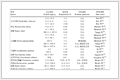
|
Table 1 Optimization of reaction conditions.a |


With the optimal conditions in hand (Table 1, entry 1), the scope of the electrochemical annulation was investigated by exploring various 2-alkynyl biaryls and diorganyl diselenides. As shown in Scheme 2, the methyl substituent at each position of the phenyl ring of diselenide 2 had little influence on the outcome of this reaction, producing the corresponding products (3ab-3ad) in 83%−94% yields. Diphenyl diselenides possessing electron-donating or -withdrawing groups on the phenyl ring were well compatible under the optimal conditions, and all the yields were > 80% (3aa, 3ae-3al). These results revealed that both the steric hindrance and electronic effect of diselenide did not affect the reaction efficiency, which is different from Chatterjee' work [51]. The present method was also applied on dialkyl diselenides, such as dimethyl diselenide and dibenzyl diselenide, led to the generation of the target products (3am and 3an) in good yields. However, when 1,2-di(quinolin-6-yl)diselane or 1,2-di(benzofuran-3-yl)diselane was subjected to the reaction, only a trace amount of product was detected.

|
Download:
|
| Scheme 2. Substrate scope. Conditions: C (15 mm × 10 mm × 2 mm) as the anode, Pt (15 mm × 10 mm × 0.1 mm) as the cathode, constant current = 8 mA, 1 (0.2 mmol), 2 (0.12 mmol), nBu4NPF6 (0.1 mmol), MeCN/HFIP (4/1, 7.5 mL), in air, r.t., 2 h, undivided cell. Isolated yields via flash chromatography. | |

Subsequently, the scope of this electrolysis with respect to the 2-alkynyl biaryls was evaluated. Pleasingly, the present electrochemical process was suitable for a broad range of 2-alkynyl biaryls. No matter whether the Ar1 phenyl ring of substrate 1 is substituted with either sterically hindered, electron-neutral, electron-donating or electron-withdrawing group, all of them delivered the corresponding products (3ba-3ja) in good to excellent yields. Both thienyl and cyclopropyl group substituted ethynyl biphenyls also efficiently participated in this transformation, delivering 3ka and 3la in 87% and 76% yields, respectively. The electronic nature of substituent group at the Ar2 phenyl ring had no obvious effect on this reaction, and good yields of the target products (3ma-3pa) were obtained. 1,2-Diphenylethyne bearing a fused aromatic and heteroaromatic structures including naphthyl, thienyl and furyl can effectively engage in the processes and give the desired products (3qa-3sa) in 71%−76% yields. Remarkably, a wide range of synthetically important functional groups were well-tolerated in the present electrolysis system, including alkyl, alkoxy (OMe and OCF3), halogen (F, Cl and Br), trifluoromethyl, cyano, ester, nitro and acetyl group.
To verify the practicability of the developed protocol, a scale-up reaction was carried out by employing 2-alkynyl biaryl 1a (3 mmol) and diselenide 2a under the modified conditions. Pleasingly, a high isolated yield (85%, 1.04 g) comparable to that of the small-scale experiment was obtained (Scheme 3).

|
Download:
|
| Scheme 3. Large-scale synthesis of 3aa. | |

To elucidate mechanism of the radical annulation, both control experiments and cyclic voltammetry experiments were conducted. The formation of 3aa was completely inhibited upon the addition of stoichiometric TEMPO or BHT under the standard conditions (Scheme 4a). Furthermore, the adduct 4a of 1,1-diphenylethylene and phenylselenyl radical was detected by ESI-MS analysis (Scheme 4b). These experimental results suggested that the electrolysis may proceed through a free radical pathway.

|
Download:
|
| Scheme 4. Radical quenching experiments. | |

Next, the cyclic voltammetry experiments for selenylative annulation of 2-alkynyl biaryls with diselenides was explored (Fig. 1). Diselenide 2a presented an oxidative peak at E = 1.46 V vs. Ag/AgCl, which was much lower than that of 2-alkynyl biaryl 1a (E = 1.88 V vs. Ag/AgCl), and similar result was observed for the mixture of 1a and 2a. These results indicating that the anodic oxidation of 2a might occur preferentially.

|
Download:
|
| Fig. 1. Cyclic voltammetry experiments. | |

Based on the above results and previous reports [35,62], the electrochemical radical annulation reaction mechanism was proposed as shown in Scheme 5. Firstly, diphenyl diselenide (2a) was oxidized at the graphite cathode to give a radical cation intermediate IM1, which decomposed into a phenylselenyl radical and phenylselenyl cation. The phenylselenyl cation was reduced at the platinum cathode to re-generate 2a for the next cycle. Meanwhile, the phenylselenyl radical was added to the alkynyl moiety of 1a to form a radical IM2, followed by an intramolecular cyclization process to generate a radical IM3, which underwent a one-electron oxidation at the anode to deliver the phenanthrene cation IM4. Finally, the intermediate IM4 underwent dehydrogenation and aromatization to deliver the target product 3aa. During the electrolysis process, the innocent side-product hydrogen gas was produced through one-electron reduction at the platinum cathode.

|
Download:
|
| Scheme 5. Proposed reaction mechanism. | |

In conclusion, the sustainable electrochemical radical selenylative annulation 2-alkynyl biaryls and 2-heteroaryl-substituted alkynyl benzenes with diorganyl diselenides was developed. A broad range of selanyl phenanthrenes and selanyl polycyclic heteroaromatics were obtain in good to excellent yields. In contrast to the previous works, the present electro-catalytic strategy not only avoids using additive, catalyst and chemical oxidant but also decreases the reaction temperature to ambient temperature and simplifies the operation procedure. The mild and neutral conditions led to high functional group tolerance and high scalability of the reaction. These merits make this protocol highly attractive in chemical and pharmaceutical industry.
Declaration of competing interestsThe authors declare that they have no known competing financial interests or personal relationships that could have appeared to influence the work reported in this paper.
AcknowledgmentThis research was funded by the Scientific Research Fund of Hunan Provincial Education Department (No. 22B0435).
Supplementary materialsSupplementary material associated with this article can be found, in the online version, at doi:10.1016/j.cclet.2023.108699.
| [1] |
C. Ma, P. Fang, Z.R. Liu, et al., Sci. Bull. 66 (2021) 2412-2429. DOI:10.1016/j.scib.2021.07.011 |
| [2] |
N. Chen, H.C. Xu, Chem. Rec. 21 (2021) 2306-2319. DOI:10.1002/tcr.202100048 |
| [3] |
Y. Yuan, J. Yang, A. Lei, Chem. Soc. Rev. 50 (2021) 10058-10086. DOI:10.1039/d1cs00150g |
| [4] |
L.F.T. Novaes, J. Liu, Y. Shen, et al., Chem. Soc. Rev. 50 (2021) 7941-8002. DOI:10.1039/d1cs00223f |
| [5] |
M.J. Luo, H. Ding, R. Yang, Q. Xiao, Green Chem. 24 (2022) 9373-9401. DOI:10.1039/d2gc03829c |
| [6] |
Z.W. Hou, H.C. Xu, L. Wang, Curr. Opin. Electrochem. 34 (2022) 100988. DOI:10.1016/j.coelec.2022.100988 |
| [7] |
H.Y. Zhou, H.T. Tan, W.M. He, Chin. J. Catal. 46 (2023) 4-10. DOI:10.1016/S1872-2067(22)64197-4 |
| [8] |
N. Chen, H.C. Xu, Green Synth. Catal. 2 (2021) 165-178. DOI:10.1016/j.gresc.2021.03.002 |
| [9] |
S. Guo, L. Liu, K. Hu, et al., Chin. Chem. Lett. 32 (2021) 1033-1036. DOI:10.1016/j.cclet.2020.09.041 |
| [10] |
J. Jiang, Z. Wang, W.-M. He, Chin. Chem. Lett. 32 (2021) 1591-1592. DOI:10.1016/j.cclet.2021.02.067 |
| [11] |
Y. Han, X. Cui, Chin. J. Org. Chem. 41 (2021) 2929-2931. DOI:10.6023/cjoc202100056 |
| [12] |
H. Wu, X. Yu, Z. Cao, Chin. J. Org. Chem. 41 (2021) 4712-4717. DOI:10.6023/cjoc202111010 |
| [13] |
S. Zhang, X. Ye, L. Wojtas, W. Hao, X. Shi, Green Synth. Catal. 2 (2021) 82-86. DOI:10.1016/j.gresc.2021.01.008 |
| [14] |
Y.H. Lu, S.Y. Mu, H.X. Li, et al., Green Chem. 25 (2023) 5539-5542. DOI:10.1039/d2gc04906f |
| [15] |
H.Y. Song, F. Xiao, J. Jiang, et al., Chin. Chem. Lett. 34 (2023) 108509. DOI:10.1016/j.cclet.2023.108509 |
| [16] |
L. Ding, K. Niu, Y. Liu, Q. Wang, Chin. Chem. Lett. 33 (2022) 4057-4060. DOI:10.1016/j.cclet.2021.12.053 |
| [17] |
D. Wang, T. Jiang, H. Wan, et al., Angew. Chem. Int. Ed. 61 (2022) e202201543. DOI:10.1002/anie.202201543 |
| [18] |
T. Feng, S. Wang, Y. Liu, S. Liu, Y. Qiu, Angew. Chem. Int. Ed. 61 (2022) e202115178. DOI:10.1002/anie.202115178 |
| [19] |
X. Meng, H. Xu, R. Liu, Y. Zheng, S. Huang, Green Chem. 24 (2022) 4754-4760. DOI:10.1039/d2gc01129h |
| [20] |
Y.H. Lu, Z.T. Zhang, H.Y. Wu, et al., Chin. Chem. Lett. 34 (2023) 108036. DOI:10.1016/j.cclet.2022.108036 |
| [21] |
X. Wang, S. Wu, Y. Zhong, et al., Chin. Chem. Lett. 34 (2023) 107537. DOI:10.1016/j.cclet.2022.05.051 |
| [22] |
B. Zhang, Y. Gao, Y. Hioki, et al., Nature 606 (2022) 313-318. DOI:10.1038/s41586-022-04691-4 |
| [23] |
M. He, P. Zhong, H. Liu, et al., Green Synth. Catal. 4 (2023) 41-45. DOI:10.1016/j.gresc.2022.03.002 |
| [24] |
H. Chuai, S.-Q. Zhang, H. Bai, et al., Eur. J. Med. Chem. 223 (2021) 113621. DOI:10.1016/j.ejmech.2021.113621 |
| [25] |
W. Hou, H. Xu, J. Med. Chem. 65 (2022) 4436-4456. DOI:10.1021/acs.jmedchem.1c01859 |
| [26] |
K. Sun, X. Wang, C. Li, H. Wang, L. Li, Org. Chem. Front. 7 (2020) 3100-3119. DOI:10.1039/d0qo00849d |
| [27] |
X. Wang, Y. Zhang, K. Sun, J. Meng, B. Zhang, Chin. J. Org. Chem. 41 (2021) 4588-4609. DOI:10.6023/cjoc202109046 |
| [28] |
J. Rafique, D.S. Rampon, J.B. Azeredo, et al., Chem. Rec. 21 (2021) 2739-2761. DOI:10.1002/tcr.202100006 |
| [29] |
B. Tóth, J. Hohmann, A. Vasas, J. Nat. Prod. 81 (2018) 661-678. DOI:10.1021/acs.jnatprod.7b00619 |
| [30] |
A. Kovács, A. Vasas, J. Hohmann, Phytochemistry 69 (2008) 1084-1110. DOI:10.1016/j.phytochem.2007.12.005 |
| [31] |
A. De Natale, A. Pollio, A. De Marco, et al., Curr. Top. Med. Chem. 22 (2022) 939-956. DOI:10.2174/1568026621666210813113918 |
| [32] |
A. Del Tito, H.O. Abdulla, D. Ravelli, S. Protti, M. Fagnoni, Beilstein J. Org. Chem. 16 (2020) 1476-1488. DOI:10.3762/bjoc.16.123 |
| [33] |
W. Guan, K. Ying, C. Yuan, et al., Green Chem. 24 (2022) 5191-5196. DOI:10.1039/d2gc01248k |
| [34] |
T. Chatterjee, D.S. Lee, E.J. Cho, J. Org. Chem. 82 (2017) 4369-4378. DOI:10.1021/acs.joc.7b00413 |
| [35] |
H.-D. Tian, Z.H. Fu, C. Li, et al., Org. Lett. 24 (2022) 9322-9326. DOI:10.1021/acs.orglett.2c03948 |
| [36] |
N. Mukherjee, T. Chatterjee, Green Chem. 23 (2021) 10006-10013. DOI:10.1039/d1gc03305k |
| [37] |
W. Liu, Y. Zhang, H. Guo, J. Org. Chem. 83 (2018) 10518-10524. DOI:10.1021/acs.joc.8b01201 |
| [38] |
T. Mandal, S. Mallick, N. Kumari, S. De Sarkar, Org. Lett. 24 (2022) 8452-8457. DOI:10.1021/acs.orglett.2c03612 |
| [39] |
J.D. Guo, X.L. Yang, B. Chen, C.H. Tung, L.Z. Wu, Org. Lett. 22 (2020) 9627-9632. DOI:10.1021/acs.orglett.0c03665 |
| [40] |
Y. Liu, P. Zhou, Y. Xu, Z. Yang, D. Wang, Chem. Commun. 59 (2023) 1681-1684. DOI:10.1039/d2cc06552e |
| [41] |
J. Zhou, W. Li, H. Zheng, et al., Org. Lett. 23 (2021) 2754-2759. DOI:10.1021/acs.orglett.1c00664 |
| [42] |
J.Y. Chen, H.Y. Wu, Q.W. Gui, et al., Chin. J. Catal. 42 (2021) 1445-1450. DOI:10.1016/S1872-2067(20)63750-0 |
| [43] |
Y. Wu, J.Y. Chen, H.R. Liao, et al., Green Synth. Catal. 2 (2021) 233-236. DOI:10.1016/j.gresc.2021.03.006 |
| [44] |
W. Li, Y. Tang, W. Ouyang, et al., Chin. J. Org. Chem. 41 (2021) 4766-4772. DOI:10.6023/cjoc202109044 |
| [45] |
J.Y. Chen, C.T. Zhong, Q.W. Gui, et al., Chin. Chem. Lett. 32 (2021) 475-479. DOI:10.1016/j.cclet.2020.09.034 |
| [46] |
H.Y. Liu, J.R. Zhang, G.B. Huang, et al., Adv. Synth. Catal. 363 (2021) 1656-1661. DOI:10.1002/adsc.202001474 |
| [47] |
X. Wang, J. Lei, S. Guo, et al., Chem. Commun. 58 (2022) 1526-1529. DOI:10.1039/d1cc06323e |
| [48] |
Z. Tan, F. Xiang, K. Xu, C. Zeng, Org. Lett. 24 (2022) 5345-5350. DOI:10.1021/acs.orglett.2c01983 |
| [49] |
K. Lin, J. Lan, T. Zhu, Adv. Synth. Catal. 364 (2022) 3466-3471. DOI:10.1002/adsc.202200597 |
| [50] |
B. Paul, S. Das, I. Chatterjee, Org. Lett. 25 (2023) 653-658. DOI:10.1021/acs.orglett.2c04261 |
| [51] |
N. Mukherjee, A.N.V. Satyanarayana, P. Singh, M. Dixit, T. Chatterjee, Green Chem. 24 (2022) 7029-7038. DOI:10.1039/d2gc02256g |
| [52] |
P. Arsenyan, A. Petrenko, S. Belyakov, New J. Chem. 45 (2021) 7247-4255. DOI:10.1039/d1nj00401h |
| [53] |
F.L. Zeng, Z.Y. Zhang, P.C. Yin, et al., Org. Lett. 24 (2022) 7912-4917. DOI:10.1021/acs.orglett.2c02930 |
| [54] |
Q.Q. Han, Y.Y. Sun, S.H. Yang, et al., Chin. Chem. Lett. 32 (2021) 3632-3635. DOI:10.1016/j.cclet.2021.04.019 |
| [55] |
J. Jiang, F. Xiao, W.M. He, L. Wang, Chin. Chem. Lett. 32 (2021) 1637-1644. DOI:10.1016/j.cclet.2021.02.057 |
| [56] |
K. Wang, J. Huang, W. Liu, et al., Chin. J. Org. Chem. 42 (2022) 2527-2534. DOI:10.6023/cjoc202203055 |
| [57] |
D. Yang, Q. Yan, E. Zhu, J. Lv, W.M. He, Chin. Chem. Lett. 33 (2022) 1798-1816. DOI:10.1016/j.cclet.2021.09.068 |
| [58] |
H.Y. Song, M.Y. Liu, J. Huang, et al., J. Org. Chem. 88 (2023) 2288-2295. DOI:10.1021/acs.joc.2c02679 |
| [59] |
Q.W. Gui, F. Teng, P. Yu, et al., Chin. J. Catal. 44 (2023) 111-116. DOI:10.1016/S1872-2067(22)64162-7 |
| [60] |
H.Y. Song, J. Jiang, C. Wu, et al., Green Chem. 25 (2023) 3292-3296. DOI:10.1039/d2gc04843d |
| [61] |
K. Sun, F. Xiao, B. Yu, W.M. He, Chin. J. Catal. 42 (2021) 1921-1943. DOI:10.1016/S1872-2067(21)63850-0 |
| [62] |
Y. Wu, J.Y. Chen, J. Ning, et al., Green Chem. 23 (2021) 3950-3954. DOI:10.1039/d1gc00562f |