 2023, Vol. 34


Oxidative cracking reaction of alkenes can allow syntheszing carbonyl compounds, deprotecting key functional groups, and degrading large molecules, especially for those from the biomass [1–11]. Thus, it is a significant transformation in many fields such as organic synthesis and biomass utilization, and has attracted comprehensive interests from academia and industry. So far, a series of protocols have been developed. For example, oxidative C=C bond cleavage of alkenes to carbonyl compounds was conventionally achieved using stoichiometric oxidants such as NaIO4, PhI(OAc)2, meta-chloroperoxybenzoic-acid (m-CPBA), or PhIO/HBF4 (Scheme 1, method a) [3–6]. However, these methods may generate large amounts of wastes, with some being highly hazardous to the environments. Then, reactions using greener oxidants such as TBHP or H2O2 were developed [7,8], but these methods still have their own limitations for requiring high loadings of transition-metal catalysts/ligands, among which some are expensive and toxic. Classical ozonolysis is another frequently employed method (Scheme 1, method b). However, it not only suffers from the unsafe issues, but also suffers from the high cost of the equipments, low ozone generation efficiency associated with the energy waste problem, and the generation of massive wastes during work-up processes [9,10]. Moreover, C=C bond cleavage can also be achieved by enzyme-catalyzed oxidative reactions (Scheme 1, method c), but these methods require rather long reaction times and complicated procedures, which lead to low efficiency of the methods [11].

|
Download:
|
| Scheme 1. Methods for oxidative alkene cracking reactions. | |
In recent years, catalytic aerobic oxidations have attracted much attention because the abundant molecular oxygen (O2) can be used as cleaner oxidant [12–23]. The technique has also been applied in alkene cracking reactions (Scheme 1, method d). Various transition metals were found to be active catalysts, but high pressure of O2, high loadings of the complex and expensive metal catalysts/ligands were usually mandatory conditions [17,18]. Methods employing transition metal-free catalysts such as azodiisobutyronitrile (AIBN), 2,2,6,6-tetramethyl-1-piperidinyloxy (TEMPO), N-hydroxyphthalimide (NHPI), CBr4 and ArSH were also reported [19–23]. Due to the easy decomposition features of most of the organocatalysts, the methods usually require high loadings of the catalysts, which may reduce the practicality and prevent further applications in large scale. Therefore, there is still a great demand in the field to develop practical and efficient methods for aerobic oxidative C=C cleavage that can use a low loading of inexpensive and readily accessible catalysts under mild conditions.
In our cases, we have investigated the oxidative cracking reaction of alkenes by using selenium catalysts, but it requires the use of H2O2 oxidant or relatively harsh reaction conditions, or suffer from the incompletely converted substrates [24]. Cerium(Ⅳ) ammonium nitrate (CAN)-catalyzed aerobic oxidation of alkenes was also reported, but the substrates were majorly styrenes or methylenecyclobutanes, and the use of 5–200 mol% of CAN was required in those works [25,26]. Recently, we unexpectedly found that, the nitrate anion (NO3−) in CAN was also a strong catalyst and it could even catalyze the oxidative C=C cracking reaction, so that the CAN catalyst loading could be reduced to be as low as 0.5 mol% (Scheme 1, method e). Herein, we wish to report our findings.
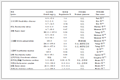
1,1-Diphenyl ethene (1a) was chosen as the model substrate and FeCl3 was initially used as the metal catalyst. However, almost no reaction occurred when heating 1a and FeCl3 in 1,4-dioxane with air (Table 1, entry 1). CuI was also ineffective for the reaction (Table 1, entry 2), but by using CuSO4 or Cu(OAc)2 as catalyst, the desired reaction occurred to produce ketone 2a in 45%–60% yields (Table 1, entries 3 and 4). CAN was then found to be an even better catalyst, affording 2a in enhanced yield (Table 1, entry 5). Besides 1,4-dioxane, other solvents, such as water, DMF and cyclohexane were tested, but all of them led to decreased 2a yield (Table 1, entries 6–8). Reducing or enhancing the reaction temperature both led to decreased product yields (Table 1, entries 9, 10 vs. 5). Using less catalyst did not reduce the product yield and with 0.5 mol% of CAN, the reaction could produce 2a in the highest yield (Table 1, entries 12 vs. 5, 11, 13, 14). In the above reactions, substrate 1a was not completely converted and could be observed in thin layer chromatography. Thus, pure O2 was then employed as a stronger oxidant instead of air. We were very glad to find that, the reaction was accelerated and could complete within 24 h to produce 2a in 93% yield (Table 1, entry 15).
|
Table 1 Condition optimizationsa. |

Substrate scope of the reaction was then examined under the optimized conditions in Table 1, entry 15. Results in Table 2 showed that the method could be widely applied for the oxidative cracking reactions of a variety of 1,1-disubstituted ethenes. Both electron-enriched and -deficient 1,1-disubstituted ethenes such as 1a−1m could be smoothly oxidized to produce ketones under mild conditions (Table 2, entries 1−13). Introducing an electron-donating group (EDG) into the substrate obviously reduced its activity for the reaction, giving ketone products in decreased yields (Table 2, entries 3, 4 vs. 1, 2; 7, 8 vs. 5, 6). In cases of the alkenes 1d and 1h bearing MeO- as the strong EDG, the reactions were retarded and extended reaction time (48 h) was required (Table 2, entries 4 and 8). Bulky substituents in substrate could also slow down the reaction and only 44%−76% of 1i−1k were converted after 48 h of reactions, but since the unconverted starting material could be recovered, the isolated yields of 2i−2k based on converted substrates were still good (73%−81%, Table 2, entries 9−11). The method was also fit for the exocyclic C=C system in 1-methylene-2,3-dihydro-1H-indene 1l, giving 2,3-dihydro-1H-inden-1-one 2l in 76% yield (Table 2, entry 12). It also showed some degree of tolerances for the strained rings in substrate and the 16 h reaction of (1-cyclopropylvinyl)benzene 1m could produce the desired cyclopropyl-contained ketone 2m in 65% yield (Table 2, entry 13).
|
|
Table 2 CAN-catalyzed oxidation of 1,1-disubstituted ethenesa. |

The reactions of tri- and tetra-substituted ethenes were also tested (Table 3). Introducing a methyl reduced the reactivity of the substrate, and the reaction of 1n led to 2a in decreased yield (Table 3, entry 1 vs. Table 2, entry 1). By enhancing the reaction temperature and extending the reaction time, the reaction of tri-substituted ethene could be improved. For example, heating 1n at 100 ℃ in O2 for 48 h led to 2a in 80% yield (Table 3, entries 2 vs. 1). Besides, the ethyl- (1o), n–butyl (1p) or even phenyl substituted substrates (1q) could lead to 2a in good yields after a 48 h reaction at 100 ℃ (Table 3, entries 3−5). The reactions of 1r-t produced 2a in 68%−75% yields and the electron-enriched substrate 1t was obviously less reactive and was not completely converted (Table 3, entries 8 vs. 6 and 7). 1,1,2,2-Tetraphenylethene 1u showed poor reactivity for the reaction, affording very low substrate conversion ratio (Table 3, entry 9).
|
|
Table 3 CAN-catalyzed oxidation of tri- and tetra-substituted ethenesa. |

The reaction of styrene produced benzaldehyde (2n) in 52% yield, while benzoic acid (3a) was also generated in 40% yield as the unavoidable deep oxidation by-product of 2n (Table 4, entry 1). After introducing a methyl on the terminal carbon of styrene, the substrate reactivity reduced and produced 2n in 56% yield, while the by-product 3a yield decreased (Table 4, entry 2). For the reactions of 1x and 1y bearing larger alkyl or aryl group, the substrate was not completely converted (Table 4, entries 3 and 4). No reaction occurred when electron deficient substrate 1z was employed (Table 4, entry 5).
|
|
Table 4 CAN-catalyzed oxidation of styrene and its derivativesa. |

Moreover, this CAN-catalyzed oxidative C=C bond cleavage method could be used for the purpose of polyene pollutant degradation (Fig. S1 in Supporting information). The reaction of β-carotene was chosen as an example to illustrate this idea for its intuitive reaction phenomenon. Heating β-carotene in the presence of 0.5 mol% of CAN with O2 flow, the color of the reaction liquid faded away gradually (Fig. S1a), while the absorption peak of the samples in UV–vis spectra shifted to the shortwave field (Fig. S1b). These results demonstrated that the C=C bonds in β-carotene were successfully cut off in this CAN-catalyzed reaction.
Mechanisms were our next concern and a series of control reactions were performed to get the mechanistic insights. The control reaction under N2 was performed, but only traces of 3a were obtained, while most of the substrate was unconverted, indicating that O2 was the crucial oxidant for the reaction (Table 5, entry 1). Using Ce(SO4)2 as catalyst resulted in decreased product yield (Table 5, entry 2), which was hardly enhanced even with elevated Ce(SO4)2 amount (Table 5, entry 3). Interestingly, after a supplementary of 3 mol% of KNO3 that contained the same amount of nitrate as in CAN, the reaction occurred smoothly and produced 3a in excellent yield (Table 5, entry 4). The reaction with 0.5 mol% of Ce(NO3)3 catalyst produced 2a in 90% yield with 95% substrate conversion (Table 5, entry 5). It could be further improved by adding KNO3 or using increased amount of Ce(NO3)3 (Table 5, entries 6, 7). In the later reaction (Table 5, entry 7), the increased product yield probably attributed to the enhanced NO3− amount other than Ce4+, in accordance with the results in Table 5, entries 2−4. Besides, the nitrate salts of Fe, Cu and Mn, which were all conventional SET catalysts, could catalyze this reaction as well (Table 5, entries 8−13), and the product yields were enhanced after adding KNO3 as an additional nitrate source (Table 5, entry 8 vs. 9; 10 vs. 11; 12 vs. 13). KNO3 alone could not catalyze the reaction (Table 5, entry 14). By using 3 mol% of HNO3 as catalyst, the reaction could produce 2a in 75% yield (Table 5, entry 15) and it could also be catalyzed by the KNO3/H2SO4 system (Table 5, entry 16). The HNO3-catalyzed reaction could be improved by adding Ce(SO4)2 (Table 5, entry 17). The reaction could be restrained by free radical scavenger such as TEMPO or HQ (hydroquinone), indicating that free radicals were involved during the process (Table 5, entries 18) [27–29]. In addition, gram-scale reaction was also conducted, and it was found that the yield of this reaction did not decrease significantly after amplification (Table 5, entry 19).
|
|
Table 5 Control experimentsa. |


X-ray photoelectron spectroscopy (XPS) analysis of the reaction mixtures showed that Ce(Ⅳ) in CAN was converted into Ce(Ⅲ) after reaction (Fig. S2a in Supporting information). Thus, it could be deduced that the reaction was catalysed by transition metals with variable valences via the single electron transfer (SET) mechanisms [30,31]. Results in Table 5 indicated that nitrate could also promote the activity of the catalytic system, and this could well explain why the catalytic activity of CAN was so high that it could be employed at very low loading (0.5 mol%). In order to explore whether there is hydroxyl radical formation in the reaction process, we designed a verification experiment by taking advantage of the property that salicylic acid can trap hydroxyl radical, and the results obtained were shown in Fig. S2b (Supporting information). After adding the reaction liquid into the salicylic acid sample, a strong adsorption at around 490−650 nm (540 nm at maximum) was observed in the UV–vis spectra (red curve vs. black curve), which was the characteristic peak of the adducts of hydroxyl radical with salicylic acid (i.e. 2,3-dihydroxybenzoic acid and 2,5-dihydroxybenzoic acid) reflecting the existence of hydroxyl radical [32].
On the basis of the above experimental results as well as the reported literatures [26,33–38], a plausible mechanism was supposed (Scheme 2). The alkenes 1 were initially oxidized by Ce(Ⅳ) to give the active free radical cation 4 [33]. As being confirmed by the XPS spectrum illustrated in Fig. 2, Ce(Ⅳ) was reduced into Ce(Ⅲ) after reaction. In the catalysis cycle, the Ce(Ⅲ) species could be oxidized by O2 to regenerate Ce(Ⅳ). Oxidation of 4 with O2 led to the intermediate 5 [34], which grabbed a proton from the 1,4-dioxane solvent and produced the intermediate 6 [35]. Cyclization of 6 afforded the 1,2-dioxetane 7 [26] and released a proton. Finally, decomposition of 7 produced carbonyls as the reaction product. Moreover, the proton generated in the previous step could enhance the acidity of the reaction liquid to facilitate the use of nitrate as an additional catalyst in the HNO3 form, which could oxidize alkenes and the generated low valent nitrogen speceis could be reoxidized by O2 to produce HNO3 and restart the HNO3 catalysis cycle B [36–38]. The proton releasing during the transition metal catalysis processes was considered to be the key for activating nitrate anion, i.e. convert NO3− into its highly active and oxidative HNO3 form. This is why KNO3 alone can not catalyze the reaction (Table 5, entrey 14). Therefore, it can be deduced that, CAN is an efficient low-loading (0.5 mol%) catalyst for the oxidative cracking reaction of alkenes because both Ce and nitrate in it are active catalytic species.

|
Download:
|
| Scheme 2. Possible mechanism of the reaction. | |

In conclusion, we have developed a novel method to split the C=C bond in alkenes by using molecular oxygen as the cheap and clean oxidant. The reaction was catalyzed by low-loading CAN (0.5 mol%) free of any additives. Mechanism studies demonstrated that the ultrahigh catalytic activity of CAN attributed to the fact that both Ce and nitrate may participate the reaction as catalyst via the coupled Ce(Ⅳ)-Ce(Ⅲ) circle and nitroxide circle respectively. The catalyitic activity of anions such as NO3− is a novel finding. It is surprising that the catalytic activity of NO3− is so strong that it can even catalyze the oxidative alkene cracking reaction, which consumes a lot of reaction energy for the high C=C bond dissociation energy (ca. 609 kJ/mol). This work not only provides an efficient method for carbonyl synthesis, but also leads to a new pathway for biomass degradation, as well as the recycling of the C=C bond-containing waste polymer. It might also inspire new ideas for catalytic system design: the significances of anions in the system should be noticed. Further investigations on the design and application of Ce catalysts are ongoing in our laboratory.
Declaration of competing interestThe authors declare no conflict of interest.
AcknowledgmentsThis work was financially supported by Priority Academic Program Development of Jiangsu Higher Education Institutions and Postgraduate Research & Practice Innovation Program of Jiangsu Province (Yangzhou University) (No. KYCX21_3205).
Supplementary materialsSupplementary material associated with this article can be found, in the online version, at doi:10.1016/j.cclet.2023.108489.
| [1] |
D.G. Lee, T. Chen, Comprehensive Organic Synthesis. Oxford: Pergamon Press, 1991.
|
| [2] |
R.C. Larock, Comprehensive Organic Transformations. New York: Wiley-VCH, 1999.
|
| [3] |
S.T. Liu, K.V. Reddy, R.Y. Lai, Tetrahedron 63 (2007) 1821-1825. DOI:10.1016/j.tet.2006.12.029 |
| [4] |
K.C. Nicolaou, V.A. Adsool, C.R.H. Hale, Org. Lett. 12 (2010) 1552-1555. DOI:10.1021/ol100290a |
| [5] |
L. Du, Z. Wang, J. Wu, Tetrahedron Lett. 61 (2020) 152204. DOI:10.1016/j.tetlet.2020.152204 |
| [6] |
K. Miyamoto, N. Tada, M. Ochiai, J. Am. Chem. Soc. 129 (2007) 2772-2773. DOI:10.1021/ja070179e |
| [7] |
S. Jarupinthusophon, U. Thong-In, W. Chavasiri, J. Mol. Catal. A: Chem. 270 (2007) 289-294. DOI:10.1016/j.molcata.2007.02.007 |
| [8] |
D. Xing, B.T. Guan, G.X. Cai, et al., Org. Lett. 8 (2006) 693-696. DOI:10.1021/ol052830t |
| [9] |
C.E. Schiaffo, P.H. Dussault, J. Org. Chem. 73 (2008) 4688-4690. DOI:10.1021/jo800323x |
| [10] |
B.R. Travis, R.S. Narayan, B. Borhan, J. Am. Chem. Soc. 124 (2002) 3824-3825. DOI:10.1021/ja017295g |
| [11] |
M.L. Niku-Paavola, L. Viikari, J. Mol. Catal. B 10 (2000) 435-444. DOI:10.1016/S1381-1177(99)00117-4 |
| [12] |
Q.W. Gui, F. Teng, P. Yu, et al., Chin. J. Catal. 44 (2023) 111-116. DOI:10.1016/S1872-2067(22)64162-7 |
| [13] |
L.Y. Xie, S. Peng, L.H. Yang, et al., Green Chem. 23 (2021) 374-378. DOI:10.1039/d0gc02844d |
| [14] |
K.J. Liu, J.H. Deng, T.Y. Zeng, et al., Chin. Chem. Lett. 31 (2020) 1868-1872. DOI:10.1016/j.cclet.2020.01.036 |
| [15] |
Z.W. Wang, Q.S. Liu, R.S. Liu, et al., Chin. Chem. Lett. 33 (2022) 1479-1482. DOI:10.1016/j.cclet.2021.08.036 |
| [16] |
K.J. Liu, Z. Wang, L.H. Lu, et al., Green Chem. 23 (2021) 496-500. DOI:10.1039/d0gc02663h |
| [17] |
A. Gonzalez-de-Castro, J.L. Xiao, Green J. Am. Chem. Soc. 137 (2015) 8206-8218. DOI:10.1021/jacs.5b03956 |
| [18] |
A. Rubinstein, P. Jiménez-Lozanao, J.J. Carbó, et al., J. Am. Chem. Soc. 136 (2014) 10941-10948. DOI:10.1021/ja502846h |
| [19] |
G.Z. Wang, X.L. Li, J.J. Dai, H.J. Xu, J. Org. Chem. 79 (2014) 7220-7225. DOI:10.1021/jo501203a |
| [20] |
T. Wang, N. Jiao, J. Am. Chem. Soc. 135 (2013) 11692-11695. DOI:10.1021/ja403824y |
| [21] |
R.Y. Lin, F. Chen, N. Jiao, Org. Lett. 14 (2012) 4158-4161. DOI:10.1021/ol3018215 |
| [22] |
S.I. Hirashima, Y. Kudo, T. Nobuta, et al., Tetrahedron Lett. 50 (2009) 4328-4330. DOI:10.1016/j.tetlet.2009.05.012 |
| [23] |
X. Baucherel, J. Uziel, S. Jugé, J. Org. Chem. 66 (2001) 4504-4510. DOI:10.1021/jo0013148 |
| [24] |
T.T. Wang, X.B. Jing, C. Chen, L. Yu, J. Org. Chem. 82 (2017) 9342-9349. DOI:10.1021/acs.joc.7b01245 |
| [25] |
L. Yu, Y.P. Huang, Z.B. Bai, et al., J. Chin. Chem. Soc. 62 (2015) 479-482. DOI:10.1002/jccs.201400421 |
| [26] |
L. Yu, L.F. Ren, R. Yi, R. Guo, Synth. Commun. 41 (2011) 2530-2538. DOI:10.1080/00397911.2010.505705 |
| [27] |
W. Shu, H. Zhang, Y. Huang, Org. Lett. 21 (2019) 6107-6111. DOI:10.1021/acs.orglett.9b02255 |
| [28] |
W. Li, F. Wang, Y. Shi, L. Yu, Chin. Chem. Lett. 34 (2023) 107505. DOI:10.1016/j.cclet.2022.05.019 |
| [29] |
H. Zhuang, H. Li, S. Zhang, et al., Chin. Chem. Lett. 31 (2020) 39-48. DOI:10.1016/j.cclet.2019.06.027 |
| [30] |
J. Yu, N.Y. Yang, J.T. Chen, et al., Org. Lett. 23 (2021) 1945-1949. DOI:10.1021/acs.orglett.1c00436 |
| [31] |
X.Y. Dong, Z.L. Li, Q.S. Gu, X.Y. Liu, J. Am. Chem. Soc. 144 (2022) 17319-17329. DOI:10.1021/jacs.2c06718 |
| [32] |
C.Y. Lee, S. Kim, K.B. Lee, et al., Arch. Pharm. Res. 26 (2003) 367-374. DOI:10.1007/BF02976693 |
| [33] |
L. Xu, H. Tian, H. Yao, T. Shi, Int. J. Chem. Kinet. 50 (2018) 856-862. DOI:10.1002/kin.21220 |
| [34] |
C. Zhang, J. Lin, Phys. Chem. Chem. Phys. 13 (2011) 3896-3905. DOI:10.1039/c0cp01782e |
| [35] |
A.A. Freitas, A.A.L. MaçAnita, F.H. Quina, Photochem. Photobiol. Sci. 12 (2013) 902-910. DOI:10.1039/c3pp25445c |
| [36] |
S.K. Bharadwaj, S.N. Sharma, S. Hussain, et al., Tetrahedron Lett. 50 (2009) 3767-3771. DOI:10.1016/j.tetlet.2009.03.106 |
| [37] |
T. Huang, W. Shi, J. Xu, Y. Fan, Catal. Commun. 93 (2017) 25-28. DOI:10.1016/j.catcom.2017.01.024 |
| [38] |
L.H. Huang, X. Li, Y.Q. Chen, New Carbon Mater. 33 (2018) 237-244. |