 2023, Vol. 34


b State Key Laboratory of Bioactive Substance and Function of Natural Medicines, Institute of Materia Medica, Chinese Academy of Medical Sciences and Peking Union Medical College, Beijing 100050, China
The bisbenzylisoquinoline alkaloids (BBIAs) are a class of special natural products that biogenetically assembled from two monomeric benzylisoquinoline alkaloids (BIAs) via one or two C−O−C or C−C bond connections [1-5]. During the past two decades, approximately seventy BBIAs have been characterized from the plants of Berberidaceae, Menispermaceae, and Ranunculaceae family, in particular, some of which have been found to exhibit intriguing new bioactivities [5-7]. For example, tetrandrine, a natural BBIA, is well-known to reverse multidrug resistance and inhibit Ebola virus [8]. Recently, another BBIA, cepharanthine, was reported to display remarkable inhibition against severe acute respiratory syndrome coronavirus 2 (SARS-CoV-2) [9].
The dried Corydalis yanhusuo W.T. Wang (Papaveraceae) tuber, a famous herbal medicine used in Asian countries, such as China, Japan, and Korean, has long been used for treating menstrual, spastic, and abdominal pain, duodenal and gastriculcers, dysmenorrhea, rheumatism, myocardial ischemia, and cardiac arrhythmias [10-13]. Among the reported compounds in this plant, BIAs are considered as the important active components of C. yanhusuo [14,15]. However, dimeric BIAs have rarely been reported in the Papaveraceae plants [16], especially the C−C bond linkage of two units of BIAs. Early on, two unique C−C coupled type of BBIAs with inhibitory activity against PD-1/PD-L1 interaction and anti-inflammatory activity have been identified from C. yanhusuo by our group [17,18]. Commonly, dimeric quaternary ammonium alkaloids usually demonstrated an intense double-charged molecular ion in the ESIMS spectrum [17-22]. During the HPLC-MS guided isolation process, a cluster of double-charged molecular ions present in the TIC data for a fraction draw our attention (Fig. S1 in Supporting information), which motivated us to target isolation of two trace benzylisoquinoline-protoberberine atropo-enantiomeric homodimers featuring unprecedented 6/7/6/6/6/6 hexacyclic skeleton, (+)/(−)-yanhusuosines A (1) and B (2) (Fig. 1). It is noticeable that compounds 1 and 2 represent a new class of alkaloid dimers biogenetically constructed by a benzylisoquinoline moiety coupled with a protoberberine unit via a [4 + 3] cycloaddition. Presented herein are the separation, structural elucidation, plausible biosynthetic pathways discussion, and biological evaluation of (+)/(−)-yanhusuosines A (1) and B (2).

|
Download:
|
| Fig. 1. Chemical structures of compounds 1 and 2. | |
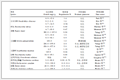
Yanhusuosine A (1), red and amorphous powder, possessed a molecular formula of C41H36N2O8 based on HRESIMS data for the double-charged molecular ion at m/z 342.1230 (calcd. for C41H36N2O8, 342.1230), in concurrence with 26 degrees of unsaturation. Its IR absorption bands at 1675, 1469, and 1446 cm−1 suggested the presence of C=N and aromatic functionalities. The 1H NMR spectrum of yanhusuosine A (1) evidenced five aromatic singlets [δH 8.26, 7.89, 7.82, 7.60, 6.29 (each 1H, s)], three pairs of AX coupling type aromatic and/or olefinic protons [δH 6.98, 6.60 (each 1H, d, J = 9.0 Hz); δH 8.49, 8.40 (each 1H, d, J = 6.6 Hz); δH 8.84, 8.42 (each 1H, d, J = 6.6 Hz)], an isolated nitrogen- or oxygen-bearing methylene [δH 6.57, 5.88 (each 1H, d, J = 13.8 Hz)], and seven OMe and/or N-Me signals [δH 4.14, 4.08, 4.06, 3.86, 3.86, 3.67, 2.75 (each 3H, s)] (Table 1). Strikingly, two proton singlets at δH 6.42 and 6.49 initially assumed to be two aromatic protons, were eventually reassigned as a methylenedioxy group by the HSQC and HMBC experiments (Fig. 2). In addition to the above protonated carbons, the 13C NMR coupled with the HSQC data revealed the presence of sixteen nonprotonated carbons with chemical shifts > 100 ppm, implying that 1 was a highly aromatized alkaloid with complex conjugated system. This observation also matched well with the three absorption bands at 320, 420, and 500 nm in the UV spectrum.
|
Table 1 NMR spectroscopic data for 1 and 2. |


|
Download:
|
| Fig. 2. Substructures (left) and selected 1H-1H COSY (blue thick lines) and HMBC (red arrows, from 1H to 13C) correlations (right) for 1 and 2. | |

The framework of yanhusuosine A (1) was constructed by interpretation of its 2D NMR spectra. The three AX coupling patterns were consistent with the COSY correlations shown in Fig. 2. A 9,11-disubsubsituted BIA moiety, part A, initially deduced by comparing NMR data with those of the biosynthetic analogues of BIAs from this plant [10,18], was affirmed on the basis of COSY correlations between H-5/H-6 plus HMBC and NOESY correlations summarized in Figs. 2 and 3. Similarly, the diagnostic signals attributed to protoberberine alkaloids, such as the isolated coupling of H2-8′ [δH 6.57, 5.88 (each 1H, d, J = 13.8 Hz) and AX coupling patterns of H-5′/H-6′ and H-11′/H-12′ were observed. In addition, the HMBC correlations that from H-4′ to C-5′, C-2′, C-3′, and C-1a', from H-6′ to C-4a', C-13a', and C-8′, from H2-8′ to C-6′, C-13a', C-12a', and C-9′, and from H-12′ to C-13′, C-8a', and C-10′, and C-10′ (Fig. 2) completed part B to be a 1′, 13′-disubstitued protoberberine moiety. This deduction was further confirmed by the NOESY cross-peaks of MeO-10′/H-11′, MeO-3′/H-4′, H-6′/H2-8′, and H-4′/H-5′ (Fig. 3).

|
Download:
|
| Fig. 3. Key NOESY correlations (red double arrows) for 1 and 2. | |

A final step to connect part A and part B was resolved by the solid HMBC correlations from H-12′ to C-9 and from H-12 to C-1′, C-2′, and C-9, thereby constructing an unprecedented 6/7/6/6/6/6 hexacyclic system in 1. Reasuringly, this fusion was fully consistent with the NOESY correlations of H-1/H-15, H-1/H-8′a, and N-Me/H-12′. Also, a 1D NOE difference experiment with 1 showed enhancements of MeO-14 and H-1 when H-15 was irradiated. These observations allowed the N-methyl-1,6-methylenedioxyisoquinoline moiety to be perpendicularly 'inserted' below the 6/7/6/6/6/6 hexacyclic system with steric hindrance at the C-8−C-9 axis (Fig. 3), which strikingly resulted in the close spatial proximity of H-1 with H-15 and H-8′a, and N-Me with H-12′. At this point, it was rational to explain the extraordinary up-field shifts of MeO-14 (δH 2.75), H-15 (δH 6.29), and H-12′ (δH 6.60) induced by the anisotropic shielding of the N-methyl-1,6-methylenedioxyisoquinoline moiety (Fig. 3).
Yanhusuosine B (2), also isolated as red and amorphous powder, was determined to be an alkaloid with a molecular formula of C41H38N2O8 based on the double-charged molecular ion at m/z 343.1309 (calcd. for C41H38N2O8, 343.1309), which differed from 1 by +H2. It was clear that 2 was assigned as the Δ5, 6 reductive analogue of 1 because the NMR signals for the double bond at C-5−C-6 in 1 were lost and replaced by two methylenes coupling to each other. The ultimate structure of 2 was completed as shown in Fig. 1 by interpretation of its 2D NMR data, especially, analogous NOESY correlations for 1 were also observed in the NOESY spectrum of 2 (Figs. 2 and 3).
With the gross structure of the novel benzylisoquinoline-protoberberine homodimers (1) and (2) established, defining the absolute axial configuration induced by the C-8−C-9 biaryl axis was proved to be more challenging owing to their lacks of [α] values and ECD Cotton effects (Figs. S14 and S26 in Supporting information). It has been reported that the rotational energy is higher than 23.3 kcal/mol that enables the atropisomers exist [23-25]. Thus, density functional theory (DFT) calculations were conducted to obtain axial conformers of 1 and 2 with rotational energy around 70 kcal/mol (Figs. S29 and S30 in Supporting information), strongly supporting the occurrence of atropisomeric mixtures of 1 and 2. Efforts to crystallize 1 and 2 proved unsuccessful. Fortunately, 1 and 2 were separated into their pure atropo-enantiomers by the CHIRAL MD(2) column (Figs. S13 and S25 in Supporting information), respectively. As expected, the atropo-enantiomers showed fully opposite [α] values and mirror-like ECD curves each other (Fig. 4). These findings clearly demonstrated that (+)/(−)-1 and 2 are configurationally fixed at ambient temperature due to the highest steric congestion. Finally, the axial chirality of (+)/(−)-1 and 2 was determined by comparing their actual electronic circular dichroism (ECD) with those predicted using time-dependent density functional theory (TDDFT) calculations.

|
Download:
|
| Fig. 4. Experimental and computational ECD spectra for 1 and 2. | |

The theoretical ECD spectra for both atropisomeric forms for 1 and 2 were in good accordance with their experimental ECD spectra (Fig. 4), which allowed the absolute axial configuration for (+)-1/2 and (−)-1/2 to be established as (M)- and (P)-configured, respectively. (+)-1/2 and (−)-1/2 were obtained as trifluoroacetate (TFA) salts due to the application of TFA during the HPLC purification.
Natural products with C−C bond-induced axial chirality have been continuously discovered during the recent decades, but rare in BBIAs [24,26]. The unusual 6/7/6/6/6/6 hexacyclic system coupled with an isoquinoline moiety via a C−C bond present in 1 and 2 has never been described in natural products chemistry. A retro-assembly analysis proposed that 1 and 2 probably biosynthesized from a molecule of benzylisoquinoline with a unit of protoberberine via an intermolecular [4+3] cycloaddition which contributed directly to seven-membered rings common in natural products [27]. Plausible biosynthetic origin of 1 and 2 were proposed in Scheme 1 with reticuline served as the upstream precursor, a very important intermediate to biosynthesize all types of bioactive BIAs including palmatine, morphine, berberine, etc. [14,28]. Briefly, reticuline would be transformed into intermediate i, which undergo an intermolecular [4 + 3] cycloaddition with palmatine to form a key intermediate ii with 6/7/6/6/6/6 hexacyclic system. Subsequently, the intermediate ii is converted to 2 and 1 through sequences of deprotonation and dehydrogenation.

|
Download:
|
| Scheme 1. Hypothetical biosynthetic pathways for 1 and 2. | |

Our last task was to evaluate 1 and 2 for biological activities in vitro. The in vitro anti-inflammatory properties of compounds 1 and 2 were evaluated against NO production in LPS-induced RAW264.7 macrophage cells. As a result, compound 2 showed moderate inhibitory activity with the IC50 value of 8.24 ± 0.73 µmol/L, which is more potent than the clinically used agent indomethacin (IC50 = 13.43 ± 4.06 µmol/L). In addition, the cytotoxic activity of 1 and 2 were evaluated in human breast cancer cells (MCF-7), human hepatoma cells (HepG2), and human ovarian cancer cells (HO-8910) by the thiazolyl blue bromide (MTT) assay. However, no cytotoxicity was found for both compounds 1 and 2 at 50 µmol/L in the above cell lines.
In summary, as a new class of alkaloid dimers with an unprecedented 6/7/6/6/6/6 hexacyclic skeleton, (+)/(−)-yanhusuosines A (1) and B (2) would attract much attention from both chemists and biologists, and further studies such as synthesis and in-depth biological tests are warranted.
Declaration of competing interestThe authors declare that they have no known competing financial interests or personal relationships that could have appeared to influence the work reported in this paper.
AcknowledgmentsThis study was supported by the National Natural Science Foundation of China (No. 82073978), the Fundamental Research Funds for the Central Universities (No. 2022-JYB-JBZR-015) and Beijing Natural Science Foundation (No. JQ18026).
Supplementary materialsSupplementary material associated with this article can be found, in the online version, at doi:10.1016/j.cclet.2022.108073.
| [1] |
H. Guinaudeau, A.J. Freyer, M. Shamma, Nat. Prod. Rep. 3 (1986) 477-488. DOI:10.1039/np9860300477 |
| [2] |
P.L. Schiff, J. Nat. Prod. 50 (1987) 529-599. DOI:10.1021/np50052a001 |
| [3] |
P.L. Schiff, J. Nat. Prod. 54 (1991) 645-749. DOI:10.1021/np50075a001 |
| [4] |
P.L. Schiff, J. Nat. Prod. 60 (1997) 934-953. DOI:10.1021/np9700174 |
| [5] |
V.K. Nguyen, K.G.M. Kou, Org. Biomol. Chem. 19 (2021) 7535-7543. DOI:10.1039/D1OB00812A |
| [6] |
C. Weber, T. Opatz, Alkaloids Chem. Biol. 81 (2019) 1-114. |
| [7] |
J.Q. Qian, Acta Pharmacol. Sin. 23 (2002) 1086-1092. |
| [8] |
I. Galindo, U. Garaigorta, F. Lasala, et al., Antiviral Res. 186 (2021) 104990. DOI:10.1016/j.antiviral.2020.104990 |
| [9] |
S. Zhang, W. Huang, L. Ren, et al., Cell Res. 32 (2022) 9-23. DOI:10.1038/s41422-021-00581-y |
| [10] |
L.Y. Wang, B.L. Qiu, H. Xia, et al., J. Nat. Prod. 83 (2020) 489-496. DOI:10.1021/acs.jnatprod.9b01155 |
| [11] |
L. Alhassen, T. Dabbous, A. Ha, et al., Molecules 26 (2021) 7498. DOI:10.3390/molecules26247498 |
| [12] |
B. Tian, M. Tian, S.M. Huang, Pharm. Biol. 58 (2020) 265-275. DOI:10.1080/13880209.2020.1741651 |
| [13] |
J. Zhang, S. He, J. Wang, et al., Nat. Prod. Commun. 15 (2020) 1-19. |
| [14] |
D. Xu, H. Lin, Y. Tang, et al., Hortic. Res. 8 (2021) 16. DOI:10.1038/s41438-020-00450-6 |
| [15] |
N. Cabedo, I. Berenguer, B. Figadere, et al., Curr. Med. Chem. 16 (2009) 2441-2467. DOI:10.2174/092986709788682100 |
| [16] |
C.M. Sai, D.H. Li, C.M. Xue, et al., Org. Lett. 17 (2015) 4102-4105. DOI:10.1021/acs.orglett.5b02044 |
| [17] |
G.Y. Xia, B.B. Xiao, L.Y. Wang, et al., Acta Pharm. Sin. 56 (2021) 553-556. |
| [18] |
B.B. Xiao, G.Y. Xia, L.Y. Wang, et al., Tetrahedron Lett. 61 (2020) 151890. DOI:10.1016/j.tetlet.2020.151890 |
| [19] |
S. Fayez, J. Li, D. Feineis, et al., J. Nat. Prod. 82 (2019) 3033-3046. DOI:10.1021/acs.jnatprod.9b00589 |
| [20] |
B.K. Lombe, T. Bruhn, D. Feineis, et al., Org. Lett. 19 (2017) 1342-1345. DOI:10.1021/acs.orglett.7b00209 |
| [21] |
B.K. Lombe, T. Bruhn, D. Feineis, et al., Org. Lett. 19 (2017) 6740-6743. DOI:10.1021/acs.orglett.7b03473 |
| [22] |
M. Xu, T. Bruhn, B. Hertlein, et al., Chemistry 16 (2010) 4206-4216. DOI:10.1002/chem.200903247 |
| [23] |
G.J. Mei, W.L. Koay, C.Y. Guan, et al., Chem 8 (2022) 1855-1893. DOI:10.1016/j.chempr.2022.04.011 |
| [24] |
J.E. Smyth, N.M. Butler, P.A. Keller, Nat. Prod. Rep. 32 (2015) 1562-1583. DOI:10.1039/C4NP00121D |
| [25] |
X.L. Min, X.L. Zhang, R. Shen, et al., Org. Chem. Front. 9 (2022) 2280-2292. DOI:10.1039/D1QO01699G |
| [26] |
B.K. Lombe, D. Feineis, G. Bringmann, Nat. Prod. Rep. 36 (2019) 1513-1545. DOI:10.1039/C9NP00024K |
| [27] |
Z. Yin, Y. He, P. Chiu, Chem. Soc. Rev. 47 (2018) 8881-8924. DOI:10.1039/C8CS00532J |
| [28] |
Z. Xu, Z. Li, F. Ren, et al., Plant J. 111 (2022) 217-230. DOI:10.1111/tpj.15788 |