 2023, Vol. 34


b Shanghai Collaborative Innovation Center for Biomanufacturing Technology, Shanghai 200237, China
The nicotinic acetylcholine (ACh) receptor (nAChR) is the prototypical ligand-gated ion-channel in charge of rapid excitatory neurotransmission and an important target for insecticide design [1-3]. Nowadays, several neonicotinoids have been developed with novel modes of action [4], e.g., targeting insect nAChRs, low mammalian toxicity, broad insecticidal spectra, and good systemic properties [5-7]. However, rise of resistance due to the wide spread applications [8,9], and overuse of neonicotinoids were major concerns plaguing this class of insecticides [10]. Therefore, it is imperative to find novel compounds to address these problems.
As for the neonicotinoids disclosed in past years (Fig. 1), the double bond in the nitromethylene group plays an important role in its mode of action. As the bond forms a conjugated system that facilitates electron flow toward the nitro group and renders the planarity of the pharmacophore, the double bond is presumably indispensable for bioactivity [11-13]. Nitromethylene proved to be one of the most effective electron-withdrawing fragments, neonicotinoids containing this scaffold were called nitromethylene neonicotinoids [14,15].

|
Download:
|
| Fig. 1. Chemical structures of neonicotinoids disclosed in past years. | |
Interestingly, in our previous study [16], compound 2 exhibited excellent insecticidal activities against cowpea aphid (craccivora), armyworm (separate Walker) and small brown rice planthopper (striatellus), into which the conjugated double bond was introduced. However, previous studies showcased that the half-life of compound 2 was only 0.77 min under the irradiation of a 300 W high-pressure mercury lamp [17]. The life-time is even shorter when dissolved in water (hydrolysis half-life in water is 2.40 h), which prohibits it from practical applications (Scheme 1).

|
Download:
|
| Scheme 1. Our previous and this work. | |
To solve this problem, we then introduced diazene moiety to compound 2 to enhance the π-π stacking interaction in order to increase the electron density of the conjugated system and reduce its proneness toward nucleophilic addition [18]. This did improve its stability mildly. Yet, these compounds were still unstable compared with imidacloprid (Scheme 1).
Inspired by the stability and activity of cycloxaprid and other nitromethylene neonicotinoids, we next switched our focus to modification of the nitroconjugated double bond of compound 2 into β-nitroenamine in order to maintain its activity and at the same time enhance the stability. According to the reaction reported by Francisco et al. in 2007 [19], sodium borohydride was employed to selectively reduce the conjugated diene system for improved stability (Scheme 1). In addition, the insecticidal activity was expected to be even improved. Twenty-four novel nitromethylene neonicotinoids were synthesized and their significant insecticidal activities and increased stabilities were reported herein.
Synthetic route of 3a-3x was shown in Scheme 2 or Fig. S1 (Supporting information). The key to prepare the target compounds was the selective reduction of conjugated diene system. Sodium borohydride can hydrogenate the double bond, which consists of C and hetero atoms like O or N. Sodium borohydride may add to C=N bond and then the C-4 was subsequently protonated to get the target compound (Scheme 3). When the five-membered aromatic ring was substituted by electron-withdrawing group such as nitro group or cyano group, the reduction reaction was unsuccessful.

|
Download:
|
| Scheme 2. The synthetic route of 24 target compounds 3a-3x. | |

|
Download:
|
| Scheme 3. Presumed synthetic mechanism of the target compounds. | |
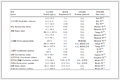
The influence of reaction temperature was also studied. Taking the reactivity of sodium borohydride into consideration, we tested the temperature from −78 ℃ to 15 ℃. The results showed that increasing the reaction temperature led to a faster rate but little effect on the yield. The most efficient temperature for this reaction was 15 ℃. The effect of the solvent on the reaction was also investigated, given that compound 2 participates in the reaction as an organic salt, various polar solvents such as H2O, methanol, ethanol, propanol and DMF were screened. When using water as solvent, due to poor water solubility of the product, it was found that an insoluble sticky substance was formed during the reaction and restrained the stirrer. Here, adding one equal volume of dichloromethane to water in reaction was found favorable to dissolve the product thorough optimization. According to the yields on Table 1, mixture of H2O/CH2Cl2 (1:1) was most suitable to yield compound 3a (Table 1, entries 9 and 11). Structures of all 24 target compounds 3a-3x were listed in Scheme 4.
|
Table 1 Optimum process to synthesis the target molecules. |


|
Download:
|
| Scheme 4. Structures of 24 target compounds 3a-3x. | |
As biological test results shown in Table 2, almost all compounds were active to rice brown planthopper in concentration of 500 mg/L, and mortality of some compounds could reach 100% even in the concentration of 4 mg/L. Most compounds were active against aphid at 500 mg/L. Some compounds could keep 100% mortality in 4 mg/L. However, this series of compounds show poor activity against the diamondback moth except 3v.
|
|
Table 2 Insecticidal activity test result of the synthesized compounds. |

Taking the structure of the compounds we synthesized into consideration, the chloropyridine ring leads to better bioactivity than other six-membered heterocyclic moieties such as clorothiazole, tetrahydrofuran and pyridine. If the pyridine ring is unsubstituted, or replaced by phenyl or chlorophenyl will lead to loss of activity. In the five-membered heterocyclic moiety, the compound substituted by thiophene is generally more active than that of furan. Compounds substituted by pyrrole ring are also good for further derivatization. The substitution position of the five-membered ring had little effect on the activity of the compound such as 3i and 3p which showed less differences in activity. Furthermore, the five-membered ring with electron-donating groups such as methyl and ethyl substituents showed better activity than electron-withdrawing group like bromine. In Table 3, we can see clearly that compound 3v showed better activity than cycloxaprid against alfalfa aphid and diamondback moth. This also proved our selective reduction was rational.
|
|
Table 3 Insecticidal activities of some target compounds with good bioactivity at 4 mg/L. |

We selected two representative compounds 3a and 3i to test their photo and water stability due to their good activity and imidacloprid was chosen as control. The degradation kinetics of 3a and 3i were calculated by the residues of peak area versus time. The relative concentration of 3a and 3i fitted well to the following pseudo first-order kinetic equation (Eq. 1).

|
(1) |
where C0 was the initial concentration of 3a, 3i and imidacloprid, Ct was the concentration of 3a, 3i and imidacloprid at time t, and k was the observed reaction rate constant (obtained from the slope of the line in the plot of ln(Ct/C0) versus time). The best fit of Eq. 1 to the observed changes was shown in Table 2. The data of photolysis rate constants (k), half-lives (t1/2), and linear response (R2) for compounds were shown in Table 4. The half-life of 3a was 9.6 h. The stability of synthesized compounds was much better than imidacloprid under irradiation of mercury lamp. Meanwhile, the energy of mercury lamp was higher than Xeron lamp, so that the degradation rate was generally faster than that described in the literature.
|
|
Table 4 Photolysis rate of some target compounds. |

The hydrolysis rate of our synthesized compounds was also taken into account (Table 5). Using the same kinetic equation in the previous section, we mapped the hydrolysis curve of compounds 2, 3a, 3i and imidacloprid. So that calculated half-life of compound 2 was 2.33 h. 3a, 3i and imidacloprid were quite stable and can kept the concentration at 5 mg/L for three months without degradation in water, which indicates our molecular design was reasonable and valuable.
|
|
Table 5 Hydrolysis rate of some target compounds. |


In summary, we designed and synthesized a series of 24 novel neonicotinoid analogues using sodium borohydride as reducing agent by selective 1,4-reduction. All target molecular structures have been confirmed by analytical and spectral data (Fig. 2 and Supporting information). Most of the compounds show good bioactivity against brown planthopper. Especially, insect activity of 3v was even better than cycloxaprid. But all these compounds show low activity against diamondback moth. The results of stability experiments showed that both hydrolytic stability and photolysis stability of compounds 3a, 3i were better than imidacloprid and superior to the original compound. All of the results met our requirements of enhancing the stability and maintaining good bioactivity of leading compound, which was likely to be enhanced by further discussion and exploration.

|
Download:
|
| Fig. 2. The single-crystal structure of 3i. | |

The authors declare that they have no known competing financial interests or personal relationships that could have appeared to influence the work reported in this paper
AcknowledgmentsThis work was supported by the Innovation Program of Shanghai Municipal Education Commission (No. 201701070002E00037) and the National Key Research Program of China (No. 2017YFD0200505).
Supplementary materialsSupplementary material associated with this article can be found, in the online version, at doi:10.1016/j.cclet.2022.107868.
| [1] |
M. Tomizawa, J.E. Casida, Acc. Chem. Res. 42 (2009) 260-269. DOI:10.1021/ar800131p |
| [2] |
M. Tomizawa, Adv. Insect Physiol. 44 (2013) 63-99. |
| [3] |
J.E. Casida, K.A. Durkin, Annu. Rev. Entomol. 58 (2013) 99-117. DOI:10.1146/annurev-ento-120811-153645 |
| [4] |
M. Tomizawa, T.T. Talley, D. Maltby, et al., Proc. Natl. Acad. Sci. U. S. A. 104 (2007) 9075-9080. DOI:10.1073/pnas.0703309104 |
| [5] |
C.C. Zhu, G.L. Li, K.Y. Xiao, et al., Chin. Chem. Lett. 30 (2019) 255-258. DOI:10.1016/j.cclet.2018.05.013 |
| [6] |
H.F. Shen, X. Chen, P. Liao, et al., Chin. Chem. Lett. 26 (2015) 509-512. DOI:10.1016/j.cclet.2015.03.017 |
| [7] |
N.Y. Chen, L.P. Ren, M.M. Zou, et al., Chin. Chem. Lett. 25 (2014) 197-200. DOI:10.1016/j.cclet.2013.12.004 |
| [8] |
R. Nauen, I. Denholm, Arch. Insect Biochem. Physiol. 58 (2005) 200-215. DOI:10.1002/arch.20043 |
| [9] |
M. Reyes, P. Franck, P.J. Charmillot, et al., Pest Manag. Sci. 63 (2007) 890-902. DOI:10.1002/ps.1421 |
| [10] |
Z.W. Liu, Z.J. Han, Y.C. Wang, et al., Pest Manag. Sci. 59 (2003) 1355-1359. DOI:10.1002/ps.768 |
| [11] |
Z.J. Ye, S. Xia, X.S. Shao, et al., J. Agric. Food. Chem. 59 (2011) 10615-10623. DOI:10.1021/jf2029708 |
| [12] |
D.D. Zhang, S.X. Cui, Z.P. Xu, D.M. Li, Z.Z. Tian, Chin. Chem. Lett. 28 (2017) 1743-1745. DOI:10.1016/j.cclet.2017.05.002 |
| [13] |
M. Cai, W. Gan, Z.Q. Ding, et al., Chin. Chem. Lett. 34 (2023) 107554. DOI:10.1016/j.cclet.2022.05.068 |
| [14] |
S. Kagabu, R. Ishihara, Y. Hieda, K. Nishimura, Y. Naruse, J. Agric. Food Chem. 55 (2007) 812-818. DOI:10.1021/jf0623440 |
| [15] |
Y.F. Fan, W.W. Zhang, X.S. Shao, et al., Chin. Chem. Lett. 26 (2015) 1-5. DOI:10.1016/j.cclet.2014.10.019 |
| [16] |
X.S. Shao, Z. Li, X.H. Qian, X.Y. Xu, J. Agric. Food. Chem. 57 (2009) 951-957. DOI:10.1021/jf803305f |
| [17] |
R.B. Xu, R. Xia, M. Luo, et al., J. Agric. Food Chem. 62 (2014) 381-390. DOI:10.1021/jf4046683 |
| [18] |
S.Y. Lu, Y.Y. Zhuang, N.B. Wu, et al., J. Agric. Food Chem. 61 (2013) 10858-10863. DOI:10.1021/jf403272h |
| [19] |
P. Francisco, V. Javier, A. Domitila, J. Org. Chem. 71 (2006) 7690-7696. DOI:10.1021/jo061140f |