 2023, Vol. 34


b Dalian National Laboratory for Clean Energy, Dalian Institute of Chemical Physics, Chinese Academy of Sciences, Dalian 116023, China;
c Leibniz-Institut für Katalyse e. V., Albert-Einstein-Straβe 29a, Rostock 18059, Germany
Indolo[2,1-a]isoquinolines represent a class of important scaffolds that is prevalent in numerous natural products and bioactive molecules (Fig. 1) [1-7]. For example, compound A was a potent melatonin antagonist to treat sleep problems [1]. Compound B was found to inhibit the polymerization of tubulin [2]. Cryptanstoline and cryptowoline were two natural occurring dibenzopyrrocoline alkaloids isolated from a plant Cryptocarya bowiei in Queensland [3-5].

|
Download:
|
| Fig. 1. Selected examples of bioactive molecules with indolo[2,1-a]isoquinoline scaffolds. | |
To assemble these useful indolo[2,1-a]isoquinoline scaffolds, numerous synthetic approaches have been realized in the past several decades. Among them, radical cascade reaction [8-18], C—H annulation [19-25], and metal-catalyzed cyclization [26-35] have been widely studied. For instance, Nevado's group developed an elegant process for the synthesis of CF3-, SCF3-, Ph2(O)P-, and N3-containing indolo[2,1-a]isoquinolin-6(5H)-ones via radical cascade cyclization of N-(arylsulfonyl)acrylamides [8]. In 2020, Lei's group discovered a manganese-catalyzed electrochemical radical cascade cyclization of N-substituted 2-arylbenzoimidazoles with alkylboronic acids to access a variety of benzo [4,5] imidazo-[2,1-a]isoquinolin-6(5H)-one derivatives [9]. Recently, Lv, Li and co-workers reported that an iron-catalyzed radical cascade reaction of 2-arylindoles with germanium hydrides for the construction of germanium-substituted indolo[2,1-a]isoquinolin-6(5H)-ones [10]. Gogoi's group developed a facile and efficient synthesis of indolo[2,1-a]isoquinolines through a ruthenium-catalyzed C—H annulation of antipyrine with alkyne [19]. Cui and co-workers revealed a rhodium-catalyzed C—H annulation of 2-phenylindoles with 4-hydroxy–2-alkynoates for the synthesis of a series of furo[3,4-c]indolo[2,1-a]isoquinolines [20]. Yang and Liang's group demonstrated a palladium-catalyzed cyclization of alkene-tethered aryl halides with o-bromobenzoic acids to produce various fused indolo[2,1-a]isoquinolines [26]. Despite the significant advance in the synthesis of functionalized indolo[2,1-a]isoquinolines, an efficient method for the incorporation of a carbonyl group into indolo[2,1-a]isoquinoline scaffolds is undeveloped. In addition, transition-metal-catalyzed carbonylation reactions have been considered as an economic and straightforward approach to access carbonyl-containing molecules [33-39]. Herein, with our recent efforts on carbonylation reactions [40-50], we would like to describe a palladium-catalyzed carbonylative cyclization of alkene-tethered indoles with phenols or arylboronic acids using TFBen as the CO source to furnish a wide range of carbonyl-containing indolo[2,1-a]isoquinolines in good yields.
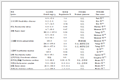
Our investigation commenced with the reaction of the alkene-tethered indole 1a, 4-methoxyphenol 2a, and TFBen in the presence of Pd(OAc)2 as the catalyst and a phosphine ligand (Table 1, entries 1–4). Gratifyingly, the reaction with PCy3 as the ligand gave the desired product 3aa in 80% yield (Table 1, entry 2). Next, a series of solvents were screened (Table 1, entries 5–9), and the yield of 3aa was significantly enhanced to 95% when DMF was used (Table 1, entry 8). It was found that lower reaction yields were obtained when other palladium catalysts such as PdCl2, Pd(acac)2, Pd(PPh3)4, and Pd(TFA)2 were employed (Table 1, entries 10–13). Moreover, reducing the loading of the catalyst gave 76% yield of 3aa (Table 1, entry 14). Additionally, when the amount of TFBen was decreased, a relatively lower yield was achieved (Table 1, entry 15). Notably, under our best reaction conditions, a similar yield can be obtained by performing the reaction under CO atmosphere (1 bar).
|
Table 1 Screening of the reaction conditions.a |


Then, the scopes of phenols were investigated in the reaction with the alkene-tethered indole 1a under the optimal reaction conditions (Table 1, entry 8). As depicted in Scheme 1, for phenols with para-electron-donating or -withdrawing groups, the reaction worked well to give the corresponding products 3aa-3ah in high to excellent yields. It was shown that the reaction of the meta-substituted phenols afforded the desired products 3ai-3ak in 80%−90% yields. When the ortho-substituted phenols were tested, moderate yields of products 3al-3am were achieved, which could be attributed to the steric hindrance. Furthermore, the di-substituted phenols were successfully converted to product 3an and 3ao in 50% and 69% yield, respectively. In addition, 67% yield of product 3ap was obtained in the reaction with 2-naphthol 2p. The reaction of sesamol 2q also proceeded smoothly to give product 3aq in 60% yield. Notably, methanol could also be transformed to product 3ar in 60% yield. However, very low yields of the corresponding products were obtained when ethanol, iPrOH, nBuOH, or amines were tested.

|
Download:
|
| Scheme 1. Scope of phenols. Reaction condition: 1a (0.2 mmol), 2 (2.0 equiv.), TFBen (5.0 equiv.), Pd(OAc)2 (10 mol%), PCy3 (20 mol%), Et3N (2.0 equiv.), DMF (1.0 mL), 100 ℃, 24 h, isolated yield. | |

Subsequently, a variety of alkene-tethered indoles were synthesized and tested in the reaction with 4-methoxyphenol 2a (Scheme 2). For the mono-substituted alkene-tethered indoles, the reaction afforded the desired products 3ba-3ea in 53%−69% yields. It was found that the reaction of the di-substituted alkene-tethered indoles led to products 3fa-3ga in moderate yields. It was noted that when substrates bearing a phenyl and benzyl group were tested, the expected product 3ha and 3ia were achieved in 54% and 62% yield, respectively. Additionally, the 2-methylallyl-substituted indole 1j was smoothly converted to product 3ja in 45% yield.

|
Download:
|
| Scheme 2. Scope of alkene-tethered indoles. Reaction condition: 1 (0.2 mmol), 2a (1.5 equiv.), TFBen (5.0 equiv.), Pd(OAc)2 (10 mol%), PCy3 (20 mol%), Et3N (2.0 equiv.), DMF (1.0 mL), 100 ℃, 24 h, isolated yield. | |

Furthermore, a series of arylboronic acids were also examined in the reaction with the alkene-tethered indole 1a as shown in Scheme 3. The reaction of arylboronic acids bearing para-electron-donating or -withdrawing substituents proceeded well to give the corresponding products 5aa-5ae in 51%−66% yields. When 3-chlorophenylboronic acid 4f was tested, 45% yield of product 5af was obtained. In addition, the reaction of 2-tolylboronic acid 4g gave 62% yield of product 5ag. It was noteworthy that product 5ah and 5ai were afforded in high yields in the reaction of arylboronic acids containing a benzo[d][1,3]dioxole and thiophene unit.

|
Download:
|
| Scheme 3. Scope of arylboronic acids. Reaction condition: 1a (0.2 mmol), 4 (2.5 equiv.), TFBen (5.0 equiv.), Pd(OAc)2 (10 mol%), PCy3 (20 mol%), Et3N (2.0 equiv.), DMF (1.5 mL), 100 ℃, 24 h, isolated yield. | |

On the basis of current results and precedent reports [26,30,33], a plausible mechanism for a palladium-catalyzed carbonylative cyclization of alkene-tethered indoles with phenols is proposed (Scheme 4). Initially, the reaction of Pd(OAc)2 with PCy3 forms the active Pd(0) species, which undergoes oxidative addition with the alkene-tethered indole 1a to generate the aryl Pd(Ⅱ) complex A'. Then, intramolecular cyclization of A' and coordination with CO released from TFBen lead to the intermediate B'. Subsequently, migratory insertion of CO in B' gives the acyl Pd(Ⅱ) complex C'. Finally, nucleophilic attack of phenol 2b on C' followed by reductive elimination affords the target product 3ab and regenerates the active Pd(0) species for the next catalytic cycle.

|
Download:
|
| Scheme 4. Plausible mechanism. | |

In conclusion, we have developed a facile and efficient method for the construction of indolo[2,1-a]isoquinoline scaffolds via a novel palladium-catalyzed carbonylative cyclization of alkene-tethered indoles with phenols or arylboronic acids. By using TFBen as the CO source, this protocol enables the incorporation of a carbonyl group into indolo[2,1-a]isoquinoline scaffolds, producing various carbonyl-containing indolo[2,1-a]isoquinoline derivatives in good yields.
Declaration of competing interestWe have no conflict of interest to declare.
AcknowledgmentsWe acknowledge the financial supports from the Joint Funds of the Zhejiang Provincial Natural Science Foundation of China (No. LTY21B020001), and the Fundamental Research Funds of Zhejiang Sci-Tech University (No. 2021Q052).
Supplementary materialsSupplementary material associated with this article can be found, in the online version, at doi:10.1016/j.cclet.2022.107873.
| [1] |
R. Faust, P.J. Garratt, R. Jones, L.K. Yeh, J. Med. Chem. 43 (2000) 1050-1061. DOI:10.1021/jm980684+ |
| [2] |
M. Goldbrunner, G. Loidl, T. Polossek, A. Mannschreck, E. von Angerer, J. Med. Chem. 37 (1997) 3524-3533. |
| [3] |
J. Ewing, G.K. Hughes, E. Ritchie, W.C. Taylor, Nature 169 (1952) 618-619. DOI:10.1038/169618b0 |
| [4] |
A.I. Meyers, T.M. Sielecki, D.C. Crans, R.W. Marshman, T.H. Nguyen, J. Am. Chem. Soc. 114 (1992) 8483-8489. DOI:10.1021/ja00048a020 |
| [5] |
I.W. Elliott, The Alkaloids, 31. New York: Academic Press, 1987.
|
| [6] |
T. Polossek, R. Ambros, S. von Angerer, et al., J. Med. Chem. 35 (1992) 3537-3547. DOI:10.1021/jm00097a011 |
| [7] |
R. Ambros, M.R. Schneider, S. von Angerer, J. Med. Chem. 33 (1990) 153-160. DOI:10.1021/jm00163a026 |
| [8] |
N. Fuentes, W. Kong, L. Fernández-Sánchez, E. Merino, C. Nevado, J. Am. Chem. Soc. 137 (2015) 964-973. DOI:10.1021/ja5115858 |
| [9] |
Y. Yuan, Y. Zheng, B. Xu, et al., ACS Catal. 10 (2020) 6676-6681. DOI:10.1021/acscatal.0c01324 |
| [10] |
Y. Luo, T. Tian, Y. Nishihara, L. Lv, Z. Li, Chem. Commun. 57 (2021) 9276-9279. DOI:10.1039/d1cc03907e |
| [11] |
K. Sun, G. Li, Y. Li, et al., Adv. Synth. Catal. 10 (2020) 1947-1954. DOI:10.1002/adsc.202000040 |
| [12] |
X. Su, H. Huang, W. Hong, et al., Chem. Commun. 53 (2017) 13324-13327. DOI:10.1039/C7CC08362A |
| [13] |
Y.L. Wei, J.Q. Chen, B. Sun, P.F. Xu, Chem. Commun. 55 (2019) 5922-5925. DOI:10.1039/c9cc02388g |
| [14] |
S. Zhai, S. Qiu, S. Yang, et al., Chin. Chem. Lett. 33 (2022) 276-279. DOI:10.1016/j.cclet.2021.06.081 |
| [15] |
H. Huang, Y. Li, J. Org. Chem. 82 (2017) 4449-4457. DOI:10.1021/acs.joc.7b00350 |
| [16] |
S.S. Jiang, Y.T. Xiao, Y.C. Wu, et al., Org. Biomol. Chem. 18 (2020) 4843-4847. DOI:10.1039/d0ob00877j |
| [17] |
M.L. Liu, J.L. Wang, X.S. Li, W.H. Sun, X.Y. Liu, Org. Chem. Front. 9 (2022) 2438-2443. DOI:10.1039/d2qo00051b |
| [18] |
J.Q. Chen, X. Tu, B. Qin, et al., Org. Lett. 24 (2022) 642-647. DOI:10.1021/acs.orglett.1c04082 |
| [19] |
S. Borthakur, B. Sarma, S. Gogoi, Org. Lett. 21 (2019) 7878-7882. DOI:10.1021/acs.orglett.9b02871 |
| [20] |
Y. Liu, Z. Yang, R. Chauvin, et al., Org. Lett. 22 (2020) 5140-5144. DOI:10.1021/acs.orglett.0c01744 |
| [21] |
K. Alam, S.W. Hong, K.H. Oh, J.K. Park, Angew. Chem. Int. Ed. 56 (2017) 13387-13391. DOI:10.1002/anie.201705514 |
| [22] |
T.S. Zhang, Q. Zhao, W.J. Hao, S.J. Tu, B. Jiang, Chem. Asian J. 14 (2019) 1042-1049. DOI:10.1002/asia.201900050 |
| [23] |
L.L. Sun, Z.Y. Liao, R.Y. Tang, C.L. Deng, X.G. Zhang, J. Org. Chem. 77 (2012) 2850-2856. DOI:10.1021/jo3000404 |
| [24] |
H. Sun, C. Wang, Y.F. Yang, et al., J. Org. Chem. 79 (2014) 11863-11872. DOI:10.1021/jo500807d |
| [25] |
K. Morimoto, K. Hirano, T. Satoh, M. Miura, Org. Lett. 12 (2010) 2068-2071. DOI:10.1021/ol100560k |
| [26] |
X. Yang, H. Lu, X. Zhu, et al., Org. Lett. 21 (2019) 7284-7288. DOI:10.1021/acs.orglett.9b02541 |
| [27] |
A.K. Verma, T. Kesharwani, J. Singh, V. Tandon, R.C. Larock, Angew. Chem. Int. Ed. 48 (2009) 1138-1143. DOI:10.1002/anie.200804427 |
| [28] |
A.K. Verma, R.R. Jha, R. Chaudhary, et al., J. Org. Chem. 77 (2012) 8191-8205. DOI:10.1021/jo301572p |
| [29] |
H. Lu, X. Yang, L. Zhou, et al., Org. Chem. Front. 7 (2020) 2016-2021. DOI:10.1039/d0qo00492h |
| [30] |
L. Zhou, S. Qiao, F. Zhou, et al., Org. Lett. 23 (2021) 2878-2883. DOI:10.1021/acs.orglett.1c00493 |
| [31] |
H. Qi, D. Chi, S. Chen, Org. Lett. 24 (2022) 2910-2914. DOI:10.1021/acs.orglett.2c00882 |
| [32] |
Y Jin, P. Fan, C. Wang, CCS Chem. 4 (2022) 1510-1518. DOI:10.31635/ccschem.021.202101040 |
| [33] |
(a) A.D. Marchese, B. Mirabi, C.E. Johnson, M. Lautens, Nat. Chem. 14 (2022) 398–406.
|
| [34] |
A.D. Marchese, A.G. Durant, M. Lautens, Org. Lett. 24 (2022) 95-99. DOI:10.1021/acs.orglett.1c03682 |
| [35] |
A.D. Marchese, T. Adrianov, M. Lautens, Angew. Chem. Int. Ed. 60 (2021) 16750-16762. DOI:10.1002/anie.202101324 |
| [36] |
J.B. Peng, F.P. Wu, X.F. Wu, Chem. Rev. 119 (2019) 2090-2127. DOI:10.1021/acs.chemrev.8b00068 |
| [37] |
Q. Liu, H. Zhang, A. Lei, Angew. Chem. Int. Ed. 50 (2011) 10788-10799. DOI:10.1002/anie.201100763 |
| [38] |
S. Zhao, N.P. Mankad, Catal. Sci. Technol. 9 (2019) 3603-3613. DOI:10.1039/c9cy00938h |
| [39] |
S. Sumino, A. Fusano, T. Fukuyama, I. Ryu, Acc. Chem. Res. 47 (2014) 1563-1574. DOI:10.1021/ar500035q |
| [40] |
L. Yao, J. Ying, X.F. Wu, Org. Chem. Front. 8 (2021) 6541-6545. DOI:10.1039/d1qo01284c |
| [41] |
L. Yao, P. Wei, J. Ying, X.F. Wu, Org. Chem. Front. 9 (2022) 2685-2689. DOI:10.1039/d2qo00112h |
| [42] |
F. Zhao, H.J. Ai, X.F. Wu, Chin. J. Chem. 39 (2021) 927-932. DOI:10.1002/cjoc.202000624 |
| [43] |
Y. Yuan, F.P. Wu, A. Spannenberg, X.F. Wu, Sci. China Chem. 64 (2021) 2142-2153. DOI:10.1007/s11426-021-1054-4 |
| [44] |
F.P. Wu, J. Holz, Y. Yuan, X.F. Wu, CCS Chem. 2 (2020) 2643-2654. DOI:10.1111/jace.16962 |
| [45] |
J.S. Wang, C. Li, J. Ying, et al., J. Catal. 408 (2022) 81-87. DOI:10.1016/j.jcat.2022.02.026 |
| [46] |
J.S. Wang, C. Li, J. Ying, et al., J. Catal. 413 (2022) 713-719. DOI:10.1016/j.jcat.2022.07.027 |
| [47] |
J. Ying, L.Y. Fu, G. Zhong, X.F. Wu, Org. Lett. 21 (2019) 5694-5698. DOI:10.1021/acs.orglett.9b02037 |
| [48] |
J. Ying, Z. Le, X.F. Wu, Org. Lett. 22 (2020) 194-198. DOI:10.1021/acs.orglett.9b04147 |
| [49] |
J. Ying, J.S. Wang, L. Yao, W. Lu, X.F. Wu, Chem. Eur. J. 26 (2020) 14565-14569. DOI:10.1002/chem.202003003 |
| [50] |
Q. Gao, J.M. Lu, L. Yao, et al., Org. Lett. 23 (2021) 178-182. DOI:10.1021/acs.orglett.0c03900 |