 2023, Vol. 34


α-Diazo carbonyl compounds have been widely investigated as a synthetically useful class of carbene precursors when paired with transition metal catalysts [1-7] or upon photo-excitation [8-10]. Their reaction with (silyl) enol ethers, a typical kind of electron-rich alkenes, provided a facile and efficient access to diverse useful compounds, thus receiving extensive attention from the synthetic community [11-32]. For instance, as depicted in Scheme 1a, the transition metal catalyst mediated cyclopropanation of diazoacetates [16-22] with different kinds of (silyl) enol ethers could afford the corresponding cyclopropanes (Scheme 1a, ⅰ). Besides, through Rh(Ⅱ) catalyzed β-C(sp2)−H bond alkylation of cyclic enol ethers with α-diazo-1, 3-dicarbonyl compounds, β', γ-unsaturated β-ketoesters were obtained (Scheme 1a, ⅱ) [25]. Performing the same reaction at lower temperature led to the generation of dihydrofuran (DHF) acetals via (3 + 2) cycloaddition with one carbonyl unit (Scheme 1a, ⅲ) [29]. While, making use of pyrrolyl-α-diazo-β-ketoesters, a putative Wolff-rearrangement/benzannulation process occurred to afforded 6-hydroxyindole-7-carboxylates in the presence of dirhodium catalysts (Scheme 1a, ⅳ) [32]. As for the vinylcarbene, generated from (Z)-siloxyvinyldiazoacetate, its reaction with silyl enol ethers was also fascinating [11-15], owning to the electrophilic character at both the vinylogous position and carbene site. Davies demonstrated that methyl substituted diazoacetates V1 reacted with cyclic silyl enol ethers at the carbenoid site via a combined C−H functionalization/Cope rearrangement pathway (Scheme 1b, ⅰ) [11]. On the contrary, when the terminal unsubstituted siloxyvinyldiazoacetate was used, the reaction favored vinylogous addition/1, 4-siloxy migration with excellent diastereoselectivity (Scheme 1b, ⅱ) [12].

|
Download:
|
| Scheme 1. Reactions of enol ethers with α-diazo carbonyl compounds. | |
Dihydrofuran O, O-acetal skeleton is frequently encountered in a number of bioactive natural products [33-35]. It could be prepared through Rh(Ⅱ) [26-29], Ru(Ⅱ) [30] and Cu(Ⅱ) [31-32] catalyzed (3 + 2) cycloaddition of α-diazo carbonyl compounds with (silyl) enol ethers as illustrated above [36], and alternative Mn(Ⅲ)-mediated radical reactions [37, 38] of β-ketoesters with enol ethers. Nevertheless, these transformations were only presented in racemic version. In view of synthetic utility, there still remains the demand to develop a general method to access enantioenriched DHF skeleton directly.
Recently, our group has achieved highly enantioselective [2, 3]- and [3, 3]-σ rearrangements [39-42], vinylogous N−H insertion [43], as well as (2 + 1) cycloaddition reaction [44] with a new type of α-diazo pyrazoleamides. Encouraged by these studies, we became interested in the reactivity of α-diazo pyrazoleamides toward silyl enol ethers. A (3 + 2) cycloaddition (Scheme 1c) occurred to yield the substituted dihydrofuran acetals via formal alkylation reaction (Scheme 1a, ii) followed a cyclization with the oxygen of the amide unit. Herein, we wish to disclose our efforts in this area. Chiral N, N'-dioxide ligands [45-53] with nickel salt were identified to be highly efficient in promoting this (3 + 2) cycloaddition reaction. A diverse set of substituted dihydrofuran acetals were obtained with moderate to high enantioselectivities.
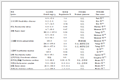
We initiated our study with the α-diazo pyrazoleamide A1 with acetophenone-derived silyl enol ether B1 to identify an appropriate chiral catalyst (Table 1). Chiral N, N′-dioxide L synthesized from L-tetrahydroisoquinoline-3-carboxylic acid and tert-butylamine was used to investigate the metal salts. According to previous works, iron, copper, cobalt and nickel salts, which could be used in both metallocarbenoid formation and Lewis acid activation, were evaluated (entries 1-5). Fe(OTf)2 was sluggish, whereas CuOTf as well as Cu(OTf)2 could promote the reaction but with poor yields (34% and 49%, respectively) and moderate enantioselectivity (40% ee). To our delight, with use of Co(OTf)2 and Ni(OTf)2, the enantioselectivity was improved dramatically (83% and 86% ee). Ni(OTf)2 was selected as the central metal for subsequent optimization in terms of high activity (87% vs. 58%; entry 5 vs. entry 4), the preference is different from the reaction in rearrangement in our previous study [41]. The counter anions of the nickel salts showed no obvious effect on the reaction, and Ni(NTf2)2 as well as Ni(ClO4)2·6H2O gave similar results (entries 6 and 7). Subsequently, the amide moiety in the ligand was examined (entries 8 and 9), and it was found that isopropylamine derived L afforded better enantiocontrol (88% ee vs. 84% ee), whereas the sterically bulky L resulted in a slightly low enantioselectivity (83% ee). The optimal conditions were established via adjusting the reaction temperature from 50 ℃ to 45 ℃, and the product C1 was provided in 90% yield with 90% ee within two minutes (entry 10). Other reaction parameters such as solvents and additives were explored as well, however, no better results were obtained. Comparatively, when chiral bisoxazoline, BINOL or phosphoric acid was used as the ligand, no reaction occurred (see Supporting information for more details).
|
Table 1 Optimization of the reaction conditions. a |


With the optimized reaction conditions in hand, the generality of the protocol for different substrates was evaluated (Scheme 2). Initially, the effect of substitution at silicon group of the silyl enol ethers was examined to react with diazo pyrazoleamide A1. It was found that IPS, TES, TIPS and TBDPS protected enol ethers were all tolerated, readily affording dihydrofuran acetal derivatives C2-C5 in moderate to good yields with high ee values. Next, the substituents on the phenyl ring of 2-siloxy-1-alkene were explored (C6-C27). As depicted in Scheme 2, a strong electron donating substituent at para position resulted in obvious erosion of enantioselectivity (C8 and C9, 69% and 71% ee). While, strong electron withdrawing CF3 group lead to a sharp drop in reactivity (C17, 45% yield, 92% ee). In addition, when silyl enol ethers containing heteroaromatic groups were employed, the corresponding products was obtained in satisfying yields (C18, 78%; C19, 89%), however only 44% enantiomeric excess was afforded for 2-thiophenyl substituted C18. The condensed ring substrates were amenable to the present reaction (C20-C22), but C20 with a tetrahydronaphthyl substituent was afforded in 74% ee. Moreover, di- and tri-substituted acetophenone-derived silyl ethers were subjected into the reaction conditions, the effect of the electronic nature of the substituents seemed to be consistent (C23-C27, 42%-84% yields, 76%-92% ee). The alkyl-bearing enol ethers, such as cyclopropyl and cyclohexyl groups, delivered the related products (C28 and C29) in either poor ee value or inferior yield. Performing the reaction with propiophenone-derived enol ether gave rise to the dihydrofuran acetal C30 bearing two contiguous stereocenters as a single diastereomer with high enantioselectivity (99% ee).

|
Download:
|
| Scheme 2. Substrate scope of silyl enol ethers. Unless otherwise noted, the reactions were carried out with diazo compound A1 (0.1 mmol), silyl enol ethers B1-B30 (0.1 mmol), Ni(OTf)2/L3-TQiPr (1:1, 10 mol%) in CHCl3 (0.5 mL) at 45 ℃ in air. Isolated yields of C1-C30, and the ee value were determined by HPLC on a chiral stationary phase. aL3-TQAd was used instead of L3-TQiPr. bL3-TQnPr was used instead of L3-TQiPr. cL3-TQcP was used instead of L3-TQiPr. | |

Next, the reaction of 2-siloxy-1-alkene B1 with various vinyl α-diazo pyrazoleamides was assessed (Scheme 3). The electronic properties and steric hindrance of substituents on the phenyl ring had a negligible effect on the enantioselectivities. A variety of vinyl diazo pyrazoleamides could react smoothly to give the corresponding products C32-C41 in high level of ee values (82%-90% ee), except C31 with an ortho-methyl substituted phenyl ring (76% ee). Notably, vinyl diazo pyrazoleamides bearing a 2-thienyl or 2-piperonyl, as well as 2-naphthyl groups were proven tolerable as well in the reaction, affording C42-C44 in 88% to 90% ee. The benzyl substituted substrate was tested in this catalytic system, moderate yield and good enantioselectivity was obtained for C45 after longer reaction time (30 min). Moreover, the aryl-substituted α-diazo pyrazoleamide compound, which was sterically demanding, provided the product C46 in sharply reduced enantioselectivity (51% ee). It is noteworthy that most of the reactions completed with a few minutes.

|
Download:
|
| Scheme 3. Substrate scope of α-diazo pyrazoleamides. Unless otherwise noted, the reactions were carried out with diazo compounds A2-A17 (0.1 mmol), silyl enol ether B1 (0.1 mmol), Ni(OTf)2/L3-TQiPr (1:1, 10 mol%) in CHCl3 (0.5 mL) at 45 ℃ in air. Isolated yields of C31-C46, and the ee value were determined by HPLC on a chiral stationary phase. aL2-Pi(OiBu)2 was used instead of L3-TQiPr. | |

To evaluate the practicality of the protocol, a gram-scale synthesis of the dihydrofuran acetal C22 was carried out under the optimal conditions with 3.0 mmol of the vinyl diazo pyrazoleamide A1 and 2-siloxy-1-alkene B22 (Scheme 4a), comparable yield and enantioselectivity were achieved (1.388 g, 86% yield, 94% ee). Next, further derivatizations were conducted. The Sonogashira reaction of C15 yielded the alkynyl coupling product D15 in 83% yield without erosion of ee value (Scheme 4b).

|
Download:
|
| Scheme 4. Gram-scale synthesis and further transformations. | |

Many attempts to get the crystals of the product were unsuccessful at current stage. As an alternative, we simulated the circular dichroism (CD) spectra of the two configurations of the product C1 [54, 55]. The absolute configuration was assigned to be R by comparing CD spectra with the ones measured experimentally (see Supporting information for details).
Based on our previous studies, the absolute configuration of products and the X-ray crystal structure of the [Ni(acac)]+[(L)-H+]− complex, as well as the general mechanism of metal carbenoid promoted (3 + 2) cycloaddition of silyl enol ethers, a plausible catalytic mode was proposed to explain the origin of stereoselectivity (Scheme 5). A chiral nickel carbenoid Int1 generates when the diazo compound A1 interacts with chiral Ni(Ⅱ)/L complex catalyst after the release of nitrogen. The electron-rich substrate 2-siloxy-1-alkene B1 attacked the Int1 at the carbene site from opening right-bottom position (TS1) to form the Int2 bearing oxonium moiety. The aryl group of enol might prefer to locate at the vinyl group of the carbenoid via stabilization of weak attraction. Subsequently, the enolate intermediate performing quickly intramolecular nucleophilic attacks to the Si-face of the oxonium via TS2 where the TBS-bearing oxonium locates downwards to avoid steric hindrance. Thus, the product C1 could be obtained as R-configuration. In the case of silyl enol ethers bearing electron-donation substitution, the addition step is slow down, giving possibility of the rotation of the oxonium unit and leading to reduced enantioselectivity.

|
Download:
|
| Scheme 5. Proposed catalytic cycle. | |

In conclusion, we have developed an efficient catalytical asymmetric (3 + 2) cycloaddition of α-diazo pyrazoleamides with 2-siloxy-1-alkenes by employing a chiral N, N'-dioxide-Ni(Ⅱ) complex catalyst. This methodology provides an expedient access to dihydrofuran acetal derivatives with moderate to good enantioselectivities. Plausible working mode were proposed to elucidate the origin of enantio-induction. Further efforts are under way to clarify the interaction of chiral nickel complex with α-diazo pyrazoleamides, and to explore the applicability of this catalytic system to other asymmetric reactions.
Declaration of competing interestThe authors declare that they have no known competing financial interests or personal relationships that could have appeared to influence the work reported in this paper.
AcknowledgmentsWe appreciate the National Natural Science Foundation of China (No. 22188101), Sichuan Science and Technology Program (No. 2021YJ0561), as well as Sichuan University (No. 2020SCUNL204) for financial support. We Thank Dr. Yuqiao Zhou (Sichuan University) for the assistance in X-ray analysis.
Supplementary materialsSupplementary material associated with this article can be found, in the online version, at doi:10.1016/j.cclet.2022.107791.
| [1] |
S.F. Zhu, Q.L. Zhou, Acc. Chem. Res. 45 (2012) 1365-1377. DOI:10.1021/ar300051u |
| [2] |
D. Gillingham, N. Fei, Chem. Soc. Rev. 42 (2013) 4918-4931. DOI:10.1039/c3cs35496b |
| [3] |
A. Ford, H. Miel, A. Ring, et al., Chem. Rev. 115 (2015) 9981-10080. DOI:10.1021/acs.chemrev.5b00121 |
| [4] |
Y. Xia, D. Qiu, J.B. Wang, Chem. Rev. 117 (2017) 13810-13889. DOI:10.1021/acs.chemrev.7b00382 |
| [5] |
H.M.L. Davies, J. Org. Chem. 84 (2019) 12722-12745. DOI:10.1021/acs.joc.9b02428 |
| [6] |
C. Damiano, P. Sonzini, E. Gallo, Chem. Soc. Rev. 49 (2020) 4867-4905. DOI:10.1039/D0CS00221F |
| [7] |
X.B. Lin, X.H. Liu, X.M. Feng, Asymmetric rearrangement and insertion reactions with metal–carbenoids promoted by chiral N, N'-dioxide or guanidine-based catalysts, in: J.B. Wang, C.M. Che, M.P. Doyle (Eds.), Transition Metal-Catalyzed Carbene Transformations, Wiley-VCH, Weinheim, 2022, pp. 299–324.
|
| [8] |
Ł.W. Ciszewski, K. Rybicka-Jasińska, D. Gryko, Org. Biomol. Chem. 17 (2019) 432-448. DOI:10.1039/C8OB02703J |
| [9] |
Z. Yang, M.L. Stivanin, I.D. Jurberg, R.M. Koenigs, Chem. Soc. Rev. 49 (2020) 6833-6847. DOI:10.1039/D0CS00224K |
| [10] |
J. Durka, J. Turkowska, D. Gryko, ACS Sustainable Chem. Eng. 9 (2021) 8895-8918. DOI:10.1021/acssuschemeng.1c01976 |
| [11] |
Y.J. Lian, K.I. Hardcastle, H.M.L. Davies, Angew. Chem. Int. Ed. 50 (2011) 9370-9373. DOI:10.1002/anie.201103568 |
| [12] |
D. Valette, Y.J. Lian, J.P. Haydek, K.I. Hardcastle, H.M.L. Davies, Angew. Chem. Int. Ed. 51 (2012) 8636-8639. DOI:10.1002/anie.201204047 |
| [13] |
A.G. Smith, H.M.L. Davies, J. Am. Chem. Soc. 134 (2012) 18241-18244. DOI:10.1021/ja3092399 |
| [14] |
P.E. Gu?mán, Y.J. Lian, H.M.L. Davies, Angew. Chem. Int. Ed. 53 (2014) 13083-13087. DOI:10.1002/anie.201406440 |
| [15] |
B.W. Zhang, H.M.L. Davies, Angew. Chem. Int. Ed. 59 (2020) 4937-4941. DOI:10.1002/anie.201914354 |
| [16] |
T. Kunz, A. Janowitz, H.U. Reißig, Synthesis 1 (1990) 43-47. |
| [17] |
R. Tokunoh, H. Tomiyama, M. Sodeoka, M. Shibasaki, Tetrahedron Lett. 37 (1996) 2449-2452. DOI:10.1016/0040-4039(96)00315-2 |
| [18] |
R. Schumacher, F. Dammast, H.U. Reißig, Chem. Eur. J. 3 (1997) 614-619. DOI:10.1002/chem.19970030418 |
| [19] |
A. Ebiger, T. Heinz, G. Umbricht, A. Pfaltz, Tetrahedron 54 (1998) 10469-10480. DOI:10.1016/S0040-4020(98)00499-2 |
| [20] |
H.M.L. Davies, P.D. Ren, J. Am. Chem. Soc. 123 (2001) 2070-2071. DOI:10.1021/ja0035607 |
| [21] |
T.F. Schneider, J. Kaschel, B. Dittrich, D.B. Werz, Org. Lett. 11 (2009) 2317-2320. DOI:10.1021/ol900694m |
| [22] |
C. Brand, G. Rauch, M. Zanoni, B. Dittrich, D.B. Werz, J. Org. Chem. 74 (2009) 8779-8786. DOI:10.1021/jo901902g |
| [23] |
D.L. Ventura, Z.J. Li, M.G. Coleman, H.M.L. Davies, Tetrahedron 65 (2009) 3052-3061. DOI:10.1016/j.tet.2008.11.059 |
| [24] |
Y. Reyes, K.T. Mead, Synthesis 47 (2015) 3020-3026. DOI:10.1055/s-0034-1379934 |
| [25] |
B.D. McLarney, M.A. Cavitt, T.M. Donnell, D.G. Musaev, S. France, Chem. Eur. J. 23 (2017) 1129-1135. DOI:10.1002/chem.201604518 |
| [26] |
E. Wenkert, T.P. Ananthanarayan, V.F. Ferreira, M.G. Hoffmann, H.S. Kim, J. Org. Chem. 55 (1990) 4975-4976. DOI:10.1021/jo00303a048 |
| [27] |
E.A. Lund, I.A. Kennedy, A.G. Fallis, Tetrahedron Lett. 34 (1993) 6841-6844. DOI:10.1016/S0040-4039(00)91809-4 |
| [28] |
M. Kitamura, K. Araki, H. Matsuzaki, T. Okauchi, Eur. J. Org. Chem. 2013 (2013) 5045-5049. DOI:10.1002/ejoc.201300712 |
| [29] |
J. Aponte-Guzmán, L.H. Phun, M.A. Cavitt, et al., Chem. Eur. J. 22 (2016) 10405-10409. DOI:10.1002/chem.201601954 |
| [30] |
L.K. Xia, Y.R. Lee, Adv. Synth. Catal. 355 (2013) 2361-2374. DOI:10.1002/adsc.201300245 |
| [31] |
W.W. Tan, N. Yoshikai, J. Org. Chem. 81 (2016) 5566-5573. DOI:10.1021/acs.joc.6b00904 |
| [32] |
G.G. Faura, T. Nguyen, S. France, J. Org. Chem. 86 (2021) 10088-10104. DOI:10.1021/acs.joc.1c00826 |
| [33] |
T. Kikuchi, K. Ishii, T. Noto, et al., J. Nat. Prod. 74 (2011) 866-870. DOI:10.1021/np100783k |
| [34] |
C.M. Yuan, G.H. Tang, Y. Zhang, et al., J. Nat. Prod. 76 (2013) 1166-1174. DOI:10.1021/np400276q |
| [35] |
G.G.L. Yue, K.M. Chan, M.H. To, et al., J. Nat. Prod. 77 (2014) 1074-1077. DOI:10.1021/np4008969 |
| [36] |
J.R. Ma, W.M. Shu, K.L. Zheng, et al., Org. Biomol. Chem. 13 (2015) 4976-4980. DOI:10.1039/C5OB00163C |
| [37] |
B.B. Snider, Tetrahedron 65 (2009) 10738-10744. DOI:10.1016/j.tet.2009.09.025 |
| [38] |
M. Mondal, U. Bora, RSC Adv. 3 (2013) 18716-18754. DOI:10.1039/c3ra42480d |
| [39] |
X.B. Lin, Y. Tang, W. Yang, et al., J. Am. Chem. Soc. 140 (2018) 3299-3305. DOI:10.1021/jacs.7b12486 |
| [40] |
X.B. Lin, W. Yang, W.K. Yang, X.H. Liu, X.M. Feng, Angew. Chem. Int. Ed. 58 (2019) 13492-13498. DOI:10.1002/anie.201907164 |
| [41] |
X.B. Lin, Z. Tan, W.K. Yang, et al., CCS Chem. 2 (2020) 1423-1433. |
| [42] |
W. Yang, X.B. Lin, Y.Y. Zhang, et al., Chem. Commun. 56 (2020) 10002-10005. DOI:10.1039/D0CC04590J |
| [43] |
W. Yang, M.P. Pu, X.B. Lin, et al., J. Am. Chem. Soc. 143 (2021) 9648-9656. DOI:10.1021/jacs.1c04367 |
| [44] |
X.B. Lin, M.P. Pu, X.P. Sang, et al., Angew. Chem. Int. Ed. 61 (2022) e202201151. |
| [45] |
X.H. Liu, L.L. Lin, X.M. Feng, Acc. Chem. Res. 44 (2011) 574-587. DOI:10.1021/ar200015s |
| [46] |
X.H. Liu, L.L. Lin, X.M. Feng, Org. Chem. Front. 1 (2014) 298-302. DOI:10.1039/c3qo00059a |
| [47] |
X.H. Liu, H.F. Zheng, Y. Xia, L.L. Lin, X.M. Feng, Acc. Chem. Res. 50 (2017) 2621-2631. DOI:10.1021/acs.accounts.7b00377 |
| [48] |
X.H. Liu, S.X. Dong, L.L. Lin, X.M. Feng, Chin. J. Chem. 36 (2018) 791-797. DOI:10.1002/cjoc.201800155 |
| [49] |
Z. Wang, X.H. Liu, X.M. Feng, Aldrichimica Acta 53 (2020) 3-10. |
| [50] |
W.D. Cao, X.H. Liu, X.M. Feng, Chin. Sci. Bull. 65 (2020) 2941-2951. DOI:10.1360/TB-2020-0158 |
| [51] |
M.Y. Wang, W. Li, Chin. J. Chem. 39 (2021) 969-984. DOI:10.1002/cjoc.202000508 |
| [52] |
S.X. Dong, X.H. Liu, X.M. Feng, Acc. Chem. Res. 55 (2022) 415-428. DOI:10.1021/acs.accounts.1c00664 |
| [53] |
G.H. Pan, C.L. He, M. Chen, et al., CCS Chem. 4 (2022) 2000-2008. DOI:10.31635/ccschem.021.202101060 |
| [54] |
M. Faltracco, K.N.A. van de Vrande, M. Dijkstra, et al., Angew. Chem. Int. Ed. 60 (2021) 14410-14414. DOI:10.1002/anie.202102862 |
| [55] |
G.P. Feng, G.Y. Ma, W.Y. Chen, et al., Molecules 26 (2021) 2969-2979. DOI:10.3390/molecules26102969 |