 2023, Vol. 34


b Key Laboratory of Water Pollution Treatment & Resource Reuse, Hainan Normal University, Haikou 571158, China;
c State Key Laboratory of Medicinal Chemical Biology, Tianjin Key Laboratory of Protein Science, and College of Life Sciences, Nankai University, Tianjin 300071, China;
d Department of Dermatology, The Second Hospital Affiliated to Xi'an Jiaotong University, Xi'an 710061, China;
e Charles Institute of Dermatology, School of Medicine, University College Dublin, Dublin 4, Ireland
Gene transfection is a process of intentional modulation of a specific protein expression by transferring exogenous nucleic acids into target cells [1-5]. Despite its tremendous importance in the treatment of various genetic disorders or acquired diseases, the effective and safe transfer of genes has long been a challenge in translating this technology from laboratory to bedsides. To overcome the multiple extracellular and intracellular obstacles to gene transfection, gene vectors are usually used to not only condense DNA and protect it from enzymatic degradation, but also to facilitate the uptake of genetic cargo into cells [6-8].
Cationic polymers are considered one of the most promising candidates for gene transfection. Ring opening polymerization (ROP) [9-12], reversible deactivation radical polymerization (RDRP) [13-15], and step-growth polymerization [16, 17] have been developed for the synthesis of cationic polymers. Thanks to their "living" nature, ROP and RDRP usually yield polymers with narrow molecular weight distribution (MWD). Meanwhile, the molecular weight (MW) of cationic polymers plays a crucial role in determining their physicochemical properties [18, 19]. Polyethyleneimine (PEI) [20], poly[2-(dimethylamino)ethyl methacrylate] (PDMAEMA) [21], chitosan (CS) [22], poly(amidoamine) (PAMAM) [23], and poly-L-lysine (PLL) [24] with different MW exhibit significantly different transfection activities and cytotoxicity both in vitro and in vivo.
In 2015, an "A2+B3+C2" Michael addition strategy was developed by our group to synthesize HPAEs [25, 26]. Amine (A2), triacrylate (B3), and diacrylate (C2) were copolymerized in one-pot, which not only effectively retarded gelation during the polymerization process but also resulted in a three-dimensional (3D) topology with multiple end groups of the obtained HPAEs. By simply varying the feed ratio of diacrylate to triacrylate, the chemical composition and branched structure of the HPAEs can be easily adjusted. In vitro, the optimized HPAEs showed up to 8521-fold improvement in gene transfection compared to the linear counterparts [27, 28]. In vivo, HPAEs were able to transfer plasmids to restore high expression of collagen Ⅶ(C7) in a knockout mouse model and a grafting mouse model for recessive dystrophic epidermolysis bullosa (RDEB). Using the generalizable "A2+B3+C2" Michael addition strategy, more than 70 HPAEs have been developed to date. Nevertheless, the iterative step-growth polymerization and branching process results in all synthesized HAPEs having a broad MWD and polydispersity index (Đ) of 2.1~12.9 [27-30]. Under these conditions, it is not possible to investigate the effect of MW on the gene transfection activity of HPAEs to develop a favorable design principle for clinical application. Moreover, the large heterogeneity of MW would affect the consistency of HPAEs in terms of their chemical composition and topological structure from batch to batch, which would greatly hinder their clinical approval. Despite this need, there has been no report on the development of HPAEs with a narrow MWD, mainly because there is no easy-to-use strategy to fractionate components from different MW on a large scale. Therefore, the aim of this work is to develop a simple fractionation strategy to isolate HPAE components with narrow MWD from the crude polymer and to investigate the effects of MW on gene transfection activity.
Using the "A2+B3+C2" Michael addition strategy, the branched 447 (HPAE-Cr) was synthesized with the monomer combination of 4-amino-1-butanol (S4), trimethylolpropane triacrylate (TMPTA), 1, 4-butanediol diacrylate (B4) and the end-capping reagent 1-(3-aminopropyl)-4-methylpiperazine (E7) (Fig. 1 and Fig. S1 in Supporting information). To promote the formation of the acrylate-terminated HPAE base polymer, the stioichiometric ratio of acrylates to amine was adjusted to 1.2:1.0 and a total monomer concentration of 300 mg/mL was used (Table S1 in Supporting information). As shown in Fig. 2a and Table S2 (in Supporting information), in the early phase of polymerization, due to the high monomer concentration, reaction mainly occurred between the monomers simultaneous through conjugation addition of S4 to B4 and TMPTA, and oligomers were formed, as shown by the GPC trace. At 2 h, the MW is about 3.0 k with a narrow Đ of 1.4. As the polymerization proceeded, most of the monomers were converted to oligomers, which further combined with each other. Under these conditions, MW and the Đ of the polymer increased rapidly to 21.2 k and 4.6, respectively, after 12 h of polymerization.

|
Download:
|
| Fig. 1. Chemical structure of HPAE. | |

|
Download:
|
| Fig. 2. (a) GPC traces of HPAE during polymerization. (b) GPC traces of HPAE components with different MW, fractionated from crude HPAE polymer. | |
However, when the polymerization time was further increased to 18.5 h, however, MW of the polymer increased only slightly to 24.1 k with a Đ of 5.1, indicating that the amine groups in the system were almost completely consumed and excess vinyl groups remained behind due to the unequal stioichiometric ratio of acrylates to amine. The polymerization was stopped and E7 was added to end-cap the base polymer by consuming the excess vinyl groups. After purification with diethyl ether, the product HPAE-Cr with MW of 26.9 k and Đ of 4.0 was obtained. The purity and chemical composition were confirmed by NMR (Fig. S2 in Supporting information).
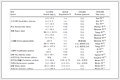
Not surprisingly, HPAE-Cr has a broad Đ of 4.0, which is due to the intrinsic chain propagation mechanism of step-growth polymerization. Previously, size exclusion chromatography (SEC) was used to fractionate polymers with relatively narrow Đ. However, this technique is not practical for large-scale production. Considering that MW has a significant effect on polymer solubility, it is likely that adjusting the polarity of the precipitant will result in fractionation of polymers with different MW. Based on this hypothesis, we propose a stepwise precipitation strategy for HPAE-Cr fractionation. We attempt to isolate HPAE components with Đ < 2.0. Acetone with a polarity index of 5.1 was initially tried as a coprecipitant with the expectation that the high MW components would precipitate in HPAE-Cr while the low MW counterparts would remain soluble in the supernatant. The initial volume ratio of acetone/diethyl ether was set at 1:7 (Table S3 and Fig. S3 in Supporting information). Indeed, a precipitate with higher MW (31.7 k) and lower Đ (2.9) was obtained compared with HPAE-Cr, indicating that part of the low MW components remained dissolved in the supernatant due to the increased polarity of the precipitant. However, the Đ of the isolated product was still too high to investigate the effect of MW on the gene transfection efficiency of HPAEs. However, when the volume ratio of acetone/diethyl ether was further increased to 1:3 (Table S2 and Fig. S4 in Supporting information), no obvious precipitate was obtained, possibly due to the excessive polarity of the precipitant, which resulted in complete dissolution of all polymers. These results suggest that acetone is not favorable for HPAE-Cr fractionation. Next, DMSO with a polarity index of 7.2 was tried as a coprecipitant in volume ratios of 1:6 and 1:4 (DMSO/diethyl ether) (Table S3, Figs. S5 and S6 in Supporting information) respectively. Similar to the acetone/diethyl ether mixture, either a component with high Đ or no precipitate was obtained, again indicating that DMSO is not beneficial for HPAE-Cr fractionation. According to the above experiments, DMF with a polarity index of 6.4 was used as a coprecipitant. Fortunately, components with different MW, but relatively narrow PDI, were precipitated successively. When the volume ratio of DMF/diethyl ether increased from 1:4 to 1:8, HPAEs (Table S3 and Figs. S7–S11 in Supporting information) with high a MW of 31.4 k~64.4 k and Đ < 2.6 were precipitated. Meanwhile, HPAEs with low MW and narrow Đ can also be isolated from the supernatant as long as the volume ratio is < 4.0 (Figs. S12 and S13 in Supporting information). Based on these preliminary studies, four HPAEs with MW of 5.3 k, 33.1 k, 48.6 k, and 68.6 k and Đ of 1.2, 1.9, 1.9, and 1.9 were successively isolated (denoted as HPAE-5.3 k, HPAE-33.1 k, HPAE-48.6 k, and HPAE-68.6 k, respectively (Fig. 2b, Table 1 and Fig. S14 in Supporting information). NMR analysis shows that the four polymers have similar chemical composition (Fig. S15 in Supporting information). All these results indicate that HPAE components of different MW and narrow Đ can be isolated from the crude product by the stepwise precipitation strategy, which makes it possible to study the effect of MW on gene transfection activity.
|
Table 1 MW and Đ of HPAEs under different fractionation conditions. |


The in vitro gene transfection activity of the isolated HPAEs and HPAE-Cr was evaluated in HeLa, HepG2, and HaCaT cells at HPAE/DNA w/w ratios of 10:1, 30:1 and 50:1, according to previous studies [25-30]. Plasmids encoding cytoplasmic green fluorescent protein (GFP) or secreted Gaussia luciferase (Gluc) were used as reporter genes. As shown in Fig. 3 and Fig. S16 (Supporting information), in general HPAE-33.1 k, HPAE-48.6 k, and HPAE-68.6 k, components with medium or high MW, generally show significantly stronger gene transfection activity in HeLa cells than the low MW counterpart HPAE-5.3 k, regardless of the w/w ratios used, as seen by the higher number of GFP positive cells in the fluorescence images. In particular, HPAE-33.1 k exhibits the strongest gene transfection activity, rivaling even the leading commercial gene transfection reagent jetPEI, especially at the lowest w/w ratio of 10:1. Compared to HPAE-Cr, isolated HPAE-33.1 k and HPAE-48.6 k also exhibit higher or comparable gene transfection activity at all three w/w ratios. The gene transfection efficiency of HPAEs with different MW was further quantified by measuring the Gluc activity of the cells after transfection, and a trend similar to that observed for GFP expression was observed. As shown in Fig. 4, the Gluc activity of HeLa cells after transfection with HPAE-33.1 k, HPAE-48.6 k and HPAE-68.6 k was up to two orders of magnitude higher than that mediated by HPAE-5.3 k. At a 10:1 w/w ratio, the Gluc activity of HeLa cells after transfection with HPAE-33.1 k was 70- and 1.1-fold higher than that mediated by HPAE-5.3 k and HPAE-Cr, respectively. Importantly, alarmarBlue assays clearly show that all isolated HPAEs retain relatively high cell viability after transfection, especially at the 10:1 and 30:1 w/w ratios. In contrast, HPAE-Cr mediates a similar level of gene transfection activity as HPAE-33.1 k, HPAE-48.6 k, and HPAE-68.6 k, but the cell viability at the 30:1 w/w was only about 60%. Although, jetPEI has the strongest gene transfection activity, cell viability after transfection was only about 40%, much lower than the viability mediated by HPAEs, even when the highest w/w ratio of 50:1 was used. In HepG2 cells, HPAE-33.1 k, HPAE-48.6 k, and HPAE-68.6 k surprisingly show much stronger transfection activity than HPAE-5.3 k and HPAE-Cr, especially at the w/w ratios of 30:1 and 50:1 (Fig. S17 in Supporting information). In a good correlation with GFP expression, the Gluc activity of cells after transfection by HPAE-33.1 k, HPAE-48.6 k, and HPAE-68.6 k is up to 100- and 4-fold higher than that mediated by HPAE-5.3 k and HPAE-Cr, respectively. At the same time, relatively higher cell viability was maintained, especially at the 10:1 and 30:1 w/w ratios (Fig. S18 in Supporting information). The low MW HPAE-5.3 k exhibited higher cytotoxicity, which may be due to the polyplexes being more aggregated and therefore adsorbing more readily to the cell membrane, leading to excessive interactions of the polyplexes with the lipid bilayer of the cells and causing higher cytotoxicity [26]. As for the difficult-to-transfect HaCaT cells, HPAEs with intermediate and high MW also showed stronger and comparable gene transfection activity compared with HPAE-5.3 k and HPAE-Cr (Figs. S19 and S20 in Supporting information). All these results indicate that MW has a significant effect on the gene transfection performance of HPAEs. In general, HPAEs with medium and high MW (e.g., 33.1 k, 48.6 k and 68.6 k) exhibit much stronger gene transfection activity than the low MW analog (e.g., 5.3 k). The fact that HPAE-5.3 k mediates low gene transfection activity, whereas HPAE-48.6 k and HPAE-68.6 k elicit relatively high cytotoxicity in certain cell types, underscores that HPAE with an intermediate MW (i.e., 33.1 k) is the most potent candidate among HPAEs for gene delivery in achieving high gene transfection efficiency and cell viability simultaneously. From this perspective, isolation of intermediate MW components from HPAE-Cr by fractionation is of great clinical importance.

|
Download:
|
| Fig. 3. Representative GFP images of HeLa cells after transfection with HPAE-5.3 k, HPAE-33.1 k, HPAE-48.6 k, HPAE-68.6 k, and HPAE-Cr (26.9 k) at 10:1, 30:1, and 50:1 w/w ratios. jetPEI was used as control. | |


|
Download:
|
| Fig. 4. (a) Gluc activity and (b) cell viability of HeLa cells after transfection with different HPAE/DNA polyplexes. For Gluc activity, "*" and "#" indicate that it is significantly higher compared with HPAE-Cr and HPAE-5.3 k groups (w/w = 50:1). For cell viability, "*" indicates that it is significantly higher than that of the jetPEI group (P < 0.05, Student's t test). | |

To better understand the mechanism behind the enhancement of gene transfection performance of HPAEs by fractionation, the DNA binding affinity of representative HPAE-Cr, HPAE-5.3 k, and HPAE-33.1 k was determined using the PicoGreen assay. As shown in Fig. 5a, HPAE-Cr has a DNA binding affinity of approximately 50%. After fractionation, the DNA binding affinity of the low MW HPAE-5.3 k was about 40%, lower than that of HPAE-Cr. In contrast, HPAE-33.1 k has a DNA binding affinity of about 70%, which is much higher than that of HPAE-Cr and HPAE-5.3 k. In addition, as shown in Fig. S21 (Supporting information), all three HPAEs (HPAE-Cr, HPAE-33.1 k, HPAE-5.3 k) showed good DNA condensation ability and no DNA shifts along the agarose gel. More importantly, the DNA binding ability of the low MW HPAE (HPAE-5.3 k) is weaker, as shown by the stronger DNA band. Accordingly, the polyplexes formulated with HPAE-33.1 k and DNA have a size of about 170 nm, which is 70 nm and 110 nm smaller than the polyplexes formulated with HPAE-Cr and HPAE-5.3 k with DNA, respectively (Figs. 5b and c). Accordingly, the zeta potential of the HPAE-33.1 k/DNA polyplexes is about +20 mV, which is more positive than that of the HPAE-Cr/DNA and HPAE-5.3 k/DNA polyplexes, which are +11 mV and +7 mV, respectively. These results are in good agreement with previous reports. Considering that the three HPAEs have similar chemical composition, the different DNA binding affinity may be due to their different MW and MWD. On the one hand, the MW of HPAE-33.1 k is much higher compared to HPAE-5.3 k, which gives it more consecutive positive charges and thus favors DNA binding and condensation. On the other hand, both HPAE-Cr and HPAE-33.1 k have a relatively high MW. However, the former has a broader Đ (4.0) than the latter (1.9). Under this condition, the low MW components in HPAE-Cr would affect DNA binding affinity because the successive positive charges are much lower. In contrast, all polymers in HPAE-33.1 k have closely spaced and high consecutive positive charges, which confer much stronger DNA binding affinity and ultimately lead to the formulation of polyplexes with a smaller size and more positive zeta potential.

|
Download:
|
| Fig. 5. HPAE-Cr, HPAE-33.1 k and HPAE-5.3 k exhibit different DNA binding affinity (a), leading to the formation of polyplexes with apparently different size and zeta potential (b), size distribution of polyplexes (c). | |

In conclusions, in this study, we fractionate HPAEs through a stepwise precipitation strategy and further elucidating the effect of MW on the gene transfection performance of HPAEs. The results show that by carefully manipulating the polarity of the precipitant, HPAEs components with a relatively narrow MWD but differentiated by MW can be isolated sequentially. Gene transfection studies show that the intermediate MW is more favorable to impart excellent transfection efficiency while maintaining high cell viability. HPAEs with intermediate MW and narrow MWD can exert stronger DNA binding affinity, leading to the formation of polyplexes with smaller size and higher zeta potential. Our study provides new insights into understanding the structure-property relationship of HPAEs, which would accelerate their clinical translation. The easy-to-use fractionation strategy proposed here could be further extended for the separation of other polymers synthesized by step-growth polymerization.
Declaration of competing interestThe authors declare no competing financial interest.
AcknowledgmentsThis work was funded by the National Natural Science Foundation of China (NSFC, No. 51903202), Hainan Provincial Natural Science Foundation of China (No. 521RC1058), the Key R & D Program of Shaanxi Province (No. 2020GXLH-Y-016), the Natural Science Foundation of Shaanxi Province (No. 2020JM-055), the Fundamental Research Funds for the Central Universities (No. xtr042019020) and the Young Talents Support Plan of Xi'an Jiaotong University (No. HG6J002).
Supplementary materialsSupplementary material associated with this article can be found, in the online version, at doi:10.1016/j.cclet.2022.06.050.
| [1] |
H. Yin, R.L. Kanasty, A.A. Eltoukhy, et al., Nat. Rev. Genet. 15 (2014) 541-555. DOI:10.1038/nrg3763 |
| [2] |
K.A. Hajj, K.A. Whitehead, Nat. Rev. Mater. 2 (2017) 17056. DOI:10.1038/natrevmats.2017.56 |
| [3] |
Q. Bi, X. Song, A. Hu, et al., Chin. Chem. Lett. 31 (2020) 3041-3046. DOI:10.1016/j.cclet.2020.07.030 |
| [4] |
J. Wang, H. Wang, H. Cui, et al., Chin. Chem. Lett. 31 (2020) 3143-3148. DOI:10.1016/j.cclet.2020.07.027 |
| [5] |
Y. Zhang, L. Wang, J. Wang, S. Xin, X. Sheng, Chin. Chem. Lett. 32 (2021) 1902-1906. DOI:10.1016/j.cclet.2021.01.032 |
| [6] |
Y. Wang, C. Li, L. Du, Y. Liu, Chin. Chem. Lett. 31 (2020) 275-280. DOI:10.1016/j.cclet.2019.03.040 |
| [7] |
D.X. Yin, M.J. Zhang, J.X. Chen, Y.Y. Huang, D.H. Liang, Chin. Chem. Lett. 32 (2021) 1731-1736. DOI:10.1016/j.cclet.2020.12.005 |
| [8] |
Y. Wang, R. Zhang, L. Tang, L. Yang, Pharmaceutics 14 (2022) 512. DOI:10.3390/pharmaceutics14030512 |
| [9] |
N. Zhu, H. Gong, W. Han, W.B. Zeng, et al., Chin. Chem. Lett. 26 (2015) 1389-1392. DOI:10.1016/j.cclet.2015.06.005 |
| [10] |
M.A. Mintzer, E.E. Simanek, Chem. Rev. 109 (2009) 259-302. DOI:10.1021/cr800409e |
| [11] |
J. Deng, N. Gao, Y. Wang, et al., Biomacromolecules 13 (2012) 3795-3804. DOI:10.1021/bm3012538 |
| [12] |
Y. Liu, D. Li, J. Ding, X. Chen, Chin. Chem. Lett. 31 (2020) 3001-3014. DOI:10.1016/j.cclet.2020.04.029 |
| [13] |
C. Zhu, M. Zheng, F. Meng, et al., Biomacromolecules 13 (2012) 769-778. DOI:10.1021/bm201693j |
| [14] |
P. Zhang, J. Yang, W. Li, et al., J. Mater. Chem. 21 (2011) 7755-7764. DOI:10.1039/c1jm10813a |
| [15] |
H. Wei, J.A. Pahang, S.H. Pun, Biomacromolecules 14 (2013) 275-284. DOI:10.1021/bm301747r |
| [16] |
D.M. Lynn, R. Langer, J. Am. Chem. Soc. 122 (2000) 10761-10768. DOI:10.1021/ja0015388 |
| [17] |
D.G. Anderson, D.M. Lynn, R. Langer, Angew. Chem. Int. Ed. 42 (2003) 3153-3158. DOI:10.1002/anie.200351244 |
| [18] |
A.A. Eltoukhy, D.J. Siegwart, C.A. Alabi, et al., Biomaterials 33 (2012) 3594-3603. DOI:10.1016/j.biomaterials.2012.01.046 |
| [19] |
J.M. Layman, S.M. Ramirez, M.D. Green, T.E. Long, Biomacromolecules 10 (2009) 1244-1252. DOI:10.1021/bm9000124 |
| [20] |
H. Huang, H. Yu, G. Tang, Q. Wang, J. Li, Biomaterials 31 (2010) 1830-1838. DOI:10.1016/j.biomaterials.2009.11.012 |
| [21] |
C.V. Synatschke, A. Schallon, V. Jerome, R. Freitag, A.H.E. Mueller, Biomacromolecules 12 (2011) 4247-4255. DOI:10.1021/bm201111d |
| [22] |
M. Huang, C.W. Fong, E. Khor, L.Y. Lim, J. Control. Release 106 (2005) 391-406. DOI:10.1016/j.jconrel.2005.05.004 |
| [23] |
J.F. KukowskaLatallo, A.U. Bielinska, J. Johnson, et al., Proc. Natl. Acad. Sci. U. S. A. 93 (1996) 4897-4902. DOI:10.1073/pnas.93.10.4897 |
| [24] |
M.A. Wolfert, P.R. Dash, O. Nazarova, D. Oupicky, et al., Bioconjugate Chem. 10 (1999) 993-1004. DOI:10.1021/bc990025r |
| [25] |
L. Cutlar, D. Zhou, Y. Gao, et al., Biomacromolecules 16 (2015) 2609-2617. DOI:10.1021/acs.biomac.5b00966 |
| [26] |
Y. Gao, J.Y. Huang, J.O.K. Ahern, et al., Biomacromolecules 17 (2016) 3640-3647. DOI:10.1021/acs.biomac.6b01120 |
| [27] |
D. Zhou, L. Cutlar, Y. Gao, et al., Sci. Adv. 2 (2016) e1600102. DOI:10.1126/sciadv.1600102 |
| [28] |
S. Liu, Y. Gao, D. Zhou, et al., Nat. Commun. 10 (2019) 3307. DOI:10.1038/s41467-019-11190-0 |
| [29] |
M. Zeng, F. Alshehri, D. Zhou, et al., ACS Appl. Mater. Interfaces 11 (2019) 30661-30672. DOI:10.1021/acsami.9b13135 |
| [30] |
Y. Wang, C.F. Wang, M. Lie, et al., Chinese J. Polym. Sci. 38 (2020) 830-839. DOI:10.1007/s10118-020-2393-y |