 2022, Vol. 33


b Peking-Tsinghua Center for Life Sciences, Peking University, Beijing 100871, China
TAT (Targeted alpha-therapy) treats cancer by using α-particles [1-3], of which the linear energy transfer (LET) is notably higher than that of β-particles [4], resulting in lethal damage in cancer cells. α-Particles often induce DNA double-strand break, which can hardly repair, and are less dependent on the oxygen level in tumors [5]. The short range of α-particles (50–100 µm) confines the killing region to the lesion and reduces the negative effects on normal tissues [6]. α-Emitters exhibit better therapeutic efficacy than that of β-emitters in clinical studies, features with much less therapeutic dose and less radiation resistance [7, 8].
For instance, 225Ac-labeled radiopharmaceuticals have demonstrated exceptional performance in clinical studies [9-11]. However, 225Ac is conventionally generated from 229Th or 233U [12, 13], and its annual worldwide manufacturing capacity is less than 3 Ci [14], posing a barrier to the growth of TAT [15]. 212Pb (t1/2 = 10.6 h) decays to the stable 208Pb, which is also an α-emitting nuclide and can be radiolabeled with DOTA or other TAT chelators [4, 17].
Extracting 212Pb from natural thorium will resolve the current shortage of α-emitters for TAT and provide a means of supplying α-emitters without relying on high-energy accelerators and reactors. Despite the fact that 212Pb has been developed for TAT for many years, the available source of 212Pb is rather insufficient. 212Pb may be separated from the decay of 228Th, 232Th or 232U [18, 19]. Compare to 232Th, 228Th and 232U are preferred due to the high content of 212Pb [16, 19]. However, both 228Th and 232U are not commercially available and can hardly be obtained by importation [20]. In contrast, 232Th is abundant, especially in China [21]. The low 212Pb content and the consequent technical challenges have hampered the investigation of directly extracting 212Pb from natural thorium. Though it may be the only realistic strategy to prepare 212Pb in China [20], the reports about isolating 212Pb from natural thorium are limited [22, 23].
In this work, we attempted to separate 212Pb directly from natural thorium compounds for labeling radiopharmaceuticals. By solid-phase extraction with a Pb-selective resin (Pb-SpecTM) [24], the 212Pb was isolated directly from the thorium nitrate solution. 2.2 MBq of 212Pb was obtained from 2.5 kg of thorium nitrate hydrate every 48 h, representing 54% of the theoretical maximal activity and 83% of the 212Pb separation efficiency. To validate the quality of the prepared 212Pb, it was applied to label several peptide conjugates of clinical importance, DOTATATE [25], PSMA-617 [26] and FAPI-04 [27, 28], with good radiochemical yields (over 88%).
232Th is abundant and often considered as radioactive waste from mining. The ineffective utilization and treatment of thorium-containing slag not only wastes resources, but also causes major environmental issues when radionuclides from 232Th enter the atmosphere as dust or enter the land and rivers via groundwater [29]. The decay of 232Th produces 212Pb, which is an α-emitter and can be exploited for TAT. The activity of 212Pb in natural thorium is 4.07 kBq/g 212Th at decay equilibrium [30], and it may be extracted directly from thorium compounds for radiopharmaceuticals. In the decay chain, 212Pb was accumulated via 224Ra (α, 3.7 d) 220Rn (α, 55.6 s) 216Po (α, 0.14 s) 212Pb. According to the aforementioned, shown in Fig. 1a, 212Pb in 232/228Th can be recovered 77% within 24 h and up to 93% within 48 h following the separation of 212Pb, which satisfies the nuclide generator's requirement.

|
Download:
|
| Fig. 1. (a) Recovering of 212Pb from 228Th and 224Ra, (b) 232/228Th decay equilibrium curve, and (c) γ-spectroscopy of commercially available thorium compounds. | |
The decay equilibrium curve of 232/228Th is shown in Fig. 1b. Right after the isolation of thorium compounds, the activity of 212Pb gradually declines due to the rapid decay of 228Th, eventually reaching the lowest value of 1.7 kBq/g natTh in the fourth year. Following that, as 232Th decays to 228Th, the 212Pb activity grows gradually until it reaches decay equilibrium.
As shown in Fig. 1c, the γ-spectrum of commercial thorium nitrate. As an inexpensive and easily accessible thorium compounds, thorium nitrate contains radionuclides from the thorium decay chain, ensuring its purity as a raw material for 212Pb generators. The acquired thorium compound had not reached decay equilibrium, as the 212Pb activity was only 1.96 kBq/g natTh, or 48% of equilibrium activity, resulting in additional thorium compound.
Thorium nitrate hydrate (2.5 kg) was dissolved in 5 L HNO3 solution (1 mol/L) with a thorium concentration of around 1 mol/L. According to previous results, this solution had an activity concentration of around 386 kBq/L and total activity of 1.93 MBq.
Pb-SpecTM is a extraction chromatographic resin by sorbing 4, 4′, (5′)-di-(t-butyldicyclohexano)−18-crown-6 (DtBu-CH18C6) in isodecanol solution on an inert substrate for the separation and preconcentration of radiolead [24, 31]. Lead has a good retention on Pb-SpecTM under a wide range of nitric acid concentration (0.1–8 mol/L). Under 1 mol/L HNO3, the Dw of the PB-SpecTM was around 1.5 × 10³ (k' ~ 8 × 10²) [24], indicating that the extraction column with 6 mL resin (2.3 g resin, Φ12.5 mm × 50 mm, 4 mL free column volume) was adequate as the extraction resin for a more efficient 212Pb extraction.
To trap 212Pb with high efficiency, 5 L of a 1 mol/L Th(NO3)4/1 mol/L HNO3 solution was loaded onto the extraction column at a flow rate of 0.5 L/h. The column was then washed with 5 mL 1 mol/L HNO3 and 5 mL H2O to remove residual Th4+ and to reduce the acidity. Finally, Pb2+ was eluted with 7 mL 0.5 mol/L (NH4)2HCit [31], which is suitable for radiopharmaceutical labeling directly.
As shown in Fig. 2a, the column trapped Pb but not Th, Ra or Ac. The radioactivity of 212Pb fell from 445 Bq/mL to 68 Bq/mL in the elution, with an 85% retention ratio, suggesting that the column can efficiently separate and enrich 212Pb. The generator could rapidly regenerate for the next 212Pb separation. The change of 212Pb activity in the column effluent is described in Fig. 2b. At the beginning of loading, the column retained 100% of the 212Pb, but as the loading volume increased, small amount of 212Pb leakage was observed. The average extraction efficiency of 212Pb was 83%, yielding 1.8 MBq 212Pb. As demonstrated in Fig. 2c, 7 mL 0.5 mol/L (NH4)2HCit could efficiently elute 95% 212Pb from the column. We analyzed the samples that had reached decay equilibrium in the next day, and found that the radioactivity of 212Pb was 2.2 MBq at the end of purification.

|
Download:
|
| Fig. 2. Pb adsorption and elution by Pb-SpecTM extraction column. (a) 212Pb, 224Ra and 228Ac activities in the loading and effluent of the column. (b) 212Pb activity curves in the extraction column loading and effluent. (c) Extraction column 212Pb elution yield in each fraction. | |
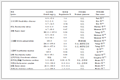
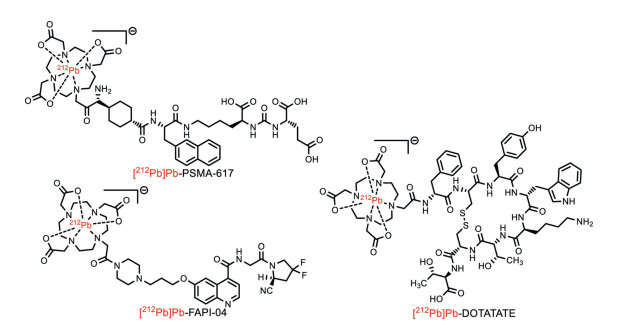
The γ-spectrum of obtained 212Pb was shown in Fig. 3a. All visible peaks were ascribed to 212Pb and its daughter, confirming the greater purity of 212Pb product obtained by this approach. To further evaluate the 212Pb's purity, it was utilized to label a couple of peptides. Although Cit3− can be coordinated with Pb2+, it was demonstrated that 0.5 mol/L (NH4)2HCit did not affect the labeling of Pb2+. Additionally, 0.5 mol/L (NH4)2HCit with a pH of 5.5 may be an ideal buffer for 212Pb labeling with DOTA. The 212Pb labeling reaction was carried out for 10 min at 95 ℃, and the reaction's progress and yield were monitored using radio-iTLC (Na3Cit as mobile phase, Fig. 3b). Table 1 summarizes the labeling conditions and results for [212Pb]Pb-FAPI-04, [212Pb]Pb-PSMA-617, and [212Pb]Pb-DOTATATE (chemical structure shown in Fig. 4). All radiochemical yields (RCY) were greater than 88%, and isolated yields were greater than 83%, indicating that the 212Pb produced using this method was reliable for radiopharmaceutical investigations.

|
Download:
|
| Fig. 3. (a) γ-spectrum of 212Pb product. (b) Radio-iTLC of free [212Pb]Pb2+, reaction mixture, and purified 212Pb-labeled compound during the 212Pb labeling of FAPI-04. | |
|
Table 1 Conditions and results of 212Pb labeling.a |


|
Download:
|
| Fig. 4. Chemical structure of [212Pb]Pb-FAPI-04, [212Pb]Pb- DOTATATE and [212Pb]Pb- PSMA-617. | |
In the above experiment, we successfully obtained 2.2 MBq 212Pb from a 5 L thorium nitrate solution. However, to obtain more 212Pb, additional thorium nitrate solution is needed, which may be difficult in the lab. Another solution to obtain 212Pb based on natTh is to extract 228/224Ra from the matrix and enrich them to isolate 212Pb in a limited volume of 228/224Ra, which would be easier to generate a higher activity of 212Pb. Therefore, the separation and enrichment of 228/224Ra from natural thorium compounds are ongoing to construct next-generation of 212Pb generator. In addition, in the process of rare earth and uranium mining, 'radium removal residue' is a kind of radium-containing waste residue in the form of Ba(Ra)SO4, and the amount of 228/224Ra is considerable. If the waste could be used as a source of 228/224Ra to prepare 228/224Ra-212Pb generators, it would be a "one-stone two-bird" strategy that make full use of the hazardous radioactive waste to produce high-value medical radionuclides.
To summarize, this study aims to extract and purify α-emitter 212Pb from natural thorium compounds for use in TAT radiopharmaceuticals. 2.2 MBq of 212Pb was extracted from 5 L of thorium nitrate solution using Pb-SpecTM with an extraction efficiency of 83% and a high purity. The 212Pb in 0.5 mol/L (NH4)2HCit solution produced could be used directly for the radiolabeling of DOTATATE, PSMA-617 and FAPI-04, which all achieved greater than 88% RCY and 83% isolation yield. The aforementioned results demonstrate that modest amounts of 212Pb can be isolated directly from natural thorium compounds for developing 212Pb-labeled radiopharmaceuticals for targeted alpha-therapy.
Declaration of competing interestWe declare that we have no financial and personal relationships with other people or organizations that can inappropriately influence our work, and there is no professional or other personal interest of any nature or kind in any product, service and/or company that could be construed as influencing the position presented in, or the review of, the manuscript entitled.
AcknowledgmentsThis work was funded by Beijing Municipal Natural Science Foundation (No. Z200018), the Special Foundation of Beijing Municipal Education Commission (No. 3500–12020123), the National Natural Science Foundation of China (Nos. U1867209 and 21778003) and the Ministry of Science and Technology of the People's Republic of China (No. 2017YFA0506300) and Li Ge-Zhao Ning Life Science Youth Research Foundation (No. LGZNQN202004).
| [1] |
J.L. Hatcher-Lamarre, V.A. Sanders, M. Rahman, C.S. Cutler, L.C. Francesconi, Nucl. Med. Biol. 92 (2021) 228-240. DOI:10.1016/j.nucmedbio.2020.08.004 |
| [2] |
T.K. Nikula, M.R. McDevitt, R.D. Finn, et al., J. Nucl. Med. 40 (1999) 166-176. |
| [3] |
M.R. McDevitt, D. Ma, L.T. Lai, et al., Science 294 (2001) 1537-1540. DOI:10.1126/science.1064126 |
| [4] |
Y.S. Kim, M.W. Brechbiel, Tumour Biol. 33 (2012) 573-590. DOI:10.1007/s13277-011-0286-y |
| [5] |
M.R. Zalutsky, D.D. Bigner, Acta Oncol. 35 (1996) 373-379. DOI:10.3109/02841869609101654 |
| [6] |
C. Kratochwil, F.L. Giesel, F. Bruchertseifer, et al., Eur. J. Nucl. Med. Mol. Imaging 41 (2014) 2106-2119. DOI:10.1007/s00259-014-2857-9 |
| [7] |
F. Khreish, N. Ebert, M. Ries, et al., Eur. J. Nucl. Med. Mol. Imaging 47 (2020) 721-728. DOI:10.1007/s00259-019-04612-0 |
| [8] |
X. Wang, X. Zhong, J. Li, Z. Liu, L. Cheng, Chem. Soc. Rev. 50 (2021) 8669-8742. DOI:10.1039/d0cs00461h |
| [9] |
C. Kratochwil, F. Bruchertseifer, F.L. Giesel, et al., J. Nucl. Med. 57 (2016) 1941-1944. DOI:10.2967/jnumed.116.178673 |
| [10] |
C. Kratochwil, F. Bruchertseifer, H. Rathke, et al., J. Nucl. Med. 58 (2017) 1624-1631. DOI:10.2967/jnumed.117.191395 |
| [11] |
C. Kratochwil, F. Bruchertseifer, H. Rathke, et al., J. Nucl. Med. 59 (2018) 795-802. DOI:10.2967/jnumed.117.203539 |
| [12] |
L. Koch, C. Apostolidis, W. Janssens, R. Molinet, J. Van Geel, Czech. J. Phys. 49 (1999) 817-822. DOI:10.1007/s10582-999-1001-8 |
| [13] |
C. Apostolidis, R. Molinet, G. Rasmussen, A. Morgenstern, Anal. Chem. 77 (2005) 6288-6291. DOI:10.1021/ac0580114 |
| [14] |
F. Bruchertseifer, A. Kellerbauer, R. Malmbeck, A. Morgenstern, J. Labelled Compd. Radiopharm. 62 (2019) 794-802. DOI:10.1002/jlcr.3792 |
| [15] |
C. Junyi, L. Yinlong, W. Feng, Z. Tianjue, L. Zhibo, Chemistry (Huaxue Tongbao) 84 (2021) 1210-1218. |
| [16] |
M. Pruszynski, R. Walczak, M. Rodak, et al., Appl. Radiat. Isot. 172 (2021) 109655. DOI:10.1016/j.apradiso.2021.109655 |
| [17] |
B.L. McNeil, A.K. Robertson, W. Fu, et al., EJNMMI Radiopharm. Chem. 6 (2021) 1-18. DOI:10.1007/978-3-030-55296-1_1 |
| [18] |
P. Boldyrev, A. Bortash, V. Zagryadskii, et al., At. Energy 111 (2012) 422-427. DOI:10.1007/s10512-012-9513-x |
| [19] |
R.W. Atcher, A.M. Friedman, J.J. Hines, International Journal of Radiation Applications and Instrumentation. Part A. Appl. Radiat. Isot. 39 (1988) 283–286.
|
| [20] |
A.D. Mendoza España, D. Wojtaszek, A.V. Colton, B.P. Bromley, Nucl. Technol. 203 (2018) 232-243. DOI:10.1080/00295450.2018.1447209 |
| [21] |
V. Fernandez, Resour. Policy 53 (2017) 26-45. DOI:10.1016/j.resourpol.2017.05.010 |
| [22] |
C. Yan, J. Jia, C. Liao, S. Wu, G. Xu, J. Tsinghua Univ. Sci. Technol. 11 (2006) 241-247. DOI:10.1016/S1007-0214(06)70183-3 |
| [23] |
G. Xu, Rare Earth Inf. 5 (2005) 4-5. |
| [24] |
E.P. Horwitz, M.L. Dietz, S. Rhoads, et al., Anal. Chim. Acta 292 (1994) 263-273. DOI:10.1016/0003-2670(94)00068-9 |
| [25] |
Z. Liu, M. Pourghiasian, F. Benard, et al., J. Nucl. Med. 55 (2014) 1499-1505. DOI:10.2967/jnumed.114.137836 |
| [26] |
Z. Liu, M. Pourghiasian, M.A. Radtke, et al., Angew. Chem. Int. Ed. 53 (2014) 11876-11880. DOI:10.1002/anie.201406258 |
| [27] |
M. Xu, P. Zhang, J. Ding, et al., J. Nucl. Med. 62 (2021) 26253. |
| [28] |
P. Zhang, M. Xu, J. Ding, et al., Eur. J. Nucl. Med. Mol. Imaging 49 (2022) 1985-1996. DOI:10.1007/s00259-021-05591-x |
| [29] |
L. Wang, B. Zhong, T. Liang, B. Xing, Y. Zhu, Sci. Total Environ. 572 (2016) 1-8. DOI:10.1016/j.scitotenv.2016.07.192 |
| [30] |
J. Narbutt, A. Bilewicz, Appl. Radiat. Isot. 49 (1998) 89-91. DOI:10.1016/S0969-8043(97)00234-0 |
| [31] |
E.P. Horwitz, R. Chiarizia, M.L. Dietz, Solvent Extr. Ion Exch. 10 (1992) 313-336. DOI:10.1080/07366299208918107 |