 2021, Vol. 32


For gas chromatographic (GC) analyses, baseline separation of individual analytes in samples is essential to acquire their accurate determinations. As known, the resolving performance of a GC column is mainly governed by the selectivity of its stationary phase. Also, it is affected by column inertness, particularly for those analytes that are highly sensitive to active sites on a column, such as volatile fatty acids, aldehydes, phenols and anilines. A column with low inertness tends to produce severely distorted peaks for these analytes and cannot be utilized for their direct analyses. Currently, the methods for addressing the issues mainly include devising selective stationary phases [1-11], derivatizing analytes [12] and deactivating column [13-18]. Derivatization and deactivation can improve the peak shapes of organic acids/bases to some extent but require extra procedures that may bring about additional problems.
Among the stationary phases reported, polycaprolactone diol (PCL) (a polar chain polymer) exhibited outstanding selectivity towards a wide range of isomers (alkylbenzenes, halobenzenes, anilines, phenols) [8]. However, it has relatively low thermal stability (240 ℃) as other hydroxyl-terminated polar polymers do. Take the typical polyethylene glycols (PEG) for example. The pristine PEG decomposes at around 234 ℃ [19] resulting from the back-biting of its terminal groups. Different measures were taken to improve its column thermal stability through cross-linking or sol-gel coating technology [13]. Moreover, modifying PEG with 2-nitroterephthalic acid results in an esterified stationary phase (FFAP) with improved inertness towards organic acids [20] (temperature limits 60 ℃–240/250 ℃). Regarding PCL, our previous work proved that embedding one large rigid triptycene (TP) unit in the middle of PCL polymer (TP-PCL) can significantly improve its thermal stability and selectivity [21]. However, both PCL and TP-PCL columns had low inertness to organic acids. Thus, developing a facile and feasible strategy for engineering a GC stationary phase with high selectivity, inertness and thermal stability would be of vital importance for practical GC analyses.
Triptycene (TP) is composed of three arene units fused to the [2.2.2] bicyclooctatriene bridgehead system with a three-dimensional (3D) rigid π-rich architecture [22]. Its unique structure has become an important building block for materials to increase their intrinsic porosity, thermal stability and solubility or reduce their melting points [22-24]. TP-based materials have good potential as the GC stationary phases [21, 25-31]. The previous reports mainly focused on the TP-based stationary phases having one TP moiety embedded in the middle of their structures and two linear flexible chains at both ends [26-30], in addition to a TP-derived macrocycle [31]. These investigations demonstrated their improved selectivity and thermal stability in contrast to their counterparts without the TP moiety. However, their inertness to highly sensitive organic acids requires to be upgraded largely.
This work presents a novel strategy to engineer a GC stationary phase with the combined features of high selectivity, inertness and thermal stability by introducing the 3D π-rich TP moieties to the terminals of a polar chain polymer. Herein, we provide the first example fulfilled by the strategy, i.e., a new TP-terminated PCL polymer (TPP, Fig. 1a) as the stationary phase for GC analyses. To our knowledge, such a unique material has not been reported up to date. As demonstrated, the TPP column exhibited distinctly advantageous performance in selectivity, inertness and thermal stability in contrast to the PCL column. The proposed strategy is facile, feasible and generally applicable to other analogous polymers.

|
Download:
|
| Fig. 1. (a) Synthesis of TPP and (b) TGA curves of the TPP and PCL stationary phases from 30 ℃ to 700 ℃ at 10 ℃/min under nitrogen. | |
First, TPP was synthesized by the procedure described in Fig. 1a. First, TP-OH and PCLTS were synthesized following the procedure described in Ref. [29]. As a result, the PCLTS product was obtained as a white waxy solid (yield, 73.5%).1H NMR (400 MHz, CDCl3), δ: 7.72–7.73 (d, 4H, Ar–H), 7.21–7.29 (d, 4H, Ar–H), 3.92–4.08 (q, 33H, –CO–O–CH2–), 3.56–3.61 (q, 2H, HO–CH2–), 2.30 (s, 3H, Ar–CH3), 2.14–2.36 (t, 33H, –O–CO–CH2–), 1.57–1.73 (m, 70H, –O–CH2–CH2–), 1.17–1.33 (p, 33H, –CH2–). Then, a 50 mL three-necked flask charged with 0.50 g of PCLTS and 0.19 g of TP−OH (molar ratio 1:2.2), 0.31 g K2CO3 in anhydrous acetonitrile was refluxed at 81 ℃ for 24 h under nitrogen. The solution was rinsed with water, dichloromethane and saturated brine three times in turn and the lower layer was evaporated to dryness. The residue was purified by column chromatography (petroleum ether/ethyl acetate, 1:1, v/v), and the TPP product (M.W. 2540) was obtained as a light yellow waxy solid and dried under vacuum oven overnight (yield, 44.4%, m.p. 42−44 ℃).1H NMR (400 MHz, CDCl3), δ: 7.19–7.31 (dd, 8H, Ar–H), 6.89–6.91 (dd, 8H, Ar–H), 6.32–6.41 (d, 4H, Ar–H), 5.71−5.71 (d, 4H, Ar–H), 4.20 (s, 4H, Ar–O–CH2–), 3.97–4.01 (t, 4H, Ar–O–CH2–), 3.56–3.59 (t, 40H, –O–CO–CH2–), 2.02–2.20 (t, 40H, –O–CO–CH2–), 1.51–1.61 (qd, 75H, –O–CH2–CH2), 1.15–1.23 (m, 40H, –CH2–).
Next, thermal gravimetric analysis (TGA) was used to determine the intrinsic thermal stability of TPP in comparison with PCL (M.W. 2000). As described in Fig. 1b, TPP is thermally stable up to 360 ℃ with 5% weight loss, showing significantly improved thermal stability over PCL (250 ℃). These results demonstrate that TPP has much higher thermal stability than PCL and can be an ideal candidate as a GC stationary phase. Thus, the TPP capillary column (10 m × 0.25 mm, i.d.) was prepared by the static coating method [21] and exhibited a column efficiency of 4347 plates/m determined by naphthalene at 120 ℃. Subsequently, we performed the investigations on the polarity, separation performance and thermal stability of the TPP column compared with the PCL column and the commercial DB-35 column coated with (35% phenyl) methyl polysiloxane.
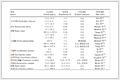
McReynolds constants are used to evaluate the polarity of a stationary phase by the retention index differences of five probe analytes, namely benzene (X'), 1-butanol (Y'), 2-pentanone (Z'), 1-nitropropane (U') and pyridine (S'), on a given column from a squalane column. In this work, the constants of the TPP column were determined by the indicated probes at 120 ℃. As provided in Table 1, the TPP column has the average polarity of 209, indicating its moderate polarity. Its lower polarity than the PCL column stems from the introduced TP moieties, revealing their discrepancy in molecular interactions and possibly different separation performance. Moreover, the DB-35MS column was used for comparison due to its close polarity to the TPP column and its recognition as a highly inert column.
|
Table 1 McReynolds constants of the TPP column compared with the PCL and DB-35MS columns. |


Further, the separation performance of the TPP column was investigated by utilizing diverse types of analytes and isomers, including volatile fatty acids, aldehydes, phenol isomers, aniline isomers, alkylated and halogenated benzene isomers. These analytes are difficult to be resolved owing to their high sensitivity to active sites on a GC column or high resemblance in physicochemical properties. Fig. 2 shows the separation results for the mixtures of fatty acids and aldehydes on the TPP column and the reference columns (PCL, DB-35MS), respectively. As shown, the TPP column achieved baseline separations of both acids and aldehydes with better peak shapes than the other columns. In contrast, the PCL column showed severely distorted peaks for the acids owing to its irreversible adsorption to them while the DB-35MS column displayed coelution of some aldehydes and noticeable peak broadening and tailing for the acids. The markedly improved inertness of the TPP column over the PCL column is mainly credited to its 3D bulky triptycene terminals that may shield the silanol groups on the capillary surface from close contact with the analytes and thus reduce their adverse adsorption. The above results prove the high selectivity and inertness of the TPP column to these highly sensitive analytes, demonstrating its advantageous feature for their analysis.

|
Download:
|
| Fig. 2. Separations of (a) fatty acids and (b) aldehydes on the TPP, PCL and DB-35MS capillary columns (10 m). Peaks for (a): (1) pentanoic acid, (2) hexanoic acid, (3) heptanoic acid, (4) octanoic acid and (5) nonanoic acid. Peaks for (b): (1) butyraldehyde, (2) pentaldehyde, (3) hexaldehyde, (4) heptaldehyde, (5) octanal, (6) nonanal, (7) decanal and (8) salicylaldehyde. Oven temperatures: (a) 100 ℃ to 160 ℃ at 10 ℃/min and (b) 90 ℃ to 160 ℃ at 10 ℃/min. Flow rate: 1.0 mL/min for (a) and (b). | |

Figs. 3a–c present the separations of cresol isomers, benzenediol isomers and chloroaniline isomers on the TPP column and the DB-35MS column, respectively. Observably, the TPP column well resolved these acidic/basic isomers with symmetric peak shapes, showing distinct advantages over the reference column. In contrast, the DB-35MS column coeluted the critical pairs of p-/m-cresol, p-/m-benzenediol and m-/p-chloroaniline. The high-resolution performance of the TPP column is ascribed to its comprehensive molecular interactions (H-bonding, π-π stacking, CH-π and van der Waals forces), which offer its capability for distinguishing isomers from each other by their delicate differences in interaction strength through the 3D π-rich TP units and the polar PCL unit. In addition, it can be observed that the TPP column showed distinctly longer retention for the phenols and anilines than the DB-35MS column, which originate from its stronger π-π stacking and H-bonding interactions with these analytes than the other column, as indicated by its higher X', Y' and S' values in Table 1.

|
Download:
|
| Fig. 3. Separations of (a) cresol isomers, (b) benzenediol isomers and (c) chloroaniline isomers on the TPP and DB-35MS capillary columns (10 m). Oven temperatures: 90 ℃ to 160 ℃ at 5 ℃/min for (a) and (c), 100 ℃ to 160 ℃ at 10 ℃/min for (b). Flow rate: 0.60 mL/min for (a) and (c), 1.0 mL/min for (b). | |

The TPP column also exhibited high resolving capability for other positional isomers. Figs. 4a–f provide its separations for the isomer mixtures of diethylbenzenes, dichlorobenzenes, dibromobenzenes, chloronitrobenzenes, bromonitrobenzenes and nitrotoluenes. As shown, the TPP column baseline resolved all the isomers with good peak shapes. The above results verified the outstanding performance of the TPP column towards diverse positional isomers with a wide range of polarity and acidic/basic nature.

|
Download:
|
| Fig. 4. Separations of the indicated isomer mixtures varying from aploar to ploar nature. Oven temperatures: 40 ℃ to 160 ℃ at 10 ℃/min for (a–e) and 70 ℃ to 160 ℃ at 10 ℃/min for (f). Flow rate: 1.0 mL/min for (a–f). | |

Column repeatability and reproducibility were determined by separations of three isomer mixtures on the TPP column, including heptane isomers, m-/p-/o-dichlorobenzene and 1, 3, 5-/1, 2, 4-/1, 2, 3-trichlorobenzenes, and evaluated by the relative standard deviations (RSD) on the retention times of the analytes. As a result, the RSD values were 0.07%–0.12% for run-to-run, 0.06%–0.25% for day-to-day and 1.3%–4.3% for column-to-column, demonstrating its excellent column repeatability and reproducibility. In addition, the thermal stability of the TPP column was tested by its column bleeding profile. Fig. 5 shows that there is no noticeable baseline rise up to 300 ℃, indicating its significantly enhanced thermal stability over the PCL column (220 ℃). This dramatic increase in thermal stability is credited to the bulky and rigid TP terminals that can prevent the side chains from dense packing [22-24] and thus reduce their back-biting tendency, one major reason for chain breakage and column bleeding. Accordingly, introducing the TP terminal units onto a polar chain polymer proves to be a facile and feasible strategy for increasing the thermal stability of the given stationary phase. Assuredly, a GC column with high thermal stability is beneficial to extend its operational temperature range and maintain stable performance for routine analyses.

|
Download:
|
| Fig. 5. Bleeding profiles of the TPP and PCL columns from 40 ℃ to 380 ℃ at 3 ℃/min under nitrogen. | |

On the basis of the above results, we applied the TPP column to commercial chemical products for their purity monitoring. As described in Fig. 6, the impurity hexanoic acid was detected in the methyl hexanoate sample with the content of 0.6% (Fig. 6a), and 2, 5-/3, 5-isomer impurities were found in the 2, 4-xylidine sample with the content of 0.4% and 0.2%, respectively (Fig. 6b). The above results demonstrate the good potential of the TPP column for practical analyses.

|
Download:
|
| Fig. 6. Applications of the TPP column to purity monitoring of chemical products. Determination of the acidic impurity in methyl hexanoate (a) and the isomer impurities in 2, 4-xylidine (b), respectively. | |

In summary, this work presents a novel strategy for developing a GC stationary phase with the desired performance by introducing the 3D π-rich triptycene units onto a polar chain polymer. By the strategy, we present a novel TPP stationary phase that exhibits high inertness towards organic acids, bases and aldehydes and displays high thermal stability, showing distinct advantages over the PCL column. As demonstrated, the TPP column has good potential for practical analyses. Moreover, the polymer based stationary phase has some advantages in comparison with porous solid stationary phases. First, its good solubility in common organic solvents favors its uniform coating on a capillary to achieve a high column efficiency. Second, its liquid state in the operational temperatures promotes its solvation process of analytes to enhance its selectivity towards analytes of high similarity. To our knowledge, this work is the first report on employing such type of materials in separation science. Importantly, the proposed strategy is facile and feasible and generally applicable to other analogues polymers.
Declaration of competing interestThe authors declare that they have no known competing financial interests or personal relationships that could have appeared to influence the work reported in this paper.
AcknowledgmentThe authors are grateful for the financial support by the National Natural Science Foundation of China (No. 21575013).
| [1] |
A. Speltini, D. Merli, A. Profumo, Anal. Chim. Acta 783 (2013) 1-16. DOI:10.1016/j.aca.2013.03.041 |
| [2] |
C.F. Poole, N. Lenca, J. Chromatogr. A 1357 (2014) 87-109. DOI:10.1016/j.chroma.2014.03.029 |
| [3] |
J. Zhang, Z. Chen, J. Chromatogr. A 1530 (2017) 1-18. DOI:10.1016/j.chroma.2017.10.065 |
| [4] |
X. Liang, X. Hou, J. Chan, et al., Trends Anal. Chem. 98 (2018) 149-160. DOI:10.1016/j.trac.2017.11.008 |
| [5] |
S. Xie, X. Chen, J. Zhang, L. Yuan, Trends Anal. Chem. 124 (2020) 115808. DOI:10.1016/j.trac.2020.115808 |
| [6] |
Y. He, M. Qi, Chin. J. Chromatogr. 38 (2020) 409-413. |
| [7] |
Y. He, M. Qi, Sci. Sin. Chim. 50 (2020) 1142-1150. DOI:10.1360/ssc-2020-0078 |
| [8] |
J. Peng, Y. Zhang, X. Yang, M. Qi, J. Chromatogr. A 1466 (2016) 148-154. DOI:10.1016/j.chroma.2016.09.005 |
| [9] |
X. Han, H. Wang, Bo Wu, et al., J. Chromatogr. A 1468 (2016) 192-199. DOI:10.1016/j.chroma.2016.09.063 |
| [10] |
J. Chen, Y. Huang, H. Qiu, et al., Chem. Commun. 55 (2019) 10908. DOI:10.1039/c9cc05307g |
| [11] |
X. Xiong, M. Qi, J. Chromatogr. A 1612 (2020) 460627. DOI:10.1016/j.chroma.2019.460627 |
| [12] |
P. Hušek, J. Chromatogr. B 717 (1998) 57-91. DOI:10.1016/S0378-4347(98)00136-4 |
| [13] |
C. Shende, A. Kabir, E. Townsend, A. Malik, Anal. Chem. 75 (2003) 3518-3530. DOI:10.1021/ac0207224 |
| [14] |
S.N. Atapattu, C.F. Poole, J. Chromatogr. A 1185 (2008) 305-309. DOI:10.1016/j.chroma.2008.02.042 |
| [15] |
L. Wang, X. Wang, M. Qi, R. Fu, J. Chromatogr. A 1334 (2014) 112-117. DOI:10.1016/j.chroma.2014.01.070 |
| [16] |
X. Wang, M. Qi, R. Fu, J. Chromatogr. A 1371 (2014) 237-243. DOI:10.1109/TrustCom.2014.62 |
| [17] |
Y. Zhang, Q. Lv, M. Qi, Z. Cai, J. Chromatogr. A 1496 (2017) 115-121. DOI:10.1007/s12250-016-3917-z |
| [18] |
X. Xiong, M. Qi, New J. Chem. 44 (2020) 10621-10627. DOI:10.1039/d0nj02185g |
| [19] |
F.R. Mansour, L. Zhou, Chromatographia 78 (2015) 1427-1442. DOI:10.1007/s10337-015-2983-y |
| [20] |
S. Hong, C.M. Duttweiler, A.T. Lemley, J. Chromatogr. A 857 (1999) 205-216. DOI:10.1016/S0021-9673(99)00781-5 |
| [21] |
T. Shi, M. Qi, X. Huang, J. Chromatogr. A 1614 (2020) 460714. DOI:10.1016/j.chroma.2019.460714 |
| [22] |
J. Chong, M.J. MacLachlan, Chem. Soc. Rev. 38 (2009) 3301-3315. DOI:10.1039/b900754g |
| [23] |
Y. Jiang, C. Chen, Eur. J. Org. Chem. 2011 (2011) 6377-6403. DOI:10.1002/ejoc.201100684 |
| [24] |
J.R. Weidman, R. Guo, Ind. Eng. Chem. Res. 56 (2011) 4220-4236. |
| [25] |
Y. Yang, Q. Wang, M. Qi, X. Huang, Anal. Chim. Acta 988 (2017) 121-129. DOI:10.1016/j.aca.2017.07.070 |
| [26] |
J. He, L. Yu, X. Huang, M. Qi, J. Chromatogr. A 1599 (2019) 223-230. DOI:10.1016/j.chroma.2019.04.018 |
| [27] |
L. Yu, J. He, M. Qi, X. Huang, J. Chromatogr. A 1599 (2019) 239-246. DOI:10.1016/j.chroma.2019.04.033 |
| [28] |
J. He, M. Qi, Chin. Chem. Lett. 30 (2019) 1415-1418. DOI:10.1016/j.cclet.2019.03.008 |
| [29] |
Y. He, M. Qi, J. Chromatogr. A 1618 (2020) 460928. DOI:10.1016/j.chroma.2020.460928 |
| [30] |
Q. Yuan, M. Qi, J. Chromatogr. A 1621 (2020) 461084. DOI:10.1016/j.chroma.2020.461084 |
| [31] |
Y. He, X. Yang, M. Qi, C. Chen, Chin. Chem. Lett. 32 (2021) 2043-2046. DOI:10.1016/j.cclet.2020.11.009 |