 2020, Vol. 31


Study found that material's performance originated from the exposed surface [1]. Understanding a material often starts from its most stable exposed surface [2], which is also the working surface in practical applications. This is especially true for gas sensing materials [3], the particular surface of which determines the sensitivity. While the exposure of material surfaces is often the result of a variety of factors constraining and balancing each other, so determining the exposed surfaces of materials is rather challenging. Recently, technological progress allows the consideration on the exposed surface become more and more widely [1-4]. The confirmation of exposed surface will provide a solid foundation for materials understanding, potential exploring, performance analyzing, and modification performing. However, in the study of materials, a truth is emerged gradually that the more detailed structure of exposed surface is the decisive factor in material performance, which has not yet been fully realized [4].
In fact, the importance of surface derives from the decisive role of structure to nature. The understanding degree of surface structure determines the understanding depth and controlling breadth over material properties. Experiments usually determine the exposed surface through the pattern of diffraction spots. The most commonly used experimental method is transmission electron microscope (TEM). It does play a key role in determining the way materials working in many influential studies. However, the traditional resolution has so far stayed on the order of nanometers [5], although new efforts are continuingly performed, more detailed description of surface is still not easy to be achieved [6]. This directly leads to the lack of the basic mechanism of various chemical-physical processes associated with surface [1]. In the context of experimental technology that has yet needed to be improved and generalized, theoretical predication is undoubtedly a convenient and powerful choice.
In the research of hexagonal WO3 (h-WO3) (001) surface [7-10], a fact discovered theoretically that the oxygen vacancy O-terminated (001) surface is actually the most exposed (001) surface in working conditions, especially in air as the most frequently working scene. This can be derived firstly from the strong oxygen-absorbing ability of WO3 surface [10-12], which can be called by effective surface or working surface as Zhou et al. [4] have ever clamed in a recent job. They found that photocatalytic activity of surfaces is determined by the actual working surface structure, the adsorbate reconstructed surface instead of their intrinsically clean one. Therefore, when the surface structure of h-WO3 (001) was changed, the performance varied significantly as disclosed in the case of CO and H2 sensing [7-10]. It can be said that there is a kind of structure change which does not change the TEM pattern ultimately, while it is large enough to change the performance of material. All these indicate that just knowing the intrinsic surface structure is far from the complete and accurate understanding of material. The surface understanding at atomic level is essential [2, 3].
For the material of h-WO3, its (001) surface can be terminated in two kinds of ways. That is oxygen atom terminated (oxygen terminated, denoted as O-) and both tungsten and oxygen atoms terminated (tungsten oxygen terminated, WO-) (001) surfaces (Figs. 1a and c). When oxygen deficiency takes place on these surfaces, oxygen vacancy occurs. Then there are new surface structure emerging, which we can call oxygen vacancy O-terminated and oxygen vacancy WO-terminated h-WO3 (001) surfaces (Vac O- and Vac WO-, Figs. 1b and d). Thus there are four detailed surface structures for h-WO3 (001) now. They are actually four h-WO3 (001) surfaces. As we have disclosed before, their performance for the same kind of gas of CO or H2 are very different [7-10].

|
Download:
|
Fig. 1. Slab models of hexagonal WO3 (001) surfaces [7-10]: (a) O-terminated surface, (b) O-terminated surface with oxygen vacancy, (c) WO-terminated surface and (d) WO-terminated surface with oxygen vacancy. Blue and red balls represent W and O atoms, respectively.  |
|
Our theoretical consideration of h-WO3 (001) working surface (the most possibly exposed surface in use) originated from the competitive adsorption behavior of CO and O2 disclosed in our CO/h-WO3 (001) gas sensing studies [7, 8, 10]. The density functional theory (DFT) calculations using DMol3 were performed based on Perdew-Bruke-Ernzerhof (PBE) parameterization of generalized gradient approximation (GGA) [13]. The h-WO3 (001) surface was simulated by a periodic (2 × 1) slab model as shown in Figs. 1a–d. The slab lattice constant was relaxed to release the static st on the oxygen lacking Wress. CO and O2 molecules were initially placed above on different binding sites. Adsorption energy Eads and formation energy of oxygen vacancy Efv are calculated (more details in Supporting information).
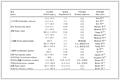
Table 1 described the adsorption energy of CO and O2 on the four kinds of different h-WO3 (001) surfaces, the clean and oxygen vacancy presented O-terminated surfaces (O- and Vac O-), and the clean and oxygen vacancy presented WO-terminated surfaces (WO- and Vac WO-). In comparison of adsorption energies (Table 1), CO is preferred on O-terminated surfaces, binding to the oxygen rich O- (binding energy 2.64 eV) or Vac O- surfaces (1.96 eV). In contrast, O2 is preferred on the oxygen lacking WO- (1.65 eV) and Vac WO- (7.30 eV) surfaces. For the former two surfaces, CO can be sensing directly. For the latter two, CO sensing will be sensitive after O2 adsorption, which is just the scene widely accepted in the field of reducing gas sensing [12]. Then due to adsorption competition, the working surface of CO gas sensing is actually always the O-terminated surface or oxygen vacancy O-terminated surface, just as indicated in the last column of Table 1.
|
Table 1 CO and O2 competitive adsorption [7, 8, 10] on the four surfaces: O-terminated, vacancy O-terminated, WO-terminated and vacancy WO-terminated h-WO3 (001) surfaces. |


As for the most exposed surface, formation energy of oxygen vacancy should be a good index. The formation energy of oxygen vacancy on the O-terminated surface is calculated to be 0.93 eV, which is much smaller than the vacancy formation energy on the WO-terminated surface of 4.23 eV. It is consistent well with the relative stability of O- and WO-terminated (001) surfaces indicated by surface energy [14]. It confirms that the formation of oxygen vacancy O-terminated surface (Vac O-) is relatively easier than the formation of oxygen-vacancy WO-terminated surface (Vac WO-) from the clean one. Then, Vac O- is easily formed from a perfect surface, and Vac WO- is difficult to form from a perfect surface. That is, O- becomes Vac O-. Then the working surface for CO gas sensing is mainly oxygen vacancy O-terminated surface. That is the Vac O- is the working surface for CO sensing. Of course, it is also the most exposed surface of h-WO3 (001).
In the synthesis process, because it is often impossible to avoid the generation of oxygen vacancies [15], the possibility of forming an oxygen-vacancy WO-terminated surface (Vac WO-) is generally high. However, according to our calculations, this kind of surface is very difficult to be stable in air. Since oxygen vacancies have superb oxygen absorption capacity and the adsorption energy can reach as high as 7.30 eV (Table 1) [10]. O2 dissociative adsorption occurs when an oxygen atom fills a surface oxygen vacancy to allow it to recover, and an oxygen atom adsorbs on the immediately adjacent four coordinated W4c to become single coordinated O1c exposed to the outside (Fig. 2a). The recent discovery of the barrier-less transformation of surface (Vac WO-) with lower oxygen density to higher one (Vac O-) confirmed this further (Fig. S1 in Supporting information). This surface can be firstly called oxygen-absorbed WO-terminated surface. The essence of it is oxygen vacancy O-terminated surface (Vac O-) with relatively less oxygen adsorption. That is, Vac WO- becomes Vac O-.

|
Download:
|
| Fig. 2. Schematic diagrams: (a) O2 dissociation on Vac WO- surface to form a new Vac O- surface. (b) CO sensing on the most exposed oxygen vacancy O-terminated surface (Vac O-) [8]. | |

If the initially formed surface is oxygen vacancy O-terminated surface (Vac O-), the ability to absorb oxygen is limited in air because of its strong repulsive effect to oxygen O2, consistent with the smaller adsorption energy (0.24 eV, Table 1). Therefore Vac O- is retained.
On the condition that WO-terminated surface (WO-) was obtained firstly in the synthesis process. It has a strong oxygenabsorbing ability with the adsorption energy for an oxygen atom up to 2.67 eV [10] and O2 up to 1.65 eV (Table 1). Thus it has large possibility of not existing or appearing as an oxygen pre-absorbed WO- surface, which we know can be regarded as a kind of oxygen vacancy O-terminated surface with large defect density. Then WO- surfaces will convert to Vac O- surface again.
Therefore, no matter which surface is initially synthesized, that can finally be stably present in air is always the oxygen vacancy O-terminated surface, Vac O- (Fig. 3). Thus, it can be concluded that the oxygen vacancy O-terminated surface is the most exposed surface of hexagonal WO3 (001) in air (From the binding energy point of view, the working surface is also confirmed in Fig. S2 in Supporting information). This explains why there are so many theoretical simulations using this surface directly as the research objects [16-19]. It also reveals the intrinsic causes of that the adsorbed oxygen and oxygen vacancies can be found together to help the material achieve a significant increase in gas sensitivity [20].

|
Download:
|
| Fig. 3. The schematic diagram of the relationship between other three surfaces and the most exposed Vac O- surface. | |

A job from Zhao et al. [20] mentioned that the sensitivity of material is derived from both adsorbed oxygen and oxygen vacancies. This may be the scene presented on the oxygen vacancy O-terminated surface, which simultaneously possesses these two kinds of active sites (Fig. 1b). Just as we have ever uncovered in the completed jobs [7-10], on the oxygen vacancy O-terminated surface, absorbed oxygen (lattice oxygen) and oxygen vacancy both contribute to the sensitivity, with adsorbed oxygen to be dominant. Adsorbed oxygen usually displayed as single coordinated O1c and oxygen vacancy displayed as five coordinated W5c. Then the active sites of the most exposed h-WO3 (001) surface include O1c site and W5c site, with the O1c site to be dominant. Fig. 2b describes the situation of CO sensing on the most exposed oxygen vacancy O- terminated surface (Vac O-) [8]. Both O1c and W5c can contribute to the sensitivity of the material.
In fact, what is confirmed here is not only the most stable exposure of a surface. It is also an effective exposure in its use. We call it working surface or effective surface. The effective surface is different from the exposed surface determined in the general TEM experiments. Compared with the experimentally measured exposed surface, it is the same surface while provides more detailed structural information. It should be analogous to intrinsic structure and reconstructed structure, respectively, mentioned in Zhou et al.'s study [4]. It can be said that it is the effective surface that determines the performance of material. Whether the surface exposed in the application environment can work effectively is decisive to performance. Material handling based on this understanding will be more targeted and purposeful so that facilitates the precise control of materials.
Based on DFT calculation, we have confirmed that the oxygen vacancy O-terminated surface is the most exposed surface of h-WO3 (001) in working condition. This judgment derived from the confirmation of the effective working surface based on energy changes, competitive adsorption, and oxygen vacancy formation energy comparison. The possibility judgement of stable existing of four different h-WO3 (001) surfaces in air will provide new perspectives and performance explanations for material research. And it can be extended to the understanding on other materials.
Declaration of competing interestsThe authors declare that they have no known competing financial interests or personal relationships that could have appeared to influence the work reported in this paper.
AcknowledgmentsThis work was supported by National Natural Science Foundation of China (Nos. 61971252, 20703027), Excellent Youth Fund of Shandong Province (No. ZR201709200070), Foundation of Shandong Educational Committee (No. J09LB06), Shandong excellent young scientist research award fund (No. BS2011NJ004) and open project of Shanghai Key Laboratory of Rare Earth Functional Materials.
Appendix A. Supplementary dataSupplementary material related to this article canbefound, in the online version, at doi:https://doi.org/10.1016/j.cclet.2020.01.015.
| [1] |
Y.K. Peng, S.C. Edman Tsang, Nano Today 18 (2018) 15-34. DOI:10.1016/j.nantod.2017.12.011 |
| [2] |
(a) C.W. Kim, S.J. Yeo, H.M. Cheng, Y.S. Kang, Energy Environ. Sci. 8 (2015) 3646-3653; (b) G. Liu, L.C. Yin, J. Pan, et al., Adv. Mater. 27 (2015) 3507-3512; (c) C.S. Tan, P.L. Hsieh, L.J. Chen, M.H. Huang, Angew. Chem. Int. Ed. 56 (2017) 15339-15343; (d) J. Meng, Q. Lin, T. Chen, et al., Nanoscale 10 (2018) 2908-2915; (e) R. Wang, J. Xue, K.L. Wang, et al., Science 366 (2019) 1509-1513. |
| [3] |
(a) X. Gao, T. Zhang, Sens. Actuator. B-Chem. 277 (2018) 604-633; (b) Z. Lin, M. Xu, P. Fu, Q. Deng, Sens. Actuator. B-Chem. 254 (2018) 755-762; (c) Q. Jia, H. Ji, D. Wang, et al., J. Mater. Chem. A 2 (2014) 13602-13611; (d) R. Wu, F.H. Tian, Z. Liu, et al., Appl. Surf. Sci. 481 (2019) 1154-1159; (e) D. Zhang, Y. Fan, G. Li, et al., Sens. Actuator. B-Chem. 293 (2019) 23-30; (f) A. Staerz, C. Berthold, T. Russ, et al., Sens. Actuator. B-Chem. 237 (2016) 54-58. |
| [4] |
P. Zhou, H. Zhang, H. Ji, et al., Chem. Commun. 53 (2017) 787-790. DOI:10.1039/C6CC08785J |
| [5] |
S. Lee, C. Fan, T. Wu, S.L. Anderson, J. Am. Chem. Soc. 126 (2004) 5682-5683. DOI:10.1021/ja049436v |
| [6] |
(a) Y. Li, Y. Li, A. Pei, et al., Science 358 (2017) 506-510; (b) W. Yuan, H. Wu, H. Li, et al., Chem. Mater. 29 (2017) 3189-3194; (c) Y. Jiang, Z. Chen, Y. Han, et al., Nature 559 (2018) 343-349; (d) R. Courtland, Nature 563 (2018) 462-464. |
| [7] |
L. Zhao, F.H. Tian, X. Wang, et al., Comp. Mater. Sci. 79 (2013) 691-697. DOI:10.1016/j.commatsci.2013.07.046 |
| [8] |
F.H. Tian, L. Zhao, X. Xue, et al., Appl. Surf. Sci. 311 (2014) 362-368. DOI:10.1016/j.apsusc.2014.05.069 |
| [9] |
F.H. Tian, C. Gong, Y. Peng, X. Xue, Sens. Actuator. B-Chem. 244 (2017) 655-663. DOI:10.1016/j.snb.2016.12.035 |
| [10] |
F.H. Tian, C. Gong, R. Wu, Z. Liu, Mater. Today Chem. 9 (2018) 28-33. DOI:10.1016/j.mtchem.2018.04.004 |
| [11] |
M. Iwamoto, Y. Yoda, N. Yamazoe, T. Seiyama, J. Phys. Chem. 82 (1978) 2564-2570. DOI:10.1021/j100513a006 |
| [12] |
(a) H. Yu, Z. Song, Q. Liu, et al., Sens. Actuator. B-Chem. 248 (2017) 1029-1036; (b) Z. Hua, M. Yuasa, T. Kida, N. Yamazoe, K. Shimanoe, Thin Solid Films 548 (2013) 677. |
| [13] |
B. Delley, J. Chem. Phys. 113 (2000) 7756-7764. DOI:10.1063/1.1316015 |
| [14] |
X. Wang, F.H. Tian, W. Zhao, A. Fu, L. Zhao, Comp. Mater. Sci. 68 (2013) 218-221. DOI:10.1016/j.commatsci.2012.10.022 |
| [15] |
J.S. Anderson, R.J.D. Tilley, Crystallographic shear and non-stoicheiometry, in: M.W. Roberts, J.M. Thomas (Eds.), Surface and Defect Properties of Solid, The Chemical Society, London, 1974, pp. 1-56.
|
| [16] |
M. Hu, W.D. Wang, J. Zeng, Y.X. Qin, Chin. Phys. B 20 (2011) 102101. DOI:10.1088/1674-1056/20/10/102101 |
| [17] |
M. Hu, W.D. Wang, P. Zeng, J. Zeng, Y.X. Qin, Chin. Phys. B 21 (2012) 023101. DOI:10.1088/1674-1056/21/2/023101 |
| [18] |
V. Oison, L. Saadi, C. Lambert-Mauriat, R. Hayn, Sens. Actuator. B-Chem. 160 (2011) 505-510. DOI:10.1016/j.snb.2011.08.018 |
| [19] |
H. Jin, H. Zhou, Y. Zhang, Sensors 17 (2017) 1898. DOI:10.3390/s17081898 |
| [20] |
M. Zhao, X. Wang, L. Ning, et al., Sens. Actuator. B-Chem. 156 (2011) 588-592. DOI:10.1016/j.snb.2011.01.070 |