 2018, Vol. 29


Nowadays, the greenhouse effect mainly caused by CO2 is a worldwide problem to be solved [1-3]. High-temperature flue gas (600–700 ℃) from fossil fuel based thermal power plants and cement plants is long-term stable sources of CO2 emission [4, 5]. Using the adsorbents, especially Li4SiO4-based adsorbents to adsorb CO2 from flue gas has been a potential method to avoid the greenhouse effect in recent years. Additionally, the Li4SiO4-based adsorbents can be further utilized in reforming reactions. By adsorbing CO2, the lowering of CO and CO2 concentration in the product leads to the increased H2 yield [6, 7]. Li4SiO4 captures CO2 at high temperatures through the reversible reaction (1) [8, 9]:

|
(1) |
The optimum adsorption temperature of Li4SiO4 in reaction (1) is ~700 ℃ [9, 10], it limits the application of Li4SiO4 in many aspects [4-7]. Thus, it is necessary to broaden the range of Li4SiO4 adsorption temperature to increase its application fields.
In recent years, using cheap and clean silica sources for the preparation of Li4SiO4-based adsorbents has become a trend, Shan et al. use diatomite as silicon source and prepared Li4SiO4-based adsorbents [11, 12]. The Inner Mongolia coal series kaolinite is widely used in various processes. The main components of kaolin clay in coal deposit from Inner Mongolia are approximately 37.5% Al2O3 and 45.8% SiO2 [13]. Nowadays, aluminum adhesive can be extracted from the coal based kaolin, leaving SiO2 as the main residue that cannot be utilized in other processes, causing the waste of resources [14, 15]. To reduce the waste of SiO2 derived from coal based kaolin, we reuse it as a silica source to synthesize Li4SiO4-based adsorbents in the present work.
Zhang et al. [16] demonstrated that K doping can remarkably improve the CO2 chemisorption process at high temperatures (e.g., 600–750 ℃). K2CO3 can co-melt with Li2CO3 at high temperatures to form a eutectic "liquid shell", in which facilitates CO2 diffusion throughout the product layer [17, 18]. In addition, J. Ortizlanderos et al. [19] reported that doping Al can also improve the adsorption performance of the Li4SiO4-based adsorbent, especially at medium temperatures (e.g., 400–600 ℃). It is because forming solid solution can accelerate the diffusion of Li+ in the adsorbents, which promotes the adsorption of CO2 [19, 20]. However, the coeffect of K and Al on the adsorption performance of the Li4SiO4-based adsorbent is still unclear and needs to be further investigated.
The previous research of our group [21] has compared the performance of the Li4SiO4 adsorbent using kaolin or commercial silica as the silica source. The results show that the CO2 adsorption capacity of kaolin-Li4SiO4 is larger than that of commercial silicaLi4SiO4, when the temperature is below 700 ℃. Therefore, we selected kaolin as a silica source to synthesize the Li4SiO4-based adsorbents in this work.
In the present study, we synthesized a series of Li4SiO4-based adsorbents using kaolin as the silica source, and the effects of codopedK and Al on the CO2 adsorption properties were systematically investigated. We expect this work can provide guidance for the rational design and fabrication of Li4SiO4-based adsorbents with wide effective adsorption temperature for various processes.
In a typical procedure, kaolin clay was firstly pretreated with acid and alkali, and then washed and calcined to obtain the kaolinSiO2. Thereafter, the Li4SiO4-based adsorbents from kaolin-SiO2 were prepared. Briefly, LiNO3 and kaolin-SiO2 were mixed in ethanol with a Li:Si molar ratio of 4:1. After continuous stirring for 4 h at 40 ℃, the ammonia was added slowly into the above solution. With another 0.5 h stirring and 3 h aging, the mixture was dried and calcination at 750 ℃ for 4 h to obtain Li4SiO4.
KNO3 was used as the K source, and halloysite nanotube (HTNs) was used as the Al source. The K-Li4SiO4 and Al-Li4SiO4 were prepared in accordance with the above method. Typically, among them, the mass fractions of K were 0.4 wt%, 0.8 wt%, 1.2 wt%, and named as 4K-Li4SiO4, 8K-Li4SiO4, 12K-Li4SiO4, respectively. The mass fractions of Al were 1.0 wt%, 1.5 wt%, 2.0 wt%, and named as 10Al-Li4SiO4, 15 Al-Li4SiO4, 20Al-Li4SiO4, respectively. Then, K and Al were simultaneously doped into Li4SiO4 adsorbent by addition of 0.8 wt% K and 1.5 wt% Al, respectively. The obtained sample was named as 8K15Al-Li4SiO4.
X-ray diffraction (XRD) characterization of the samples was performed using a Philips PW 1050/25 X-ray diffractometer with Cu-Ka radiation (λ = 0.1542 nm). The accelerating voltage and the applied current were 40 kV and 40 mA, respectively. The scanning electron microscopy (SEM) images of the samples were taken on a Hitachi S-4800 scanning electron microscope (5 kV). Nuclear magnetic resonance (NMR) spectra were recorded on a Bruker Avance Ⅱ spectrometer with a magnetic field strength of 7.05 T, corresponding to a 27Al Larmor frequency of 78.3 MHz. 29Si MAS NMR spectra were obtained by operating the spectrometer at a resonance frequency of 59.59 MHz.
The CO2 adsorption performances of the adsorbents were performed on a thermo-gravimetric analyzer (TG-DTA Instrument, PerkinElmer). Prior to the detection, to remove the adsorbed water and CO2, 10 mg of adsorbent was heated to 760 ℃ at a heating rate of 10 ℃/min, and then cooled to 100 ℃ in a N2 atmosphere (100 mL/min). Thereafter, the adsorbent was heated in a CO2 atmosphere (60 mL/min) at a heating rate of 10 ℃/min. Additionally, to examine the stability of the selected adsorbents 10 absorption/desorption cycles were carried out: CO2 was adsorbed at 600 ℃ for 20 min, and subsequently desorbed in N2 atmosphere for 1 h.
The kinetics experiment was also performed on TG-DTA. The adsorbents were firstly heated to 760 ℃ in N2 atmosphere, then cooled down to 550, 575, 600 and 650 ℃, respectively. Finally, we switched to the CO2 atmosphere to get the isothermal adsorption results.
Figs. S1 and S2 (Supporting information) show the XRD patterns of the Li4SiO4-based adsorbents with K and Al doping. All the adsorbents were successfully prepared. Figs. S1C and S1D show the diffraction peaks of the samples doped with K or Al shift to lower angles, which indicates that K and Al were successfully doped into the Li4SiO4 lattice.
Fig. S3A (Supporting information) shows the 29Si MAS NMR spectra of the adsorbents. Notably, all of the adsorbents exhibit a resonance peak at δ -67. The peak intensities of 8K-Li4SiO4 have little change compared with the pristine Li4SiO4, indicating that K cannot modulate the neighborhood of [SiO4]4- tetrahedral units [22, 23]. However, the peak intensity of 29Si becomes weaker after doping with Al, which suggests the modified angle of Si-O in the [SiO4]4- tetrahedral. Fig. S3B displays the corresponding 27Al MAS NMR spectra of 15Al-Li4SiO4 and 8K15Al-Li4SiO4. The peaks reveal two types of aluminum 4-fold coordinated in the lattice [19]. The main peak is located at δ 78, and the other convoluted peak is located at δ 62. After doped with K and Al, the peak located at δ 62 vanishes, indicating the increase of lattice order [23, 24]. It also proves that K and Al are co-doped into Li4SiO4.
Fig. 1 shows the SEM images of the CO2 adsorbents. Doping K and Al in Li4SiO4 directly affects the morphology of the samples. Compared with the pristine Li4SiO4, the surface of the doped adsorbents becomes rough, which is helpful to the contaction of CO2 and the adsorbents.

|
Download:
|
| Fig. 1. SEM images of the adsorbents. (A) Li4SiO4, (B) 8K-Li4SiO4, (C) 15Al-Li4SiO4, (D) 8K15Al-Li4SiO4. | |
Fig. 2A shows the CO2 adsorption capacity of Li4SiO4-based adsorbents. The maximum CO2 adsorption of the doped adsorbents locates at around 700 ℃, and the adsorption is much higher than that of the pristine Li4SiO4 below 700 ℃. Fig. S4 (Supporting information) shows the influence of K or Al on the CO2 adsorption performance of the Li4SiO4-based adsorbents. The CO2 adsorption capacity is significantly enhanced at medium or high temperatures, respectively. And the temperature of the maximum CO2 adsorption capacity is lower than that of Li4SiO4 about 30 ℃. The adsorbent 8K15Al-Li4SiO4 in Fig. 2A shows that it takes advantages of high and medium temperature adsorption performance, and the adsorption capacity is much higher than that of the pristine Li4SiO4 among 350–700 ℃. The temperature range of 8K15Al-Li4SiO4 for carbon dioxide adsorption is greatly broadened. The results illustrate that the addition of K and Al alters the morphology and accelerates the CO2 adsorption rate and enhances the CO2 capture capacity of the Li4SiO4-based adsorbents at the medium and high temperatures.

|
Download:
|
| Fig. 2. Adsorption/desorption performance of the doped Li4SiO4 adsorbents for CO2 (60 mL/min) adsorption and N2 (100 mL/min) desorption. (A) Different Li4SiO4-based adsorbents, (B) the 8K15Al-Li4SiO4 adsorbent. | |
In Fig. 2B, the adsorption/desorption test was carried out at a fixed temperature of 600 ℃ to investigate the cyclic adsorption performance of 8K15Al-Li4SiO4. As shown in Fig. 2B, the CO2 adsorption capacity reaches 24.6 wt% in the first cycle. With the cycle times increased, the CO2 adsorption amount gradually decreases, and then maintains at a relatively high adsorption capacity (about 22.0 wt%) after 3 cycles, better than reported [25]. Thus the 8K15Al-Li4SiO4 exhibits not only an excellent adsorption performance, but also good cycle adsorption stability at lower temperatures.
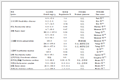
The saturated adsorption capacity of the adsorbents is summarized in Table 1. Notably, the CO2 adsorption capacity of 8K15Al-Li4SiO4 achieves about 120.0% and 24.5% higher than that of the pristine Li4SiO4 at 500 and 600 ℃, respectively. Additionally, the saturation adsorption capacity of 8K15Al-Li4SiO4 at 600 ℃ is very close to that at 700 ℃. It can also be inferred that the 8K15AlLi4SiO4 has a great preponderance and application prospect for the removal of CO2 in a wide temperature region.
|
Table 1 Saturated CO2 adsorption capacity of the adsorbents. |

The kinetic information about the CO2 adsorption and additional isothermal analysis over the Li4SiO4-based adsorbents are displayed in Fig. S5 (Supporting information). The CO2 adsorption capacity of these adsorbents was improved with the increase of temperatures. Both the adsorption capacity and the adsorption rate of the doped adsorbents are higher than those of the pristine Li4SiO4. To analyze the reasons for the increasement of CO2 adsorption amount after doping K and Al into Li4SiO4 we use the double shell model, which is most widely accepted in many literatures [12, 26, 27].The double exponential model was successfully established to simulate the CO2 adsorption on different adsorbents such as Li4SiO4 [28], Li2ZrO3 [29], and Na2ZrO3 [30]. The model can be represented as Eq. (2):

|
(2) |
Where y represents the percentage of adsorbents weight change by CO2 adsorption; t is the time; k1 and k2 are the rate constants, and k1 is the rate constant of surface chemical reaction, while k2 is the rate constants of lithium migration process; A, B, and C are the preexponential factors. The exponential constant values obtained at each temperature are listed in Table S1 (Supporting information). The k1 values are much higher than k2 for all the adsorbents, indicating that the chemisorption step is faster than lithium diffusion step. Lithium diffusion is the rate-determining step in the total process.
To further investigate the kinetic results, the incremental quantities of k1 and k2 values were calculated at corresponding temperatures. The data are listed in Table 2. After doping K and Al, the k1 and k2 values were increased, and the range of k2 values increased more. It indicates that lithium migration process have been much more affected by doping method. The addition of K mainly reflected lithium migration at above 600 ℃, and k2 values increased by more than 65%. However, when doping with Al, the lithium migration rate has been greatly improved at below 600 ℃, and k2 values increased by almost 60%. The lithium migration rate of 8K15Al-Li4SiO4 is ~2 times higher than that of the pristine Li4SiO4 at 575–650 ℃ compared with the pristine Li4SiO4.
|
|
Table 2 Percentage increment of the rate constant after doping at different temperatures. |


Lithium diffusion is the rate-determining step in the total process. As a result, the reaction rate enhances with the increase of the lithium migration process rate, which promotes the reaction at lower temperatures. Therefore, the adsorption capacity of the 8K15Al-Li4SiO4 is 22% at 500 ℃, and 32% at 650 ℃, which is close to that of 700 ℃. It means that 8K15Al-Li4SiO4 has a high adsorption capacity at low temperature. The CO2 adsorption range of 8K15Al-Li4SiO4 is greatly widened.
In summary, we use kaolin as the silica source to synthesize a series of Li4SiO4-based adsorbents. The doped K or Al in Li4SiO4 promoted both surface chemical reaction and lithium migration process, especially for the later one. The lithium migration rate of the adsorbent 8K15Al-Li4SiO4 is ~2 times higher than that of the pristine Li4SiO4. Additionally, the 8K15Al-Li4SiO4 has good reproducibility and can be used repeatedly. The co-doping of K and Al improves the adsorption performance of Li4SiO4-based adsorbents, especially at the range of 500–650 ℃. The co-doped K and Al not only broaden the effective adsorption temperature range, but also greatly improve the adsorption performance of Li4SiO4, which can provide guidance for the rational design and synthesis of Li4SiO4-based adsorbents with wide effective adsorption temperature for various processes.
AcknowledgmentsThis work was supported by the National Natural Science Foundation of China (Nos. 21476160, 21476159] and the Natural Science Foundation of Tianjin (Nos.15JCYBJC23000, 15JCZDJC37400).
Appendix A. Supplementary dataSupplementary data associated with this article can be found, in the online version, at http://dx.doi.org/10.1016/j.cclet.2017.07.031.
| [1] |
W.C. Wilfong, S.S.C. Chuang, Pharmacol. Biochem. Behav. 53 (2014) 4224-4231. |
| [2] |
Y. Xu, Q. Gao, M. Zhao, et al., Chin. Chem. Lett. 28 (2017) 55-59. DOI:10.1016/j.cclet.2016.06.006 |
| [3] |
R. Balasubramanian, S. Chowdhury, J. Mater. Chem. A 3 (2015) 21968-21989. DOI:10.1039/C5TA04822B |
| [4] |
L. Zhang, N. Zhan, Q. Jin, et al., Ind. Eng. Chem. Res. 55 (2016) 5885-5891. DOI:10.1021/acs.iecr.5b04760 |
| [5] |
N. Jiang, Z. Deng, G. Wang, et al., Prog. Chem. 26 (2014) 1645-1654. |
| [6] |
A. Hafizi, M.R. Rahimpour, S. Hassanajili, J. Taiwan Inst. Chem. E 62 (2016) 140-149. DOI:10.1016/j.jtice.2016.01.023 |
| [7] |
J.D. Silva, C.A.M. de Abreu, Int. J. Hydrogen Energy 41 (2016) 11660-11674. DOI:10.1016/j.ijhydene.2016.01.083 |
| [8] |
K. Wang, P. Zhao, X. Guo, et al., Environ. Prog. Sustain. 34 (2014) 526-532. |
| [9] |
K. Wang, X. Guo, P. Zhao, et al., J. Hazard. Mater. 189 (2011) 301-307. DOI:10.1016/j.jhazmat.2011.02.040 |
| [10] |
K. Wang, Z.Y. Zhou, P.F. Zhao, et al., Appl. Energy. 183 (2016) 1418-1427. DOI:10.1016/j.apenergy.2016.09.105 |
| [11] |
S.Y. Shan, Q.M. Jia, L.H. Jiang, et al., Ceram. Int. 39 (2013) 5437-5441. DOI:10.1016/j.ceramint.2012.12.051 |
| [12] |
S.Y. Shan, Q.M. Jia, L.H. Jiang, et al., Ind. Eng. Chem. Res. 52 (2013) 6941-6945. DOI:10.1021/ie400743p |
| [13] |
F. Pan, X.C. Lu, Y. Wang, et al., Mater. Lett. 115 (2014) 5-8. DOI:10.1016/j.matlet.2013.10.007 |
| [14] |
S.S. Park, E.H. Hwang, B.C. Kim, et al., J. Am. Ceram. Soc. 83 (2000) 1341-1345. DOI:10.1111/jace.2000.83.issue-6 |
| [15] |
S.A. Hosseini, A. Niaei, D. Salari, Open J. Phys. Chem. 01 (2011) 23-27. DOI:10.4236/ojpc.2011.12004 |
| [16] |
Q. Zhang, C. Shen, S. Zhang, et al., Int. J. Hydrogen Energy 41 (2016) 4831-4842. DOI:10.1016/j.ijhydene.2015.12.116 |
| [17] |
X. Yang, W. Liu, J. Sun, et al., ChemSusChem 9 (2016) 2480-2487. DOI:10.1002/cssc.201600737 |
| [18] |
S. Zhang, M.B.I. Chowdhury, Q. Zhang, et al., Ind. Eng. Chem. Res. 55 (2016) 12524-12531. DOI:10.1021/acs.iecr.6b03746 |
| [19] |
J. Ortizlanderos, C. Gómezyáñez, L.M. Palaciosromero, et al., J. Phys. Chem. A 116 (2012) 3163-3171. DOI:10.1021/jp3006298 |
| [20] |
L. Zhao, Q. Guan, J. Li, et al., Fusion Eng. Des. 113 (2016) 331-335. DOI:10.1016/j.fusengdes.2016.03.069 |
| [21] |
Y.L. Liu, T. Ding, Z. Ma, et al., J. Chem. Ind. Eng. 5 (2013) 11-15. |
| [22] |
A. Madani, A. Aznar, J. Sanz, et al., J. Phys. Chem. 94 (1990) 760-765. DOI:10.1021/j100365a046 |
| [23] |
S.D. Wang, K.L. Scrivener, Cem. Concr. Res. 33 (2003) 769-774. DOI:10.1016/S0008-8846(02)01044-X |
| [24] |
R. Oestrike, W.H. Wang, R.J. Kirkpatrick, et al., Geochim. Cosmochim. Acta 51 (1987) 2199-2209. DOI:10.1016/0016-7037(87)90269-9 |
| [25] |
P.V. Subha, B.N. Nair, A.M. Peer, et al., J. Mater. Chem. A 4 (2016) 16928-16935. DOI:10.1039/C6TA06133H |
| [26] |
M.J. Venegas, E.F. Israel, R. Escamilla, Ind. Eng. Chem. Res. 46 (2007) 2407-2412. DOI:10.1021/ie061259e |
| [27] |
R.M. Rafael, P. Heriberto, J. Phys. Chem. A 114 (2010) 4535-4541. DOI:10.1021/jp911491t |
| [28] |
R.T. Xiong, J. Ida, Y.S. Lin, Chem. Eng. Sci. 58 (2003) 4377-4385. DOI:10.1016/S0009-2509(03)00319-1 |
| [29] |
L. Martínezdlcruz, H. Pfeiffer, Ind. Eng. Chem. Res. 49 (2010) 9038-9042. DOI:10.1021/ie1005417 |
| [30] |
I. Alcérreca-Corte, E. Fregoso-Israel, H. Pfeiffer, J. Phys. Chem. C 112 (2008) 6520-6525. DOI:10.1021/jp710475g |