 2018, Vol. 29


b Beijing Advanced Innovation Center for Food Nutrition and Human Health, Beijing Engineering and Technology Research Center of Food Additives, Beijing Technology & Business University, Beijing 100048, China
Coriaria nepalensis is the only species in the Coriariaceae family and is distributed in the southern and southwestern of China. The dried root is used in the treatment of numbness, toothache, traumatic injury, and acute conjuncticitis in the traditional Chinese medicine [1]. Sesquiterpene lactones are the characteristic bioactive constituents of family Coriariaceae and possessed many interesting variations in the structure [2-7]. So far, there are only 17 similar sesquiterpene lactones separated from the species. In our previous study, we reported a series of sesquiterpenes and sesquiterpene lactones with anti-convulsant activities from C. nepalensis [8]. Continuing our investigation on the less polar fractions from the same plant led to the isolation of one new sesquiterpene lactone, corialactone E (1), one new neolignan, coriarianeolignan A (2), three known apocarotenoids, (6R, 9R)-9-hydroxy-4-megastigmen-3-one (3) [9], blumenol A (4) [10], and 3S, 5R-dihydroxy-6, 7-megstigmadien-9-one (5) [11], and one known neolignan, 1-(4-hydroxy-3, 5-methoxyphenyl)-2-(3, 5-dimethoxy-4-aldehyde-phenoxy)-propane-1, 3-diol (6) [12] (Fig. 1). In the present paper, we reported details of the isolation, structure elucidation of compounds 1-6 and their bioactivities.

|
Download:
|
| Fig. 1. Structures of compounds 1-6. | |
The air-dried roots of C. nepalensis (52 kg) were smashed and extracted with 95% EtOH. The EtOH extract (10.5 kg) was suspended in H2O and partitioned successively with petroleum ether, CHCl3, EtOAc and n-BuOH. The 45% EtOH soluble portion (210 g) of the CHCl3 extract (420 g) was then subjected to a polyamide column chromatography with a gradient of aqueous EtOH to yield 4 fractions. Fr1 (130 g) eluted by 45% EtOH was subjected to a silica gel column chromatography, a polyamide column chromatography, and an ODS column chromatography, purified by a Sephadex LH-20 and preparative HPLC to afford compounds 1 (5 mg), 2 (5 mg), 3 (20 mg), 4 (22 mg), and 5 (26 mg).
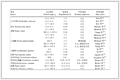
Compound 1 was obtained as colorless needles with [α]D20 +15.9 (c 0.09, MeOH). The molecular formula (C15H18O6) with 7 degrees of unsaturation was determined by HR-ESIMS at m/z 317.1003 [M + Na]+) and NMR data (Table 1). The IR spectrum of 1 showed the absorption of lactone carbonyl group (1738 cm-1). Fifteen carbon signals including one carbonyl carbon (δC 171.6) were observed in the 13C NMR (DEPT) data (Table 1). In comparison to the known compound apotutin [3], which is a typical sesquiterpene lactone separated from Coriaria nepalensis, the 1H NMR data of compound 1 showed two proton signals for one AB spin-spin coupling system at δH 3.76 and δH 3.96, which is a characteristic functional group in the series of sesquiterpene lactones separated from Coriaria nepalensis. The C-11 (δC 56.5) and C-12 (δC 52.9) signals in the 13C NMR data confirmed the presence of epoxide ring of C-11/O/C-12. The C-6 (δC 85.4) and C-8 (δC 92.0) signals in the 13C NMR data also indicated the skeleton of compound 1 was mostly similar with apotutin. The 1H NMR data of compound 1 showed the proton signals at δH 1.31, δH 4.00, and δH 3.53, which indicated that one methyl of isopropyl in compound 1 transformed into an oxygenated methylene. Structure units assigned above were further confirmed by the signals of C-10 (δC 20.1), C-8 (δC 92.0), and C-9 (δC 76.2) in the 13C NMR data. Meanwhile, the proton signals at δH 4.17 and δH 4.14, and the C-14 (δC 60.8) signals indicated the opening of epoxide ring of C-13/O/C-14, which is another characteristic functional group in the series of sesquiterpene lactones separated from Coriaria nepalensis, and transformed into hydroxymethyl in compound 1. Analysis of the 1H-1H COSY and HSQC correlations allowed for the assignment of two spin systems: CH2(2) -CH(3) -CH(4) -CH(5) and CH(11) -CH(12) units (Fig. 2A and Figs. S4-S5 in Supporting information), which were further identified as characteristic fragments in a skeleton similar with the known compound apotutin. The C-3 (δC 77.4) and C-9 (δC 76.2) signals revealed that C-3 and C-9 were two oxygenated carbons, and the correlation of H-9a with C-3 in the HMBC spectrum indicated that C-3 and C-9 was connected by an ether bond (Fig. 2A). The C-15 (δC 171.6) signal indicated the presence of lactone carbonyl group, and the correlation of H-5 with C-15 in the HMBC spectrum confirmed that C-5 was connected with C-15 (Fig. 2A). The HR-ESIMS showed that compound 1 had six oxygen atoms with 7 degrees of unsaturation. So far the ether bonds of C-3/O/C-9, C-6/O/C-8, and C-11/O/C-12, the lactone carbonyl connecting C-5 and C-15, and the hydroxymethyl at C-13 have already showed six oxygen atoms and 6 degrees of unsaturation in compound 1. The C-13 (δC 91.7) signal indicated that C-13 was also an oxygenated carbon, so the only connecting way of oxygenated C-13 was to form an ester bond between C-13 and C-15. The structure shown above was further confirmed by the HMBC spectrum (Fig. S6 in Supporting information). In the HMBC spectrum, the correlations of H3-10 with C-4, C-8 and C-9, of H3-7 with C-1, C-2, C-6 and C-13, of H-2α with C-1, C-3, C-4, C-6 and C-7, of H-2β with C-1, C-7 and C-13, of H-4 with C-2, C-5, C-6, C-8 and C-10, of H-9b with C-8 and C-10, of H-5 with C-1, C-3, C-4, C-6, C-11 and C-15, of H-11 with C-1, C-6, C-12 and C-13, of H-12 with C-1, C-6, C-11 and C-13, of H-9a with C-3, C-4 and C-8, of H-14b with C-12, of H-14a with C-12 and C-1, and of H-3 with C-1 and C-8 verified the planar structure of 1.
|
Table 1 1H NMR (500 MHz) and 13C NMR (125 MHz) data for compound 1 in pyridine-d5. |


|
Download:
|
| Fig. 2. Selected 1H-1H COSY (▂) and HMBC correlations (H → C) (A), and key ROESY correlations (H↔H) (B) of compound 1. | |
The epoxide rings at C-11, C-12 and C-14 used to be considered as the characteristic function groups of this type of sesquiterpenes. However, in our previous study, we elucidated a series of four new sesquiterpene lactones (corialactone B, corialactone C, corialactone D, and corianol) and these compounds all possessed new variations in the epoxide rings. For example, the epoxide rings in corialactone B, corialactone C and corialactone D were opened and transformed into methylene (C-11), olefinic (C-12 and C-13), and aldehyde (C-14) groups in corialactone B, oxygenated methine (C-11), olefinic (C-12 and C-13), and hydroxymethyl (C-14) groups in corialactone C, and methylene (C-11), oxygenated methine (C-12), and terminal olefinic (C-13 and C-14) groups in corialactone D, respectively. Besides, in corianol, the connection of C-3 and C-11 formed a new oxygen bridge, which was also found from this family for the first time [8]. In this study, the epoxide ring of C-13/O/C-14 in compound 1 was also opened and transformed into hydroxymethyl (C-14) group. In addition, the lactone ring located at C-3 was opened and formed a new lactone ring connecting C-13 and C-5. Besides, oxygenated C-3 and C-9 connected and formed a new ether ring. The newly formed lactone ring located at C-13 and C-5 produced shielding effect, so the signals of C-12 (δC 52.9), C-6 (δC 85.4), and C-5 (δC 50.0) were observed at a higher field compared with those of apotutin (δC 57.2, δC 89.9, and δC 55.62, respectively). For the influence of the newly formed cyclic ether of C-3/O/C-9, the signals of C-3 (δC 77.4) and C-4 (δC 50.5) were also observed at a higher field comparing with those of apotutin (δC 83.6 and δC 53.5, respectively).
The relative configuration of 1 was elucidated based on the ROESY spectrum (Fig. S7 in Supporting information). Due to the fused ring structure of compound 1, the relative configuration was rather complex. As shown in Fig. 2B, in the ROESY spectrum, H3-7 showed correlation with H-2α and H-14, indicating that H3-7 and H-2α were in the same α-orientation, and H-14 was the same side with H3-7. H-9a showed correlations with H3-7 and H3-10, indicating that the newly formed cyclic ether of C-3/O/C-9, H3-10, and the cyclic ether of C-6/O/C-8 were all at the same side with H3-7. Thus, the H-3 and H-4 adapted β-orientation. As elucidated in the literature [6-8], the relative configuration of H-5 was determined as α-orientation on the basis of its small coupling (J = 4.0 Hz) with H-4 and its REOSY correlations with H3-10 and H-4. Moreover, as shown in Fig. 2B and according to the literature [6-8], H-11 showed correlations with H-5 and H-12, indicating that H-11 and H-12 were all in β-orientation. The absolute configuration of 1 was established by the sector rule [13]. Based on the assigned relative configuration and the positive Cotton effect at 208 nm in the CD spectrum (Fig. S11 in Supporting information), the absolute configuration of 1 was determined to be 1R, 3R, 4S, 5S, 6R, 8S, 11S, 12R, and 13S (Fig. 3). Hence, the structure of 1 was established as shown and named to be corialactone E.

|
Download:
|
| Fig. 3. Projection of the sector rule for compound 1. | |
Compound 2 was obtained as light yellow solid with [α]D20 +0.04 (c 0.08, MeOH). Its IR spectrum showed the presence of hydroxy (3387 cm-1) and aromatic (1688 cm-1, 1589 cm-1) functionalities. The molecular formula (C19H22O8) with 9 degrees of unsaturation was determined by HR-ESIMS at m/z 401.1218 [M + Na]+. The NMR data (Table 2) indicated that there are both guaiacylglycerol-8-yl and 3'5'-dimethoxy-4'-oxyphenyl groups in 2. The 1H NMR data of 2 showed signals attributed to one oxymethylene at δH 3.72 and δH 3.36, together with two signals attributed to two oxymethines at δH 4.92 and δH 4.29. The 1H NMR data of 1 also showed one group of 1, 3, 4-tri-substituted benzene ring signal at δH 6.91, δH 6.64, and δH 6.76, together with one group of 1, 3, 4, 5-tetra-substituted benzene ring signal at δH 7.15. The 13C NMR and DEPT spectra (Figs. S13-14 in Supporting information) of 2 showed 19 carbon resonances including twelve aromatic carbons. The 1H-1H COSY correlations (Figs. S15-16 in Supporting information) indicated the presence of CH(7)-CH(8)-CH2(9) units. The 1H NMR and 13C NMR data of 2 resembled those of the known compound, (+)-(7S, 8S)-4-hydroxy-3, 3', 5'-trimethoxy-8', 9'-dinor-8, 4'-oxyneolignan-7, 9-diol-7'-oic acid [14], except for substitution of CHO-1' in 2 by COOH-1' in (+)(7S, 8S)-4-hydroxy-3, 3', 5'-trimethoxy-8', 9'-dinor-8, 4'-oxyneolignan-7, 9-diol-7'-oic acid, which was indicated by the chemical shifts for C-1' and C-4' significantly shifted by ΔδC 9.7 and 3.6, respectively. In the HMBC spectrum (Fig. S17 in Supporting information), the correlations of H-7 with C-2, C-6, C-8, and C-9, of H-2'/6' with C-3'/5', C-4' and CHO, and of OMe-3'/5' with C-3'/5' verified the location of the substitution groups and the 8, 4'-oxy linkage in 2. The HMBC spectrum also showed correlations of aldehyde hydrogen between C-10 and C-2'/6', which indicated the presence of one aldehyde group (Fig. 4).
|
|
Table 2 1H NMR (500 MHz) and 13C NMR (125 MHz) data for compound 2 in CD3OD. |


|
Download:
|
| Fig. 4. Selected 2D NMR correlations for compound 2. | |

It has been previously reported that for syringoylglycerols and guaiacylglycerol derivatives, the coupling constant (J value) between H-7 and H-8 is ≤ 5 Hz for the erythro isomer and ≥ 7 Hz for the threo isomer [15]. Thus, the coupling constant between H-7 and H-8 (J = 5.0 Hz) indicated the 7, 8-erythro configuration of compound 2. The absolute configuration was established by the CD spectrum. The positive Cotton effect at 246 nm in the CD spectrum indicated that the absolute configuration was 7R, 8S [16-20]. Hence, the structure of 2 was established to be coriarianeolignan A, and its structure was shown in Fig. 1.
Three known apocarotenoids, (6R, 9R)-9-hydroxy-4-megastigmen-3-one (3) [9], blumenol A (4) [10], and 3S, 5R-dihydroxy-6, 7-megstigmadien-9-one (5) [11], and one known neolignan, 1-(4-hydroxy-3, 5-methoxyphenyl)-2-(3, 5-dimethoxy-4-aldehyde-phenoxy)-propane-1, 3-diol (6) [12], were identified by comparing their spectroscopic data (NMR, UV, IR, and MS) with known compounds.
Compounds 1, 3, and 5 were also tested in neurotoxic assay against PC12 cells (pheochromocytoma 12 cells) and cytotoxic assay against human cancer cell lines including HCT-8 (human colon cancer), HepG2 (human hepatoma cancer), BGC823 (human gastric cancer), A549 (human lungepithelia cancer) by using MTT method [21]. All these compounds were inactive (10 μmol/L) in neurotoxic assay. Compound 5 showed cytotoxic activity on SKOV3 (human ovarian cancer) cells with IC50 values of 4.67 μmol/L, and the other compounds were inactive at 10 μmol/L concentration in cytotoxic assay. In the preliminary anti-convulsant activity assay in vivo, compounds 3 and 5 were tested by electroshock experiments [22]. After intraperitoneal administration to mice at a dose of 5 mg/kg, compound 5 showed anti-convulsant activity by 34%. However, compound 3 induced convulsions at the same dosage. The positive control (sodium phenobarbital) showed 100% anticonvulsant activities at a dose of 20 mg/kg.
In conclusion, one new sesquiterpene lactone (1), one new neolignan (2), and four known compounds (3-6) were isolated from the ethanolic extract of roots of C. nepalensis. The unique structure of newly formed ether ring of C-3/O/C-9 and lactone ring connecting C-13 and C-5 of compound 1 is of interesting for synthetic chemists and biologists. Compound 5 showed cytotoxic activity on SKOV3 (human ovarian cancer) cells with IC50 values of 4.67 μmol/L. In vivo system, compound 3 showed anti-convulsant activity by 34% at the dose of 5 mg/kg.
AcknowledgmentsFinancial support from the National Natural Science Foundation of China (No. 21132009) and the National Science and Technology Project of China (No. 2012ZX09301002-002) is acknowledged. We are grateful to the Department of Instrumental Analysis, Institute of Materia Medica, Chinese Academy of Medical Sciences and Peking Union Medical College for measuring the IR, UV, NMR, MS, and CD spectra.
Appendix A. Supplementary dataSupplementary data associated with this article can be found, in the online version, at https://doi.org/10.1016/j.cclet.2017.10.009.
| [1] |
Jiangsu New Medical College, Dictionary of Traditional Chinese Medicine, 1th. Ed., Shanghai People's Publishing House, Shanghai, 1977.
|
| [2] |
T. Okuda, T. Yoshida, Chem. Pharm. Bull. 15 (1967) 1955-1965. DOI:10.1248/cpb.15.1955 |
| [3] |
H. Wei, F.J. Zeng, M.Y. Lu, R.J. Tang, Acta Pharm. Sinica 33 (1998) 688-692. |
| [4] |
K. Koike, Y. Suzuki, T. Ohmoto, Phytochemistry 35 (1994) 701-704. DOI:10.1016/S0031-9422(00)90591-0 |
| [5] |
T. Okuda, T. Yoshida, Tetrahedron Lett. 47 (1971) 4499-4502. |
| [6] |
Y.H. Shen, S.H. Li, R.T. Li, et al., Org. Lett. 6 (2004) 1593-1595. DOI:10.1021/ol049660p |
| [7] |
K. Takeshi, I. Nao, H. Maho, et al., Chem. Pharm. Bull. 53 (2005) 1040-1042. DOI:10.1248/cpb.53.1040 |
| [8] |
F. Zhao, Y.B. Liu, S.G. Ma, et al., Tetrahedron 68 (2012) 6204-6210. DOI:10.1016/j.tet.2012.05.067 |
| [9] |
B. D'Abrosca, M.D. Greca, A. Fiorentino, et al., Phytochemistry 65 (2004) 497-505. DOI:10.1016/j.phytochem.2003.11.018 |
| [10] |
X.M. Niu, S.H. Li, Z. Na, Chin. Tradit. Herbal Drugs 34 (2003) 300-303. |
| [11] |
M.D. Greca, C.D. Marino, A. Zarrelli, et al., J. Nat. Prod. 67 (2004) 1492-1495. DOI:10.1021/np049857q |
| [12] |
D.R. Dimmel, X.Q. Pan, J.J. Bozell, J. Wood, Chem. Technol. 16 (1996) 205-219. |
| [13] |
H. B. Kagan, 1th. ed., Stereochemistry. Fundamentals and Methods, Vol 2, Georg Thieme Publishers, Stuttgart, 1977.
|
| [14] |
L. Xiong, C.G. Zhu, Y.R. Li, et al., J. Nat. Prod. 74 (2011) 1188-1200. DOI:10.1021/np200117y |
| [15] |
L. Li, P.S. Navindra, J. Agric, Food Chem. 59 (2011) 7708-7716. DOI:10.1021/jf2011613 |
| [16] |
S.G. Liao, Y. Wu, J.M. Yue, Chim Helv, Acta 89 (2006) 73-80. |
| [17] |
M.L. Gan, Y.L. Zhang, L. Sheng, et al., J. Nat. Prod. 71 (2008) 647-654. DOI:10.1021/np7007329 |
| [18] | |
| [19] |
M.D. Greca, A. Molinaro, P. Monaco, et al., Phytochemistry 35 (1994) 777-779. DOI:10.1016/S0031-9422(00)90604-6 |
| [20] |
C. Huo, H. Liang, Y. Zhao, et al., Phytochemistry 69 (2008) 788-795. DOI:10.1016/j.phytochem.2007.08.022 |
| [21] |
D.M. Su, J. Qu, Y.C. Hu, et al., Chin. Chem. Lett. 19 (2008) 845-848. DOI:10.1016/j.cclet.2008.04.043 |
| [22] |
Y. Kitano, C. Usui, K. Takasuna, et al., Pharmacol. Toxicol. Meth. 35 (1996) 25-29. DOI:10.1016/1056-8719(95)00115-8 |