 2018, Vol. 29


Transition metal-catalyzed direct C-H bond functionalization as an effective approach for the construction of carbon-carbon and carbon-heteroatom bonds has attracted much attention due to the synthetic simplicity and step-economy [1]. Compared with the well-developed C(sp2)-H functionalization, the direct functionalization of unactivated C(sp3)-H bonds remains a challenge owing to the lack of π-electrons that can interact with transition metals [1, 2]. The chelation-assisted C(sp3)-H bond activation has been proved to be an effective strategy to meet this challenge through the introduction of a directing group, such as 8-aminoquinoline, 2-pyridiylmethyl and N-(2-pyridyl)sulfonyl [3]. The formation of a stable metallacycle intermediate plays an important role in the activation of C(sp3)-H bonds, thus allowing numerous C(sp3)-H bond functionalization to take place, including various cross-coupling and cyclization reactions [3a, 3e]. Undoubtedly, it is more practical to employ a readily removable directing group [3, 4].
The γ-lactam scaffold is an important structural motif frequently found in biologically active natural products and pharmaceuticals [5]. The synthesis of substituted γ-lactams usually involves multiple-step reactions as well as the tedious processes associated with the separation and purification of intermediate products [6]. Recently, the transition metal-catalysed bidentate ligand-directed C(sp3)-H activation and cyclization of aliphatic amides have been developed to construct a variety of N-(quinolin-8-yl) γ-lactams, which greatly shorten the synthetic route of γ-lactam derivatives (Scheme 1) [7]. Especially, employing the aliphatic amide of 8-amino-5-methoxyquinoline as a substrate, an N-unprotected γ-lactam can be obtained [7b]. γ-Lactams can be further transformed into pyrrolidines and this method thus allows access to both N-unsubstituted γ-lactams and pyrrolidines, which are structural motifs widely found in natural products and medicinal agent [5, 6]. However, the price of 8-amino-5-methoxyquinoline is extraordinarily expensive. Therefore, it is very necessary to develop a more inexpensive and easily removable directing group and a highly efficient catalytic system for the β-C(sp3)-H activation and cyclization of aliphatic amides. Inspired by the 2-pyridylmethyl bidentate system developed by Chatani et al. [3b, 8], herein, we present the first example of palladium-catalyzed β-C(sp3)-H activation and cyclization of aliphatic amides bearing a removable 2-pyridylmethyl directing group with gem-dibromoolefins to construct a variety of γ-lactams (Scheme 1).

|
Download:
|
| Scheme 1. Synthesis of γ-lactams. | |
Initially, the effect of varying directing groups on the β-C(sp3)-H activation of aliphatic amides was examined. The cyclized product was not observed by taking advantage of 8-aminoquinoline as a directing group. Gratifyingly, the reaction of the aliphatic amide of 2-pyridylmethylamine (1a) and (2, 2-dibromovinyl)benzene (2a) with a 1:1 stoichiometry provided the cyclized product 3a including Z-and E-configurations in a total yield of 59% (E/Z = 7:1), which might be attributed to the flexible bidentate structural feature of 2-pyridylmethyl amide, assisting the β-C(sp3)-H activation to take place [3, 8]. In contrast, the amide substrates bearing other functional groups, including benzyl, 2-(methylthio)phenyl, 2-(methylsulfonyl)phenyl and perfluorophenyl, either failed to give the corresponding cyclized product, or afforded only a trace amount of 3a.
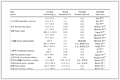
Next, several reactions were performed to optimize the reaction conditions. Unexpectedly, employing 2 equiv. 2a, an exclusive E-isomer of 3a was obtained in 60% yield (Table 1, entry 1). After surveying several palladium catalysts, Pd2dba3 turned out to be the best choice (Table 1, entries 1–4). The screening of bases indicates that K2CO3 was the most efficient, whereas tBuOK only provided a trace of 3a (Table 1, entries 5–7). The investigation of solvents turned out that 1, 4-dioxane was a more efficient solvent than others (Table 1, entries 8–10). Moreover, the reaction worked well also under air atmosphere, affording 3a in 84% yield (Table 1, entry 11).
|
Table 1 Optimization of reaction conditions.a |

With the optimized reaction conditions in hand, the substrate scope of gem-dibromoolefins was investigated. It was found that the reaction of (2, 2-dibromovinyl)benzenes bearing an electron-donating group such as p-CH3 and p-OMe could deliver the products in 85% and 86% yields, respectively (Table 2, entries 2–3). Halide substituents including fluoro, chloro and bromo on the benzene ring were tolerated, affording the corresponding cyclized products in satisfactory yield (Table 2, entries 4–6). The (2, 2-dibromovinyl)benzene bearing an electron-withdrawing cyano-substituent group gave the E-configurated 3g in a relatively low yield, illustrating that the electronic effect might have a great impact on the reaction yield. 4, 4-Dibromobuta-1, 3-dien-1-ylbenzene and 4-phenyl-1, 1-dibromobut-1-ene also worked well to provide the E-isomer of 3i and Z-isomer of 3j in synthetically useful yields (Table 2, entries 9–10). In addition, gem-dibromoolefin substrates containing heteroarenes such as furan and thiophene were amenable to this reaction, giving the cyclized products in moderate yields (Table 2, entries 11–12).
|
|
Table 2 Optimization of reaction conditions.a |

Subsequently, various aliphatic amides were examined (Table 3). Aliphatic amides with alkyl chains of varying length reacted well with (2, 2-dibromovinyl)benzene, leading to the corresponding cyclized products in good to excellent yields (Table 3, entries 1–4). 2-Methyl-2-phenyl-N-(2-pyridylmethyl)propanamide bearing a sterically hindered phenyl group gave a slightly lower yield than that bearing the alkyl group. Moreover, the β-C(sp3)-H in the methyl group was prior to react even though there is a more reactive site such as the C(sp3)-H of the benzylic group, indicating this reaction might be sensitive to the steric hindrance (Table 3, entries 6–9). Unfortunately, the E/Z stereoselectivity of these β-C(sp3)-H activation and cyclization reactions is fairly unpredictable. However, it was worth noting that the Z- and E-isomers of all products could be easily separated and purified through a silica gel column, demonstrating the effectiveness and applicability of the method herein developed. Analytical data for all new compounds and copies of 1H and 13C NMR spectra can be found in Supporting information.
|
|
Table 3 Optimization of reaction conditions.a |


To gain insight into the mechanism of this β-C(sp3)-H activation and cyclization of aliphatic amides, deuterium-labeling experiments were carried out (Scheme 2). When the reaction was performed with D2O instead of 2a, no deuterated product was detected, indicating that the cleavage step of β-C(sp3)-H was an irreversible process [9]. The investigation of primary kinetic isotope effect (KIE) via two parallel reactions between 1c and its [D3]-methyl derivative revealed that the value of kH/kD was 3.0, thus indicating that the β-C(sp3)-H cleavage of the amide substrate was involved in the rate-determining step [10]. Therefore, a plausible mechanism is depicted (Scheme 3). Initially, the Pd(0) might convert to Pd(Ⅱ) species in the presence of gem-dibromoolefins [11], which chelated with amide to form complex IM1. Subsequently, the β-C(sp3)-H bond palladation takes place to provide the metallacycle intermediate IM2[12]. Then, the gem-dibromoolefin reacts with IM2 generates the complex IM3, which undergoes a reductive elimination to afford IM4. Next, IM4 transforms to IM5 through an oxidative addition. Finally, the reductive elimination of IM5 gives the desired product 3 or 4.

|
Download:
|
| Scheme 2. Deuterium-labeling and kinetic isotope experiments. | |


|
Download:
|
| Scheme 3. Plausible mechanistic pathway. | |

To demonstrate the practicability of our synthetic method, the removal of the directing group was performed [8b]. Gratifyingly, the 2-pyridylmethyl directing group can be readily detached. Adding lithium diisopropylamide (LDA) dropwise in the solution of 3a at -78 ℃ and then continuously bubbling O2 for a while, an N-H free γ-lactam 5 was obtained in excellent yield (Scheme 4).

|
Download:
|
| Scheme 4. Removal of the directing group. | |

In conclusion, a highly efficient palladium-catalyzed 2-pyridylmethyl-directed β-C(sp3)-H activation and cyclization of aliphatic amides with gem-dibromoolefins has been developed to construct a variety of γ-lactam derivatives. The reaction can proceed well under air atmosphere, possessing the merit of operational simplicity. Moreover, the 2-pyridylmethyl directing group can be readily detached to afford an N-H free γ-lactam. In addition, the Z-and E-isomers of all products could be easily separated and purified after the reaction, demonstrating the effectiveness and applicability of the method herein developed. In addition, kinetic isotope experiments indicate that the β-C(sp3)-H cleavage of the amide substrate was involved in the rate-determining step.
AcknowledgmentsWe are grateful for the financial supports from the National Natural Science Foundation of China (Nos. 21672154 and 21372164). We thank the Comprehensive Training Platform of Specialized Laboratory, College of chemistry, Sichuan University, for NMR measurements and HRMS measurements.
Appendix A. Supplementary data.Supplementary data associated with this article can be found, in the online version, at http://dx.doi.org/10.1016/j.cclet.2017.06.007.
| [1] |
(a) R. Giri, B. F. Shi, K. M. Engle, et al., Chem. Soc. Rev. 38(2009) 3242-3272; (b) T. W. Lyons, M. S. Sanford, Chem. Rev. 110(2010) 1147-1169; (c) J. Wencel-Delord, T. Dröge, F. Liu, F. Glorius, Chem. Soc. Rev. 40(2011) 4740-4761; (d) S. H. Cho, J. Y. Kim, J. Kwak, S. Chang, Chem. Soc. Rev. 40(2011) 5068-5083; (e) C. Liu, H. Zhang, W. Shi, A. Lei, Chem. Rev. 111(2011) 1780-1824; (f) K. Hirano, M. Miura, Chem. Commun. 48(2012) 10704-10714; (g) Y. Yang, J. Lan, J. You, Chem. Rev. 117(2017), doi: http://dx.doi.org/10.1021/acs.chemrev.6b00567. |
| [2] |
(a) O. Baudoin, Chem. Soc. Rev. 40(2011) 4902-4911; (b) B. J. Li, Z. J. Shi, Chem. Soc. Rev. 41(2012) 5588-5598; (c) J. L. Jeffrey, R. Sarpong, Chem. Sci. 4(2013) 4092-4106; (d) J. Xie, C. Pan, A. Abdukader, C. Zhu, Chem. Soc. Rev. 43(2014) 5245-5256; (e) W. H. Rao, B. F. Shi, Org. Chem. Front. 3(2016) 1028-1047. |
| [3] |
(a) V. G. Zaitsev, D. Shabashov, O. Daugulis, J. Am. Chem. Soc. 127(2005) 13154-13155; (b) N. Hasegawa, V. Charra, S. Inoue, et al., J. Am. Chem. Soc. 133(2011) 8070-8073; (c) N. Rodríguez, J. A. Romero-Revilla, M. Á. Fernández-Ibáñez, J. C. Carretero, Chem. Sci. 4(2013) 175-179; (d) M. Zhang, Y. Zhang, X. Jie, et al., Org. Chem. Front. 1(2014) 843-895. |
| [4] |
F. Zhang, D.R. Spring, Chem. Soc. Rev. 43(2014) 6906-6919. DOI:10.1039/C4CS00137K |
| [5] |
(a) R. H. Feling, G. O. Buchanan, T. J. Mincer, et al., Angew. Chem. Int. Ed. 42(2003) 355-357; (b) M. Stadler, J. Bitzer, A. Mayer-Bartschmid, et al., J. Nat. Prod. 70(2007) 246-252; (c) T. A. M. Gulder, B. S. Moore, Angew. Chem. Int. Ed. 49(2010) 9346-9367; (d) J. Caruano, G. G. Muccioli, R. Robiette, Org. Biomol. Chem. 14(2016) 10134-10156. |
| [6] |
(a) S. H. Kang, H. S. Jun, Chem. Commun. (1998) 1929-1930; (b) E. J. Corey, W. D. Z. Li, Chem. Pharm. Bull. 47(1999) 1-10; (c) A. G. M. Barrett, J. Head, M. L. Smith, et al., J. Org. Chem. 64(1999) 6005-6018; (d) Y. Hayashi, M. Shoji, J. Yamaguchi, et al., J. Am. Chem. Soc. 124(2002) 12078-12079; (e) A. Yazici, S. G. Pyne, Synthesis 3(2009) 339-368; (f) A. Yazici, S. G. Pyne, Synthesis 3(2009) 513-541; (g) P. Q. Huang, H. Geng, Y. S. Tian, et al., Science China-Chem. 58(2015) 478-482; (h) J. L. Ye, Y. Liu, Z. P. Yang, P. Q. Huang, Chem. Commun. 52(2016) 561-563. |
| [7] |
(a) X. Wu, K. Yang, Y. Zhao, et al., Nat. Commun. 6(2015) 6462-6471; (b) G. He, S. Y. Zhang, W. A. Nack, et al., Angew. Chem. Int. Ed. 52(2013) 11124-11128; (c) J. Zhang, H. Chen, C. Lin, et al., J. Am. Chem. Soc. 137(2015) 12990-12996; (d) J. Zhang, D. Li, H. Chen, et al., Adv. Synth. Catal. 358(2016) 792-807. |
| [8] |
(a) S. Inoue, H. Shiota, Y. Fukumoto, N. Chatani, J. Am. Chem. Soc. 131(2009) 6898-6899; (b) H. Shiota, Y. Ano, Y. Aihara, et al., J. Am. Chem. Soc. 133(2011) 14952-14955. |
| [9] |
X. Huang, Y. Wang, J. Lan, J. You, Angew. Chem. Int. Ed. 54(2015) 9404-9408. DOI:10.1002/anie.201504507 |
| [10] |
E.M. Simmons, J.F. Hartwig, Angew. Chem. Int. Ed. 51(2012) 3066-3072. DOI:10.1002/anie.v51.13 |
| [11] |
Y. Aihara, N. Chatani, J. Am. Chem. Soc. 136(2014) 898-901. DOI:10.1021/ja411715v |
| [12] |
D. Shabashov, O. Daugulis, J. Am. Chem. Soc. 132(2010) 3965-3972. DOI:10.1021/ja910900p |