 2018, Vol. 29


 ,
Yang Meibinga,
Li Yanga,
Li Xiaobina,
Jia Tianweia,
He Haojiea,
Yu Quna,
Guo Naa,
He Yunb,
Yu Penga,
Yang Yanga
,
Yang Meibinga,
Li Yanga,
Li Xiaobina,
Jia Tianweia,
He Haojiea,
Yu Quna,
Guo Naa,
He Yunb,
Yu Penga,
Yang Yanga
b Research Institute of Tsinghua University in Shenzhen, Shenzhen 518057, China
N-Acetyl neuraminic acid (Neu5Ac, also called sialic acid, SA) (Scheme 1), an acidic monosaccharide with nine-carbon backbone, is commonly found on the termini branches of N-glycans, O-glycans, glycosphingolipids and glycoproteins on the cell surface [1]. Due to its external position, SA is fully accesible to other biomolecules and further control cell-cell interactions [2]. It has been found that SA-protein interactions play vital roles in various biological and pathological processes including cancer [3, 4], inflammation [5] and immunization [6]. Moreover, many viruses [7, 8] and bacteria [9, 10] also utilized this interaction at various stages in their life cycles for cell entry or release.

|
Download:
|
| Scheme 1. Synthesis of di-and tetra-valent triazole-sialoside. (a) (ⅰ) H+ resine/MeOH, (ⅱ) Ac2O/Py. (b) BiCl3/CH3SiCl3, CH2Cl2, 90%. (c) NaN3/nBu4HSO4, CH2Cl2/H2O. (d) CuSO4·5H2O, VcNa, THF/H2O, alkynyl scaffold. (e) (ⅰ) CH3ONa/CH3OH, (ⅱ) NaOH, H2O/MeOH. | |
Influenza virus, a genus of the Orthomyxoviridae family that causes outbreaks of respiratory disease as annual epidemics and unpredictable pandemics remains a significant risk to global health and economy [11]. It has been widely accepted that two multivalent SA-protein interactions serve important roles in the initial and final steps of the replication cycles of influenza viruses [12]. Hemagglutinin (HA) is one of the major surface glycoprotein of the virus (80%, ~300 copies of trimer), which binds to α-SA to induce fusion between viral and cellular membranes [13]. Neuraminidase (NA) is another receptor-destroying surface glycoprotein (17%, ~50 copies of tetramer), it cleaves the residual SA to release the virus from infected cells [14]. Two FDA approved SA derivatives Zanamivir and Osetamivir as potent NA inhibitors were invented based on the elucidation of SA-NA interactions, which were effective measurements to prevent potential Flu pandemics [15]. However, the mutations lead to the drug resistance [16] have decreased the effectiveness of the two drugs, thus developing new anti-influenza agents are in great need.
An alternative strategy for the development of antiviral agents is inspired by the mucin [17], a heavily glycosylated protein secreted by epithelial tissues of organisms of mammal to trap viruses and expel the virions by mucocilliary transportation via multivalent SA-HA/NA interactions [18]. Native O-linked sialoside can be hydrolyzed by NA [19], which is the major drawback of using it directly as virus inhibitor. Alternatively, presenting multivalent NA resistant pseudo-SA on different scaffolds including polymer [20], liposome [21], dendrimers [22] and nanoparticles [23] as mucin mimic to bound to both HA and NA have been developed as the virus adsorbents to prevent the infection. Our previous work [24] has also demonstrated that unlike natural O-sialylated complex-type glycan protein conjugates [25], NA resistant S-sialosides protein conjugates can bind not only to HA with high affinity resulting in the inhibition of the viral adhesion to erythrocytes, but also NA with moderate affinity resulting in the prevention of the hydrolysis of the SA to reduce virus propagation. Compared with other SA modified macromolecules, the sialyl human serum albumin (HSA) and bovine serum albumin (BSA) can closely mimic the 3D natural presentation of SA on the mucin protein scaffold. Moreover, the density of the SA on the protein surface can be easily determined by matrix-assisted laser desorption ionization time of flight mass spectrometry (MALDI-TOF-MS), which makes it feasible to quantitatively analyze the SA-HA/NA interactions. Finally, these glycoconjugates also showed negligible cytotoxicity against human cells with concentration up to 100 μmol/L. These initial results encourage us to develop non-hydrolyzable pseudo-sialoside protein conjugates library with different HA/NA binding affinity pattern to the influenza virus and further investigate the recognition and interaction process of sialoside to HA or NA.
Herein, a new class of triazole-sialoside protein conjugates was prepared and their influenza adsorption activity was evaluated by hemagglutinin/neuraminidase inhibition. Furthermore, the binding affinity of the glycoconjugates to intact virus was studied by the dynamic light scattering (DLS). We wish with other sensor technology, these triazole-sialoside protein conjugates could directly serve as anti-influenza agent development and capture molecules for influenza to complement the elucidation of the SA-HA/NA molecular recognition and interaction for the detection of influenza viruses.
At first, the key intermediate peracetylated 2-azido-α-sialic acid 3 was synthesized using the method shown in Scheme 1. Fully protected SA was first converted to β-chloride derivative 2with a catalytic amount of BiCl3 in the presence of CH3SiCl3 in CH2Cl2[26]. A phase-transfer catalysis process was used to introduce azido group on C-2 position with α-configuration, which was confirmed by the NMR spectra [27] (see Supporting information). Then click chemistry [28, 29] was employed to attach the SA monomer to the alkynyl scaffolds to afford fully protected di-and tetravalent triazole-sialoside 4 and 5. After deacylation, demethylation, purification on Sephadex LH-20 and lyophilisation under standard procedures, di-, DT and tetravalent, TT triazole-sialoside were prepared, respectively (Scheme 1).
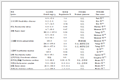
The neoglycoprotein conjugates BSA-SA2 and HSA-SA4 were synthesized using the dimethyl squarate strategy as we previously reported [24] (Scheme 2). The molecular weights of the resulting glycoconjugates were characterized by MALDI-TOF-MS (see supporting information). Unfortunately, high density of pseudo SA modification was not achieved as the S-sialoside BSA or HSA conjugates we prepared previously. Mass analysis of the glycoconjugates (BSA-SA2 and HSA-SA4) revealed that only about two or four triazole-sialosides were attached on one molecule of BSA or HSA, respectively, even when increasing the starting reaction molar ratio of 8 and protein to 50:1 (Table 1). This could due to the steric hindrance effect caused by the triazole ring on 2-position of SA, which reduce the protein coupling efficiency. In order to attach more sialoside residue on the protein scaffold, longer and more flexible spacer arm (polyethylene glycol, n = 3, OEG) and N-hydroxysuccinimide (NHS)-activated adipate [30] were adopted to covalently couple primary amine of the triazole-SA to lysine residues on protein. After the synthesis and purification steps as shown in Scheme 2, mass analysis of glycoconjugates revealed that an average of 7 SA residues with OEG linker were loaded onto one molecule of BSA or HSA (see supporting information). Methoxypolyethylene glycols (HO-PEG-OMe, MW ~ 2000) modified BSA, BSA-PEG-OMe and HSA, HSA-PEG-OMe were also prepared with adipate linker as controls.

|
Download:
|
| Scheme 2. Synthesis of multivalent triazole-sialoside and PEG protein conjugates. (a) CuSO4·5H2O, VcNa, THF/H2O. (b) (ⅰ) CH3ONa/CH3OH, (ⅱ) NaOH, H2O/MeOH. (c) TFA/ CH2Cl2. (d) Squaric acid diethyl esters, phosphate buffer saline (pH 7.0). (e) BSA/HSA, borate buffer buffer (pH 9.0). (f) (ⅰ) Et3N, DMSO, (ⅱ) sodium phosphate buffer (pH 7.5), overnight. (g) p-Toluensulfonyl chloride, TosCl/Et3N. (h) (ⅰ) NaN3/DMF, (ⅱ) H2, Pd(OH)2/C. | |
|
Table 1 The conjugation of triazole-sialoside with proteins. |

With the glycoconjugates in hand, we investigated the binding between the synthetic neoglycoproteins and influenza virus. The adsorption activity was first evaluated by Hemagglutination Inhibition (HAI) assay [31]. HA can bind to the SA on the surface of chicken red blood cells (CRBCs) resulting in agglutination, which can be inhibited by the adsorption of HA by our synthetic glycoconjugates. The lowest concentration of the conjugates to prevent an influenza virus induced hemagglutination was measured and defined as Ki[32]. Three strains of influenza virus [A/Puerto Rico/8/1934 (H1N1), A/Huairou Beijing/11069/2014 (H3N2), A/Chicken/Beijing/AT609/2014 (H9N2)] with different HA subtype were chosen. Mucins from bovine submaxillary glands (BSG) were used as positive control due to its high sialyled protein content [33].
We found that all of the monomeric SA, low valent triazole-sialosides (DT and TT) and BSA had no inhibitory effect on the hemagglutination with the concentration up to 1 mmol/L (Table 1). Regarding the glycoconjugates, only the BSA-SA2 and HSA-SA4 inhibited hemagglutination at concentrations around 50-100 μmol/L when H3N2 and H9N2 were used as the sources of HA. Although BSA-OEG-SA7 and HSA-OEG-SA7 have higher density of triazole-sialoside residue on the protein surface, no enhanced hemagglutination inhibition was observed. This clearly demonstrated that appropriate dimensional presentation of the sugar ligand on the surface of the scaffold is the key factor for the binding affinity enhancement of multivalent carbohydrate-protein interaction [34]. We speculated that the distribution of the SA on the protein surface in BSA-OEG-SA7 and HSA-OEG-SA7 was not homogeneous, which couldnot fit the exposed binding site of HA trimers and resulted in decreased binding to the HA. On the other hand, compared with the S-sialoside protein conjugates prepared by us previously, the triazole-sialosides protein conjugates BSA-OEG-SA7 and HSA-OEG-SA7 were found to show worse inhibition performance due to the different triazole structure on anomeric centre. It is therefore envisioned that different pseudo-SA conjugates have a potential application to differentiate and classify various influenza virus strains due to their different binding affinity to HA, which have been already initially proved by our group [35]. When PR8 strain was used as the HA source, no hemagglutination inhibition was observed due to the lack of galactosyl linkage to the SA in all of the glycoconjugate which is in agreement with our [24] and other group's results [33]. Because all types of SA linkages are contained in the BSG mucins, it showed potent inhibition toward all virus strains as positive control.
|
|
Table 2 Inhibition constant Ki of HAI assay. |

We next performed the fluorescent MUNANA [2'-(4-methylumbelliferyl)-α-D-N-acetylneuraminic acid]-based NA inhibition assay [36] to evaluate the NA binding activity of our glycoconjugtes. The fluorescent signal produced by the hydrolysis of MUNANA by NA decreased when the glycoprotein conjugates competitively bind to the active site of NA compared to blank. In this assay system, the same virus strains inactivated by β-propiolactone (β-PL) as mentioned in the HAI assay were used as the sources of NAs. The IC50 was calculated as the concentration of the glycoconjugates resulting in a 50% reduction in hydrolysis reaction rate compared to the blank and Zanamivir was used as positive control [37] (Table 3).
|
|
Table 3 IC50 values in the neuramidinase inhibition assay. |


The data showed that divalent SA derivative is significantly more potent than monomeric and tetravalent sialoside against all the three strains with IC50 around 10 μmol/L which is in the range of literature values [27]. Interestingly, TT, HSA-SA4 and even HSA-OEG-SA7 have more sialoside residue per molecule did not enhance the inhibitory activity. These could be explained by the incorrect presentation of SA on the surface of the backbone which cannot achieve effective interactions with the NA active site on the same virus particle or adjacent other NA in different virions [38]. When changing the protein backbone from BSA to HSA, both of the glycoproteins HSA-SA4 and HSA-OEG-SA7 have the best inhibition activity against all virus strains, which is consistent with our previous results [24]. More importantly, these results also indicated SA protein conjugate for multivalent carbohydrate display [39] and appropriate dimensional presentations on protein backbone are important in the development of NA inhibitor and native mucins mimic.
The influenza adsorbent behaviours of the neoglycoproteins, HSA-OEG-SA7 which have the highest sugar density and NA binding activity were further investigated by dynamic light scattering (DLS) in solution [40, 41]. The size of the glycoconjugates in PBS before and after mixing with H9N2 was measured and the intensity-based size distribution was plotted in Fig. 1a. The diameters of the different molecule grafted protein and H9N2 virus in solution were found to be around 15 and 150 nm, respectively. After the addition of the virus to the sialyl modified HSA, DLS indicated that the mean diameter of the conjugate had increased to 250 nm, indicating the agglutination [42] formed by the multivalent interaction between the HSA-OEG-SA7 and H9N2. On the contrary, the addition of the virus did not increase the size of the HSA-PEG-OMe, as still two separated peaks at 15 nm and 150 nm, which were assigned to individual HSA-PEG-OMe and viron, respectively. Similar results were observed when H3N2 and H1N1 were added to the conjugates solution (Fig. 1b and Fig. c). All of the DLS size distribution curves clearly showed our glycoconjugate can specifically attach to the surface of the influenza virus and could also cross-link several virus particles through multivalent SA-NA interactions. This glycoconjugate is promising candidate for more effective viral shielding agent in antiviral therapies and influenza detection development with other detection technologies.

|
Download:
|
| Fig. 1. Hydrodynamic size distribution curves of the influenza virus a) Influenza A/Chicken/Beijing/AT609/2014 (H9N2). b) Influenza A/Puerto Rico/8/1934 (H1N1). c) Influenza A/Huairou, Beijing/11069/2014 (H3N2) before and after mixed with different molecule modified HSA. | |

Finally, it was essential to study the cell toxicity of the neoglycoproteins for the antiviral applications. The NCI-H1299, human non-small cell lung cancer cells were incubated in the presence of glycoproteins for 24 h. The cell activity was determined by MTT [43]. Fig. 2 showed that the cell viability was maintained at nearly to 80% compared to the untreated blank control under the concentration of 250 μmol/L, indicating the extensive medical developments of these glycoconjugates.

|
Download:
|
| Fig. 2. Cytotoxicity study of glycoproteins. | |

To a summary, we have successfully synthesized multivalent hydrolysis resistant triazole-sialoside monomer by click chemistry and their protein conjugates via squaric acid diester and adipate NHS ester strategy. The prepared glycoconjugates can bound to HA to prevent the viral adhesion to erythrocytes. Moreover these glycoproteins can also strongly bind to NA to inhibit the hydrolysis of the sialylside for the virus releasing. In addition, a pronounced aggregation can also be observed by DLS when mixing the sialoside protein conjugates with influenza virus through multivalent interactions. Our findings suggest these pseudo-sialoside protein conjugates could serve as effective influenza virus capture in biosensor application, detection and antiviral development.
AcknowledgmentsThis work was financially supported by the National Natural Science Foundation of China (Nos. 21402140, 21502139), Shenzhen Peacock Plan (No. KQTD2016053114253158), Natural Science Foundation of Tianjin City (No. 16JCTPJC46000), Key Laboratory of Industrial Fermentation Microbiology of Ministry of Education and Tianjin Key Lab of Industrial Microbiology (No. 2015IM107) and Youth Innovation Research Foundation of Tianjin University of Science and Technology (No. 2016LG08). The authors are thankful to the Research Centre of Modern Analytical Technology, Tianjin University of Science and Technology for NMR and MALDI-TOF-MS measurements. The authors also appreciate National Institute for Viral Disease Control and Prevention, China CDC for the viral strains.
| [1] |
R. Schauer, Curr. Opin. Struct. Biol. 19(2009) 507-514. DOI:10.1016/j.sbi.2009.06.003 |
| [2] |
C.W. Lloyd, Biol. Rev. Camb. Philos. Soc. 50(1975) 325-350. DOI:10.1111/brv.1975.50.issue-3 |
| [3] |
N. Katopodis, Y. Hirshaut, N.L. Geller, C.C. Stock, Cancer Res. 42(1982) 5270-5275. |
| [4] |
J. Zhao, D.M. Simeone, D. Heidt, M.A. Anderson, D.M. Lubman, J. Proteome Res. 5(2006) 1792-1802. DOI:10.1021/pr060034r |
| [5] |
S.S. Gokmen, C. Kazezoglu, B. Sunar, et al., Clin. Chem. Lab. Med. 44(2006) 199-206. |
| [6] |
G.R. Moe, T.S. Bhandari, B.A. Flitter, J. Immunol. 182(2009) 6610-6617. DOI:10.4049/jimmunol.0803677 |
| [7] |
S. Taube, M. Jiang, C.E. Wobus, Viruses 2(2010) 1011-1049. DOI:10.3390/v2041011 |
| [8] |
S. Olofsson, T. Bergstrom, Ann. Med. 37(2005) 154-172. DOI:10.1080/07853890510007340 |
| [9] |
C. Jones, M. Virji, P.R. Crocker, Mol. Microbiol. 49(2003) 1213-1225. DOI:10.1046/j.1365-2958.2003.03634.x |
| [10] |
S.J. Crennell, E.F. Garman, W.G. Laver, E.R. Vimr, G.L. Taylor, Proc. Natl. Acad. Sci. U. S. A 90(1993) 9852-9856. DOI:10.1073/pnas.90.21.9852 |
| [11] |
R.G. Webster, W.J. Bean, O.T. Gorman, T.M. Chambers, Y. Kawaoka, Microbiol. Rev. 56(1992) 152-179. |
| [12] |
R. Wagner, M. Matrosovich, H.D. Klenk, Rev. Med. Virol. 12(2002) 159-166. DOI:10.1002/(ISSN)1099-1654 |
| [13] |
J.J. Skehel, D.C. Wiley, Annu. Rev. Biochem. 69(2000) 531-569. DOI:10.1146/annurev.biochem.69.1.531 |
| [14] |
P.M. Colman, Protein Sci. 3(1994) 1687-1696. DOI:10.1002/pro.v3:10 |
| [15] |
L.V. Gubareva, L. Kaiser, F.G. Hayden, Lancet 355(2000) 827-835. DOI:10.1016/S0140-6736(99)11433-8 |
| [16] |
A. Moscona, N. Engl. J. Med. 353(2005) 2633-2636. DOI:10.1056/NEJMp058291 |
| [17] |
S.K. Linden, P. Sutton, N.G. Karlsson, V. Korolik, M.A. McGuckin, Mucosal Immunol. 1(2008) 183-197. DOI:10.1038/mi.2008.5 |
| [18] |
O. Lieleg, C. Lieleg, J. Bloom, C.B. Buck, K. Ribbeck, Biomacromolecules 13(2012) 1724-1732. DOI:10.1021/bm3001292 |
| [19] |
J.C. Wilson, M.J. Kiefel, D.I. Angus, von Itzstein M., Org. Lett. 1(1999) 443-446. DOI:10.1021/ol990652w |
| [20] |
A. Nazemi, S.M.M. Haeryfar, E.R. Gillies, Langmuir 29(2013) 6420-6428. DOI:10.1021/la400890f |
| [21] |
H.W. Yeh, T.S. Lin, H.W. Wang, et al., Org. Biomol. Chem. 13(2015) 11518-11528. DOI:10.1039/C5OB01376C |
| [22] |
D. Zanini, R. Roy, J. Org. Chem. 63(1998) 3486-3491. DOI:10.1021/jo972061u |
| [23] |
F. Feng, Y. Sakoda, T. Ohyanagi, et al., Antiviral Chem. Chemother. 23(2013) 59-65. DOI:10.3851/IMP2553 |
| [24] |
Y. Yang, H.P. Liu, Q. Yu, et al., Carbohydr. Res. 435(2016) 68-75. DOI:10.1016/j.carres.2016.09.017 |
| [25] |
H. Wang, W. Huang, J. Orwenyo, et al., Bioorg. Med. Chem. 21(2013) 2037-2044. DOI:10.1016/j.bmc.2013.01.028 |
| [26] |
J.L. Montero, J.Y. Winum, A. Leydet, et al., Carbohydr. Res. 297(1997) 175-180. DOI:10.1016/S0008-6215(96)00269-8 |
| [27] |
M. Weïwer, C.C. Chen, M.M. Kemp, R.J. Linhardt, Eur. J. Org. Chem. 2009(2009) 2611-2620. DOI:10.1002/ejoc.v2009:16 |
| [28] |
W.Q. Zhang, Y. He, Q. Yu, et al., Eur. J. Med. Chem. 121(2016) 640-648. DOI:10.1016/j.ejmech.2016.05.069 |
| [29] |
Z.L. Yang, X.F. Zeng, H.P. Liu, et al., Tetrahedron Lett. 57(2016) 2579-2582. DOI:10.1016/j.tetlet.2016.04.079 |
| [30] |
A. Geissner, C.L. Pereira, M. Leddermann, C. Anish, P.H. Seeberger, ACS Chem. Biol. 11(2016) 335-344. DOI:10.1021/acschembio.5b00768 |
| [31] |
J.M. Katz, K. Hancock, X. Xu, Expert Rev. Anti. Infect. Ther. 9(2011) 669-683. DOI:10.1586/eri.11.51 |
| [32] |
M. Mammen, G. Dahmann, G.M. Whitesides, J. Med. Chem. 38(1995) 4179-4190. DOI:10.1021/jm00021a007 |
| [33] |
S. Tang, W.B. Puryear, B.M. Seifried, et al., ACS Macro Lett. 5(2016) 413-418. DOI:10.1021/acsmacrolett.5b00917 |
| [34] |
R. Bansil, B.S. Turner, Curr. Opin. Colloid Interface Sci. 11(2006) 164-170. DOI:10.1016/j.cocis.2005.11.001 |
| [35] |
Y. He, Y. Yang, S.S. Iyer, Bioconjug. Chem. 27(2016) 1509-1517. DOI:10.1021/acs.bioconjchem.6b00150 |
| [36] |
S. Barrett, P.G. Mohr, P.M. Schmidt, McKimm-Breschkin J.L., PLoS ONE 6(2011) e23627. DOI:10.1371/journal.pone.0023627 |
| [37] |
Y. Yang, Y. He, X. Li, H. Dinh, S.S. Iyer, Bioorg. Med. Chem. Lett. 24(2014) 636-643. DOI:10.1016/j.bmcl.2013.11.077 |
| [38] |
S.J.F. Macdonald, K.G. Watson, R. Cameron, et al., Antimicrob. Agents. Chemother. 48(2004) 4542-4549. DOI:10.1128/AAC.48.12.4542-4549.2004 |
| [39] |
S. Bhatia, L.C. Camacho, R. Haag, J. Am. Chem. Soc. 138(2016) 8654-8666. DOI:10.1021/jacs.5b12950 |
| [40] |
V. Poonthiyil, P.T. Nagesh, M. Husain, V.B. Golovko, A.J. Fairbanks, ChemistryOpen 4(2015) 708-716. DOI:10.1002/open.201500109 |
| [41] |
J.D. Driskell, C.A. Jones, S.M. Tompkins, R.A. Tripp, Analyst 136(2011) 3083-3090. DOI:10.1039/c1an15303j |
| [42] |
Z. Zhang, B. Schepens, L. Nuhn, et al., Chem. Commun. 52(2016) 3352-3355. DOI:10.1039/C6CC00501B |
| [43] |
M. Yu, Y. Yang, R. Han, et al., Langmuir 26(2010) 8534-8539. DOI:10.1021/la904488w |