 2018, Vol. 29


It is well known that oligosaccharides play important roles in inflammation mediation, immune response, cell transfer and the process of fertilization [1-4]. As the study on biological activity of oligosaccharides and glycoconjugates is more and more in-depth, the demand for the type and quantity of oligosaccharides and glycoconjugates is increasing sharply. Thus the chemical synthesis of oligosaccharides and glycoconjugates have drawn much more attention [5, 6]. However, chemical synthesis of oligosaccharides is very challenging [7]. Various methods have been developed to meet these requirements including one-pot synthesis [8, 9], solid-phase oligosaccharides assembly [10-14] and the other soluble carrier supported synthesis methods [15, 16]. The HASP (hydrophobically assisted switching phase) strategy, reported by Rademann et al. in 2005 [17], showed great success in preparation of a penta-rhamnoside. This strategy was also used to establish a glycolipid library [18]. Inspired by this work, lots of groups made improvements based on this achievement. According to the concept of liquid-liquid extraction, CBT (cycloalkane-based theomorphic) system was proposed by Chiba and co-workers [19]. In recent years, HASP strategy was also used to synthesize other compounds. For example, in 2012, Chiba et al. synthesized peptides using hydrophobic alkyl group as support [20]. Then Segments of Clostridium botulinum C2 toxin ligand was also synthesized in 2013, which demonstrated the usefulness of the HASP procedure for the construction of oligosaccharides in a convergent synthetic strategy [21]. Professor Ye and co-workers took various hydrophobic alkyl groups and alcohols into applications of Mitsunobu reaction, which simplified purification process of products largely [22]. In 2015, our research group completed the synthesis of hexa-mannosides and 2, 6-branched penta-mannosides [23]. Although the HASP strategy obtained great success in the synthesis of penta-saccharides or tri-saccharides, its applicability in the synthesis of more complex oligosaccharides still needs to be explored [5]. No immediate synthesis of oligosaccharides larger than penta-saccharides has been reported. In the present work, we designed various hydrophobic alkyl groups (Fig. 1) and then applied them in mannosides synthesis to study the relationship between the number of hydrophobic groups and the load capacity in HASP strategy in order to improve the practicability of this strategy. Nona-mannosides were finally assembled through HASP strategy successfully supported by hydrophobic acceptor 3.

|
Download:
|
| Fig. 1. Structures of different hydrophobic groups and donors. | |
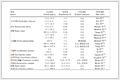
At first, compound 4 was synthesized as the donor for HASP strategy. But its reactivity was too high that so many byproducts generated, especially the ortho-ester 8 (Scheme 1). Then we synthesized donors 5 and 6 in order to decrease the byproducts. With series of attempts, we found that donor 6 had a suitable reactivity and better application for HASP strategy with 0.05 equiv. TMSOTf as catalyst, which avoided producing ortho-ester 14 (Table 1, entry 13).

|
Download:
|
| Scheme 1. Glycosylation of 4 with 1. | |
|
Table 1 Series attempts for glycosylation with 5 and 6. |

Then the temperature and time of glycosylation were also optimized with the reaction of 1 and 6. Because of the weak solubility of 1 under low temperatures, the reactions did not afford good yields below 0 ℃. Besides, higher temperatures (e.g., r.t.) and longer reaction time would lead to the decomposion of products, we finally got the highest yield when the glycosylation was carried out at 0 ℃ for 30 min.
Thus we established the best glycosylation condition: 1.5 equiv. donor and 1.0 equiv. acceptor in dichloromethane with 0.05 equiv. TMSOTf as catalyst and the mixture was stirred at 0 ℃ for 30 min. 2-O-Bz could be easily removed by NaOMe in mixture of dichloromethane and methanol and thus a new acceptor for the next glycosylation was obtained. The assembly of oligosaccharides was carried out like this way.
The single chain in compound 1 had a good solubility in isopropanol, which would cause the yield decreasing. So the carrier Ⅰ (Fig. 2) supported oligosaccharide synthesis could only be purified by MeOH-water, while isopropanol was used for purification during the assembly supported by Ⅱ and Ⅲ because the excess donors and their rearrangement byproducts had better solubility than that in methanol (Table 2).

|
Download:
|
| Fig. 2. Structures of synthesized oligomannosides. | |
|
|
Table 2 Proportion (v/v) of elution agents for HASP purification. |

Table 3 showed the yields of assembly supported by carrier Ⅰ, Ⅱ, Ⅲ. Tri-mannoside 18 was gained with a yield much lower than that of di-mannoside 16, which hinted that the absorption of Ⅰ on reverse phase silica gel was too low to support the synthesis of larger oligosaccharide. Better than that of carrier Ⅰ, the yield of carrier Ⅱ loaded tri-mannosides 23 reached 93%. When it comes the hexa-mannosides 29, the yield was only 74%, much lower than that of penta-mannoside 27. So the assembly was ended here.
|
|
Table 3 Yield of assembly with supported by carrier Ⅰ, Ⅱ and Ⅲ. |

When we used Ⅲ as carrier, we obtained larger oligomannoside than that supported by both Ⅰand Ⅱ. The nona-mannoside 46 was yielded in 75% from the octa-mannoside receptor 45. We continued the assembly using the deprotected nona-mannoside 47 as receptor, however the yield of deca-mannoside 48 was only 42% (Table 3).
All above, we summarized that carrier Ⅰ, Ⅱ and Ⅲ had gradually increasing absorbability. The higher the absorbability was, the less we lost during the purification and the higher yield we could achieve. So carrier Ⅲ had the best applicability for HASP strategy.
At present, the outcome analysis of HASP purification were always implemented by TLC and NMR, both of which could only afford only qualitative result. So we established a new system using HPLC to characterize the purification result quantitatively. The purity of all oligosaccharides gained from HASP was analyzed by HPLC (SiO2 as stationary phase, n-hexane-THF as mobile phase) and the results were summarized in Table 4. Purity of tri-mannosides with carrier Ⅰ was 90.35%, limited by its absorbability with ODS. But acceptor 1was easy to obtain, which made it suitable for rapid assembly of structurally simple oligosaccharides. For carrier Ⅱ, the purity of tri-mannosides was better and the purity of hexa-mannosides was 90.62%. The purity of tri-mannosides and hexa-mannosides was increased with carrier Ⅲ, by which we got nona-mannosides with a purity of 90.63%. Carrier Ⅲ had a better applicability for HASP because of its high yield, high purity and large scale of oligosaccharides.
|
|
Table 4 Purity of oligosaccharides gained from HASP. |


In conclusion, we designed and synthesized a new hydrophobic carrier Ⅲ containing three hydrophobic octadecyl chains, which had a better applicability for HASP strategy. In addition, HPLC was used to analyze the purity of HASP products quantitatively. Moreover, the elution system was also investigated to improve the separation efficiency. These measures could all benefit the HASP strategy for complex oligosaccharides syntheses.
AcknowledgmentsThis work was supported by the grants from the National Natural Science Foundation of China (No. 21232002) and the National Basic Research Program of China (No. 2012CB822100).
| [1] |
A. Varki, Glycobiology 3(1993) 97-130. DOI:10.1093/glycob/3.2.97 |
| [2] |
U. Spohr, R.U. Lemieux, Carbohydr. Res. 174(1988) 211-237. DOI:10.1016/0008-6215(88)85093-6 |
| [3] |
D.J. Miller, M.B. Macek, B.D. Schur, Nature 357(1992) 589-593. DOI:10.1038/357589a0 |
| [4] |
R.A. Dwek, Chem. Rev. 96(1996) 683-720. DOI:10.1021/cr940283b |
| [5] |
G. Opdenakker, P.M. Rudd, C.P. Ponting, R.A. Dwek, FASEB J. 7(1993) 1330-1337. |
| [6] |
P. Sears, C.H. Wong, Science 291(2001) 2344-2350. DOI:10.1126/science.1058899 |
| [7] |
P. Stanley, Glycobiology 2(1992) 99-107. DOI:10.1093/glycob/2.2.99 |
| [8] |
S. Takayam, G.J. MvGarvey, C.H. Wong, Chem. Soc. Rev. 26(1997) 407-415. DOI:10.1039/cs9972600407 |
| [9] |
K.M. Koeller, C.H. Wong, Chem. Rev. 100(2000) 4465-4494. DOI:10.1021/cr990297n |
| [10] |
M.H. Caruthers, Science 230(1985) 281-285. DOI:10.1126/science.3863253 |
| [11] |
E. Atherton, R. C. Sheppard, IRL, Press at Oxford University Press, Oxford, England, 1989, p. 203.
|
| [12] |
S. Manabe, Y. Ito, J. Am. Chem. Soc. 124(2002) 12638-12639. DOI:10.1021/ja020781z |
| [13] |
O.J. Plante, E.R. Palmacci, P.H. Seeberger, Science 291(2001) 1523-1527. DOI:10.1126/science.1057324 |
| [14] |
K. Larsen, M.B. Thygesen, F. Guillaumie, W.G.T. Willats, K.J. Jensen, Carbohydr. Res. 341(2006) 1209-1234. DOI:10.1016/j.carres.2006.04.045 |
| [15] |
H. Ando, S. Manabe, Y. Nakahara, Y. Ito, Angew. Chem. Int. Ed. 40(2001) 4725-4728. DOI:10.1002/1521-3773(20011217)40:24<>1.0.CO;2-C |
| [16] |
H. Ando, S. Manabe, Y. Nakahara, Y. Ito, J. Am. Chem. Soc. 123(2001) 3848-3849. DOI:10.1021/ja003856c |
| [17] |
J. Bauer, J. Rademann, J. Am. Chem. Soc. 127(2005) 7296-7297. DOI:10.1021/ja051737x |
| [18] |
J. Bauer, K. Brandenburg, U. Zähringer, J. Rademann, Chem. Eur. J. 12(2006) 7116-7124. DOI:10.1002/(ISSN)1521-3765 |
| [19] |
S. Kim, A. Tsuruyama, A. Ohmori, K. Chiba, Chem. Commun(2008), 1816-1818. |
| [20] |
Y. Okada, H. Suzuki, T. Nakae, et al., J. Org. Chem. 78(2013) 320-327. DOI:10.1021/jo302127d |
| [21] |
S. Kitada, S. FuJita, Y. Okada, K. Chiba, Tetrahedron 69(2013) 2555-2559. DOI:10.1016/j.tet.2013.01.068 |
| [22] |
J. Guo, Y.J. Lu, L. Zhang, X.S. Ye, Synlett 23(2012) 1696-1700. DOI:10.1055/s-0031-1290406 |
| [23] |
S. Meng, T. Tian, D. Han, et al., Org. Biomol. Chem. 13(2015) 6711-6722. DOI:10.1039/C5OB00730E |