 2017, Vol. 28


Zeolites are an important class of inorganic microporous materials that have been widely used as catalysts, adsorbents, and ion-exchangers in chemical industry [1-7]. The framework structures of all zeolites are built from corner-sharing TO4 tetrahedra (T denotes tetrahedrally coordinated Si, Al, or P, etc.). Different ways of TO4 connection render a rich structural diversity of zeolites. To date, there are over two hundred different zeolite framework types discovered [8], and the pursuit of new zeolites has never stopped due to their wide applications. In addition to traditional synthetic approaches, in silico prediction of unknown structures may accelerate the discovery of new zeolites [9-14] with desired properties by providing a large number of synthetic targets [15-17]. Although millions of hypothetical zeolite structures have been predicted through various computer methods [18-26], it is well accepted that only a small fraction of them are experimentally accessible under conventional hydrothermal conditions. Therefore, screening out unrealizable structures as many as possible is crucial for the selection of synthetic targets among millions of hypothetical zeolites.
Several structure evaluation methods have been postulated [12, 27-31], among which the local interatomic distance (LID) criteria are applicable to all existing uninterrupted oxide zeolites, being the most important criteria existing so far [32, 33]. These criteria include: (1) the average O-T-O distance ( < DOO > ) and the average T-O-T distance ( < DTT > ) are linearly correlated with the average T-O distance ( < DTO > ), and the vertical offsets (ε < OO > and ε < TT > ) of a feasible zeolite structure from the regression lines should be very small (Fig. 1); (2) the standard deviations of T-O, O-T-O, and T-O-T distances (σTO, σOO, and σTT) in a feasible zeolite structure should be very small; (3) the ranges of T-O, O-T-O, and T-O-T distances (RTO, ROO, and RTT) in a feasible zeolite structure should be very small. Using these criteria, many unfeasible zeolites can be screened out, which were incorrectly deemed feasible by previous structure evaluation methods [32].

|
Download:
|
| Fig. 1. Linear relationship among < DTO > , < DOO > , and < DTT > calculated from existing zeolite structures. Blue spheres: T atoms; red spheres: O atoms. | |
The original LIDs were calculated among structures fully optimized without symmetry constraints, followed by phonon calculations to ensure the absence of imaginary frequency. When a large number of structures were evaluated, such calculations can be computationally quite expensive due to the forbiddingly high degrees of freedom. Since zeolite frameworks usually have high symmetry, optimizing zeolite structures with symmetry constraints will be much easier than optimizing them without symmetry constraints due to the much fewer degrees of freedom for symmetric structures. Here, we investigate whether the LIDs calculated among structures optimized with symmetry constraints are similar to the original LIDs calculated among non-symmetric structures. If so, we can use symmetric LIDs as new criteria to screen out unfeasible zeolite structures and the time consumption will be reduced by at least one order of magnitude.
2. Results and discussionFirst, we optimized all of the 218 existing uninterrupted oxide zeolite structures as silica polymorphs without symmetry constraints. The starting models for existing zeolites were derived from the official online database of International Zeolite Association [8]. Meanwhile, we optimized the 218 existing structures using the same starting models with symmetry constraints. As expected, since symmetric structures had much fewer degree of freedom (15, 495) than non-symmetric ones (229, 299), the total time consumption for optimizing 218 existing zeolite structures with symmetry constraints (8, 912 s) was one order of magnitude less than optimizing them without symmetry constraints (92, 855 s).
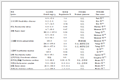
Next, we calculated LIDs among 218 non-symmetric and symmetric existing zeolite structures, respectively. The LIDs for each structure are listed in Tables S1 and S2 in Supporting information. Thus, we obtained two sets of LID criteria from existing zeolite structures: the original LID criteria from non-symmetric structures and the new LID criteria from symmetric structures (designated LIDsym criteria). As shown in Table 1, half of the two parameter sets are quite similar, whereas the ε < TT > , σOO, σTT, and RTO values for LIDsym criteria are a little larger than those for original non-symmetric LID criteria. This is not surprising because symmetric structures were not fully optimized as non-symmetric structures due to the existence of symmetry constraints, so the LIDs in symmetric structures had larger variations than those in non-symmetric ones.
|
Table 1 Original non-symmetric LID criteria and new LIDsym criteria derived from existing zeolite structures, respectively. |

To investigate whether the large variations in LIDsym criteria would affect the detection of unfeasible hypothetical structures, we tested both LID criteria on hypothetical zeolite structures selected from DEEM_PCOD database [16]. We chose representative structures with framework densities (FDs) ranging from 11.0 to 21.0 T 1000 Å-3. For each FD increment of 0.1 T 1000 Å-3, we chose 10 hypothetical structures with the lowest FDs. Since the DEEM_PCOD database did not have enough entries for some low-FD increments, we obtained 995 hypothetical structures in the end. These hypothetical structures were optimized without and with symmetry constraints, respectively. Then, we applied the original non-symmetric LID criteria to hypothetical structures optimized without symmetry constraints, and the new LIDsym criteria to hypothetical structures optimized with symmetry constraints (Tables S3 and S4 in Supporting information). Table 2 lists the numbers of unfeasible hypothetical structures within each FD increment detected by these two LID criteria. The original non-symmetric LID criteria detected 378 unfeasible hypothetical structures. In comparison, the new LIDsym criteria detected 275 unfeasible structures, 261 of which were also deemed unfeasible by the original non-symmetric LID criteria. For both criteria, the unfeasible-structure-detection rate did not exhibit any obvious distribution bias among different FD increments.
|
|
Table 2 Numbers of unfeasible structures among 995 hypothetical zeolite structures detected by the original non-symmetric LID criteria and the new LIDsym criteria. |

To further improve the unfeasible-structure-detection rate for LIDsym criteria, we compared the LIDs for non-symmetric and symmetric existing zeolite structures (Tables S1 and S2). The LIDs for most existing zeolites did not differ much between non-symmetric and symmetric versions. However, the symmetric σTT values for zeolites AHT and VFI differed significantly from non-symmetric LIDs (Tables 1 and 3). Notably, the frameworks of these two zeolites are both built from the "4-2" building units [8]. In a regular 4-2 unit observed in most other zeolites, the central T atoms in the 4-2 building unit point to the same direction out of the 4-2 plane (the "cis" conformation). However, the 4-2 building units in zeolites AHT and VFI are highly twisted, where the two central T atoms point to opposite directions out of the 4-2 plane (the "trans" conformation; Fig. 2) [34]. Moreover, the type materials of these two zeolite frameworks are both hydrated aluminophosphates (AlPO-H2 and VPI-5, respectively). The central Al atoms in their 4-2 building units are both octahedrally coordinated to four bridging O atoms and two terminal water molecules [35], where the local bond distances are significantly different from those around tetrahedrally coordinated T atoms in regular 4-2 building units. When we excluded AHT and VFI from the 218 existing zeolites, we obtained a new set of LIDsym criteria, which were very similar to the original non-symmetric criteria (Tables 1 and 3). Applying these modified LIDsym criteria to 995 hypothetical structures selected from the DEEM_PCOD database, we detected 340 unfeasible structures, 320 of which were also deemed unfeasible by the original LID criteria (Table 4). Using these modified LIDsym criteria, we were able to detect 85% of the unfeasible structures detected by the original LID criteria within one order of magnitude less computation time. Notice that nearly all hypothetical zeolite structures currently available had already been optimized under symmetry constraints as soon as they were predicted. That means we will be able to evaluate millions of hypothetical structures at once without introducing any additional time-consuming computation. Taking this tremendous time-consumption benefit into consideration, the modified LIDsym criteria would be ideal for the rapid detection of unfeasible structures among a large number of hypothetical ones.
|
|
Table 3 LIDs of symmetric structures AHT, VFI, MVY, and the modified LIDsym criteria excluding them. |


|
Download:
|
| Fig. 2. Twisted 4-2 building unit occurred in zeolites AHT and VFI. | |
|
|
Table 4 Numbers of unfeasible structures detected by the modified LIDsym criteria among 995 hypothetical zeolite structures. Numbers of structures deemed unfeasible by both the original LID and the modified LIDsym criteria are shown in brackets. |


If we excluded more outliers from existing zeolites, we would have stricter LIDsym criteria. For instance, there was another zeolite, MVY, built from the distorted 4-2 building units. When we excluded MVY in addition to AHT and VFI, we got a new set of LIDsym criteria that detected 393 unfeasible structures among 995 hypothetical ones, 358 of which were also deemed unfeasible by the original LID criteria (Table 4; Tables S3 and S4 in Supporting information). In addition to detecting 95% of the structures deemed unfeasible by the original LID criteria, the modified LIDsym criteria detected 35 structures deemed feasible by the LID criteria. Although the modified LIDsym criteria were not universally valid for all existing zeolites as the original LID criteria did, we could not draw a conclusion that the LIDsym criteria incorrectly deemed feasible structures unfeasible. For instance, zeolite IPC-9 was recently synthesized via the unconventional assembly-disassembly-organization-reassembly (ADOR) approach [36]. It was incorrectly deemed unfeasible by the original LID criteria. However, after optimizing its framework structure with symmetry constraints, we found that zeolite IPC-9 well obeyed the modified LIDsym criteria. Considering these facts, we postulated that the reliability of the modified LIDsym criteria was at the same level as that of the original LID criteria.
3. ConclusionTo date, millions of hypothetical zeolite structures have been predicted. Evaluating the chemical feasibility for such a large number of structures via non-symmetric LID criteria will be too computationally expensive. Although the LIDsym criteria postulated in this work are not universally valid to all existing zeolites, with minor modifications they can be as reliable as the original LID criteria. More importantly, because symmetric zeolitic structures usually have much fewer degrees of freedom than non-symmetric ones, the LIDsym criteria require much less computation at the initial geometry optimization stage than the original LID criteria, making them a useful tool for the rapid detection of unfeasible ones among millions of hypothetical structures.
4. ExperimentalAll geometry optimizations were performed on a desktop PC using program GULP [37] with SLC potentials [38]. For symmetry optimizations, default GULP keywords were used; for non-symmetric optimizations, additional keywords "nosymmetry" and "phonon" were used. If imaginary frequencies were found in optimized non-symmetric structures, additional geometry optimizations were performed until all imaginary frequencies disappeared. For symmetric structures, we did not perform phonon calculations because imaginary frequencies were unavoidable due to the existence of symmetry constraints. For the ease of comparison, the time consumption for additional calculations for non-symmetric structures was not counted.
All LID calculations were performed using program FraGen [24].
AcknowledgmentsThis work was supported by the National Natural Science Foundation of China (Nos. 21622102, 21621001 and 21320102001) and the National Key Research and Development Program of China (No. 2016YFB0701100).
Appendix A. Supplementary dataSupplementary data associated with this article can be found, in the online version, at http://dx.doi.org/10.1016/j.cclet.2017.04.010.
| [1] | Y. Li, J.H. Yu. New stories of zeolite structures: their descriptions, determinations, predictions, and evaluations. Chem. Rev. 114 (2014) 7268–7316. DOI:10.1021/cr500010r |
| [2] | M. Moliner, C. Martinez, A. Corma. Multipore zeolites: synthesis and catalytic applications. Angew. Chem. Int. Ed. 54 (2015) 3560–3579. DOI:10.1002/anie.201406344 |
| [3] | S.M. Baghbanian. Propylsulfonic acid functionalized nanozeolite clinoptilolite as heterogeneous catalyst for the synthesis of quinoxaline derivatives. Chin. Chem. Lett. 26 (2015) 1113–1116. DOI:10.1016/j.cclet.2015.04.037 |
| [4] | V.V. Speybroeck, K. Hemelsoet, L. Joos, et al., Advances in theory and their application within the field of zeolite chemistry. Chem. Soc. Rev. 44 (2015) 7044–7111. DOI:10.1039/C5CS00029G |
| [5] | G.D. Feng, P. Cheng, W.F. Yan, et al., Accelerated crystallization of zeolites via hydroxyl free radicals. Science 351 (2016) 1188–1191. DOI:10.1126/science.aaf1559 |
| [6] | Z.L. Cheng, S. Han. Preparation of a novel composite electrode based on N-doped TiO2-coated NaY zeolite membrane and its photoelectrocatalytic performance. Chin. Chem. Lett. 27 (2016) 467–470. DOI:10.1016/j.cclet.2015.12.010 |
| [7] | B. Yang, Y. Liu, M. Li. Separation of CO2-N2 using zeolite NaKA with high selectivity. Chin. Chem. Lett. 27 (2016) 933–937. DOI:10.1016/j.cclet.2016.01.017 |
| [8] | C. Baerlocher, L. B. McCusker, Database of Zeolite Structures, (2013) http://www.iza-structure.org/databases/. |
| [9] | A. Corma, M.J. Diaz-Cabanas, J.L. Jorda, et al., High-throughput synthesis and catalytic properties of a molecular sieve with 18-and 10-member rings. Nature 443 (2006) 842–845. DOI:10.1038/nature05238 |
| [10] | J.X. Jiang, J.L. Jorda, M.J. Diaz-Cabanas, et al., The synthesis of an extra-large-pore zeolite with double three-ring building units and a low framework density. Angew. Chem. Int. Ed. 49 (2010) 4986–4988. DOI:10.1002/anie.v49:29 |
| [11] | J.A. Armstrong, M.T. Weller. Beryllosilicate frameworks and zeolites. J. Am. Chem. Soc. 132 (2010) 15679–15686. DOI:10.1021/ja106313p |
| [12] | C.J. Dawson, V. Kapko, M.F. Thorpe, et al., Flexibility as an indicator of feasibility of zeolite frameworks. J. Phys. Chem. C 116 (2012) 16175–16181. DOI:10.1021/jp2107473 |
| [13] | R. Martinez-Franco, M. Moliner, Y.F. Yun, et al., Synthesis of an extra-large molecular sieve using proton sponges as organic structure-directing agents. Proc. Natl. Acad. Sci. U. S. A. 110 (2013) 3749–3754. DOI:10.1073/pnas.1220733110 |
| [14] | R.W. Broach, N. Greenlay, P. Jakubczak, et al., New ABC-6 net molecular sieves ZnAPO-57 and ZnAPO-59: framework charge density-induced transition from two-to three-dimensional porosity. Micropor. Mesopor. Mater. 189 (2014) 49–63. DOI:10.1016/j.micromeso.2013.09.022 |
| [15] | M. D. Foster, M. M. J. Treacy, A database of hypothetical zeolite structures, http://www.hypotheticalzeolites.net. |
| [16] | M. W. Deem, Deem database, http://www.hypotheticalzeolites.net/DATABASE/DEEM/DEEM_PCOD/. |
| [17] | Y. Li, J. H. Yu, R. R. Xu, Hypothetical zeolite database, http://mezeopor.jlu.edu.cn/hypo/. |
| [18] | M.W. Deem, J.M. Newsam. Determination of 4-connected framework crystal structures by simulated annealing. Nature 342 (1989) 260–262. DOI:10.1038/342260a0 |
| [19] | C.M. Draznieks, J.M. Newsam, A.M. Gorman, et al., De novo prediction of inorganic structures developed through automated assembly of secondary building units (AASBU Method). Angew. Chem. Int. Ed. 39 (2000) 2270–2275. DOI:10.1002/(ISSN)1521-3773 |
| [20] | Y. Li, J.H. Yu, D.H. Liu, et al., Design of zeolite frameworks with defined pore geometry through constrained assembly of atoms. Chem. Mater. 15 (2003) 2780–2785. DOI:10.1021/cm0213826 |
| [21] | S.M. Woodley, C.R.A. Catlow, P.D. Battle, et al., The prediction of inorganic crystal framework structures using excluded regions within a genetic algorithm approach. Chem. Commun. (2004) 22–23. |
| [22] | M.M.J. Treacy, I. Rivin, E. Balkovsky, et al., Enumeration of periodic tetrahedral frameworks. Ⅱ. Polynodal graphs. Micropor. Mesopor. Mater. 74 (2004) 121–132. DOI:10.1016/j.micromeso.2004.06.013 |
| [23] | R. Pophale, P.A. Cheeseman, M.W. Deem. A database of new zeolite-like materials. Phys. Chem. Chem. Phys. 13 (2011) 12407–12412. DOI:10.1039/c0cp02255a |
| [24] | Y. Li, J.H. Yu, R.R. Xu. FraGen: a computer program for real-space structure solution of extended inorganic frameworks. J. Appl. Crystallogr. 45 (2012) 855–861. DOI:10.1107/S002188981201878X |
| [25] | Y. Li, X. Li, J.C. Liu, et al., In silico prediction and screening of modular crystal structures via a high-throughput genomic approach. Nat. Commun. 6 (2015) 8328. DOI:10.1038/ncomms9328 |
| [26] | Y. Li, J.H. Yu. Genetic engineering of inorganic functional modular materials. Chem. Sci. 7 (2016) 3472–3481. DOI:10.1039/C6SC00123H |
| [27] | M.D. Foster, O. Delgado Friedrichs, R.G. Bell, et al., Structural evaluation of systematically enumerated hypothetical uninodal zeolites. Angew. Chem. Int. Ed. 42 (2003) 3896–3899. DOI:10.1002/(ISSN)1521-3773 |
| [28] | Y. Li, J.H. Yu, Z.P. Wang, et al., Design of chiral zeolite frameworks with specified channels through constrained assembly of atoms. Chem. Mater. 17 (2005) 4399–4405. DOI:10.1021/cm050536p |
| [29] | A. Sartbaeva, S.A. Wells, M.M.J. Treacy, et al., The flexibility window in zeolites. Nat. Mater. 5 (2006) 962–965. DOI:10.1038/nmat1784 |
| [30] | D. Majda, F.A.A. Paz, O.D. Friedrichs, et al., Hypothetical zeolitic frameworks: in search of potential heterogeneous catalysts. J. Phys. Chem. C 112 (2008) 1040–1047. |
| [31] | J.R. Lu, L. Li, H.X. Cao, et al., Screening out unfeasible hypothetical zeolite structures via the closest non-adjacent O...O pairs. Phys. Chem. Chem. Phys. 19 (2017) 1276–1280. DOI:10.1039/C6CP06217B |
| [32] | Y. Li, J.H. Yu, R.R. Xu. Criteria for zeolite frameworks realizable for target synthesis. Angew. Chem. Int. Ed. 52 (2013) 1673–1677. DOI:10.1002/anie.v52.6 |
| [33] | X.H. Liu, S. Valero, E. Argente, et al., The importance of T…T…T angles in the feasibility of zeolites. Z. Kristallogr. Cryst. Mater. 230 (2015) 291–299. |
| [34] | G.O. Brunner. Criteria for the evaluation of hypothetical zeolite frameworks. Zeolites 10 (1990) 612–614. DOI:10.1016/S0144-2449(05)80322-7 |
| [35] | H.X. Li, M.E. Davis, J.B. Higgins, et al., Aluminophosphate molecular sieves comprised of hydrated triple crankshaft chains. J. Chem. Soc. Chem. Commun. (1993) 403–405. |
| [36] | M. Mazur, P.S. Wheatley, M. Navarro, et al., Synthesis of 'unfeasible' zeolites. Nat. Chem. 8 (2015) 58–62. DOI:10.1038/nchem.2374 |
| [37] | J.D. Gale, A.L. Rohl. The general utility lattice program (GULP). Mol. Simul. 29 (2003) 291–341. DOI:10.1080/0892702031000104887 |
| [38] | M.J. Sanders, M. Leslie, C.R.A. Catlow. Interatomic potentials for SiO2. J. Chem. Soc. Chem. Commun. (1984) 1271–1273. |