 2017, Vol. 28


 , Yue-Wei Guoa
b Institute of Biomolecular Chemistry(ICB) of the National Research Council(CNR), Via Campi Flegrei 34, 80078, Pozzuoli, Napoli, Italy
Marine sponge of the genus Mycale (Carmia) is a rich source of bioactive secondary metabolites of diverse structure features, such as peloruside A [1], mycalamides A and B [2, 3]. Pateamine [4], and a series of pyrrole-containing lipids [5-11], with a wide range of biological activities, including antibacterial, antifungal, antiviral, and antitumoral effects. It is worth to mention that even if pyrrole is a structurally simple five-membered ring, pyrrole-containing lipids have seldom been discovered in the marine organisms, with distribution limited primarily to specific species of algae, sponges, bryozoans, tunicates and mollusks [12]. Among these marine sources, sponges of the Mycale genus have been recognized as one of the main origins of pyrrole-containing lipids. In the last decades, a variety of new 5-alkylpyrrole-2-carbaldehydes have been isolated from this genus of sponges and some of them were found to be of strong antidiabetic and antitumoral activities [8, 10, 11]. In our continuous searching for biologically active secondary metabolites from Chinese marine sponges [13-15], M. lissochela was collected from Lingshui, Hainan, China. The chemical investigation of its acetone extract resulted in the discovery of two new, namely mycalenitrile-15 (1) and mycalenitrile-16 (2), and five known 5-alkylpyrrole-2-carboxaldehyde derivatives (3-7). Herein, we report their isolation, structure determination and PTP1B inhibitory activities.
2. Results and discussionFractionation of the Et2O soluble residue of the acetone extract of the title animals by silica gel column chromatography (CC), followed by further silica gel CC and RP-HPLC, led to the isolation of compounds 1-7 (Fig. 1). All these compounds showed very similar spectroscopic properties. Their typical IR absorptions at vmax around 3260, 1645 cm-1, and 1H NMR spectra (a singlet at δ 9.37, a pair of "dd" peak at around δ 6.89 and 6.08, large integration at δ 1.20-1.50) indicated that compounds 1-7 were 5-alkylpyrrole-2-carboxaldehyde derivatives. In addition, their characteristic IR absorption at vmax around 2250 cm-1, 13C NMR datum at δ 119.9, indicated the presence of nitrile functionality. Therefore, compounds 1-7 should be 5-alkylpyrrole-2-carboxaldehyde with a terminal nitrile group. On the basis of the above analysis and by comparing the NMR data with the reported 5-alkylpyrrole-2-carboxaldehyde in the literature, the known isolates were readily identified as mycalenitrile-13 (3) [11], 5-(19'-cyanononadecyl) pyrrole-2-carbaldehyde (4) [7], mycalenitrile-2 (5) [10], mycalenitrile-3 (6) [10], (6'Z)-5-(23'-cyano-6'-tricosenyl)pyrrole-2-carboxaldehyde (7) [9], respectively.

|
Download:
|
| Fig. 1. The structures of compounds 1-7. | |
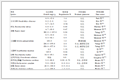
Compound 1 was obtained as an optically inactive white amorphous powder, and its molecular formula, C29H46N2O, was established from HR-EIMS with the ion peak at m/z 438.3621 (calcd. for C29H46N2O: 438.3611). Its 1H NMR spectrum not only comprised an aldehyde proton signal at δH 9.37 (s, 1H, H-1), two pyrrole proton signals at δH 6.87-6.89 (dd, 1H, J = 3.6, 2.7 Hz, H-3) and 6.06-6.08 (dd, 1H, J = 3.6, 2.7 Hz, H-4), a broad NH signal at δH 9.35 (1H, brs), but also four olefinic proton signals at δH 5.33-5.38 (m, 4H, H-10, H-11, H-13, and H-14), and signals at δH 2.66 (t, 2HJ = 7.5 Hz, H-6), 2.33 (t, 2H, J = 7.2 Hz, H-28), and 2.00-2.10 (m, 4H, H-9 and H-15). The 13C NMR data confirmed the presence of the aldehyde [δC 178.1 (d, C-1)], pyrrole carbons [δC 142.9, 131.8 (s, C-2), 122.4 (d, C-3), 109.4 (d, C-4)], olefin [δC 130.4 (d, C-11), 129.3 (d, C-14), 128.6 (d, C-10), 127.8 (d, C-13)], and a nitrile carbon [δC 119.9 (s, C-29)] (Table 1). By comparing with the NMR data with those reported for the co-isolated known compounds 3-7, 1 was suggested to be a 5-alkylpyrrole-2-carboxaldehyde derivative with a long unsaturated aliphatic side chain at the C-5 position. Furthermore, the triplet of CH2-12 at δ 2.77 (t-J = 5.9 Hz) and δC 25.6 (C-12), and its strong 1H-1H COSY correlation (Fig. 2) with the olefinic protons, inferred that the two double bonds were separated by the methylene-12. The presence of allylic carbon signals at δC 27.2 (C-9), 27.7 (C-12) and 27.8 (C-15), with no signals in the range 31-35 ppm, indicated that both two olefinic bonds encompassed Z geometry [5, 9]. The position of the two olefinic bonds was determined from interpretation of the COSY spectrum, leading to the spin-spin system b (C-6 to C-15) (Fig. 2). Such connection was confirmed by the EI-MS analysis (Fig. 2) with the specific signals at m/z 136, 176, 190, and 230, resulted from CH2 or allylic cleavage of the side chain [5, 9]. In view of the molecular formula of C29H46N2O, the linkage of the terminal nitrile was determined, and thus compound 1 was characterized as presented in Fig. 1, namely mycalenitrile-15.
|
Table 1 1H NMR and 13C NMR data of compounds 1 and 2.a |


|
Download:
|
| Fig. 2. Selected key 1H-1H COSY (bold lines) correlations of 1 and key EI-MS fragments of 1 and 2. | |
The molecular formula of compound 2 was also established from HR-EIMS with the ion peak at m/z 412.3461 (calcd. for C27H44N2O: 412.3453). Its typical IR bands, as well as the specific 1H NMR data at the downfield [δH 9.90 (brs, 1H, NH), 9.35 (s, 1H, H-1), 6.89 (m, 1H, H-3), 6.07 (m, 1H, H-4), 5.33-5.34 (m, 2H, H-11/H-12); δC 178.1 (C-1), 131.8 (C-2), 122.6 (C-3), 109.4 (C-4), 143.2 (C-5), 129.4 (C-11), 130.2 (C-12), 119.9 (C-27)] (Table 1), were nearly the same as those of 7, indicated 2 as a 5-alkylpyrrole-2-carboxaldehyde derivative with only one olefinic bond on the middle and a nitrile at the end of the side chain. The only 28 mass units fewer on the MS of compound 2 than that of 7, suggested that the structure of 2 might only a lost of two CH2 groups on that of 7. The Z geometry of its olefinic bond was also confirmed by the allylic carbon signals at δC 27.2 (C-10) and 25.6 (C-13), respectively [5, 9]. The position of the double bond at C-11 and C-12 in the long side chain was determined from the mass spectrum, with the fragment ion peaks at m/z 150 and 204 that resulted from the allylic cleavage (Fig. 2) [5, 9]. From the above spectral evidences, and by comparing with 7, compound 2 was determined as mycalenitrile-16.
All the compounds were assayed for their inhibitory activity against PTP1B, and mostof theminhibited PTP1 B activitiesin a dosedependent manner (Table 2).Among them, the newcompound 1 and the known one 7 exhibited the most potent inhibitory activities, with IC50 values of 8.6 and 3.1 μmol/L, respectively, comparable with the positive control ursolic acid (IC50 = 3.6 μmol/L) [16]. Compounds 3-6, with the presence of a saturated side chain, were less active than 1, 2 and 7, indicating that the unsaturated aliphatic side chain may be helpful for the resultant activity.
|
|
Table 2 Inhibitory activity of isolated compounds against PTP1B. |


3. Conclusion
Pyrrole-containing lipids are uncommon secondary metabolites in nature, which mainly distributed in certain marine organisms such as sponges of the Mycale genus. In order to find potential antidiabetic pyrrole-containing lipids [8], we did a systematic chemical investigation of the South China Sea sponge M. lissochela, resulting in the discovery of two new and five known 5-alkylpyrrole-2-carboxaldehyde derivatives with a terminal nitrile on the aliphatic side chain (1-7). All the isolated compounds, except for 3, exhibited PTP1 B inhibitory activities, and those with unsaturated side chain (1, 2 and 7) had a better performance, which gave us some fundamental evidence for the discovery of antidiabetic lead compounds on the specific target protein such as PTP1B. Further pharmacological mechanism study of these compounds should be conducted toward PTP1 B and other targets for the finding of novel antidiabetic drug leads.
4. Experimental 4.1. GeneralColumn chromatography: commercial silica gel (Qingdao Haiyang Chemical Group Co.; 200-300 mesh). Reversed-phase HPLC was employed on Agilent 1100 series liquid chromatography with a VWD G1314A detector at 210 nm using a semi-preparative ODS-HG-5 [5 μm, 10 mm (i.d.) × 25 cm] column. TLC: precoated silica gel plates (Yantai Zifu Chemical Group Co.; G60, F-254). Optical rotation: Perkin-Elmer 341 polarimeter. IR spectra: Nicolet Magna FT-IR 750 spectrophotometer; vmax in cm-1. NMR Spectra: Bruker DRX-400 spectrometer; d in ppm rel. to residual CHCl3 (δH 7.26, δC 77.0) as internal standard, J in Hz. MS: Finnigan MAT-95 spectrometer; in m/z.
4.2. Collection of biological materialsThe specimen of M. cecilia, identified by Prof. R.-L. Zhou of the South China Sea Institute of Oceanology, Chinese Academy of Sciences, were collected in February 2004 by scuba techniques at a depth of -10 m off Lingshui, Hainan Province, China, in the South China Sea. A voucher specimen is available for inspection at the Shanghai Institute of Materia Medica, CAS, under the registration No.04LS-247.
4.3. Extraction and isolationThe frozen animals (120 g dry weight) were cut into small pieces and exhaustively extracted with acetone (1.0 L×3) at r.t. The extract was concentrated under reduced pressure, and the crude residue was partitioned between Et2O and H2O. The Et2O-soluble portion was fractionated by CC (silica gel, light petroleum ether with increasing amounts of ethyl acetate): 10 fractions (A-J). The fraction D, which performed obvious reactions with dragendorff reagent, was subjected to repeated reversed HPLC separations using MeOH-H2O (90:10) as eluent to afford 1 (2.8 mg) with retention time of 67.4 min, 2 (12.0 mg, with retention time of 65.1 min), 3 (3.6 mg, with retention time 62.9 min), 4 (22.0 mg, with retention time of 64.3 min), 5 (4.0 mg, with retention time of 66.7 min), 6 (24.0 mg, with retention time of 68.3 min), 7 (28.0 mg, with retention time of 70.3 min).
Mycalenitrile-15 (1): Optically inactive white amorphous powder; IR (KBr, cm-1): vmax 3260, 2924, 2853, 2245, 1643, 1495, 1412, 1195, 1132, 1077, and 1042; 1H NMR (CDCl3, 400 MHz): see Table 1; 13C NMR (CDCl3, 100 MHz): see Table 1; EI-MS (70 eV) m/z 438 (60.8) (M)+, 412 (8.0) (M-CN)+, 409 (24.0) (M-CHO)+, 230 (8.0) (M-C14H26N)+, 190 (12) (M-C17H30N)+, 176 (12) (M-C18H32N)+, 150 (24) (M-C20H34N)+, 136 (12) (M-C21H36N)+, 122 (100) (M-C22H38N)+, and 108 (90.9) (M-C23H40N)+; HR-EI-MS: m/z 438.3621 (calcd. for C29H46N2O: 438.3611).
Mycalenitrile-16 (2): Optically inactive white amorphous powder; IR (KBr, cm-1): vmax 3255, 2924, 2853, 2248, 1644, 1496, 1411, 1195, 1132, 1077, and 1042; 1H NMR (CDCl3, 400 MHz): see Table 1; 13C NMR (CDCl3, 100 MHz): see Table 1; EI-MS (70 eV) m/z 412 (92.0) (M)+, 386 (11.0) (M-CN)+, 150 (21.0) (M-C18H32N)+, 136 (8.0) (M-C19H34N)+, 122 (100) (M-C20H36N)+, and 108 (68.0) (M-C21H38N)+; HR-EI-MS: m/z 412.3461 (calcd. for C27H44N2O: 412.3453).
4.4. PTP1B assayPTP1B (human, recombinant) was purchased from BIOMOL® International LP (USA) and the enzyme activity was measured using pNPP as previously described [17]. To each well of a 96-well plate (final volume: 200 μL) was added 2 mmol/L pNPP and PTP1 B (0.05-0.1 μg) in a buffer containing 50 mmol/L citrate (pH 6.0), 0.1 mol/L NaCl, 1 mmol/L EDTA and 1 mmol/L dithiothreitol (DTT) with or without test compounds. Following incubation at 37 ℃ for 30 min, the reaction was terminated with 10 mol/L NaOH. The amount of produced p-nitrophenol was estimated by measuring the absorbance at 405 nm. The non-enzymatic hydrolysis of 2 mmol/L pNPP was corrected for by measuring the increase in absorbance at 405 nm obtained in the absence of PTP1 B enzyme.
AcknowledgmentsThis research work was financially supported by the National Natural Science Foundation of China (Nos. 41476063, 81520108028, 81273430, 41306130 81302692, 41676073, 81603022), SCTSM Project from Shanghai Science and Technology Committee, Shanghai, China (Nos. 14431901100, 15431901000), The project from Institutes for Drug Discovery and Development, Chinese Academy of Sciences, China (No. CASIMM0120152039), the SKLDR/SIMM Projects from Shanghai Institute of Materia Medica, China (No. SIMM 1501ZZ-03). X.-W. Li acknowledges the financial support of "Youth Innovation Promotion Association" (No. 2016258) from Chinese Academy of Sciences, "Young Talent Supporting Project" from China Association for Science and Technology (No. 2016QNRC001), and Shanghai "Pujiang Program"(No. 16PJ1410600).
| [1] | L.M. West, P.T. Northcote. Peloruside A:a potent cytotoxic macrolide isolated from the New Zealand marine sponge Mycale sp. J. Org. Chem. 65(2000)445–449. DOI:10.1021/jo991296y |
| [2] | N.B. Perry, J.W. Blunt, H.G. Munro. Mycalamide A, an antiviral compound from a New Zealand sponge of the genus Mycale. J. Am. Chem. Soc. 110(1988)4850–4851. DOI:10.1021/ja00222a067 |
| [3] | N.B. Perry, J.W. Blunt, H.G. Munro, A.M. Thompson. Antiviral and antitumor agents from a New Zealand sponge, Mycale sp. 2. Structures and solution conformations of mycalamides A and B. J. Org. Chem. 55(1990)223–227. DOI:10.1021/jo00288a037 |
| [4] | P.T. Northcote, J.W. Blunt, H.G. Munro. Pateamine:a potent cytotoxin from the New Zealand marine sponge, Mycale sp. Tetrahedron Lett. 32(1991)6411–6414. DOI:10.1016/0040-4039(91)80182-6 |
| [5] | D.B. Stierle, D.J. Faulkner. Metabolites of the marine sponge Laxosuberites sp. J. Org. Chem. 45(1980)4980–4982. DOI:10.1021/jo01312a033 |
| [6] | M.J. Ortega, E. Zubia, J.L. Carballo, J. Salva. New cytotoxic metabolites from the sponge Mycale micracanthoxea. Tetrahedron 53(1997)331–340. DOI:10.1016/S0040-4020(96)00989-1 |
| [7] | R.S. Compagnone, M.C. Oliveri, I.C. Pina, et al., 5-Alkylpyrrole-2-carboxaldehydes from the Caribbean sponges Mycale microsigmatosa and Desmapsamma anchorata. Nat. Prod. Lett. 13(1999)203–211. DOI:10.1080/10575639908048787 |
| [8] | G. B.S. Reddy, N. Dhananjaya. Chemical investigation of Mycale mytilorum and a study on toxicity and antidiabetic activity of 5-octadecylpyrrole-2-carboxaldehyde. Bioorg. Med. Chem. 8(2000)27–36. DOI:10.1016/S0968-0896(99)00274-6 |
| [9] | U. Venkatesham, M.R. Rao, Y. Venkateswarlu. New 5-alkylpyrrole-2-carboxaldehyde derivatives from the sponge Mycale tenuispiculata. J. Nat. Prod. 63(2000)1318–1320. DOI:10.1021/np000101a |
| [10] | M.J. Ortega, E. Zubia, M.C. Sanchez, J. Salva, J.L. Carballo. Structure and cytotoxicity of new metabolites from the sponge Mycale Cecilia. Tetrahedron 60(2004)2517–2524. DOI:10.1016/j.tet.2004.01.056 |
| [11] | S.C. Mao, Y. Liu, B. Morgan, et al., Lipophilic 2, 5-disubstituted pyrroles from the marine sponge Mycale sp. inhibit mitochondrial respiration and HIF-1 activation. J. Nat. Prod. 72(2009)1927–1936. DOI:10.1021/np900444m |
| [12] | F. Pietra, 'Biodiversity and natural product diversity, in: J. E. Baldwin, R. M. Williams (Eds. ), Tetrahedron Organic Chemistry Series, vol. 21, Oxford Publisher, Pergamon, 2002, pp. 61. |
| [13] | S.C. Mao, E. Manzo, Y.W. Guo, et al., New diastereomeric bis-sesquiterpenes from Hainan marine sponges Axinyssa variabilis and Lipastrotethya ana. Tetrahedron 63(2007)11108–11113. DOI:10.1016/j.tet.2007.08.028 |
| [14] | S.C. Mao, Y.W. Guo, R.V. Soest, G. Cimino. New nitrogenous bisabolene-type sesquiterpenes from a Hainan sponge Axinyssa aff. variabilis. Helv. Chim. Acta 90(2007)588–593. DOI:10.1002/(ISSN)1522-2675 |
| [15] | H.L. Liu, D.Q. Xue, S.H. Chen, X.W. Li, Y.W. Guo. New highly oxidative formamidobisabolene-derived sesquiterpenes from a Hainan sponge Axinyssa variabilis. Helv. Chim. Acta 99(2016)650–653. DOI:10.1002/hlca.201600077 |
| [16] | W. Zhang, D. Hong, Y.Y. Zhou, et al., Ursolic acid and its derivative inhibit protein tyrosine phosphatase 1B, enhancing insulin receptor phosphorylation and stimulating glucose uptake. Biochim. Biophys. Acta 1760(2006)1505–1512. DOI:10.1016/j.bbagen.2006.05.009 |
| [17] | H. Oh, B.S. Kim, M.S. Kim, et al., Inhibition of PTP1B by metabolites from Micromucor ramannianus var, angulisporus CRM000232. J. Antibiot. 57(2004)528–531. DOI:10.7164/antibiotics.57.528 |