 2017, Vol. 28


p-Aminophenol (PAP) is an important intermediate for the production of drugs, pesticides, dyestuffs, and photographic chemicals [1]. The preparation of PAP by catalytic hydrogenation of nitrobenzene (NB) is an important process owing to its simple technology and low cost of raw material. This process involves hydrogenation of NB to the intermediate N-phenylhydroxylamine (PHA) and PHA's conversion through an acid-catalyzed rearrangement to PAP [2]. An industrialized process has been realized by Mallinckrodt Inc. (USA) several decades ago [3]. Sulfuric acid, which is used in the process to catalyze the in situ rearrangement of PHA to PAP, brings considerable burden to the environment by generating effluents because of the inevitable neutralization step to separate PAP from the reaction mixture. Many researchers have applied solid acids such as S2O8 2-/ZrO2 [4], H-ZSM-5 [5] and MgAPO-5 [6] to replace sulfuric acid, aiming to solve the effluents problem, but coke formation on the acid sites [5] restricted their performance and lifetime. In our previous work, the pressurized CO2/H2O system has been applied in the hydrogenation of NB to PAP [7] and an optimized PAP's selectivity of 85% was obtained over Pt-Sn catalyst. In contrast to the conventional permanent mineral acid, the self-neutralizable CO2/H2O system is totally rid of the effluents problem [8, 9]. Nevertheless highly selective catalyst for the conversion of NB to PAP in the new system is very important. It is known that various catalysts [10-14], including PtO2, Pt, Pd, Mo, Ni-Pt, Au, Ni-Si, etc., have been tested for the hydrogenation of NB to PAP, and Pt catalysts showed to be the best for obtaining high selectivity of PAP. Pt supported on different supports [15-19] have also been reported and the selectivity of PAP could be as high as 88%. Some additives such as dimethylsulfoxide [20], dimethylalkylamine oxide [21] and the surfactant dodecyltrimethyl ammonium bromide [22] were also explored in the reaction to modify Pt catalyst for higher selectivity of PAP, but most of the additives were not environmentally friendly. It should be noticed that the application of bimetallic catalysts, using onemetal component to modify another active catalyst metal, has been an effective method to improve the catalyst's performance in selective hydrogenation reactions. Lindlar catalyst [23, 24] and Pt-Sn, which are typical examples, have been applied in many selective transformations [25-28]. Moreover, the bimetallic Pt-Pb catalysts were also applied in some reactions [29, 30]. On continuing our research for the hydrogenation of NB to PAP in the pressurized CO2/H2O system [7], various supported Pt-Pb bimetallic catalysts were prepared and examined in the reaction.
2. Experimental 2.1. Catalyst preparation and characterizationThe Pt-Pb/SiO2 catalyst was prepared according to the known method [6] with slightly modification: Silica (Aerosil 300, Macklin, 2 g) was impregnated with 20 mL aqueous solution of H2PtCl6 (Alfa, 82 mg, 0.2 mmol Pt) and (CH3COO)2Pb (Alfa, 65 mg, 0.2 mmol Pb) for 24 h. After the impregnation, the content in the vessel was dried at 120 ℃ for 3 h and calcined at 500 ℃ for 4 h. Afterward, the dried solid was reduced in hydrogen atmosphere at 300 ℃ for 4 h forming the catalyst. The catalysts with other supports, including carbon black (Vulcan XC-72, Macklin), g-Al2O3 (basic type, >60 mesh, Aladdin) and ZrO2 (99.99%, 0.2-0.4 mm, Aladdin), were also prepared according to the method mentioned above.
The Pt loading of the Pt-Pb/SiO2 catalysts were measured using a Optima 2000DV ICP spectrometer. The sample was firstly dispersed in aqua regia in order to dissolve all Pt, and then sent for analysis. XRD patterns of the Pt-Pb/SiO2 catalyst and the SiO2 support were recorded on a D/max-2400 diffractometer with Cu Ka radiation (λ=0.1541 nm). The scanning rate was 4° /min in the range of 10-65o. TEM image of the Pt-Pb/SiO2 catalyst was taken by a Tecnai F30 electron microscope operating at 300 kV. Sample was mounted on a copper grid-supported carbon film by placing a few droplets of an ultrasonically dispersed suspension of samples in ethanol, and followed by drying at ambient conditions.
2.2. Typical catalysis experimentA 100 mL autoclave (Parr 4842) was applied to carry out the reaction of NB to PAP. The catalyst, NB and water were introduced into the autoclave which was then purged three times with 0.2 MPa CO2, then the autoclave was gradually charged with designated pressure of CO2. H2 was charged when the autoclave reached the designated temperature under constant stirring. The total operating pressure was maintained constant by continuous recruitment of H2 during the reaction process. After the reaction, the gas was released slowly. The suspension was filtered and the solid was washed with methanol, then the filtrate was dissolved in methanol to obtain a homogeneous solution and analyzed by high performance liquid chromatography (HPLC). The following method was used: Agilent TC-C18 column (5 mm, 4.6 mm × 250 mm); column temperature: 30 ℃; UV detector: 254 nm; Mobile phase: (A)70 mmol/L aqueous solution of ammonium acetate; (B) methanol. Gradient: t=0min 70% A 30% B, t=20min 0% A 100% B; flow rate: 1.0 mL/min.
3. Results and discussion 3.1. Characterization of the Pt-Pb/SiO2 catalystsThe prepared Pt-Pb/SiO2 (2%) catalyst was characterized via ICP-OES, XRD and TEM. The exact Pt loading was 1.890 wt% according to the result determined by ICP-OES. XRD measurements of the Pt-Pb/SiO2 catalyst and SiO2 support were performed and the results were shown in Fig. 1. The alloy between Pb and Pt were confirmed by the diffraction peak of PtPb (101) plane at 29.3° (JCPDS-ICDD, Card No. 06-374), the result was in agreement with that of Huang's work [31]. TEM image of the Pt-Pb/SiO2 catalyst was shown in Fig. 2, and it can be seen that the majority of metal particles were dispersed uniformly on the SiO2 support within the diameter range of 1-4 nm.

|
Download:
|
| Figure 1. XRD patterns of SiO2 and Pt-Pb/SiO2. | |

|
Download:
|
| Figure 2. TEM image of Pt-Pb/SiO2 catalyst. | |
3.2. Effect of different catalysts on the hydrogenation of NB to PAP
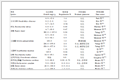
Different supported catalysts were applied in the reaction, and the selectivity of PAP when the reaction was catalyzed by Pt-Pb catalysts were 12.9-19.2% higher than the selectivity when the reaction was catalyzed by Pt catalyst (entries 1-8, Table 1). PAP's selectivity of 65.1% was obtained when the reaction was catalyzed by Pt-Pb supported on the SiO2, and it was the best result of the examined catalysts. Afterward, Pt-Pb/SiO2 catalysts with different Pt loadings 1 wt%, 2 wt%, 5 wt% and 10 wt% were used to catalyze the reaction. It is found that the conversion of NB increased from 12.2% to 42.6%, and the selectivity of PAP decreased from 67.2% to 52.8% while Pt loading increased from 1 wt% to 10 wt% (entries 8-11). With lower Pt loading, PHA could desorb from the catalyst easily and migrate into acidic phase rearranging into PAP, the results were in agreement with those of previously reported [6]. Pt-Pb/SiO2 (Pt: 2%) catalyst used in entry 8 was chosen for the further studies.
|
Table 1 Effect of different catalysts on the hydrogenation of NB to PAPa |


3.3. Reaction results with different nNB/nPt (molar ratio of NB to Pt)
Keeping the amount of catalyst constant, the hydrogenation of NB to PAP was studied with different nNB/nPt from 2500 to 30000 and the results were shown in Fig. 3. The yield of PAP and the yield of AN decreased with the increase of nNB/nPt. The selectivity of PAP increased from 35% to 65% when the nNB/nPt increased from 2500 to 20000, and it was almost constant with nNB/nPt's further increase. According to the commonly accepted mechanism of NB's conversion to PAP [12], the intermediate PHA's remaining absorbed on the catalyst tends to generate more byproduct AN by further hydrogenation, while PHA's desorption from the catalyst and migration into the acidic phase would favor its rearrangement into PAP. It is likely that when the nNB/nPt was low, more PHA tended to remain absorbed on the catalyst being further hydrogenated to AN, thus resulting in lower PAP selectivity. When the nNB/nPt increased, more NB's competitive adsorption would facilitate PHA's desorption from the catalyst, thus leading to higher PAP selectivity. Apparently, this competitive adsorption's effect did not make a great difference with further increase of nNB/nPt from 20000 to 30000.

|
Download:
|
| Figure 3. Reaction results with different nNB/nPt. Conditions: Pt-Pb/SiO2 (Pt: 2 wt%, 1 μmol Pt), H2O=60 mL, PCO2=5.5 MPa (at reaction temperature, 3 MPa initially at room temperature), PH2=0.2 MPa, T=120 ℃, stir rate=1250 r/min, t=3 h. | |

3.4. The hydrogenation of NB under different CO2 pressures
Fig. 4 showed that there was hardly any PAP produced with no CO2 in the system, but the selectivity of PAP increased dramatically from 0 to 70% when the initial CO2 pressure increased from 0 to 5 MPa. Apparently, the increase of CO2 pressure increased the acidity of the system and favored the formation of PAP, the result was in agreement with that reported in our previous work [7].

|
Download:
|
| Figure 4. The hydrogenation of NB under different CO2 pressures. Conditions: NB=20 mmol, Pt-Pb/SiO2 (Pt: 2 wt%, 1 μmol Pt), H2O=60 mL, PH2=0.2 MPa, T=120 ℃, stir rate=1250 r/min, t=3 h. PCO2: initial pressure at room temperature. | |

3.5. Effect of temperature on the hydrogenation of NB
The reaction was studied within a range of temperatures 90-140 ℃ and the results were shown in Fig. 5. The selectivity of PAP increased from 65% to nearly 75% when the temperature increased from 90 ℃ to 110 ℃, and then decreased from 75% to=% with the temperature's further increase from 110 ℃ to 140 ℃. This may because that the yield of AN continued increasing with temperature's increase but the yield of PAP was almost constant when the temperature increased from 110 ℃ to 140 ℃. Meanwhile, the color of the reaction liquid changes gradually from pale yellow to dark brown when the temperature was higher than 110 ℃, as a result of PAP's conversion to other byproducts such as 4, 4'-diaminodiphenyl ether [32]. Therefore, 110 ℃ was chosen for the following studies.

|
Download:
|
| Figure 5. Effect of temperature on the hydrogenation of NB. Conditions: NB=20 mmol, Pt-Pb/SiO2 (Pt: 2 wt%, 1 μmol Pt), H2O=60 mL, PCO2=7 MPa (at reaction temperature, 5 MPa initially at room temperature), PH2=0.2 MPa, stir rate=1250 r/min, t=3 h. | |

3.6. The hydrogenation of NB under different H2 pressures
Different H2 pressure from 0.1 MPa to 2 MPa were applied in the reaction and the results were shown in Fig. 6. The yield of PAP and the yield of AN increased with the increase of the H2 pressure, while the selectivity of PAP gradually decreased from 82% to 62%. The formation rate of the intermediate PHA, which would convert to PAP or AN, was accelerated by the increase of H2 pressure, so the yield of PAP and the yield of AN increased. It is worth mentioning that the rate of PHA's desorption from the catalyst was almost constant with the temperature keeping at 110 ℃, so the PHA which cannot desorb from the catalyst in time were further hydrogenated to AN, thus leading to the decrease of PAP's selectivity. 0.2 MPa was chosen for the following studies.

|
Download:
|
| Figure 6. The hydrogenation of NB under different H2 pressures. Conditions: NB=20 mmol, Pt-Pb/SiO2 (Pt: 2 wt%, 1 μmol Pt), H2O=60 mL, PCO2=7 MPa (at reaction temperature, 5 MPa initially at room temperature), T=110 ℃, stir rate=1250 r/min, t=3 h. | |

3.7. Effect of reaction time on the hydrogenation of NB to PAP
The reactionwas studied by changing the reaction time from1 to 7 h, the yield of PAP and the yield of AN increased, the selectivity of PAP showed a continuous decrease from 90% to 60% but it was higher than 82% within 2 h (Fig. 7). With the prolongation of reaction time, the selectivity of PAP decreased along with nNB/nPt's decrease, and the result was consistent with the results in Fig. 3. Another probable cause of PAP selectivity's decrease may be that the generated PAP in the system might convert to other byproducts such as 4, 4'-diaminodiphenyl ether [32].

|
Download:
|
| Figure 7. Effect of reaction time on the hydrogenation of NB to PAP. Conditions: NB = 20 mmol, Pt-Pb/SiO2 (Pt: 2 wt%, 1 μmol Pt), H2O = 60 mL, PCO2 = 7 MPa (at reaction temperature, 5 MPa initially at room temperature), PH2 = 0.2 MPa, T = 110 ℃, stir rate = 1250 r/min. | |

4. Conclusion
In summary, supported Pt-Pb bimetallic catalysts were proven to be selective for the hydrogenation of NB to PAP in pressurized CO2/H2O system. When the reaction was carried out at 110 ℃ under 0.2 MPa H2 and 5 MPa CO2 for 2 h by employing Pt-Pb/SiO2 as catalyst, PAP's selectivity was up to 82%.
| [1] | M.S. Kirk-Othmer, Encyclopedia of Chemical Technology, 4th edn., Wiley, New York, 1992. |
| [2] | E. Bamberger, Ueber das phenylhydroxylamin. Ber. Dtsch. Chem. Ges. 27 (1894) 1548–1557. DOI:10.1002/(ISSN)1099-0682 |
| [3] | D.C. Caskey, D.W. Chapman, Process for preparing p-aminophenol and alkyl substituted p-aminophenol, US 4571437. |
| [4] | S.F. Wang, Y.H. Ma, Y.J. Wang, W. Xue, X.Q. Zhao, Synthesis of p-aminophenol from the hydrogenation of nitrobenzene over metal-solid acid bifunctional catalyst. J. Chem. Tech. Biotechnol. 83 (2008) 1466–1471. DOI:10.1002/jctb.v83:11 |
| [5] | T. Komatsu, T. Hirose, Gas phase synthesis of para-aminophenol from nitrobenzene on Pt/zeolite catalysts. Appl. Catal. A:Gen. 276 (2004) 95–102. DOI:10.1016/j.apcata.2004.07.044 |
| [6] | S.F. Wang, B.B. He, Y.J. Wang, X.Q. Zhao, MgAPO-5-supported Pt-Pb-based novel catalyst for the hydrogenation of nitrobenzene to p-aminophenol. Catal. Commun. 24 (2012) 109–113. DOI:10.1016/j.catcom.2012.03.024 |
| [7] | T.T. Zhang, J.Y. Jiang, Y.H. Wang, Green route for the preparation of p-aminophenol from nitrobenzene by catalytic hydrogenation in pressurized CO2/H2O system. Org. Process Res. Dev. 19 (2015) 2050–2054. DOI:10.1021/acs.oprd.5b00307 |
| [8] | G. Gao, Y. Tao, J.Y. Jiang, Environmentally benign and selective reduction of nitroarenes with Fe in pressurized CO2-H2O medium. Green Chem. 10 (2008) 439–441. DOI:10.1039/b719259b |
| [9] | S.J. Liu, Y.H. Wang, J.Y. Jiang, Z.L. Jin, The selective reduction of nitroarenes to Narylhydroxylamines using Zn in a CO2/H2O system. Green Chem. 11 (2009) 1397–1400. DOI:10.1039/b906283a |
| [10] | C.O. Henke, J.V. Vaughen, Reduction of aryl nitro compounds, US 2198249. |
| [11] | L. Shi, X. Zhou, Industrial synthesis method of p-aminophenol, CN 1087623. |
| [12] | L.Y. Zou, Y.Y. Cui, W.L. Dai, Highly efficient Au/TiO2 catalyst for one-pot conversion of nitrobenzene to p-aminophenol in water media. Chin. J. Chem. 32 (2014) 257–262. DOI:10.1002/cjoc.v32.3 |
| [13] | C.V. Rode, M.J. Vaidya, R.V. Chaudhari, Single step hydrogenation of nitrobenzene to p-aminophenol, US 6403833. |
| [14] | Z. Dong, T. Wang, J. Zhao, Ni-silicides nanoparticles as substitute for noble metals for hydrogenation of nitrobenzene to p-aminophenol in sulfuric acid. Appl. Catal. A:Gen. 520 (2016) 151–156. DOI:10.1016/j.apcata.2016.04.013 |
| [15] | C.V. Rode, M.J. Vaidya, R.V. Chaudhari, Synthesis of p-aminophenol by catalytic hydrogenation of nitrobenzene. Org. Process Res. Dev. 3 (1999) 465–470. DOI:10.1021/op990040r |
| [16] | S.K. Tanielyan, J.J. Nair, N. Marin, Hydrogenation of nitrobenzene to 4-aminophenol over supported platinum catalysts. Org. Process Res. Dev. 11 (2007) 681–688. DOI:10.1021/op700049p |
| [17] | K.I. Min, J.S. Choi, Y.M. Chung, p-Aminophenol synthesis in an organic/aqueous system using Pt supported on mesoporous carbons. Appl. Catal. A:Gen. 337 (2008) 97–104. DOI:10.1016/j.apcata.2007.12.004 |
| [18] | P.L. Liu, Y.H. Hu, M. Ni, K.Y. You, H.N. Luo, Liquid phase hydrogenation of nitrobenzene to para-aminophenol over Pt/ZrO2 catalyst and SO42-/ZrO2-Al2O3 solid acid. Catal. Lett. 140 (2010) 65–68. DOI:10.1007/s10562-010-0427-8 |
| [19] | A. Deshpande, F. Figueras, M.L. Kantam, Environmentally friendly hydrogenation of nitrobenzene to p-aminophenol using heterogeneous catalysts. J. Catal. 275 (2010) 250–256. DOI:10.1016/j.jcat.2010.08.005 |
| [20] | P.N. Rylander, I.M. Karpenko, G.R. Pond, Process for preparing para-aminophenol, US 3715397. |
| [21] | E.L. Derrenbacker, Process for the selective preparation of p-aminophenol from nitrobenzene, US 4307249. |
| [22] | X.B. Shan, Y. Liu, Preparation of p-aminophenol from catalytic hydrogenation of nitrobenzene, CN 85103667. |
| [23] | H. Lindlar, R. Dubuis, Palladium catalyst for partial reduction of acetylenes, in:Organic Syntheses, John Wiley & Sons, Inc., New York, 2003, p. 89. |
| [24] | H. Lindlar, Ein neuer katalysator für selektive hydrierungen. Helv. Chim. Acta 35 (1952) 446–450. DOI:10.1002/hlca.19520350205 |
| [25] | Y.S. Hwang, Y.S. Kang, B.C. Koo, et al., Method for selective hydrogenation acetylene alcohols, KR 2001082987. |
| [26] | T.L. Ho, S.H. Liu, Semihydrogenaticn of triple bonds in 1-alkene solutions. Synth. Commun. 17 (1987) 969–973. DOI:10.1080/00397918708063955 |
| [27] | J.C. Serrano-Ruiz, G.W. Huber, M.A. Sánchez-Castillo, Effect of Sn addition to Pt/CeO2-Al2O3 and Pt/Al2O3 catalysts:an XPS, 119Sn Mössbauer and microcalorimetry study. J. Catal. 241 (2006) 378–388. DOI:10.1016/j.jcat.2006.05.005 |
| [28] | M.Y. Yin, S.B. He, Z.K. Yu, Effect of alumina support on catalytic performance of Pt-Sn/Al2O3 catalysts in one-step synthesis of N-phenylbenzylamine from aniline and benzyl alcohol. Chin. J. Catal. 34 (2013) 1534–1542. DOI:10.1016/S1872-2067(12)60608-1 |
| [29] | G.D. Angel, G. Torres, V. Bertin, The role of lanthanum oxide in the formation of NO2 over Pt-Pb/Al2O3-La2O3 catalysts under lean-burn conditions. Catal. Commun. 7 (2006) 232–235. DOI:10.1016/j.catcom.2005.10.012 |
| [30] | S.A. Bocanegra, O.A. Scelza, S.R. de Miguel, Behavior of PtPb/MgAl2O4 catalysts with different Pb contents and trimetallic PtPbIn catalysts in n-butane dehydrogenation. Appl. Catal. A:Gen. 468 (2013) 135–142. DOI:10.1016/j.apcata.2013.07.051 |
| [31] | Y.Y. Huang, J.D. Cai, M.Y. Liu, Y.L. Guo, Fabrication of a novel PtPbBi/C catalyst for ethanol electro-oxidation in alkaline medium. Electrochim. Acta 83 (2012) 1–6. DOI:10.1016/j.electacta.2012.07.089 |
| [32] | G.Q. Sun, Synthesis of p-Aminophenol by Catalytic Hydrogenation, Qingdao University of Science & Technology, Qingdao, 2008. |