 2016, Vol. 27


 , Jun Jiang, Wen-Juan Wang, Jiu-You Chen, Hong-Ting Sheng, Xiang-Ming Meng, Man-Zhou Zhu
The noble metal gold (Au) and its salts have attracted intense attention owing to their potentials in catalysis [1, 2] and biomedical applications [3-5]. Gold ions are known to activate alkynes for nucleophilic addition, and a series of organic transformations has been carried out according to the characteristic alkynophilicity of gold ions [6-10]. Also, gold-based drugs have been widely used in the treatment of rheumatoid arthritis and tuberculosis [11-13]. However, gold salts such as gold chloride are also highly toxic because they can damage the liver, kidneys, and nervous system [14-16]. Furthermore, Au3+ ions have strong affinity to DNA, which could lead to the serious damage of DNA via the catalytic cleavage [17-19]. Therefore, it is highly desirable to develop effective methods for the specific, rapid, and real-time monitoring of Au3+ ions in the environment, agrochemicals, and potentially living systems.
Fluorescence sensing has become a preferable approach for Au3+ detection because of its high sensitivity and selectivity, versatility, and ease of use [20, 21]. Alkynes are often used as the recognition moietyfor gold ions, due totheirwell-acknowledgedalkynophilicity. Therefore, introducing a reactive alkyne moiety to the fluorophore could provide an efficient route to developing Au3+-selective fluorescent probes. Representative examples are Au3+-induced intramolecular cyclization of the rhodamine-based alkynes to yield oxazolecarbaldehyde derivatives [22-25]. Additionally, several alkyne-containing compounds as fluorescent probes for Au3+ ions based on fluorescein [26, 27], BODIPY [28], 1, 8-naphthalimide [29], and coumarin [30, 31] fluorophores are also successfully designed and reported in the literature. However, the most prominent drawback of this sensing mechanism is the cross affinity with other alkynophilic metal species such as Au+, Ag+, Pd2+, Ni2+, Cu2+ and Hg2+, which interferes with the detection of Au3+ ions. Hence, there is an urgent need to develop a fluorescent probe for Au3+ free from the cross-sensitivity of other alkynophilic metal species.
Herein, we present a colorimetric and fluorescent probe (NC7-AL) for the detection of Au3+ utilizing the characteristic alkynophilicity of gold ions with low detection limit, large Stokes shift, and rapid response. Probe NC7-AL shows a remarkable fluorescence "turn-on" response only toward Au3+ ions over Au+, Ag+, Pd2+, Ni2+, Cu2+, and Hg2+. Upon addition of Au3+ ions, color changes from light yellow to colorless could be observed with the naked eye, and the NC7-AL-based modified TLC plates is an easy and convenient testing method that can be used for Au3+ detection.
2. Experimental 2.1. Materials and equipmentsAll solvents were purchased and dried according to standard procedures before use. 1H NMR and 13C NMR spectra were recorded on a Bruker Avance Ⅱ spectrometer at 400 MHz and 100 MHz, respectively. ESI-TOF spectra were recorded over a Waters xevo G2 QT mass spectrometer. UV-vis absorption spectra were recorded on a Shimadzu UV-1800 spectrophotometer. Fluorescence spectra were obtained using a Hitachi F-7000 Fluorescence spectrometer. The fluorescence quantum yields were measured with HORIBA FluoroMax-4P.
2.2. Synthesis of 7-((4-(dimethylamino)phenyl)ethynyl)-2-oxoN-(prop-2-yn-1-yl)-2H-chromene-3-carboxamide (NC7-AL)A solution of NC7 (0.333 g, 1 mmol), 1-hydroxybenzotriazole (HOBT, 0.203 g, 1.5 mmol), 1-(3-dimethylaminopropyl)-3-ethylcarbodiimide hydrochloride (EDC·HCl, 0.211 g, 1.1 mmol), ethyldiisopropylamine (DIPEA, 0.496 mL, 3 mmol), and propargylamine (0.192 mL, 3 mmol) in anhydrous DMF (10 mL) was stirred at r.t. under N2 atmosphere for 24 h. The crude product was extracted with CH2Cl2, washed with brine and purified by column chromatography on silica gel (CH2Cl2:petroleum ether=1:1, v/v) to afford 0.136 g of NC7-AL as a yellow solid in a 37% yield. 1H NMR (400 MHz, DMSO-d6): δ 8.91 (t, 1H, J=5.6 Hz), 8.87 (s, 1H), 7.98 (d, 1H, J=8.1 Hz), 7.58 (s, 1H), 7.50 (d, 1H, J=7.8 Hz), 7.42 (d, 2H, J=8.6 Hz), 6.74 (d, 2H, J=8.7 Hz), 4.13 (d, 2H, J=3.2 Hz), 3.16 (s, 1H), 2.98 (s, 6H). 13C NMR (100 MHz, DMSO-d6): δ 160.97, 160.08, 153.95, 150.60, 147.16, 132.94, 130.47, 128.92, 127.45, 118.06, 117.81, 117.52, 111.79, 107.12, 96.39, 86.99, 80.70, 73.26, 39.61, 28.70. HRMS (ESI-TOF): m/z: calcd. For [C23H18N2O3 + H]+: 371.1317, found: 371.1396.
2.3. Preparation of test solutionIn this paper, a solution of NC7-AL at 5 μmol/L in CH3CN was used for testing. The solutions of various testing species were prepared in doubly distilled water, and CH3CN-doubly distilled water (1:1, v/v) was used for Au3+ due to solubility problems. Various ions were prepared from AuCl, AuCl3, Ce(NO3)3·6H2O, Cs2CO3, NaCl, ZnCl2, NiSO4·6H2O, CrCl3·6H2O, CoCl2, MnCl2·4H2O, CaCl2, MgSO4, BaCl2, KCl, CuCl2, CuI, FeCl2·4H2O, FeCl3, AgNO3, HgCl2, PdCl2, and n-Bu4N+CN-.
3. Results and discussion 3.1. Synthesis of probe NC7-ALCompound NC7 was synthesized from salicylaldehyde following literature procedures [32, 33]. Condensation of NC7 with propargylamine afforded NC7-AL as a yellow powder in a 37% yield (Scheme 1). The structure of NC7-AL was confirmed by 1H NMR, 13C NMR, and HR-MS.

|
Download:
|
| Scheme. 1. Synthetic route and possible Au3+-induced reaction mechanism of probe NC7-AL. | |
3.2. Spectroscopic properties
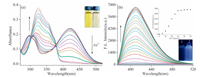
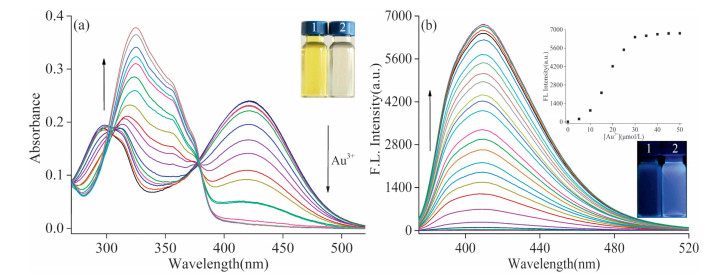
The UV-vis and fluorescence spectra of NC7-AL (5 μmol/L) were investigated in CH3CN. As shown in Fig. 1, the NC7-AL solution displayed almost no fluorescence. Addition of Au3+ to this solution resulted in enhancement of an emission band at 420 nm upon excitation at 360 nm. The emission intensity reached its maximum with ca. 6 equivalent of Au3+. An approximate 200-fold fluorescence enhancement could be observed accompanied by a quantum yield increase from < 0.1% to 18.5%. The UV-vis spectra of NC7-AL displayed a similar sensing behavior toward the addition of Au3+. NC7-AL showed two absorption bands at 300 nm and 422 nm. With the addition of Au3+ (10 equivalent), the absorption band at 422 nm diminished, and a new absorption band with a maximum at 330 nm gradually increased. Concomitantly, the solution color changed from light yellow to colorless, facilitating direct observation by the naked eyes. A well-defined isosbestic point at 378 nm was found indicating a desired one-to-one type clean conversion. The Stokes shift was as large as 90 nm, which could minimize self-quenching.
|
Download:
|
| Figure 1. UV-vis absorption spectra (a) and emission spectra (b) of NC7-AL (5.0 μmol/L) in the presence of Au3+ (0-50.0 μmol/L) in CH3CN. Insets: images of NC7-AL solutions under (a) ambient light (b) UV 365 nm lamp, respectively, before (1) and after (2) treatment with Au3+ (50.0 μmol/L). Inset: the relationship between the fluorescence intensity (I420 nm) and the Au3+ concentrations. | |
We studied the kinetics of the fluorescence enhancement resulting from the addition of Au3+ (6 equivalent) to the solution of probe NC7-AL. As shown in Fig. S1 in Supporting information, the fluorescence intensity reached its maximum in ca. 20 s. Thus, all testing of UV-vis absorption and fluorescence were performed after 1 min. Moreover, a good linear relationship between the dosage of Au3+ (from 0 to 2 equivalent) and the emission intensity was observed (Fig. S2 in Supporting information), and the detection limit (3σ/k) [34] was as low as 3.58 nmol/L. These results show that probe NC7-AL has a rapid response and good detection sensitivity toward Au3+.
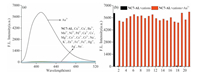
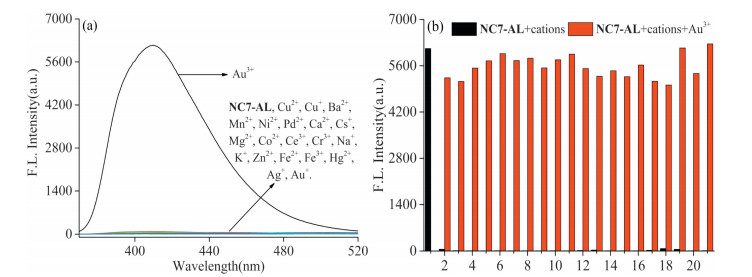
We further investigated the selectivity profile of NC7-AL against other metal ions, such as Cu2+, Cu+, Ba2+, Mn2+, Ni2+, Pd2+, Ca2+, Cs+, Mg2+, Co2+, Ce3+, Cr3+, Na+, K+, Zn2+, Fe2+, Fe3+, Hg2+, Ag+, and Au+. The fluorescence intensity changes of the probe NC7-AL upon addition of various other metal ions are shown in Fig. 2a. It can be seen that the fluorescence of NC7-AL showed no obvious changes after the addition of metal ions except Au3+ ions. Remarkably, commonly coexistent alkynophilic metal ions, such as Au+, Ag+, Pd2+, Ni2+, Cu2+, and Hg2+ have no interference on NC7-AL. This is a notable advantage of NC7-AL compared to the existing probes for Au3+. As shown in Fig. 2b, bar graphs of NC7-AL toward various other metal ions (60 equivalent) both in the absence and presence of Au3+ (6 equivalent) were carried out to investigate the selectivity of NC7-AL to Au3+ in the presence of other metal ions. The fluorescence was activated when Au3+ ions were added to the solutions of NC7-AL and those metal ions, which indicated that the coexistence of other metal ions had little effect on the detection of Au3+. As a result, NC7-AL could efficiently detect Au3+ ions in the mixture of other species.
|
Download:
|
| Figure 2. (a) Fluorescence spectra of NC7-AL (5 μmol/L) to Au3+ (6 equivalent) and other metal ions (60 equivalent) in CH3CN (λex=360 nm). (b) Fluorescence intensity of NC7-AL (5 μmol/L) to various metal ions (1-21: Au3+, Cu2+, Cu+, Ba2+, Mn2+, Ni2+, Pd2+, Ca2+, Cs+, Mg2+, Co2+, Ce3+, Cr3+, Na+, K+, Zn2+, Fe2+, Fe3+, Hg2+, Ag+, and Au+) in CH3CN. The black bars represent the emission of NC7-AL in the presence of various ions (60 equivalent). The red bars represent the emission that occurs upon subsequent addition of Au3+ (6 equivalent) to the solutions. | |
3.3. The sensing mechanism
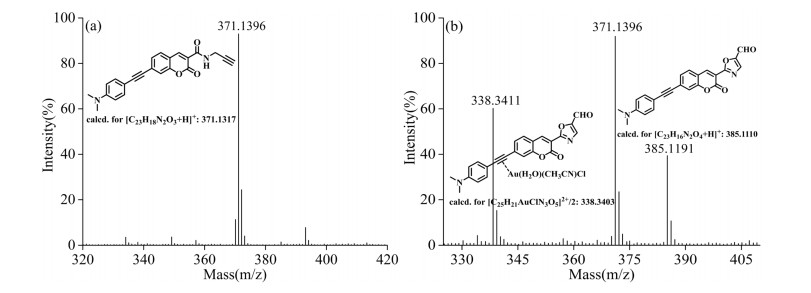
We propose that the carbon-carbon triple bond on the 3-position of coumarin framework (a terminal ethynyl) in NC7-AL could coordinate with Au3+, which initiates a cascade to generate the oxazolecarbaldehyde (NC7-CHO). This mechanism is widely acknowledged in the literature [22, 24, 25]. To further confirm the speculation (Scheme 1), the ESI-TOF mass spectra were used to study the reaction process of NC7-AL by Au3+. The peak of [NC7-AL + H]+ at m/z=371.1396 was observed (Fig. 3a). When 6 equivalent of Au3+ was added to the solution, the peak at m/z=385.1191 appeared, which unambiguously proved the formation of [NC7-CHO + H]+ (Fig. 3b). In addition, the carbon-carbon triple bond on the 7-position of coumarin framework (an internal ethynyl) also had an affinity function with Au3+, which was confirmed by the divalent peak at m/z=338.3411 corresponding to the [NC7-CHO-Au(H2O)(CH3CN)Cl]2+ in Fig. 3b. To further demonstrate that Au3+ can coordinate with the internal ethynyl in probe NC7-AL, a certain amount of tetrabutylammonium cyanide (n-Bu4N+CN-) was added into the solution of NC7-AL pre-incubated with Au3+. The intense fluorescence immediately turned off (Fig. S3 in Supporting information), accompanying a distinctive color change from colorless to light yellow. The dramatic "on-off" response indicated that CN- could sequester Au3+ from the complex NC7-AL-CHO-Au, and obtained free NC7-CHO. The result is in accordance with the blue-shift in the UV-vis absorption spectra of NC7-AL after addition of Au3+, and a similar mechanism has been reported by Emrullahoğlu and co-workers [35]. In light of the above, we speculated that the high selectivity of NC7-AL to Au3+ can be attributed to not only the Au3+-induced intramolecular cyclization of terminal ethynyl in the probe, but also the strong affinity of Au3+ to the internal ethynyl in NC7-AL. We think it is of great value in the rational design of Au3+ probes with high selectivity.

|
Download:
|
| Figure 3. ESI-TOF mass spectra of (a) NC7-AL, and (b) NC7-AL + Au3+. | |
3.4. Applications
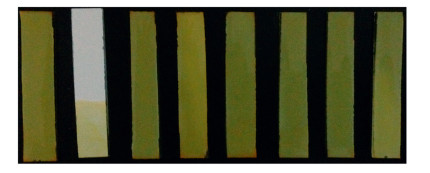
Au3+ ions are widely used in various industrial processes and do extreme harm to humans. As such, easy and convenient testing methods for practical application are highly demanded. Therefore, we prepared the test strips by immersing TLC plates in the CH3CN solution of NC7-AL (10 μmol/L). Then we immersed the modified TLC plates into different metal ion solutions, and a distinct color changefromlightyellowtocolorlesswasobservedinthepresenceof Au3+, comparing to no color changes for the other metal ions (Fig. 4). Therefore, the NC7-AL-based modified TLC plates can conveniently detect Au3+ in solutions without any additional equipment.

|
Download:
|
| Figure 4. Photograph of the NC7-AL-based modified TLC plates toward various metal ions from left to right: NC7-AL, Au3+, Au+, Ag+, Hg2+, Cu2+, Pd2+, and Ni2+. | |
4. Conclusion
In summary, a coumarin-based colorimetric and fluorescent probe (NC7-AL) for the detection of Au3+ ions was reported with a low detection limit, large Stokes shift, and rapid response. Probe NC7-AL exhibited a prominent "turn-on" fluorescent enhancement response only toward Au3+. High selectivity toward Au3+ was exhibited, and no cross-sensitivity was observed to other commonly coexistent alkynophilic metal ions. NC7-AL can detect Au3+ by the color change from light yellow to colorless without the use of any instrumentation.
AcknowledgmentThis work was supported by the National Natural Science Foundation of China (Nos. 21102001, 21271035 and 21372005), Anhui Provincial Natural Science Foundation (No. 1608085MB39), Natural Science Foundation of Education Department of Anhui Province (Nos. KJ2015A047, KJ2014A013) and 211 Project of Anhui University.
Appendix A. Supplementary dataSupplementary data associated with this article can be found, in the online version, at http://dx.doi.org/10.1016/j.cclet.2016.02.021.
| [1] | Fierro-Gonzalez J.C., Gates B.C.. Catalysis by gold dispersed on supports:the importance of cationic gold. Chem. Soc. Rev. 37 (2008) 2127–2134. DOI:10.1039/b707944n |
| [2] | Hashmi A.S.K., Rudolph M.. Gold catalysis in total synthesis. Chem. Soc. Rev. 37 (2008) 1766–1775. DOI:10.1039/b615629k |
| [3] | Brown D.H., Smith W.E.. The chemistry of the gold drugs used in the treatment of rheumatoid arthritis. Chem. Soc. Rev. 9 (1980) 217–240. DOI:10.1039/cs9800900217 |
| [4] | Dreaden E.C., Alkilany A.M., Huang X.H., Murphy C.J., El-Sayed M.A.. The golden age:gold nanoparticles for biomedicine. Chem. Soc. Rev. 41 (2012) 2740–2779. DOI:10.1039/C1CS15237H |
| [5] | Sperling R.A., Gil P.R., Zhang F., Zanella M., Parak W.J.. Biological applications of gold nanoparticles. Chem. Soc. Rev. 37 (2008) 1896–1908. DOI:10.1039/b712170a |
| [6] | Arcadi A.. Alternative synthetic methods through new developments in catalysis by gold. Chem. Rev. 108 (2008) 3266–3325. DOI:10.1021/cr068435d |
| [7] | Rudolph M., Hashmi A.S.K.. Gold catalysis in total synthesis-an update. Chem. Soc. Rev. 41 (2012) 2448–2462. DOI:10.1039/C1CS15279C |
| [8] | Hashmi A.S.K.. Gold-catalyzed organic reactions. Chem. Rev. 107 (2007) 3180–3211. DOI:10.1021/cr000436x |
| [9] | Li Z.G., Brouwer C., He C.. Gold-catalyzed organic transformations. Chem. Rev. 108 (2008) 3239–3265. DOI:10.1021/cr068434l |
| [10] | Corma A., Leyva-Pérez A., Sabater M.J.. Gold-catalyzed carbon-heteroatom bondforming reactions. Chem. Rev. 111 (2011) 1657–1712. DOI:10.1021/cr100414u |
| [11] | Shaw Ⅲ C.F.. Gold-based therapeutic agents. Chem. Rev. 99 (1999) 2589–2600. DOI:10.1021/cr980431o |
| [12] | Ott I.. On the medicinal chemistry of gold complexes as anticancer drugs. Coord. Chem. Rev. 253 (2009) 1670–1681. DOI:10.1016/j.ccr.2009.02.019 |
| [13] | Navarro M.. Gold complexes as potential anti-parasitic agents. Coord. Chem. Rev. 253 (2009) 1619–1626. DOI:10.1016/j.ccr.2008.12.003 |
| [14] | Block W.D., Knapp E.L.. Metabolism, toxicity, and manner of action of gold compounds in the treatment of arthritis VⅡ. The effect of various gold compounds on the oxygen consumption of rat tissues. J. Pharmacol. Exp. Ther. 83 (1945) 275–278. |
| [15] | Jones J.R.E.. A further study of the relation between toxicity and solution pressure, with Polycelis nigra as test animal. J. Exp. Biol. 17 (1940) 408–415. |
| [16] | Connor E.E., Mwamuka J., Gole A., Murphy C.J., Wyatt M.D.. Gold nanoparticles are taken up by human cells but do not cause acute cytotoxicity. Small 1 (2005) 325–327. DOI:10.1002/(ISSN)1613-6829 |
| [17] | Goodman C.M., McCusker C.D., Yilmaz T., Rotello V.M.. Toxicity of gold nanoparticles functionalized with cationic and anionic side chains. Bioconjugate Chem. 15 (2004) 897–900. DOI:10.1021/bc049951i |
| [18] | Habib A., Tabata M.. Oxidative DNA damage induced by HEPES (2-[4-(2-hydroxyethyl)-1-piperazinyl] ethanesulfonic acid) buffer in the presence of Au(Ⅲ). J. Inorg. Biochem. 98 (2004) 1696–1702. DOI:10.1016/j.jinorgbio.2004.07.005 |
| [19] | Nyarko E., Hara T., Grab D.J., et al. In vitro toxicity of palladium(Ⅱ) and gold(Ⅲ) porphyrins and their aqueous metal ion counterparts on Trypanosoma brucei brucei growth. Chem. Biol. Interact. 148 (2004) 19–25. DOI:10.1016/j.cbi.2004.03.004 |
| [20] | Zhang J.F., Zhou Y., Yoon J., Kim J.S.. Recent progress in fluorescent and colorimetric chemosensors for detection of precious metal ions (silver, gold and platinum ions). Chem. Soc. Rev. 40 (2011) 3416–3429. DOI:10.1039/c1cs15028f |
| [21] | Singha S., Kim D., Seo H., Cho S.W., Ahn K.H.. Fluorescence sensing systems for gold and silver species. Chem. Soc. Rev. 44 (2015) 4367–4399. DOI:10.1039/C4CS00328D |
| [22] | Jou M.J., Chen X.Q., Swamy K.M.K., et al. Highly selective fluorescent probe for Au3+ based on cyclization of propargylamide. Chem. Commun. 46 (2009) 7218–7220. |
| [23] | Emrullahoğlu M., Karakuş a E., Üçüncü M.. A rhodamine based "turn-on" chemodosimeter for monitoring gold ions in synthetic samples and living cells. Analyst 138 (2013) 3638–3641. DOI:10.1039/c3an00024a |
| [24] | Egorova O.A., Seo H., Chatterjee A., Ahn K.H.. Reaction-based fluorescent sensing of Au(I)/Au(Ⅲ) species:mechanistic implications on vinylgold intermediates. Org. Lett. 12 (2010) 401–403. DOI:10.1021/ol902395x |
| [25] | Song F.L., Ning H.F., She H.Y., Wang J.Y., Peng X.J.. A turn-on fluorescent probe for Au3+ based on rodamine derivative and its bioimaging application. Sci. China Chem. 57 (2014) 1043–1047. DOI:10.1007/s11426-014-5107-x |
| [26] | Seo H., Jun M.E., Egorova O.A., et al. A reaction-based sensing scheme for gold species:introduction of a (2-ethynyl) benzoate reactive moiety. Org. Lett. 14 (2012) 5062–5065. DOI:10.1021/ol302291c |
| [27] | Patil N.T., Shinde V.S., Thakare M.S., et al. Exploiting the higher alkynophilicity of Au-species:development of a highly selective fluorescent probe for gold ions. Chem. Commun. 48 (2012) 11229–11231. DOI:10.1039/c2cc35083a |
| [28] | Wang J.B., Wu Q.Q., Min Y.Z., Liub Y.Z., Song Q.H.. A novel fluorescent probe for Au(Ⅲ)/Au(I) ions based on an intramolecular hydroamination of a Bodipy derivative and its application to bioimaging. Chem. Commun. 48 (2012) 744–746. DOI:10.1039/C1CC16128H |
| [29] | Chinapang P., Ruangpornvisuti V., Sukwattanasinitt M., Rashatasakhon P.. Ferrocenyl derivative of 1, 8-naphthalimide as a new turn-on fluorescent sensor for Au(Ⅲ) ion. Dyes Pigment. 112 (2015) 236–238. DOI:10.1016/j.dyepig.2014.07.013 |
| [30] | Do J.H., Kim H.N., Yoon J., Kim J.S., Kim H.J.. A rationally designed fluorescence turn-on probe for the gold(Ⅲ) ion. Org. Lett. 12 (2010) 932–934. DOI:10.1021/ol902860f |
| [31] | Wang B.L., Fu T., Yang S., Li J.S., Chen Y.. An intramolecular charge transfer (ICT)-based dual emission fluorescent probe for the ratiometric detection of gold ions. Anal. Methods 5 (2013) 3639–3641. DOI:10.1039/c3ay40450a |
| [32] | Toumi M., Couty F., Evano G.. Total synthesis of paliurine F. Angew. Chem. Int. Ed. 46 (2007) 572–575. DOI:10.1002/(ISSN)1521-3773 |
| [33] | Yin H.J., Zhang B.C., Yu H.Z., et al. Two-photon fluorescent probes for biological Mg2+ detection based on 7-substituted coumarin. J. Org. Chem. 80 (2015) 4306–4312. DOI:10.1021/jo502775t |
| [34] | Lin S.Y., Zhu H.J., Xu W.J., Wang G.M., Fu N.Y.. A squaraine based fluorescent probe for mercury ion via coordination induced deaggregation signaling. Chin. Chem. Lett. 25 (2014) 1291–1295. DOI:10.1016/j.cclet.2014.04.027 |
| [35] | Üçüncü M., Karakuş E., Emrullahoğlu M.. A ratiometric fluorescent probe for gold and mercury ions. Chem. Eur. J. 21 (2015) 13201–13205. DOI:10.1002/chem.v21.38 |