 2016, Vol. 27


Alzheimer’s disease (AD) is affecting more and more elder people worldwide and in 2010 it is officially listed as the sixth fatal disease in the Unites States [1]. With the upcoming era of aging population,AD will be a serious problem affecting people’s health and heavy economic burden on the society. Current treatments of AD are palliative and only transiently effective,and they do not impact disease progression [2]. Amyloid β (Aβ)-derived plaques in the hippocampal and cortical regions of the brain are hallmarks of this disease. Aβ is produced from b-amyloid precursor protein (β-APP) by the sequential cleavage of the β- and γ-secretase,while β-secretase (BACE1) is a rate-limiting enzyme in the formation process of Aβ [3]. BACE1 inhibition could prevent the formation of Aβ peptide and thus targeting the β-secretase BACE1 is a potential treatment for Alzheimer’s disease. BACE1 was considered as a promising therapeutic target [4]. A lot of novel BACE1 inhibitors with excellent biological activity and selectivity over other aspartic proteases have been discovered,some of which have entered clinical trials [5-16].
In a previous article we reported a series of cyclic acylguanidine compounds as BACE1 inhibitors [17]. By attaching the Rivastigmine pharmacophore phenol ester group to the meta-position of one phenyl ring of compound 1 to occupy the S3 pocket,we successfully discovered compound 2 with an IC50 of 0.5 mmol/L,14-fold improved potency than the compound 1 [17]. Encouraged by this result,in this paper we design and synthesized compounds 9 (Fig. 1) and tested their BACE1 inhibitory activity. It is hoped that these compounds with further improved inhibition efficiency against BACE1.

|
Download:
|
| Figure 1. Structures of compounds 1, 2 and designed compounds. | |
2. Experimental
The synthesis of the compounds 9 was shown in Scheme 1. 1-Bromo-3-iodobenzene 3 was dissolved in anhydrous THF to which PdCl2(PPh3)2,CuI and TEA were sequentially added. The resulting mixture was placed under ice-water bath and ethynyltrimethylsilane was added dropwise at the temperature of <5 ℃,upon completion the reaction mixture was stirred at room temperature for 24 h to give 4 in a yield of 87%. K2CO3 and PdCl2(dppf) were added to a solution of 4 and (3-hydroxyphenyl)- boronic acid in 1,4-dioxane at room temperature and the mixture was then heated to 80 ℃ for 24 h to afford 5 (yield 71%). 5 and TBAF were dissolved in THF and the solution was stirred at room temperature for 30 min. To the solution 1-bromo-3-chlorobenzene (take R = -Cl as an example) and PdCl2(PPh3)2 were added. The resulting mixture was heated to 80 ℃ for 8 h to give the diphenylethyne intermediate 6 (yield 40%,R = -Cl). 6 was dissolved in a mixture solvent of acetone/H2O (v/v = 1.6/1) to which MgSO4,Na2CO3 and KMnO4 was added. After reacting at room temperature for 2 h,intermediate 7 was obtained in a yield of 53%. 7 reacted with 1-methylguanidine hydrochloride in 50% ethanol at the temperature of 90 ℃ for 2 h to give cyclic acylguanidine intermediate 8 (yield 44%). The phenol group of 8 then reacted with 3-bromoprop-1-yne or corresponding carbamic chloride in acetone at room temperature to give final product 9a-l.

|
Download:
|
| Scheme. 1. Synthetic route of the designed compounds. Reagents and conditions: (a) Trimethylsilylacetylene, PdCl2(PPh3)2, TEA, CuI, THF, <5 ℃—r.t., 24 h; (b) (3- hydroxyphenyl)boronic acid, PdCl2(dppf), K2CO3, 1,4-dioxane, 80 ℃, 24 h; (c) 3-bromo chlorobenzene, TBAF, PdCl2(PPh3)2, THF, 80 ℃, 8 h; (d) KMnO4, MgSO4, Na2CO3, r.t., 2 h; (e) 1-methylguanidine hydrochloride, Na2CO3, EtOH/H2O, 90 ℃, 2 h; (f) 3-bromopropyne (or ethylmethyl-carbamic chloride or dimethylcarbamoyl chloride) acetone,K2CO3, r.t., 36 h. | |
The structure of the new compounds was characterized by 1H NMR and MS. Experimental procedures,characterization data and 1H NMR and MS spectra of target compounds,BACE1 inhibition test methods are available in Supporting information.
3. Results and discussionIt has been known that when the lead compound 1 binds to BACE1 active binding site,the guanidine forms essential hydrogen bond interactions with Asp228 and Asp32 while the two phenyl rings occupy the S1 and S' 2 pocket,respectively [17]. To obtain compounds with further improved inhibition efficiency,we have design and synthesized compounds of formula 9 (Fig. 1). In formula 9 the third phenyl ring was introduced to interact with the unoccupied S3 pocket through hydrophobic force,the phenol ester or prop-1-yne group was attached at the meta-position of the third phenyl ring to fill the S3 sub-pocket formed by a flexible loop located near the Ser10 loop [18] (Fig. 2). These enhanced interactions together with the hydrogen bond interactions between the guanidine and Asp228 and Asp32 [19] are expected to result in compounds with much improved inhibition efficiency. Docking results of 9h with BACE1 active binding site showed that the new compounds retained the essential hydrogen bond interactions between the guanidine and Asp228 and Asp32. The third phenyl ring interacted with the S3 pocket while the prop-2- yn-1-yloxy group nicely filled the S3 sub-pocket as expected. This is believed to be an important cause of the BACE1 inhibitory activity improvement.

|
Download:
|
| Figure 2. Docking result of compound 9h with BACE1 active binding site (PDB: 4DJV). | |
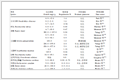
Twelve target compounds were synthesized. BACE1 inhibition test shows that the new compounds exhibited much improved inhibition efficiency than the compound 2 (Table 1) except for compound 9a,9b,9d and 9e,which is maybe because the phenol ester group is too large to fill the S3 sub-pocket,while the size of prop-1-yne is much proper to plug in to form the essential interactions. Among the compounds (9c,9f-9l) with submicromolar bio-activity,compound 9g (R = -F) exhibited relatively weaker inhibition efficiency (IC50 = 0.776 mmol/L) and this may implies that the electronegativity of the substituent -R on the phenyl ring have some effect on the bio-activity. The strong electron-attracting -F atom reduced the electron density of the phenyl ring,leading to weakened interactions between the ligand and the enzyme. The size of -R also seems to have some effect on the inhibitory activity,as compounds with larger size of -R (9f,9j,9k) exhibited relatively higher IC50 value. It is also obvious that the group -X have great influence on the bioactivity against BACE1 and this is preliminary considered to be related to the size of the group -X. Proper sized -X was required to fill the S3 sub-pocket thus to increase the enzymatic inhibitory activity.
|
Table 1 Inhibitory activity of the target compounds against BACE1a |


4. Conclusion
In this section,12 target compounds were designed and synthesized. The inhibitory activity of these compounds against BACE1 was tested by using a time-resolved fluorescence (TRF) method. The result showed that all of the compounds exhibited more potent BACE1 inhibition than compound 1. Especially all those prop-2-yn-1-yloxy substituted compounds their BACE1 inhibition increased to comparative with compound 2. It is suggested that the prop-2-yn-1-yloxy group is a suitable fragment for modification of cyclic acylguanidine BACE1 inhibitors. It also should be noted that this series of compounds have a chiral carbon,while all the compounds were tested with their racemic mixtures. Efforts to determine which configuration of the compounds exactly is the one performing the enzymatic inhibitory activity and search for new compounds with further improved bio-efficiency are ongoing.
| [1] | S.L. Murphy, J.Q. Xu, K.D. Kochanek. Deaths: final data for 2012. Natl. Vital Stat. Rep 61 (2013) 1–117. |
| [2] | J.L. Cummings. Alzheimer's disease. N. Engl. J. Med. 351 (2004) 56–67. |
| [3] | V.R. Bennett, S. Kahn, E.A. Mendiaz, et al. , Beta-secretase cleavage of Alzheimer's amyloid precursor protein by the transmembrane aspartic protease BACE. Science 286 (1999) 735–741. |
| [4] | M. Citron. Emerging Alzheimer's disease therapies: inhibition of β-secretase. Neurobiol. Aging 23 (2002) 1017–1022. |
| [5] | L. Hong, G. Koelsch, X. Lin, et al. Structure of the protease domain of memapsin, 2 (β-secretase) complexed with inhibitor. Science 290 (2000) 150–153. |
| [6] | L. Hong, R.T. Turner, G. Koelsch, et al. Crystal structure of memapsin, 2 (β-secretase) in complex with an inhibitor OM00-3. Biochemistry 41 (2002) 10963–10967. |
| [7] | J. Liu, W.Y. Chen, Y.C. Xu, et al. Design, synthesis and biological evaluation of tasiamide B derivatives as BACE1 inhibitors. Bioorg. Med. Chem 23 (2015) 1963–1974. |
| [8] | A.K. Ghosh, M. Brindisi, Y.C. Yen, et al. , Structure-based design, synthesis and biological evaluation of novel β-secretase inhibitors containing a pyrazole or thiazole moiety as the P3 ligand. Bioorg. Med. Chem. Lett. 25 (2015) 668–672. |
| [9] | S.Y. Jeon, K.H. Bae, Y.H. Seong, et al. , Green tea catechins as a BACE1 (β-secretase) inhibitor. Bioorg. Med. Chem. Lett. 13 (2003) 3905–3908. |
| [10] | T. Kimura, D. Shuto, S. Kasai, et al. , KMI-358 and KMI-370, highly potent and small-sized BACE1 inhibitors containing phenylnorstatine. Bioorg Med. Chem. Lett. 14 (2004) 1527–1531. |
| [11] | Y. Cheng, J. Brown, T.C. Judd, et al. , An orally available BACE1 inhibitor that affords robust CNS Aβ reduction without cardiovascular liabilities. ACS Med. Chem. Lett. 6 (2015) 210–215. |
| [12] | I.V. Efremov, F.F. Vajdos, K.A. Borzilleri, et al. , Discovery and optimization of a novel spiropyrrolidine inhibitor of β-secretase (BACE1) through fragment-based drug design. J. Med. Chem. 55 (2012) 9069–9088. |
| [13] | J. Tseng, M. Dockendorf, G. Krishna, et al. , Safety and pharmacokinetics of the novel BACE inhibitor MK-8931 in healthy subjects following single-and multipledose administration. Alzheimer's Dement. 8 (2012) 184–185. |
| [14] | R. Lai, B. Albala, J.M. Kaplow, et al., First-in-human study of E2609, a novel BACE1 inhibitor, demonstrates prolonged reductions in plasma beta-amyloid levels after single dosing. Alzheimer's Dement., 8 (Supp.) (2012) P96. |
| [15] | K. Höglund, H. Salter, H. Zetterberg, et al., Monitoring the soluble amyloid precursor protein α (SAPPA) and β (SAPPB) fragments in plasma and CSF from healthy individuals treated with BACE inhibitor azd3293 in a multiple ascending dose study: pharmacokinetic and pharmacodynamic correlate. Alzheimer's Dement., 10 (Supp.) (2014) P447. |
| [16] | H. Takahashi, H. Fukumoto, R. Maeda, et al. , Ameliorative effects of a noncompetitive BACE1 inhibitor TAK-070 on Aβ peptide levels and impaired learning behavior in aged rats. Brain Res. 1361 (2010) 146–156. |
| [17] | J.K. Liu, W. Gu, X.R. Cheng, et al. , Design and synthesis of cyclic acylguanidines as BACE1 inhibitors. Chin. Chem. Lett. 26 (2015) 1327–1330. |
| [18] | S. Geschwindner, J. Ulander, P. Johansson. Ligand binding thermodynamics in drug discovery: still a hot tip?. J. Med. Chem 58 (2015) 6321–6335. |
| [19] | M.S. Malamas, J. Erdei, I. Gunawan, et al. , Aminoimidazoles as potent and selective human b-secretase (BACE1) inhibitors. J. Med. Chem. 52 (2009) 6314–6323. |