 2016, Vol.27


 , Shi-Jun Zhengc, Li-Xiang Wanga,b
b. University of the Chinese Academy of Sciences, Beijing 100049, China;
c. School of Materials Science and Engineering, Zhengzhou University, Zhengzhou 450052, China
As a new generation of organic semiconductor, discotic liquid crystals (DLCs) have attracted intensive attention in the last decade. Because of the large π-π overlap within columnar stacks, one-dimensional high charge transport mobility can be achieved. Prospective applications for the DLCs in opto-electronic devices, such as field effect transistors (FETs), photovoltaic solar cells (PSCs) have been developed [1, 2, 3, 4, 5, 6, 7, 8, 9, 10]. To fulfill the device application of the DLCs, the materials should exhibit the mesophase behavior within a broad temperature range. Moreover, disc-shaped mesogens could arrange in different columnar stacking types, such as the columnar hexagonal (Colh) phase and the columnar rectangular (Colr) phase, which definitely influences charge transport along the column axis [11]. Besides, the alignment of disc-shaped molecules is desirable to construct efficient devices. For example, the planar and homeotropic orientations are needed for FETs and PSCs, respectively. Although several factors influence the alignment process, the mesophase type plays a critical role in the orientation process. As has been reported [12], the Colh phase and the Colr phase are preferred for face-on and edge-on alignments, respectively.
Among different kinds of DLCs, triphenylene-based compound is one of the most widely investigated materials, because they are relatively easy to synthesis. In the past years, efforts have been made to modify the mesophase properties. One approach to this aim is the modification of the cores and the side chains [13]. However, it takes more effort for the design and synthesis of desired materials. An alternative way to this synthesis-intensive requirement is blending triphenylene DLCs with other materials, such as 2, 4, 7-trinitro-9-fluorenone (TNF) [14, 15] and hexaazatriphenylene derivatives [16]. These molecules can form face-to-face alternating stacks, leading to the enhanced mesophase temperature range. The extended stability of these mixtures is the result of either the complementary polytopic interaction (CPI) [17, 18, 19, 20] or the charge transfer interaction [21, 22, 23, 24].
Though physical methods have been widely adopted to tune the liquid crystal properties [12, 16, 17, 21, 25, 26], little attention has been paid to the close relationship between columnar stacking type and properties of materials mixture upon incorporating guest component [12]. In this work, we blended hexakis(n-hexyloxy)- triphenylene (H6TP) with hexaazatriphenylene derivative (PBH) (Scheme 1) to form alternatively stacking columns. These two molecules are complementary in both shape and electronic characteristics. The mesophase types of mixtures change from the Colh phase to the Colr phase with the increase of PBH content, resulting in the novel trend of the isotropic temperatures. The clearing temperatures decreased firstly and then rose up with the increasing amount of PBH molecules. Moreover, it is inferred that the structure variation was possibly driven by the competition of the alkyl chains interaction induced by PBH molecules with the strong π-π interaction between H6TP molecules.

|
Download:
|
| Scheme 1.The chemical structures of H6TP and PBH molecules. | |
H6TP was purchased from Sichuan Normal University. PBH was synthesized as in Ref. [27]. Chloroform (99%) was purchased from Beijing Chemical, China. All the materials were used as received without further purification.
The glass and silicon substrates (1.5 cm × 1.5 cm) were cleaned in a piranha solution (70/30, v/v of concentrated H2SO4 and 30% H2O2) at 90 ℃ for 20 min, then thoroughly rinsed with deionized water, and finally blown dry under nitrogen.
2.2. Sample preparationAll H6TP/PBH mixtures with desired molar ratios were obtained by blending the corresponding individual chloroform solutions, and the total concentration was 10 mg/mL.
Thin films of H6TP, PBH and H6TP/PBH blends were prepared through spin-coating and drop-casting processes. In the spincoating procedure, the solution was cast for 18 s at a rate of 500 rpm. The thicknesses of the spin-coating films are about 140-180 nm. In the drop-casting process, 50 μL solution was deposited on the glass/silicon substrate with a size of 1.5 cm × 1.5 cm. All the experiments were performed at room temperature.
2.3. CharacterizationPolarized optical microscopy (POM), differential scanning calorimetry (DSC) and grazing incidence X-ray diffraction (GIXD) analysis were performed to characterize the thermotropic behaviors and the structures of the mixtures. The thermal stability of the mixtures was investigated by Thermal gravimetric analysis (TGA). The interaction between H6TP and PBH in solution and thin film state was characterized through UV-vis absorption spectroscopy, fluorescence emission spectroscopy and nuclear magnetic resonance (1H NMR) spectroscopy. The detailed procedures are collected in the Supporting information.
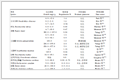
3. Results and discussion 3.1. Phase transition temperatures variation with the increase of PBH contentDSC and POM was used to characterize the transition points of the individual components and the mixtures (Table 1). Since the transition points variation with the increase of PBH content in the heating cycle is similar to that in the cooling cycle, only the transition temperatures in the cooling cycle were utilized to show the variation trend. Firstly, prior to discuss the thermotropic behaviors of the mixtures, we focused on the individual components. Upon cooling from the isotropic state, H6TP exhibited the liquid crystalline phase from 91 ℃ to 53 ℃ as previously reported (Fig. 1a) [28], and gave the focal conic texture representative of the Colh phase (Fig. 2a). In contrast, PBH showed complex polymorphism. After heating at 200 ℃, five exothermic transitions at 155 ℃, 131 ℃, 99 ℃, 51 ℃ and 28 ℃ were observed in subsequent cooling to 20 ℃ (Fig. S1 in Supporting information). The temperature-dependent GIXD patterns of PBH showed a series of reflections during these transition points, indicating the crystalline phase (Fig. S2 in Supporting information). Furthermore, no significant changes of textures were observed during the transition points in POM. (Fig. S3 in Supporting information). In addition, it is difficult for the PBH film to be sheared with a cover slide even at 200 ℃. Hence, PBH is clearly in crystalline phase. The thermal stability of mixtures has also been investigated by TGA. The TGA measurements show that both H6TP and PBH compounds were thermally stable with 1% weight loss at 327 ℃ and 395 ℃, respectively. The H6TP/PBH = 1/1 compound was stable up to 340 ℃ with 1% weight loss (Fig. S4 in Supporting information). The decomposition temperature of the H6TP/PBH = 1/1 mixture is different to those of individual components, indicating the existence of the superstructure between H6TP and PBH.
|
Table 1 The phase transition temperatures (℃) and enthalpies (J/g) of H6TP/PBH mixtures upon cooling from the isotropic state. Tc = the crystalline temperature; Tiso = the isotropic temperature. |


|
Download:
|
| Fig. 1.The DSC curves of H6TP/PBH blends in different molar ratios. (a) Curves on the first cooling cycle; (b) Curves on the second heating cycle; and (c) The first phase transition temperatures and enthalpies of H6TP/PBH blends on cooling. | |


|
Download:
|
| Fig. 2.The POM images of H6TP/PBH blends in different molar ratios in the cooling cycle. All images were taken at 5 ℃ below the first transition points in the cooling cycle. (a) 1/0, (b) 1/0.25, (c) 1/0.5, (d) 1/1, (e) 1/2, (f) 1/4, and (g) 0/1. | |

Blending H6TP with PBH in different molar ratios results in two transitions in DSC traces except for the H6TP/PBH = 1/4 blend of which the DSC trace shows only one single phase transition (Fig. 1). As shownin Fig. 1c, when the molar ratio of H6TP/PBH changes from 1/0 to 1/0.5, the clearing temperatures decrease from91 ℃ to 59 ℃. While for the H6TP/PBH = 1/1 blend, the isotropic temperatures are augmented to 144 ℃ in comparison to the H6TP/PBH = 1/0.5 blend. Besides, the transition enthalpies follow the similar trend. In contrary to the tendency of the clearing points, as themolar fraction of PBH raises, the crystallization temperatures of the H6TP/PBH blends decrease. In the heating andcoolingcycles, none of the blends shows the characteristic of their components undergoing individual phase transition behavior, indicating the good miscibility between H6TP and PBH [26].
To ensure the existence of H6TP/PBH blends mesophase, the drop-cast films were measured by temperature-dependent POM. For H6TP/PBH = 1/0.05, 1/0.25, 1/0.5 and 1/1 mixtures, when heated above 160 ℃, the birefringence was lost, indicating that the isotropic state is reached. Furthermore, textures could be observed in the cooling cycle of these blends. Besides, the cover slips could slide past the drop-cast films with little resistance above the crystallization temperatures, demonstrating the fluidity of blends in mesophase. However, the fluidity of the films was lost upon reaching the crystallization points. Both the birefringence and the fluidity demonstrate the existence of the liquid crystalline phase. The textures of the mixtures in different molar ratios are notably different from those of single components (Fig. 2). This contrast demonstrates the existence of superstructure between H6TP and PBH molecules.
The temperature-dependent GIXD was also utilized to verify the existence of the mesophase. Considerable changes can be observed in the GIXD patterns at different phases of blends. Shown in Fig. 3 are representative patterns of H6TP/PBH = 1/1 blend. When recorded at 191 ℃ (above the clearing temperature) in the cooling cycle, the pattern of H6TP/PBH = 1/1 mixture shows two broad halos, indicating the isotropic state. Then when recorded at 65 ℃ (in the mesophase), the small-angle region of the pattern consists of two sharp reflections at d = 2.75 nm and 1.84 nm, which stand for intercolumnar distance of the Colr phase. While the wideangle region shows a broad halo centered at d = 0.44 nm and a less intense reflection at dY= 0.35 nm, corresponding to the packing of aliphatic side chains and the π-π stacking of aromatic cores, respectively. When the film is cooled at 35 ℃ (below the crystalline temperature), the GIXD profile of PBH exhibits multiple intensive peaks, which is the feature of crystallization state.

|
Download:
|
| Fig. 3.The temperature-dependent GIXD pattern of H6TP/PBH = 1/1 upon cooling from the isotropic state. | |

For H6TP/PBH = 1/2 mixture, although two transition points were observed in the DSC trace, no notable change of texture occurred inPOMduring the transitionpoints. Furthermore, there are obvious and intensive reflections on the X-ray diffractogram above the first transition temperature in the cooling cycle (Fig. S5 in Supporting information), as mentioned above, for liquid crystalline material in the isotropic state, only broad halos can be observed. Therefore we can confirmthat the H6TP/PBH = 1/2 mixture remains crystalline between the transition points. For the H6TP/PBH = 1/4 blend, only one phase transition point was observed in both heating and cooling cycles. Moreover, no change in optical texture could be observed here. Hence the H6TP/PBH = 1/4 mixture is also not mesogenic.
3.2. Structure variation of the mixtures from columnar hexagonal phase to columnar rectangular phaseGIXD has been used to investigate the evolution of the blends structure as a function of PBH content. The GIXD patterns of the mixtures in mesophase are shown in Fig. 4. Firstly, the GIXD profiles of H6TP and PBH are discussed. H6TP exhibits the Colh phase as reported previously [17]. Due to the inability to the alignment of thin films during the GIXD measurement, only (1 0 0) peak at d = 1.84 nm is observed. As PBH is crystalline at 65 ℃, the GIXD pattern of PBH shows multiple reflections at dY= 3.56 nm, 2.70 nm, 2.04 nm and 1.84 nm.

|
Download:
|
| Fig. 4.The GIXD patterns of H6TP/PBH blends in different molar ratios at 65 ℃ (in the mesophase). | |

GIXD was also used to confirm whether there is phase separation between H6TP and PBH. For example, two reflections at d = 3.15 nm and 1.84 nmare observed for the H6TP/PBH = 1/0.25 film. No reflections of the blend correspond to the GIXD patterns of individual components except for the peak at d = 1.84 nm, which appears in the GIXD profiles of both H6TP and PBH. And there are no other peaks which could be attributed to the crystalline phase of PBH in the GIXD pattern of the H6TP/PBH = 1/0.25 blend film. These evidences demonstrate good miscibility between H6TP and PBH.
When 5% PBH molecules are added, the GIXD pattern of the mixture is almost identical to that of the pure H6TP. With further increase of PBH content, the GIXD profiles of the H6TP/PBH = 1/0.25 and 1/0.5 blends show two separate peaks at d = 3.15 nm and 1.84 nm whose reciprocal spacings follow the molar ratio 1: $\sqrt 3 $, indicative of the Colh phase. Therefore these two blends form the Colhphase andthetwo reflections canbe identifiedas the (1 0 0) and (1 1 0) peaks. Compared to the GIXD pattern of H6TP, the (1 0 0) peaks of the H6TP/PBH = 1/0.25 and 1/0.5 blends shift to the low angle, which indicates the enlargement of intercolumnar distance caused by the insertion of PBH molecules into the columnar assembly of H6TP. In contrast to the GIXD patterns of the H6TP/PBH = 1/0.25 and 1/0.5 blends, that of the H6TP/PBH = 1/1 blendshowstwo strong reflections at d = 2.76 nmand1.84 nmat the small-angle region, which is a signature of the Colr phase. Besides, the hexaazatriphenylene derivative tends to assembly as the Colr phase [29]. Therefore, it is confirmed that the H6TP/PBH = 1/1 blend exhibit the Colr phase. Then it is concluded that the structures of the mixtures undergo the Colh to Colr phase transition with the increasing content of PBH (Scheme 2). A similar situation was reported by Geerts’ group [12]. The isotropic temperatures of two phthalocyanine derivatives blends decreased firstly and then increased with the increase of one component amount. It was reported that the trend was caused by the structure variation. In the present case the structure transition is in agreement with the trend of the clearing temperatures, therefore it is reasonable to conclude that this structure variation leads to the contrary trend of the isotropic temperatures when the molar ratio of H6TP/PBH varies from 1/0 to 1/1.When few PBH molecules are added to the mixture, because of the electron deficient nature of PBH [29] and the steric hindrance of the bulky substituents [20], the inducement of PBH disrupts the columnar hexagonal assembly of H6TP, which leads to the decrease of the clearing temperatures.However, when more PBH component is added to the mixture, the whole structure is transformed to the Colr phase, which is more ordered. Hence the isotropic point is enlarged by 51 ℃.

|
Download:
|
| Scheme 2.Schematic representation of structure transformation. | |

To investigate the interaction between H6TP and PBHmolecules, the solutions and thin films of the mixtures were characterized by UV-vis absorption spectroscopy, fluorescence emission spectroscopy and 1H NMR spectroscopy. As H6TP/PBH = 1/2, 1/4 mixtures did not show liquid crystalline behavior, only H6TP/PBH = 1/2 mixture was utilized to study the interaction between H6TP and PBH together with the H6TP/PBH = 1/0.05, 1/0.25, 1/0.5 and 1/1 blends. Firstly, the interaction between H6TP and PBH in corresponding chloroform solutions was studied. We found no noticeable color change when equimolar H6TP and PBH solutions were mixed. As shown in Fig. 5a, for H6TP/PBH mixtures, although the first absorption bands of the UV-vis spectra show a small red shift, as the red shift changes with the variation of the blend molar ratio, the shiftmay result from the decreased concentration of PBH rather than the charge transfer interaction (Fig. 5a). The fluorescence emission spectra of the solutions were also performed. The H6TP solution shows weak emission peak centered at 386 nm, when excited at 343 nm. For the PBH solution, an emission peak at 537 nm is observed, when excited at 468 nm. Due to the weak emission of H6TP, the blends are excited at 468 nm. As shown in Fig. S7 in Supporting information, no peak shift is observed. Besides, the 1H NMR spectrum of H6TP/PBH = 1/1 is the superposition of the spectra of the individual components (Fig. S7). All of these measurements demonstrate that there is no efficient charge transfer interaction between H6TP and PBH in solution.

|
Download:
|
| Fig. 5.(a) The UV-vis absorption spectra of H6TP, PBH and H6TP/PBH blends of different molar ratios in chloroform solutions. (b) The UV-vis absorption spectra and of H6TP, PBH and H6TP/PBH blend of different molar ratios drop-cast films. | |

Then we investigated the interaction between H6TP and PBH in solid state, the spectra of all the blends show blue shifts compared to that of the pure PBH film (Fig. 5b). While the inducement of the charge transfer interaction should lead to a red shift in the UV-vis spectra of mixtures compared to these of individual components, therefore the observed blue shift might result from H-aggregation or change of coherent length of the stacks rather than the charge transfer interaction. Based on these results, we conclude that there is no charge transfer interaction between individual components in thin films.
Based on the UV-vis absorption spectra, 1H NMR spectra and fluorescence emission spectra, we can conclude that there is no charge transfer interaction between H6TP and PBH molecules, therefore it could not be the driving force for the alteration of the columnar structure. As can be seen in Fig. 4, there is strong π-π interaction between individual H6TP molecules. While due to the electron deficient nature of PBH and the steric hindrance of the bulky substituents on the side chain, there is no strong π-π interaction between adjacent PBH molecules. For system without efficient π-π stacking, the packing between alkyl chains plays a vital role in the construction of ordered structure [29, 30]. Hence we speculate that the packing of alkyl chains rather than the π-π stacking is more crucial to determine the crystal structure of PBH. Therefore it may be assumed that with the inducement of PBH molecules, the interaction among alkyl chains is enhanced compared to the π-π interaction, thus leading to the structure transformation.
To investigate whether the competition between the alkyl chains interaction with the π-π interaction results in the structure change, the temperature-dependent X-ray diffraction in mesophase was performed. As seen in Fig. 4, for the pure H6TP and the H6TP/PBH = 1/0.05 blend, strong peaks for π-π stacking can be observed, which contributes significantly to the Colh phase. When the PBH amount is increased above 20%, the strong π-π interaction is largely declined due to the insertion of PBH molecules into the H6TP columns, while the reflection for the alkyl chains packing is still intensive. With the PBH amount increased to 50%, the stacking types of blends change from the Colh phase to the Colr phase. For that reason it may be interpreted that it is the competition between the alkyl chains interaction with the π-π interaction that results in the structure transformation. With the increase of PBH content, compared to the π-π interaction, the interaction among alkyl chains is enhanced, therefore leading to the stacking type change (Scheme 2).
4. ConclusionIn summary, a superstructure between H6TP and PBH molecules has been constructed, the stacking structures altered from the Colh phase to the Colrphase as the molar ratio of PBH raises. Furthermore, a novel trend was observed that the clearing temperatures firstly declined from 91 ℃ to 598C and then rose up to 144 ℃ with the increase of PBH content. When less than 33% amount of PBH was mixed, PBH molecules disrupted the columnar hexagonal phase, leading to the decrease of the isotropic temperatures. However, as the amount of PBH was increased to 50%, the stacking structure was transformed to the columnar rectangular phase, resulting in the increase of the clearing points.And the structure transformation was possibly driven by the competition between the alkyl chains interaction with the π-π interaction. The manipulation of liquid crystal properties via blending discotic molecules could prove useful in the organic optoelectronic application, such as improving the charge carrier mobility.
AcknowledgmentThis work was supported by the National Natural Science Foundation of China (No. 51303177) and the Strategic Priority Research Program of the Chinese Academy of Sciences (No.XDB12020300).
Appendix A. Supplementary dataSupplementary data associated with this article can be found, in the online version, at http://dx.doi.org/10.1016/j.cclet.2015.12.024.
| [1] | B.R. Kaafarani, Discotic liquid crystals for opto-electronic applications, Chem. Mater. 23(2011) 378-396. |
| [2] | S. Sergeyev, W. Pisula, Y.H. Geerts, Discotic liquid crystals:a new generation of organic semiconductors, Chem. Soc. Rev. 36(2007) 1902-1929. |
| [3] | S.S. Chen, T. Li, D.H. Zhao, Progress in discotic liquid crystalline materials, Acta Phys. Chim. Sin. 26(2010) 1124-1134. |
| [4] | S. Laschat, A. Baro, N. Steinke, et al., Discotic liquid crystals:from tailor-made synthesis to plastic electronics, Angew. Chem. (Ⅰ)nt. Ed. Engl. 46(2007) 4832-4887. |
| [5] | R.J. Bushby, K. Kawata, Liquid crystals that affected the world:discotic liquid crystals, Liq. Cryst. 38(2011) 1415-1426. |
| [6] | S. Kumar, Playing with discs, Liq. Cryst. 36(2009) 607-638. |
| [7] | M.Q. Li, Y. Li, J.Q. Liu, L.X. Wang, Y.C. Han, Morphological transformation of pyrazine-based acene-type molecules after blending with semiconducting polymers:from fibers to quadrilateral crystals, Soft Matter 9(2013) 5634-5641. |
| [8] | E.K. Fleischmann, R. Zentel, Liquid-crystalline ordering as a concept in materials science:from semiconductors to stimuli-responsive devices, Angew. Chem. (Ⅰ)nt. Ed. Engl. 52(2013) 8810-8827. |
| [9] | W. Pisula, M. Zorn, J.Y. Chang, K. Müllen, R. Zentel, Liquid crystalline ordering and charge transport in semiconducting materials, Macromol. Rapid Commun. 30(2009) 1179-1202. |
| [10] | M. Funahashi, Nanostructured liquid-crystalline semiconductors-a new approach to soft matter electronics, J. Mater. Chem. C 2(2014) 7451-7459. |
| [11] | H. (Ⅰ)ino, Y. Takayashiki, J.(Ⅰ). Hanna, R.J. Bushby, D. Haarer, High electron mobility of 0.1 cm2V-1s-1 in the highly ordered columnar phase of hexahexylthiotriphenylene, Appl. Phys. Lett. 87(2005) 192105. |
| [12] | G. Schweicher, G. Gbabode, F. Quist, O. Debever, N. Dumont, S. Sergeyev, Y.H. Geerts, Homeotropic and planar alignment of discotic liquid crystals:the role of the columnar mesophase, Chem. Mater. 21(2009) 5867-5874. |
| [13] | T.J. Zhang, D.M. Sun, X.K. Ren, et al., Synthesis and properties of siloxane modified perylene bisimide discotic liquid crystals, Soft Matter 9(2013) 10739-10745. |
| [14] | L.A. Haverkate, M. Zbiri, M.R. Johnson, et al., On the morphology of a discotic liquid crystalline charge transfer complex, J. Phys. Chem. B 116(2012) 13098-13105. |
| [15] | O. Kruglova, E. Mendes, Z. Yildirim, et al., Structure and dynamics of a discotic liquid-crystalline charge-transfer complex, ChemPhysChem 8(2007) 1338-1344. |
| [16] | T. Kreouzis, K. Scott, K.J. Donovan, et al., Enhanced electronic transport properties in complementary binary discotic liquid crystal systems, Chem. Phys. 262(2000) 489-497. |
| [17] | E.O. Arikainen, N. Boden, R.J. Bushby, et al., Complimentary polytopic interactions, Angew. Chem. (Ⅰ)nt. Ed. Engl. 39(2000) 2333-2336. |
| [18] | N. Boden, R.J. Bushby, Z.B. Lu, O.R. Lozman, CP(Ⅰ) induction of liquid crystal behaviour in triphenylenes with a mixture of hydrophobic and hydrophilic side chains, Liq. Cryst. 28(2001) 657-661. |
| [19] | N. Boden, R. Bushby, O. Lozman, A comparison of CP(Ⅰ) and charge-transfer twocomponent columnar phases, Mol. Cryst. Liq. Cryst. 411(2004) 345-354. |
| [20] | R.J. Bushby, J. Fisher, O.R. Lozman, et al., The stability of columns comprising alternating triphenylene and hexaphenyltriphenylene molecules:variations in the structure of the hexaphenyltriphenylene component, Liq. Cryst. 33(2006) 653-664. |
| [21] | W. Pisula, M. Kastler, D. Wasserfallen, et al., Pronounced supramolecular order in discotic donor-acceptor mixtures, Angew. Chem. (Ⅰ)nt. Ed. Engl. 45(2006) 819-823. |
| [22] | A. Das, S. Ghosh, Supramolecular assemblies by charge-transfer interactions between donor and acceptor chromophores, Angew. Chem. (Ⅰ)nt. Ed. Engl. 53(2014) 2038-2054. |
| [23] | M. Kumar, K. Venkata Rao, S.J. George, Supramolecular charge transfer nanostructures, Phys. Chem. Chem. Phys. 16(2014) 1300-1313. |
| [24] | P.S. Kumar, S. Kumar, V. Lakshminarayanan, Electrical conductivity studies on discotic liquid crystal-ferrocenium donor-acceptor systems, J. Phys. Chem. B 112(2008) 4865-4869. |
| [25] | K.R. Leight, B.E. Esarey, A.E. Murray, J.J. Reczek, Predictable tuning of absorption properties in modular aromatic donor-acceptor liquid crystals, Chem. Mater. 24(2012) 3318-3328. |
| [26] | J.J. Reczek, K.R. Villazor, V. Lynch, T.M. Swager, B.L. (Ⅰ)verson, Tunable columnar mesophases utilizing C2 symmetric aromatic donor-acceptor complexes, J. Am. Chem. Soc. 128(2006) 7995-8002. |
| [27] | M. Wang, Y. Li, H. Tong, et al., Hexaazatriphenylene derivatives with tunable lowest unoccupied molecular orbital levels, Org. Lett. 13(2011) 4378-4381. |
| [28] | P.J. Stackhouse, M. Hird, (Ⅰ)nfluence of branched chains on the mesomorphic properties of symmetrical and unsymmetrical triphenylene discotic liquid crystals, Liq. Cryst. 35(2008) 597-607. |
| [29] | M. Lehmann, G. Kestemont, R. Gómez Aspe, et al., High charge-carrier mobility in pi-deficient discotic mesogens:design and structure-property relationship, Chemistry 11(2005) 3349-3362. |
| [30] | X. Wang, Y. Zhou, T. Lei, et al., Structural-property relationship in pyrazino[2,3-g] quinoxaline derivatives:morphology, photophysical, and waveguide properties, Chem. Mater. 22(2010) 3735-3745. |