 2016, Vol.27


Benzimidazoles,which are an important class of nitrogencontaining heterocycles,display broad potential applications as medicinal agents [1],supramolecular blocks [2] as well as functional materials [3] and so on. 3-(1H-Benzimidazol-1-yl)propanehydrazide derivatives,for example,inhibit bacterial cell division (Fig. 1) and have been exhaustively investigated [4]. Additionally,medicines containing the benzimidazole skeleton such as Astemizole,have been successfully employed in clinic [1a] (Fig. 1). Recently,research on the construction and functionalization of the benzimidazole scaffold has attracted enormous interest and produced a large number of exciting findings [5]. However,the exploration of green and convenient synthetic strategies for preparing novel benzimidazole derivatives under mild conditions is still of current interest.

|
Download:
|
| Fig. 1. Compounds with the benzimidazole skeleton. | |
The aza-Michael addition reaction as a versatile and atomeconomical method can construct multiple new C-N bonds via the 1,4-conjugate addition of various nitrogen nucleophiles to various Michael acceptors [6]. Compared with aliphatic and aromatic amines along with indoles,imidazoles as N-nucleophiles were inert or less reactive to Michael acceptors [7]. There were just a limited number of examples involving the aza-Michael addition of imidazoles to a series of activated alkenes catalyzed by N-methyl imidazole or Y(NO3)3-6H2O or promoted under ultrasound (US) irradiation [8,9d,9h]. Nevertheless,the aza-Michael addition reaction of the 1H-benzimidazole,as a benzene-fused imidazole,is very difficult and has been rarely reported [9],especially in the water medium. Water as a medium can fully meet several requirements of Green Chemistry and has attracted much interest [10]. Besides,transition metal reagents in the water medium have shown great potential in catalyzing or promoting diverse organic transformations; for instance,the 1,4-addition of terminal alkynes to acrylates was catalyzed by palladium in water [11].Weintended to explore the synthesis of novel N-alkylated benzimidazole derivatives via the aza-Michael addition of 1H-benzimidazoles to a,β-unsaturated compounds in water and the evaluation of their antimicrobial activity.
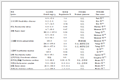
2. ExperimentalWe initially investigated the aza-Michael addition of 1Hbenzimidazole (1a) to butyl acrylate (2a) as a model reaction to synthesize butyl 3-(1H-benzo[d]imidazol-1-yl)propanoate (3a). It was an exciting finding that the reaction of 1a and 2a without any additives in neat water at 85 ℃ for 24 h formed the addition product 3a in an isolated yield of 67% (Table 1,entry 1). However, this transformation was incomplete by TLC analysis. In order to improve this transformation,Pd(OAc)2 as a catalyst was tested. To our delight,the nearly complete conversion of 1a into 3a was realized in the presence of 5 mol% of Pd(OAc)2 in a 87% isolated yield (Table 1,entry 2). Moreover,the result of anhydrous toluene as a solvent instead of water without any additives verified the promoting action of water to this aza-Michael addition (Table 1,entry 3). Also,the result of 5 mol% of PdCl2 illustrated that the chlorine anion of PdCl2 had a negative effect on this reaction (Table 1,entry 4). Other transition metal salts,such as Cu(OAc)2-H2O,Ag2O and FeCl3,showed inferior efficiency for this transformation (Table 1,entries 5-7). Compared with water,other solvents were not suitable for this transformation (Table 1,entries 8-12). The above experimental results confirmed that the synergistic effect of palladium acetate and water played a critical role in this addition reaction. Besides,the tests of lowering or increasing reaction temperature,in comparison with the reaction temperature of 85 ℃,showed that the lower reaction temperature clearly reduced the addition reaction rate,but the higher temperature could not significantly promote the reaction (Table 1,entries 13-15). The molar concentration of the starting materials also had a certain influence on this transformation by changing the amount of water (Table 1,entries 16-17). Furthermore,the yield of freshly distilled butyl acrylate was the same as that of commercial available butyl acrylate (Table 1,entry 18),which demonstrated inhibitors in commercial acrylates having no effect on this addition reaction. Finally,the optimal conditions of the aza-Michael addition reaction had been established.
|
Table 1 Optimization of the reaction conditionsa. |

A variety of substituted 1H-benzimidazoles reacting with 2a were explored in neat water under the conditions with palladium acetate and without palladium,respectively (Table 2). 1HBenzimidazoles bearing electron-donating groups on the phenyl gave the desired products in excellent yields under both palladium acetate and palladium-free conditions (Table 2,3b,3c). Because of the tautomerism,5-methylbenzimidazole having a tautomer of 6-methylbenzimidazole produced a tautomeric mixture of 1,5- and 1,6-disubstituentbenzimidazoles (Table 2,3b). In particular,the chlorine atom on the phenyl ring of benzimidazole did not decrease the nucleophilicity of benzimidazole and afforded tautomeric products in a better yield under the optimal conditions (Table 2,3d). 1H-Benzimidazoles with electron-withdrawing groups on the benzene ring obviously showed lower nucleophilicity and gave the products in low to moderate yields even with increased palladium salt loading and prolonged reaction time (Table 2,3e,3f). Different substituents at the 2-position of benzimidazole apparently suppressed the conjugate addition.
|
|
Table 2 Preparation of compounds 3a |

However,2-methyl and 2-hydroxymethyl benzimidazoles,respectively afforded the desired products in moderate yields by adding LiCl as a co-catalyst [12],increasing reaction temperature or lengthening reaction time (Table 2,3g,3h). Astonishingly,2- chlorobenzimidazole reacting with benzyl acrylate for 48 h afforded a moderate yield under the palladium-based conditions,yet the product was not found in the absence of palladium acetate (Table 2,3i). Unfortunately,2-substituted benzimidazole derivatives involving functional groups such as the phenyl,the chloromethyl and the thiol did not give the desired products,whether the palladium acetate was added or not (Table 2,3j-3l). Subsequently,the aza-Michael addition reactions of 1a to a series of a,β-unsaturated compounds were also examined under the palladium-based and the palladium-free conditions,respectively.
Owing to the lower boiling point,methyl acrylate and ethyl acrylate as Michael acceptors reacted with 1a to afford the addition products in low to moderate yields,respectively. The yields with palladium acetate were obviously better than the yields without palladium acetate (Table 2,3m,3n). In addition,the methyl group presenting at the a or β-position of ethyl acrylate remarkably suppressed the reaction,which was attributed to the effect of steric hindrance (Table 2,3o,3p). Fortunately,benzyl acrylate as a Michael acceptor gave excellent yields under both palladiumbased and palladium-free conditions (Table 2,3q). Free acrylamide was inert in the 1,4-addition reaction and only trace amount of product was found by NMR (Table 2,3r). The aza-Michael addition of 1H-benzimidazoles to a,bunsaturated compounds without palladium acetate might be a result of the self-catalysis effect [8] involving hydrogen bond in the water medium. Nonetheless,palladium acetate as a Lewis acid [12] effecting on the oxygen of the carbonyl of a,β-unsaturated compounds synergistically promoted the 1,4-addition reaction in water.
Furthermore,a series of freshly synthesized compounds were evaluated for their antifungal activity in vitro against five fungi [13, 14],and the bioactive data are shown in Table 3. These data indicated that compounds 3b,3c and 3d selectively displayed moderate inhibitory potency against the tested fungi. Particularly,both 3c and 3d showed 4-fold higher inhibitory activity than Fluconazole toward Aspergillus flavus strains. Besides,the antimicrobial activity against both Gram-positive bacteria and Gram-negative bacteria were also tested (Table 4) [13, 14]. Compared with clinical Chloromycin,3c exhibited 2-and 4-fold higher inhibitory activity against Bacillus subtilis (MIC = 16 μg/mL) and Bacillus proteus (MIC = 8 μg/mL),respectively.
|
|
Table 3 Antifungal data as MIC (μg/mL) for compounds 3a,b. |

|
|
Table 4 Antibacterial data as MIC (μg/mL) for compounds 3a,b. |


Additionally,3d displayed 4-fold higher inhibitory activity against B. proteus with an MIC value of 8 μg/mL. The above bioactive results showed that benzimidazole derivatives containing substituent groups on the phenyl group obviously exhibited better bioactivity against the tested bacteria,compared with benzimidazole derivatives without substituents on the phenyl group. Furthermore,the bioactivity of benzimidazole derivatives containing electron-donating group on the phenyl group was superior to that of electron-withdrawing group,and especially 5,6-dimethyl substituents benzimidazole derivative 3c exhibited higher inhibitory activity against B. subtilis and B. proteus in comparison with Chloromycin. Additionally,3c possessing highlighted potential bioactivity,as an important segment in vitamin B12,would be further investigated with DNA to probe its biological mechanism.
4. ConclusionIn summary,the first palladium-promoted 1,4-addition of 1Hbenzimidazoles to a,β-unsaturated compounds was developed in water in open air with convenient manipulation. Eight unknown benzimidazole-based products were synthesized and their structures were confirmed. To a certain extent,the prepared compounds showed superior bioactivity against tested strains to the comparator clinical drugs. 3c,for example,exhibited 2-and 4-fold higher inhibitory activity against B. subtilis (MIC = 16 μg/mL) and B. proteus (MIC = 8 μg/mL),respectively. This green synthetic method will facilitate the preparations of various bioactive or functional compounds containing the benzimidazole scaffold under mild conditions.
AcknowledgmentThis work was supported by the National Natural Science Foundation of China (Nos. 21004075,21372186),Beijing National Laboratory of Molecular Sciences (BNLMS) (No. 20140130),the Doctoral Fund of Southwest University (No. SWU111075) and the Research Funds for the Central Universities (No. XDJK2013C112).
Appendix A. Supplementary dataSupplementary data associated with this article can be found,in the online version,at http://dx.doi.org/10.1016/j.cclet.2015.12.014.
| [1] | (a) X.M. Peng, G.X. Cai, C.H. Zhou, Recent developments in azole compounds as antibacterial and antifungal agents, Curr. Top. Med. Chem. 13(2013) 1963-2010;(b) Y. Bansal, O. Silakari, The therapeutic journey of benzimidazoles:a review, Bioorg. Med. Chem. 20(2012) 6208-6236. |
| [2] | (a) V. Vajpayee, S.M. Lee, J.W. Park, et al., Growth inhibitory activity of a bisbenzimidazole-bridged arene ruthenium metalla-rectangle and-prism, Organometallics 32(2013) 1563-1566;(b) J.Y. Hu, R. Liu, X.L. Zhu, X. Cai, H.J. Zhu, et al., A highly efficient and selective probe for F- detection based on 1H-imidazo[4,5-b]phenazine derivative, Chin. Chem. Lett. 26(2015) 339-342. |
| [3] | J.A. Asensio, E.M. Sánchez, P. Gómez-Romero, Proton-conducting membranes based on benzimidazole polymers for high-temperature PEM fuel cells. A chemical quest, Chem. Soc. Rev. 39(2010) 3210-3239. |
| [4] | (a) Y.J. Eun, M.Q. Zhou, D. Kiekebusch, et al., Divin:a small molecule inhibitor of bacterial divisome assembly, J. Am. Chem. Soc. 135(2013) 9768-9776;(b) M.Q. Zhou, Y.J. Eun, (Ⅰ).A. Guzei, D.B. Weibel, Structure-activity studies of divin:an inhibitor of bacterial cell division, ACS Med. Chem. Lett. 4(2013) 880-885. |
| [5] | (a) J.B. Wright, The chemistry of the benzimidazoles, Chem. Rev. 48(1951) 397-541;(b) P.N. Preston, Synthesis, reactions, and spectroscopic properties of benzimidazoles, Chem. Rev. 74(1974) 279-314;(c) V.A. Mamedov, A.M. Murtazina, Recyclization reactions leading to benzimidazoles, Russ. Chem. Rev. 80(2011) 397-420;(d) S.S. Panda, R. Malik, S.C. Jain, Synthetic approaches to 2-arylbenzimidazoles:a review, Curr. Org. Chem. 16(2012) 1905-1919;(e) R.S. Begunov, G.A. Ryzvanovich, Synthesis of pyrido[1,2-a]benzimidazoles and other fused imidazole derivatives with a bridgehead nitrogen atom, Russ. Chem. Rev. 82(2013) 77-97;(f) N. Zheng, K.W. Anderson, X.H. Huang, H.N. Nguyen, S.L. Buchwald, A palladium-catalyzed regiospecific synthesis of N-aryl benzimidazoles, Angew. Chem. (Ⅰ)nt. Ed. 46(2007) 7509-7512;(g) B.L. Zou, Q.L. Yuan, D.W. Ma, Synthesis of 1,2-disubstituted benzimidazoles by a Cu-catalyzed cascade aryl amination/condensation process, Angew. Chem. (Ⅰ)nt. Ed. 46(2007) 2598-2601;(h) L.M. Stanley, J.F. Hartwig, Regio-and enantioselective N-allylations of imidazole, benzimidazole, and purine heterocycles catalyzed by single-component metallacyclic (Ⅰ)ridium complexes, J. Am. Chem. Soc. 131(2009) 8971-8983;(i) Q. Sun, C.J. Wang, S.S. Gong, Y.J. Ai, H.B. Sun, Cp2ZrCl2-catalyzed synthesis of 2-aminovinyl benzimidazoles under microwave conditions, Chin. Chem. Lett. 26(2015) 297-300. |
| [6] | (a) L.W. Xu, C.G. Xia, A catalytic enantioselective aza-michael reaction:novel protocols for asymmetric synthesis of β-amino carbonyl compounds, Eur. J. Org. Chem.2005(2005) 633-639;(b) P.R. Krishna, A. Sreeshailam, R. Srinivas, Recent advances and applications in asymmetric aza-Michael addition chemistry, Tetrahedron 65(2009) 9657-9672;(c) D. Enders, C. Wang, J.X. Liebich, Organocatalytic asymmetric aza-Michael additions, Chem. Eur. J. 15(2009) 11058-11076;(d) A.Y. Rulev, Aza-Michael reaction:achievements and prospects, Russ. Chem. Rev. 80(2011) 197-218;(e) Z. Amara, J. Caron, D. Joseph, Recent contributions from the asymmetric aza-Michael reaction to alkaloids total synthesis, Nat. Prod. Rep. 30(2013) 1211-1225;(f) A. Lauber, B. Zelenay, J. Cvengroš, Asymmetric synthesis of N-stereogenic molecules:diastereoselective double aza-Michael reaction, Chem. Commun. 50(2014) 1195-1197. |
| [7] | J. Wang, P.F. Li, S.H. Chan, A.S.C. Chan, F.Y. Kwong, Catalyst-free aza-Michael addition of azole to β,γ-unsaturated-α-keto ester:an efficient access to C-N bond formation, Tetrahedron Lett. 53(2012) 2887-2889. |
| [8] | B.K. Liu, Q. Wu, X.Q. Qian, D.S. Lv, X.F. Lin, N-methylimidazole as a promising catalyst for the aza-Michael addition reaction of N-heterocycles, Synthesis 17(2007) 2653-2659. |
| [9] | (a) W.B. Wheatley, G.F. Stiner, 1-(β-Aminoalkyl)benzimidazoles, J. Org. Chem. 22(1957) 923-925;(b) A. Horváth, Catalysis and regioselectivity in the Michael addition of azoles. kinetic vs. thermodynamic control, Tetrahedron Lett. 37(1996) 4423-4426;(c) P. Zaderenko, M.C. Ló pez, P. Ballesteros, Addition of azoles and amines to unsymmetrical fumaric esters, J. Org. Chem. 61(1996) 6825-6828;(d) M.J. Bhanushali, N.S. Nandurkar, S.R. Jagtap, B.M. Bhanage, Y(NO3)3·6H2O catalyzed aza-Michael addition of aromatic/hetero-aromatic amines under solvent-free conditions, Catal. Commun. 9(2008) 1189-1195;(e) M.L. Kantam, M. Roy, S. Roy, B. Sreedhar, R.L. De, Polyaniline supported Cu(Ⅰ):an efficient catalyst for C-N bond formation by N-arylation of N(H)-heterocycles and benzyl amines with aryl halides and arylboronic acids, and aza-Michael reactions of amines with activated alkenes, Catal. Commun. 9(2008) 2226-2230;(f) M.N.S. Rad, A. Khalafi-Nezhad,M. Divar, S. Behrouz, Silica sulfuric acid (SSA) as a highly efficient heterogeneous catalyst for persilylation of purine and pyrimidine nucleobases and other N-heterocycles using hmds, Phosphorus Sulfur Silicon Relat. Elem. 185(2010) 1943-1954;(g) F. Medina, C. Michon, F. Agbossou-Niedercorn, (Ⅰ)ntermolecular mono-and dihydroamination of activated alkenes using a recoverable gold catalyst, Eur. J. Org. Chem. 31(2012) 6218-6227;(h) G. Zbancioc, (Ⅰ).(Ⅰ). Mangalagiu, C. Moldoveanu, Ultrasound assisted synthesis of imidazolium salts:an efficient way to ionic liquids, Ultrason. Sonochem. 23(2015) 376-384. |
| [10] | (a) R. Breslow, Hydrophobic effects on simple organic reactions in water, Acc. Chem. Res. 24(1991) 159-164;(b) C.J. Li, Organic reactions in aqueous media with a focus on carbon-carbon bond formations:a decade update, Chem. Rev. 105(2005) 3095-3166;(c) R.N. Butler, A.G. Coyne, Water:nature's reaction enforcer-comparative effects for organic synthesis "in-water" and "on-water, Chem. Rev. 110(2010) 6302-6337. |
| [11] | L. Chen, C.J. Li, The first palladium-catalyzed 1,4-addition of terminal alkynes to conjugated enones, Chem. Commun. (2004) 2362-2364. |
| [12] | (a) C.Y. Wang, Z.F. Xi, Co-operative effect of Lewis acids with transition metals for organic synthesis, Chem. Soc. Rev. 36(2007) 1395-1406;(b) H. Li, G.X. Cai, Z.J. Shi, LiCl-promoted Pd(Ⅱ)-catalyzed ortho carbonylation of N,N-dimethylbenzylamines, Dalton Trans. 39(2010) 10442-10446. |
| [13] | H.Z. Zhang, G.L.V. Damu, G.X. Cai, C.H. Zhou, Design, synthesis and antimicrobial evaluation of novel benzimidazole type of Fluconazole analogues and their synergistic effects with Chloromycin, Norfloxacin and Fluconazole, Eur. J. Med. Chem. 64(2013) 329-344. |
| [14] | H.Z. Zhang, S.F. Cui, S. Nagarajan, et al., A unique one-pot reaction via C-C cleavage from aminomethylene benzimidazoles to access benzimidazolones with wide potentiality, Tetrahedron Lett. 55(2014) 4105-4109. |