 2016, Vol.27


 , Ling-Zhen Xub, Ling Huanga, Jian-Rong Gaob, Miao-Chang Liuc, Fu-You Pana, Ding-Ben Chena
b. College of Chemical Engineering and Materials, Zhejiang University of Technology, Hangzhou 310014, China;
c. Faculty of Chemistry & Material Engineering, Wenzhou University, Wenzhou 325027, China
Transition metal catalysts,such as palladium,ruthenium,and rhodium have shown powerful catalytic ability in the formation of C(sp2 )-C(sp2) bonds [1]. However,their relatively high price and toxicity have limited their applications. Therefore,chemists are increasingly turning their attention to cheaper transition metals,such as copper and iron [2]. Iron,being one of the most abundant metals on earth,offers several advantages. It is relatively inexpensive,readily available,and environmentally friendly [3]. To date,chemists have reported various iron-catalyzed organic transformations [4],including nucleophilic addition,substitution,reduction,oxidation,hydrogenation,cycloaddition,isomerization,rearrangement,as well as direct C-H transformations. Ironcatalyzed direct C-H activation has attracted continuous interests because of its accessibility,activity,and selectivity [5].
Direct acylation of aromatic rings is an important transformation in organic synthesis. The classic syntheticmethod for acylation is the well-known Friedel-Crafts reaction of carboxylic acid derivatives. Another method is the transition-metal-catalyzed C-H activation of aldehydes,carbonyl acids,anda-dicarbonyl compounds [6]. Inrecent years,the area of cheap transition metal-catalyzed direct acylation of aldehyde involving the sp2-hybridized C has been actively explored. Wang et al. reported a copper-catalyzed ortho-acylation of phenols with aryl aldehydes; a one-step reaction between 2-substituted aryl aldehydes and phenols produced xanthones in high yields [7a] (Scheme 1). Meanwhile,Lei et al. described a copper-catalyzed oxidative coupling of alkenes with aldehydes [7b],and Studer et al. reported a FeCp2-catalyzed preparation of fluorenones and xanthones from ortho-formyl biphenyls and ortho-formyl biphenylethers. In addition,the synthesis of 6-aroylated phenanthridines from readily available 2-isocyano-biphenyls and aromatic aldehydes has also been investigated [8].
Our group is actively engaged in the development of cascade synthesis of heterocycles and has developed a number of tandem reactions to synthesize different heterocycles [9]. We have previously reported a copper-catalyzed cascade synthesis of azoquinazolinones from substituted 2-halobenzamides and different N-heterocycles [9e]. However,attempts to synthesize polycyclic- fused azo[l,2-a]indol-ones from 2-bromobenzaldehyde and 1H-benzo[d]imidazole using a similar strategy were unsuccessful. Even though Rosevear and Wilshire have previously reported the reaction between azoles and o-fluorobenzaldehydes without metal catalysts,more substituted products were obtained than cyclic ketones [10]. As iron salts could catalyze both C-H activation/direct acylation of aldehyde and C-N bond formation,we seek to apply iron-based catalysis in the synthesis of azo[l,2-a]indol-ones. Herein,we present a highly efficient approach for the synthesis of polycyclic-fused azo[1,2-a]indolones via an iron-catalyzed tandem reaction of azoles with 2-fluoroaldehydes (Scheme 1) involving an intermolecular SNAr and an intramolecular direct acylation reaction.

|
Download:
|
| Scheme 1.One-pot synthesis of xanthone and 11H-indolo[l,2-a]benzimidazol-11- one. | |
All reagents and solvents were pure analytical grade materials purchased from commercial sources and used without further purification,unless stated otherwise. All melting points are uncorrected. The NMR spectra were recorded in CDCl3 on a 500 MHz instrument with TMS as the internal standard. TLC was performed using 0.2 mm thick silica gel plates (GF254). Visualization of the TLC plates was accomplished under UV light. The columns were hand-packed with silica gel 60 (200-300). All reactions were carried out in an oven-dried Schlenk tube equipped with a magnetic stir bar under a N2 atmosphere. All products were confirmed by 1 H NMR and 13C NMR. Unknown compounds were confirmed by high-resolution mass spectroscopy (HR-MS) analysis. HR-MS spectra were recorded using an electrospray quadrupole time-of-flight (ESI-Q-TOF) mass spectrometer.
2.1. General experimental procedures for the iron-catalyzed one-pot synthesis of azo[l,2-a]indolones 3FeCl3 (8 mg,0.05 mmol,10 mol%),K3PO4 (212 mg,1 mmol),Nheterocycles 1 (0.50 mmol),and o-fluorobenzaldehydes 2 (0.50 mmol) were added to an oven-dried Schlenk tube (with a magnetic stirrer bar within) equipped with a Teflon valve. The tube was repeatedly evacuated and back-filled with N2 (3 times). Under a counter flow of N2,DMF (2.0 mL) was added by a syringe,and the mixture was stirred for about 16 h at 130 ℃. When the reaction was complete,the mixture was extracted with ethyl acetate (3 × 15 mL),and the organic layer was washed with brine (3 × 10 mL) and dried over anhydrous Na2SO4. Subsequently,the solvent was removed and the product was purified by column chromatography on silica gel (PE:EA = 5:1-1:1,v/v) to give the desired product 3.
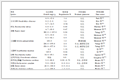
3. Results and discussionDuring the preliminary experiments,the reaction between benzimidazole 1a and o-fluorobenzaldehyde 2a was chosen as a model reaction to optimize the reaction conditions,including the screening of catalyst,base,and solvent. The results are summarized in Table 1. Firstly,the reactants with 10 mol% FeCl3 and anhydrous K2CO3 in DMSO (at 130 ℃ under N2) afforded 11Hindolo[l,2-a]benzimidazole-11-one 3a in 61% yield (Table 1,entry 1). When various solvents were tested (Table 1,entries 1-5),DMF gave an improved yield of 73% whereas only 40% of 3a was obtained in toluene (Table 1,entries 2 and 4). Other solvents,such as NMP and 1,4-dioxane,were incompatible with the reaction (Table 1,entries 3 and 5). Stronger bases (NaOEt,Cs2CO3,and t-BuOK) did not work well in the reaction,giving <50% yields of 3a (Table 1,entries 6-8); and the organic base DBU was also ineffective,giving only trace amount of the product (Table 1,entry 10). To our delight,the yield of 3a increased to 94% when K3PO4 was used as a base (Table 1,entry 9). The effect of different iron sources on product formation was also investigated. FeCl3-6H2O gave no product,suggesting that water is detrimental to the reaction (Table 1,entry 11). In contrast,with 10 mol% Fe2(SO4)3 as the catalyst,3a was obtained in 84% yield (Table 1,entry 12). Neither Fe nor FeCl2 was suitable for the reaction,as they afforded only 37% and 34% isolated yields,respectively (Table 1,entries 13 and 15). In the absence of an iron source,the product was obtained in 30% yield (Table 1,entry 14),which was close to Rosevear’s report [10]. Therefore,FeCl3 was shown to have good catalytic activity in facilitating the synthesis of 11H-indolo[l,2- a]benzimidazole-11-one. Four different Lewis acids,including CuCl2,ZnCl2,InCl3,and La(OTf)3,were also studied for their catalytic potential (Table 1,entries 17-20). However,these Lewis acids were less efficient compared to FeCl3. When the reaction was carried out under ambient air,a low product yield was obtained (Table 1,entry 21).
|
Table 1 Optimization of the reaction conditions for the synthesis of 11H-indolo[l,2- a]benzimidazole-ll-one.a |

We then investigated the scope of the iron-catalyzed tandem reaction of substituted o-fluorobenzaldehyde (2a-2e) and different N-heterocyclic compounds (1a-1e) for the synthesis of azo[l,2- a]indol-ones under the optimized conditions aforementioned (10 mol% FeCl3,anhydrous K3PO4 in DMF; under N2 at 130 ℃).
As shown in Table 2,most 11H-indolo[l,2-a]benzimidazol-11-ones were obtained in higher yields compared to 9H-imidazo[l,2- a]indol-9-ones and 11H-indolo[l,2-b]indazol-11-ones. In general,the electron-donating groups (e.g. -OCH3) ino-fluorobenzaldehydes negatively affected the reaction,resulting in lower product yields,when compared to compounds bearing the electron-withdrawing groups (e.g. -Cl and -Br) (Table 2,entries 2-5,9-12,and 16-17). However,the yield of CH3O-substituted azo[l,2-a]indolones increased when K2CO3 was used as a base (Table 2,entry 12). The position of the substituents also affected product yield. o-Fluorobenzaldehyde bearing the -Cl group at the para position showed higher activity compared to 5-chloro-2-fluorobenzaldehyde (Table 2,entries 3-4 and 10-11). The use of 5,6-dimethylbenzimidazole and 4-methyl-1H-imidazole as substrates gave lower product yields (Table 2,entries 6-7 and 13-14). Other N-heterocyclic compounds,such as 1,2,4-triazole,indazole,and pyrazole,were also investigated. The indazole 1e reacted with o-fluorobenzaldehydes to afford 11H-indolo[l,2-b]indazol-11-ones in moderate yields (Table 2,entries 15-16). However,other Nheterocyclic compounds did not give their corresponding products.
|
|
Table 2 FeCl3-catalyzed tandem reaction of substituted o-fluorobenzaldehydes and N-heterocycles.a |


The proposed pathway for the formation of 11H-indolo[l,2- a]benzimidazol-11-ones invovles two steps (Scheme 2). The reaction might first proceed through an intermolecular SNAr reaction between benzimidazole 1 and o-fluorobenzaldehyde 2 (step a),consequently forming the intermediate 2-(benzimidazol- 10-y1)benzaldehyde 4,which has been isolated and confirmed by spectral data. Subsequently,the conversion of the intermediate 4 to product 3a was studied (Scheme 3). While the desired compound 3a was readily obtained under the optimum conditions,it was found that the product yield was positively correlated to the reaction time. However,3a was only obtained in 27% yield without the addition of FeCl3. Hence,it was concluded that FeCl3 facilitated the intramolecular cyclization process to give the target product 3a in step b (Scheme 2). According to the literature [10, 11],a possible mechanism for the cyclization of intermediate 4 to give 11Hindolo[l,2-a]benzimidazol-11-ones is shown in Scheme 4. The mechanism proposed a base- and iron-initiated C-2 (benzimidazole) nucleophilic addition of the aldehyde followed by the formation of the hydroxyl intermediate (Ⅰ). In the presence of a base,intermediate (Ⅰ) can be isomerized to a carbonyl intermediate (Ⅱ). Then it is aromatized by trace air at 130 ℃ to generate the target product. Although the intramolecular cyclization process could proceed without FeCl3,the product was obtained in lower yield. Therefore,FeCl3 could potentially function as a Lewis acid to increase the electrophilicity of the aldehyde,leading to a higher yield of the cyclic products.

|
Download:
|
| Scheme 2.The proposed reaction pathway for the one-pot synthesis of 11Hindolo[l,2-a]benzimidazol-11-one. | |


|
Download:
|
| Scheme 3.The reaction of the intermediate 4 under different conditions. | |


|
Download:
|
| Scheme 4.A possible mechanism for the cyclization of 11H-indolo[l,2- a]benzimidazol-11-one. | |

In summary,we have developed an iron-catalyzed cascade reaction between azoles and 2-fluoroaldehydes to synthesize azo[l,2-a]indol-ones via an SNAr/acylation. This method circumvents the use of expensive catalytic agents,giving access to the desired polycyclic-fused azo[l,2-a]indolone compounds in good yields,and could be a valuable tool in the synthesis of heterocyclic molecules with biological and medicinal activities.
AcknowledgmentsThis work was financially supported by the Natural Science Foundation of China (Nos. 21302135 and 21272169),and Taizhou Science & Technology program (No. 111ZD02).
| [1] | (a) K. Fagnou, M. Lautens, A rhodium-catalyzed carbon-carbon bond forming reactions of organometallic compounds, Chem. Rev. 103(2003) 169-196;(b) V. Ritleng, C. Sirlin, M. Pfeffer, Ru-, Rh-, and Pd-catalyzed C-C bond formation involving C-H activation and addition on unsaturated substrates:reactions and mechanistic aspects, Chem. Rev. 102(2002) 1731-1769;(c) B.M. Trost, D.F. Toste, A.B. Pinkerton, Non-metathesis ruthenium-catalyzed C-C bond formation, Chem. Rev. 101(2001) 2067-2096;(d) T.Y. Luh, M.K. Leung, K.T. Wong, Transition metal-catalyzed activation of aliphatic C-X bonds in carbon-carbon bond formation, Chem. Rev. 100(2000) 3187-3204. |
| [2] | For reviews, see:(a) M Shibasaki, M. Kanai, Asymmetric synthesis of tertiary alcohols and α-tertiary amines via Cu-catalyzed C-C bond formation to ketones and ketimines, Chem. Rev. 108(2008) 2853-2873;(b) C. Bolm, J. Legros, J.L. Paih, L. Zani, (Ⅰ)ron-catalyzed reactions in organic synthesis, Chem. Rev. 104(2004) 6217-6254;(c) D.D. Díaz, P.O. Miranda, J.(Ⅰ). Padron, V.S. Martín, Recent uses of iron (Ⅲ) chloride in organic synthesis, Curr. Org. Chem. 10(2006) 457-476;(d) C.L. Sun, B.J. Li, Z.J. Shi, Direct C-H transformation via iron catalysis, Chem. Rev. 111(2011) 1293-1314. |
| [3] | (a) W.D. Jones, G.P. Foster, J.M. Putinas, The catalytic activation and functionalization of carbon-hydrogen bonds. Aldimine formation by the insertion of isonitriles into aromatic carbon-hydrogen bonds, J. Am. Chem. Soc. 109(1987) 5047-5048;(b) Z.P. Li, R. Yu, H. Li, (Ⅰ)ron-catalyzed C-C bond formation by direct functionalization of C-H bonds adjacent to heteroatoms, J. Angew. Chem. (Ⅰ)nt. Ed. 47(2008) 7497-7500;(c) Z.P. Li, L. Cao, C. Li, FeCl2-catalyzed selective C-C bond formation by oxidative activation of a benzylic C-H bond, J. Angew. Chem. (Ⅰ)nt. Ed. 46(2007) 6505-6507;(d) J. Norinder, A. Matsumoto, N. Yoshikai, E. Nakamura, (Ⅰ)ron-catalyzed direct arylation through directed C-H bond activation, J. Am. Chem. Soc. 130(2008) 5858-5859. |
| [4] | (a) C. Bolm, J. Legros, P.J. Le, L. Zani, (Ⅰ)ron-catalyzed reactions in organic synthesis, Chem. Rev. 104(2004) 6217-6254;(b) (Ⅰ). Bauer, H.J. Knölker, (Ⅰ)ron catalysis in organic synthesis, Chem. Rev. 115(2015) 3170-3387;(c) C.F. Lee, Y.C. Liu, S.S. Badsara, Transition-metal-catalyzed C-S bond coupling reaction, Chem. Asian J. 9(2014) 706-722. |
| [5] | (a) W. Jones, F. Fehe, Comparative reactivities of hydrocarbon carbon-hydrogen bonds with a transition-metal complex, Acc. Chem. Res. 22(1989) 91-100;(b) J.A. Labinger, J.E. Bercaw, Understanding and exploiting C-H bond activation, Nature 417(2002) 507-514;(c) K. Godula, D. Sames, C-H bond functionalization in complex organic synthesis, Science 312(2006) 67-72;(d) R.G. Bergman, Organometallic chemistry:C-H activation, Nature 446(2007) 391-393. |
| [6] | (a) J. Park, E. Park, A. Kim, et al., Rhodium-catalyzed oxidative ortho-acylation of benzamides with aldehydes:direct functionalization of the sp2 C-H bond, Org. Lett. 13(2011) 4390-4393;(b) H. Wang, L.N. Guo, X.H. Duan, Decarboxylative acylation of cyclic enamides with α-oxocarboxylic acids by palladium-catalyzed C-H activation at room temperature, Org. Lett. 14(2012) 4358-4361;(c) W. Zhou, H.J. Li, L. Wang, Direct carbo-acylation reactions of 2-arylpyridines with α-diketones via Pd-Catalyzed C-H activation and selective C(sp2)-C(sp2) cleavage, Org. Lett. 14(2012) 4594-4597. |
| [7] | (a) J. Hu, E.A. Adogla, Y. Ju, D. Fan, Q. Wang, Copper-catalyzed ortho-acylation of phenols with aryl aldehydes and its application in one-step preparation of xanthones, Chem. Commun. 48(2012) 11256-11258;(b) J. Wang, C. Liu, J.W. Yuan, A.W. Lei, Copper-catalyzed oxidative coupling of alkenes with aldehydes:direct access to α,β-unsaturated ketones, Angew. Chem. (Ⅰ)nt. Ed. 52(2013) 2256-2259. |
| [8] | (a) S. Wertz, D. Leifert, A. Studer, Cross dehydrogenative coupling via basepromoted homolytic aromatic substitution (BHAS):synthesis of fluorenones and xanthones, Org. Lett. 15(2013) 928-931;(b) D. Leifert, C.G. Daniliuc, A. Studer, 6-Aroylated phenanthridines via base promoted homolytic aromatic substitution (BHAS), Org. Lett. 15(2013) 6286-6289. |
| [9] | (a) D.B. Chen, G.D. Shen, W.L. Bao, An efficient cascade synthesis of various 2H-1,4-benzoxazin-3-(4H)-ones from o-halophenols and 2-halo-amides catalyzed by Cu(Ⅰ), Org. Biomol. Chem. 7(2009) 4067-4073;(b) D.B. Chen, Z.J. Wang, W.L. Bao, Copper-catalyzed cascade syntheses of 2H-benzo[b][1,4] thiazin-3(4H)-ones and quinoxalin-2(1H)-ones through capturing S and N atom respectively from AcSH and TsNH2, J.Org. Chem. 75(2010) 5768-5771;(c) D.B. Chen, W.L. Bao, An efficient domino synthesis of quinoxalin-2(1H)-ones via an SNAr/coupling/demesylation reaction catalyzed by copper((Ⅰ)) as key step, Avd. Synth. Catal. 352(2010) 955-960;(d) D.B. Chen, J.S. Wu, J.G. Yang, et al., Cascade syntheses of aza[2,1-b][1,3]-benzothiazinone heteropolycyclic compounds from cyclic thiourea catalyzed by Cu((Ⅰ)), Tetrahedron Lett. 53(2012) 7104-7107;(e) D.B. Chen, Q.F. Chen, M.C. Liu, et al., Cascade synthesis of azoquinazolinones by Cu((Ⅰ))-catalyzed C-N coupling/C-H activation/C-N formation reactions under O2, Tetrahedron 69(2013) 6461-6467. |
| [10] | J. Rosevear, J.E.K. Wilshire, Cyclization reactions in azole chemistry:the reaction of some azoles with o-fluoroacetophenone, o-fluorobenzaldehyde and o-fluorobenzophenone, Aust. J. Chem. 44(1991) 1097-1114. |
| [11] | (a) J.Y. Yang, C.Y. Dong, H.Y. Li, H.F. Li, Y.Z. Li, (Ⅰ)ron-catalyzed one-pot reactions of o-aryloxybenzaldehydes to xanthones, Chin. Sci. Bull. 57(2012) 2364-2367;(b) K. Paul, K. Bera, S. Jalal, S. Sarkar, U. Jana, Fe-catalyzed novel domino isomerization/cyclodehydration of substituted 2-[((Ⅰ)ndoline-3-ylidene)(methyl)]-benzaldehyde derivatives:an efficient approach toward benzo[b]carbazole derivatives, Org. Lett. 16(2014) 2166-2169. |